
Local SEO Audit & Strategy: How to Audit a Local Site (2026)
The 8-part local SEO audit framework that finds what is actually costing you rankings, plus a realistic strategy and timeline for Australian businesses.

Most local SEO audits hand you a checklist and a vague sense of dread. This one is built to find what is actually costing you enquiries, fix it in the right order, and skip the busywork that fills most “audit” reports.
Here is what it covers:
- How Google’s local algorithm actually works in 2026
- The 8-part audit framework that finds what is broken before you spend money fixing the wrong things
- How to read the results: where leads leak, why rankings drop, and what to fix first
- Realistic timelines, not the fantasy version where you rank in 30 days
What Is Local SEO (And How It Works in 2026)
Local SEO is the system that determines whether your business shows up when someone nearby searches for what you do.
When a Fremantle resident Googles “emergency dentist” at 11pm, or someone in Joondalup searches “personal injury lawyer” after a car accident, local SEO decides whether your business appears or your competitor does. It is the difference between a phone that rings and one that does not.
Google’s Local Algorithm Explained (Proximity, Relevance, Prominence)
Google uses three core factors to rank local businesses. They’ve been pretty transparent about this, which is rare for them.
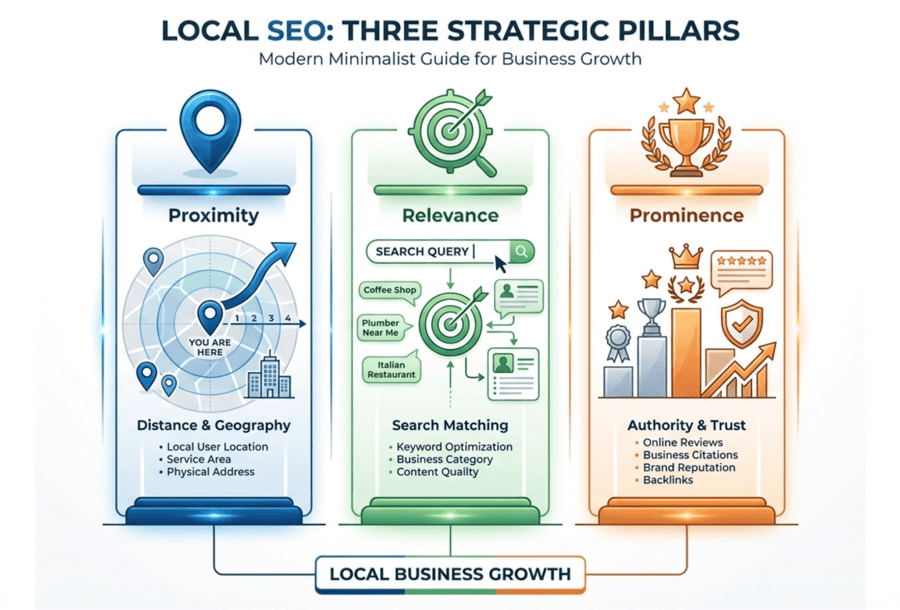
1. Proximity (Distance)
How physically close you are to the searcher.
Google’s November 2021 local search update ran from 30 November to 8 December 2021. Google never named it; the industry called it the Vicinity Update. Since then, proximity carries way more weight than it used to, and that changed things for Perth businesses. A business 2km from the searcher will often outrank a business 10km away, even if that distant competitor has better reviews or more backlinks.
You can’t change your physical location. Obviously. But you can optimise for multiple service areas using location pages and strategic Google Business Profile management.
2. Relevance
How well your business matches what the user is actually searching for.
This comes down to a bunch of things:
- Your Google Business Profile categories (get these wrong and you’re invisible)
- Keywords in your business description
- Website content that actually answers search queries
- Service listings that align with what people want
Here’s an example, a plumber who lists “blocked drains” as a specific service will rank for “emergency blocked drain plumber” way better than a plumber who just says “general plumbing services.” Specificity wins.
3. Prominence
How well-known and trusted your business appears to Google.
They measure this through:
- Number and quality of reviews (not just quantity)
- Backlinks from Perth directories, industry sites, and local media
- Consistent citations (Name, Address, Phone) across the web
- User engagement signals, clicks, calls, direction requests
Prominence is the hardest factor to build and the easiest to fake. Which is why low-quality agencies obsess over it while ignoring the fundamentals.
How AI Search & Google Maps Changed Local Rankings
Two major shifts broke the old playbook, and most Perth agencies are still pretending it’s 2019.
1. AI Search Integration
ChatGPT, Google’s AI Overviews, Perplexity, these tools now answer questions before users even click a link.
Someone asks “best family lawyer in Subiaco” and these AI engines scrape content from websites, reviews, and structured data to generate an answer on the spot. Winning that answer is exactly what our SEO for lawyers is built to do. They cite sources. Or they don’t cite anyone.
The businesses that get cited? They’re structuring content for entity-based SEO, not stuffing keywords like it’s 2015. They also get cited by the right sources.
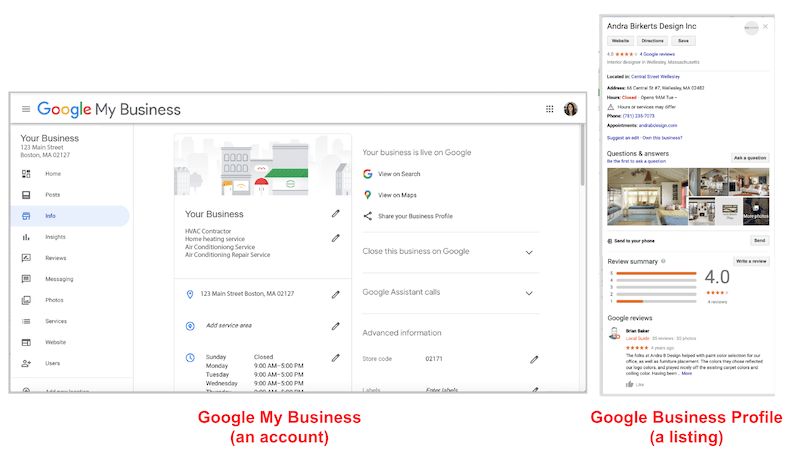
2. Google Business Profile as Your New Homepage
For many customers your Google Business Profile is now the first touchpoint, not your website. Google’s own research found that 76% of people who search on their smartphone for something nearby visit a business within a day, though that figure comes from a 2016 US study and Google has not refreshed it since, and a lot of that happens straight from the profile.
If your GBP is incomplete, outdated, or suspended, you are functionally invisible no matter how good your website is.
The Complete Local SEO Audit Framework
Alright, this is the system.
Not a checklist you skim once and forget about. This is a diagnostic framework you run quarterly to identify what’s broken, what’s working, and where your competitors are quietly gaining ground while you’re asleep.
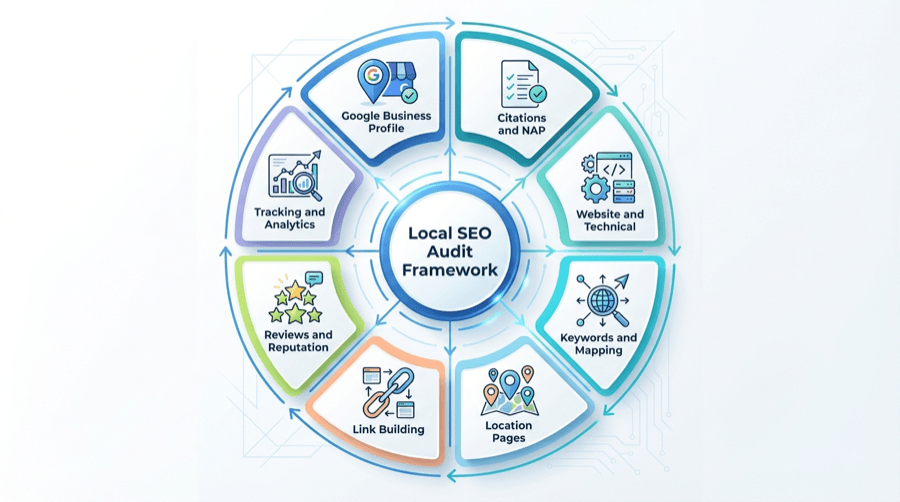
1. Google Business Profile Audit
Your GBP is your highest-ROI asset. Full stop.
I don’t care how much you spent on your website, if your Google Business Profile is a mess, you’re leaving money on the table every single day.
A complete audit covers:
Listing Completeness
Look, this seems basic, but you’d be shocked how many businesses get this wrong:
- Business name (no keyword stuffing, Google will suspend you)
- Address (must be verified, and never a PO box or a mailbox at a remote location, which Google rules out for everyone, not just some categories)
- Phone number (use a local Perth number, not a 1300)
- Website URL (should link to a location-specific page if you have multiple locations)
- Hours (updated for holidays, special events, Christmas closures)
- Service areas (if you’re a service area business like a plumber or electrician)
Categories
Your primary category must match your core offering exactly. Not “kind of close.” Exactly.
Secondary categories should cover all services you want to rank for. Wrong categories mean wrong rankings. It’s that simple.
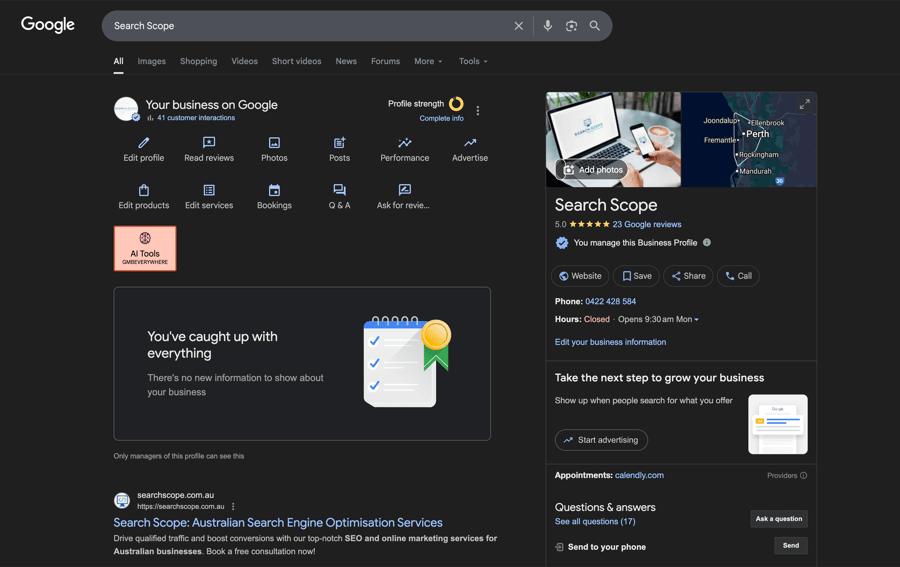
NAP Accuracy
Does your GBP match your website footer? Does it match your citations in major directories?
Any discrepancies = lost rankings. Google doesn’t know which version to trust, so it trusts neither.
Reviews
- How many reviews do you have?
- What’s your average rating?
- How quickly are you responding to reviews? (Hint: you should be responding to all of them)
- Are competitors generating reviews faster than you?
Review velocity matters more than total review count in 2026.
Posts
Are you posting twice a week? Do posts include images and calls-to-action? Are you using posts to target seasonal keywords?
Most businesses ignore GBP posts. Which means it’s an easy competitive advantage if you actually do it.
Suspension Risks
This is the big one. Are you:
- Using a virtual office in an ineligible category?
- Managing multiple listings for the same location?
- Violating any GBP compliance rules that put the listing at risk?
If your GBP gets suspended, the map pack disappears for you overnight, and for most local businesses that is the majority of their enquiries. I’ve seen it happen to Perth businesses that were dominating their niche one day and invisible the next.
Full GBP optimisation guide here
2. Citation & NAP Consistency Audit
Citations are mentions of your business name, address, and phone number across the web.
Most businesses have inconsistent citations because:
- They moved offices 3 years ago and never updated old listings
- Different staff members submitted listings with slightly different business names
- Some genius previous agency created duplicate listings “to rank better”
None of this helps. It all hurts.
The Australian Citation Reality
Skip the US “data aggregator” playbook (Data Axle, Foursquare, Neustar). Australia does not have that competitive aggregator layer feeding the directories, so there is nothing to “fix at the source” the way US guides describe.
Here, you get your details right on the platforms that actually matter, Google, Apple, Bing and the main local directories, and keep them identical everywhere. Our Australian citation sites guide covers which ones are worth your time.
Duplicate Suppression
If Google finds two listings for your business with different addresses or phone numbers, it doesn’t know which one is correct.
Result? Neither ranks well.
Use tools like Moz Local, BrightLocal, or Semrush Local to:
- Identify duplicate listings
- Suppress or merge duplicates
- Monitor for new duplicates (they pop up constantly)
This part is critical if you want to be cited in LLM answers. In 2026 and beyond, you cannot have a messy digital footprint. This destroys trust in your business.
Industry Citations
Generic directories like Yelp and Yellow Pages are table stakes. Everyone’s on them.
Industry-specific directories are your competitive advantage:
- Dentists: Healthengine, Australian Dental Association
- Lawyers: your state law society’s Find a Lawyer directory (the Law Society of Western Australia’s requires at least half the firm’s practitioners to be members)
- Tradespeople: ServiceSeeking, hipages, Airtasker (Oneflare closed on 30 June 2026 and now redirects to Airtasker, so it is no longer on this list)
- Travel: Tripadvisor, Australian Tourism Data Warehouse, your regional tourism organisation
These matter more than 20 random directories combined.
Audit Process
Here’s the manual way to check (if you don’t have fancy tools):
- Google your business name + city
- Check your NAP details on the first 20 results
- Document every inconsistency you find
- Prioritise fixes by domain authority
Start with the big sites first. Fix Google, Facebook, Yelp before worrying about some random Perth directory with 12 visitors a month.
Local citations and how to audit them
3. Website On-Page & Technical Audit
Your website needs to do three things well:
- Load fast
- Make sense to Google’s crawlers
- Convert visitors into actual leads
That’s it. Everything else is noise.
Site Structure
You need a clear hierarchy. Not complicated, just logical:
Homepage
├── Service Pages (Plumbing, Emergency Plumbing, Drain Cleaning)
├── Location Pages (Plumber Fremantle, Plumber Joondalup, Plumber Subiaco)
└── Blog (Local SEO, How-To Guides, Industry News)
Internal Linking
Every page should link to relevant related content. The industry calls this a topic cluster; Google does not use the term, but the underlying idea, that related pages linked together make the topic easier to understand, holds up.
Your pillar content, pages like this one, should link out to 15 to 20 supporting articles. Those supporting articles should link back here.
This signals topical depth to Google. It tells them “this business knows their stuff.”
Our guide to internal linking best practices for local SEO goes deeper on which pages should link to which, and why.
Schema Markup
Structured data tells Google exactly what your content is about. No guessing required.
For local businesses, implement:
- LocalBusiness schema (name, address, phone, hours)
- Service schema (specific list of services offered)
- Not review or aggregate rating schema for your own business. Google has excluded self-serving reviews from star ratings since September 2019: pages using LocalBusiness or Organization markup are ineligible when the entity being reviewed controls the reviews, and that covers embedded third-party review widgets too. Your stars come from your Business Profile, not your schema.
- FAQ content on the page, but skip the schema. Google narrowed FAQ rich results to government and health sites in August 2023 and retired the feature entirely on 7 May 2026, so FAQPage markup no longer produces anything in search. Keep answering the questions, they still convert.
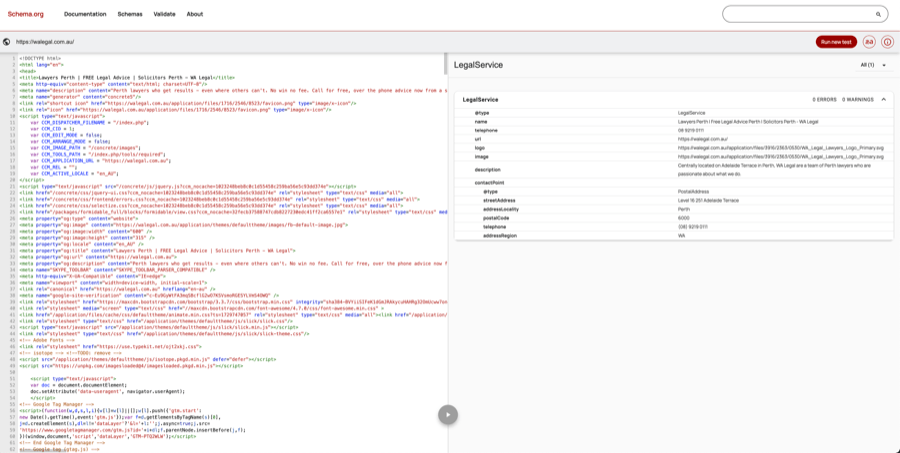
Local Schema for a Lawyer
Speed Optimisation
Most mobile users abandon a site that takes more than about three seconds to load. Speed is not a major direct ranking factor, but it quietly kills conversions.
Common speed killers:
- Oversized images (the #1 problem I see)
- Bloated, unoptimised code
- Too many third-party scripts loading
- Cheap hosting that can’t handle traffic
Use PageSpeed Insights to identify issues. Then actually fix them.
Mobile UX
The majority of local searches happen on mobile.
Your site must:
- Be readable without zooming
- Have clickable phone numbers that actually dial
- Load in under 3 seconds even on dodgy mobile data
- Have buttons big enough to tap with a thumb
If your site was built more than 3 years ago, there’s a good chance it fails at least two of these.
Technical SEO audit checklist for local businesses
4. Local Keyword & Suburb Mapping
Most businesses waste enormous effort targeting the wrong keywords. Here is what right looks like.
Geo Modifiers
Every keyword should have a location attached. Not optional.
Wrong: “dentist”
Still wrong: “dentist Perth”
Right:
- “dentist Fremantle”
- “emergency dentist Joondalup”
- “cosmetic dentist Subiaco”
See the difference? Specificity wins rankings. For a dental practice, our dental SEO applies exactly this approach.
Service + Suburb Combinations
If you offer three services across five suburbs, you need 15 keyword targets minimum. Actually, probably more.
Example for a plumbing business:
| Service | Suburb | Target Keyword |
|---|---|---|
| Blocked Drains | Fremantle | blocked drain plumber Fremantle |
| Hot Water Repairs | Joondalup | emergency hot water repairs Joondalup |
| Gas Fitting | Subiaco | licensed gas fitter Subiaco |
Each combination is a separate keyword target. Each one needs dedicated content.
Competitor Keyword Gap Analysis
What keywords are your competitors ranking for that you’re completely missing?
Use Semrush or Ahrefs to:
- Enter your domain
- Enter your top 3 local competitors
- Run a keyword gap analysis
- Prioritise by search volume and commercial intent
This usually reveals 50 to 100 keyword opportunities you didn’t even know existed.
5. Location Page Structure & Optimisation
Location pages are how you rank for suburb-specific searches. But, and this is important, they need to be done right.
Service Area Businesses
If you travel to customers (plumbers, electricians, mobile mechanics, pet groomers), you can create location pages for every suburb you service.
But each page must be unique, valuable, and substantive. Not thin doorway pages that exist only to rank.
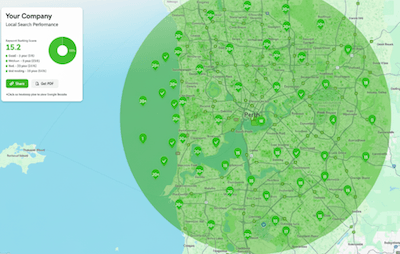
Multi-Location Structure
If you have actual physical offices in multiple suburbs, each location needs:
- Its own GBP listing
- Its own dedicated location page on your website
- Unique content (not duplicated across locations, Google will catch you)
- Embedded Google Map showing the actual location
- Location-specific reviews and testimonials
Avoiding Doorway Pages
Google penalises thin location pages that exist only to rank for a keyword.
What makes a page thin?
- Only a couple of hundred words of content. Google publishes no word-count threshold, but a page this thin rarely answers the question well enough to compete
- Same template repeated across 20 suburbs with just the suburb name changed
- No unique value offered
What makes a page strong?
- 800+ words of substantive content
- Suburb-specific details (local landmarks, community information)
- Real testimonials from customers in that specific area
- FAQs addressing local concerns
- Actual helpful information
The difference? One ranks. The other gets you penalised.
How to create location pages that actually rank
6. Local Link Building Strategy
Backlinks still matter. Anyone telling you otherwise is either lying or clueless.
But not all links are equal. In fact, most links are worthless.
Perth-Specific Links
While you can rank a website organically by using placements on international websites (as in sites that are not geographically relevant), getting locally relevant placements and mentions is critical for Google Maps SEO, because the map pack is judged on local relevance rather than raw domain strength.
A link from a Perth website or business directory carries more weight for local rankings than a link from some national directory nobody in Perth has heard of.
Target:
- Chamber of Commerce and Industry of Western Australia (CCIWA), the body the old Perth Chamber merged into in 1983. Useful for credibility and networking rather than as a citation, since it publishes no public member directory
- Local business associations (BNI,…)
- Suburb-specific community directories
- Build genuine relationships with locally relevant businesses, sponsors and community groups. Do not set up reciprocal link swaps for their own sake: Google’s link spam policies name excessive link exchanges specifically
Community Links
Sponsor a local sports team. Host a community event. Partner with local charities.
These generate:
- High-quality backlinks
- Brand awareness in your actual service area
- Real business relationships (which sometimes turn into referrals)
Industry Links
Medical websites or directories for dentists.
Legal websites for lawyers.
Trade directories for home service businesses.
These links signal relevance and authority in your specific niche. They tell Google “this business is legitimate in their industry.”
Digital PR
Get featured in Perth media outlets:
- Perth Now
- WAtoday
- Community newspapers
Write expert commentary on industry trends. Offer insights on local business stories. Position yourself as the go-to expert.
This is harder than directory submissions. It’s also 10x more valuable.
Local link building tactics that actually work
7. Reputation & Review Signals
Reviews are the most visible trust signal in local search. Period.
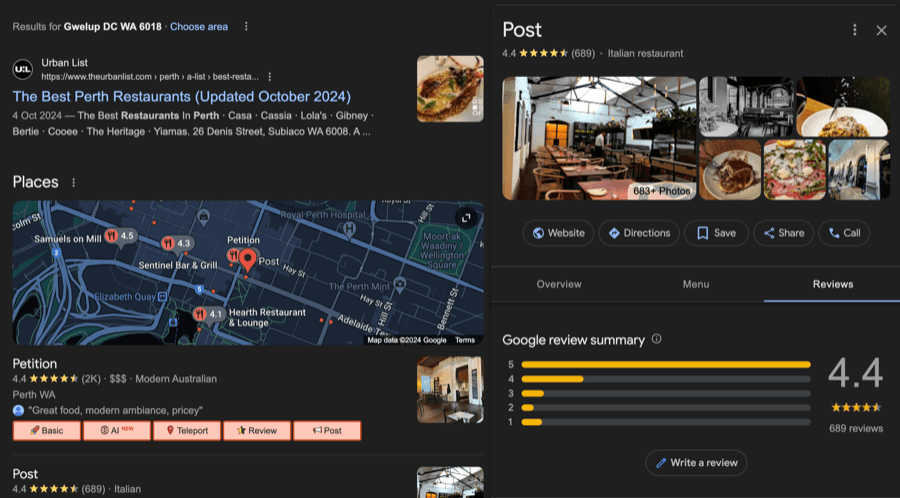
Review Velocity
Google doesn’t just count total reviews. That would be too simple.
They track how fast you’re generating new reviews. A business with 50 reviews that generated 10 in the last month will often outrank a business with 200 reviews that hasn’t received one in six months.
Fresh reviews signal active business operations. Stale reviews signal… well, staleness.
Response Strategy
Respond to every review. Positive and negative. Every single one.
Why?
- Shows you care about customer feedback
- Signals active business management to Google
- Gives you a chance to address complaints publicly (other customers are watching)
15 review response templates you can copy
Fake Review Handling
Look, the fake review problem is real. Competitors leave fake negative reviews. Scammers demand payment to remove fake reviews they posted themselves.
Google’s review system is broken and everyone knows it.
Your options:
- Report fake reviews through Google Business Profile. Success is patchy, so expect to escalate
- Document evidence of fake reviews for potential legal action
- Keep asking real customers for reviews so the fake ones matter less over time
Option 3 is the one that actually works, but pace it. A sudden burst of reviews is what Google’s filter is built to catch, and at volume it puts the profile itself at risk.
How to combat fake Google reviews
8. Geo Grid & Performance Tracking
You can’t fix what you don’t measure. Everyone says this. Fewer people actually do it.
What is Geo Grid Tracking?
Traditional rank tracking checks your position from a single location. Usually the center of a city.
Geo grid tracking checks your rankings from multiple points across your entire service area.
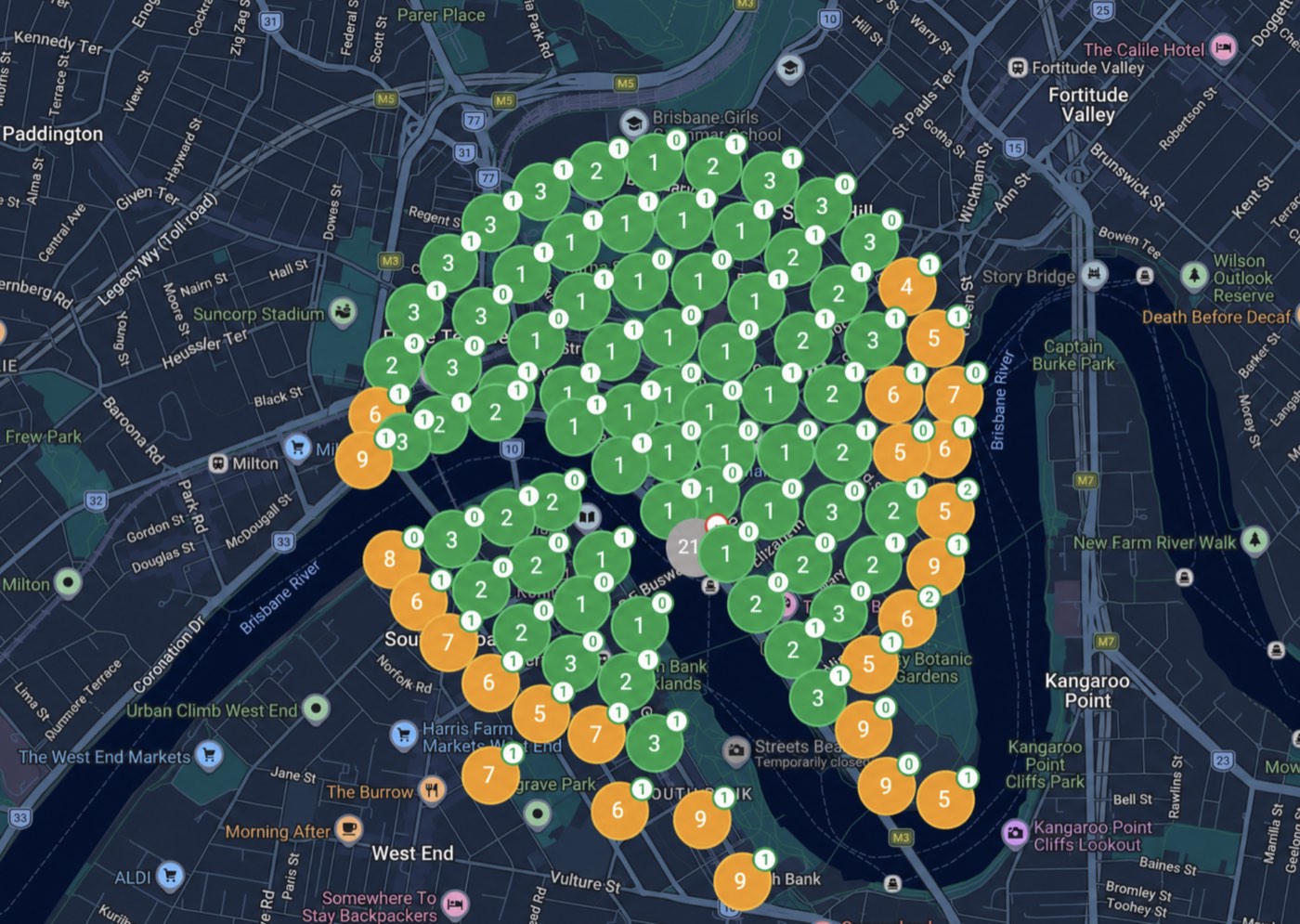
A real geo-grid scan from one of our own client campaigns, a Brisbane childcare group, months into the work
Why does this matter?
Because you might rank #1 when someone searches from Fremantle but #15 when they search from Joondalup, even though both are part of Greater Perth.
Knowing this lets you identify weak spots and fix them.
What is geo grid rank tracking?
Ranking Movement Analysis
Track:
- Which suburbs you’re gaining rankings in
- Which suburbs you’re losing ground in
- How competitors are moving across the grid
- Seasonal patterns (some suburbs search more in summer, others in winter)
ROI Attribution
Tie rankings back to actual business outcomes:
- Phone calls that turn into bookings
- Form submissions that become customers
- Appointment bookings
- Actual revenue generated
Use call tracking tools (CallRail, ResponseTap) and conversion tracking (Google Analytics, HubSpot) to measure what actually matters to your business.
AI Visibility Check
Rankings are no longer the whole picture, so make an AI-visibility test part of every audit. Ask ChatGPT, Gemini and Google’s AI Overviews your real money queries (“best [service] in [suburb]”, “who should I call for [problem] in [city]”) and note whether your business is mentioned, cited, or absent.
If you are not showing up, ask the model why. The answer is usually thin reviews, inconsistent business data, or no authoritative third-party mentions, all of which the rest of this audit already fixes. Log it monthly, the same way you track rankings.
Where Your Leads Actually Leak
Here is the audit step almost everyone skips. You can win every ranking in this guide and still have a quiet phone, because the leak is between the search and the booked job, not in the rankings.
Tick the ones that are true. Each is a place leads disappear.
Where are your leads leaking?
Tick each leak that applies. More ticks means you are losing leads your rankings already earned.
0 of 6 leaks
Tight
You can actually see what your SEO returns. Keep judging it on booked jobs.
The sharpest trap here is the fifth one. If you add a tracking number or dynamic number insertion and it shows a number that does not match your Google Business Profile and citations, you have just created a NAP inconsistency while trying to measure leads. Track calls, but keep the displayed number consistent everywhere.
Diagnosing a Ranking Drop (Before You Panic-Fix)
Rankings fell. Before you change things at random, work out which kind of drop it is, because the fixes are opposite.
- Did only you drop, or everyone? Check whether your main competitors moved too. If the whole market shuffled, it is probably a Google update, so hold steady and keep doing the fundamentals. If it is just you, the cause is on your profile or site.
- Is the profile itself flagged? Look for a suspension or “pending” banner, and for recent edits, yours or a public suggested edit. A moved pin or a name change is a classic isolated cause.
- Did one page lose a query, not the whole site? Sometimes Google reassigns which of your pages ranks for a term (homepage drops, a location page takes over). That is a re-ranking, not a penalty, and the fix is strengthening the page Google now favours.
- Are you being filtered by a near neighbour? If a similar business close by holds the spot and you vanish only for some keywords, that is the local filter, not a quality problem.
Two diagnostics most owners miss. First, check what city Google thinks you’re in: pull up your knowledge panel and look at the city name. Sterling Sky has documented cases where Google quietly reassigned the attributed city based on where your pin sits versus the city boundary, killing geo-modified keyword rankings overnight. If your address is on the wrong side of a city limit, you’re trying to rank for a city Google doesn’t think you’re in. Move the pin back to the correct side and rankings tend to recover.
Second, tag your GBP website link with a UTM parameter (something like ?utm_source=gbp). It costs nothing and unlocks a powerful diagnostic in Google Search Console: you can filter by that URL plus a specific query and isolate exactly which keywords lost traffic from the profile, separate from organic. Without this tag, GBP traffic and organic traffic are tangled together and ranking drops are hard to attribute. Sterling Sky calls the resulting data “a treasure trove” for diagnosing which keyword lost what.
The mistake is panic-editing categories, name and description all at once. That is how an isolated drop becomes a suspension.
Prioritise by Lead Impact, Not Issue Count
A thorough audit hands you a long list, and the list is its own trap. A tool that flags 200 “issues” tempts you to fix the 150 harmless ones and feel productive. Sort by what moves leads instead:
- Fix now: anything losing leads today. A suspension risk, a broken or untracked click-to-call, a wrong phone or address, a false “closed” status.
- Next: the things that move rankings. Primary category, review velocity, your money service and location pages, NAP on the big platforms.
- Later: low-impact tidy-ups. Alt text on a blog image, a citation on a directory with no traffic. Real, but not what is costing you the phone.
One suspension risk outranks fifty missing alt tags. Triage accordingly.
From Audit to Suburb Strategy
The audit tells you which suburbs are worth targeting. Turning that into pages and rankings is a separate piece of work: our local SEO strategy for Perth businesses covers tiering suburbs and building location pages without cannibalisation.
The Fastest Ways to Tank Your Own Rankings
Most self-inflicted damage comes down to a short list, all of it covered above, so treat this as the quick-reference version:
- Inconsistent NAP across your profile, website and directories.
- A keyword-stuffed business name, which is a suspension trigger.
- A virtual office or PO box in a category that needs a real address.
- Thin, templated suburb pages that exist only to rank.
- Treating reviews as a one-off launch task instead of an ongoing habit.
- Setting up the Google Business Profile once and never touching it again.
Each one is an unforced error, which is exactly why fixing it is such a reliable win.
How Long Does Local SEO Take in Perth?
The question every business owner asks on the first call.
“How long until we see results?”
Honest answer: it depends on three things.
- Your starting point
- Your competition
- How well you actually execute
Timeline Expectations
Month 1 to 2: Foundation Phase
- GBP optimisation and verification
- Technical fixes on your website
- Citation cleanup and suppression
- Baseline tracking setup
No rankings yet. This phase is all infrastructure. It’s boring but necessary.
Month 3 to 4: Initial Movement
- First rankings start appearing for low-competition long-tail keywords
- GBP visibility improves in Maps results
- Website traffic starts increasing, though how much depends entirely on your starting point and competition
We published the numbers from exactly this window in a three-month local SEO case study: a business starting from almost no search presence went from three keywords in the top ten to 24, while its Maps visibility moved far more slowly.
Month 5 to 6: Building Momentum
- Rankings improve for primary target keywords
- Qualified leads start coming in consistently
- Review velocity increases as systems kick in
Month 7 to 12: Market Dominance
- Competing for the top three on your core keywords in the suburbs closest to you, with the outer suburbs following the grid outward
- Consistent, predictable lead flow
- Competitive moat established (harder for competitors to displace you)
If your website is already established, unless your fundamentals are a total mess and your niche is super competitive, it should not take 3 to 6 months to see results!
Competitive Niches (Lawyers, Dentists, Cosmetic Services)
If you’re competing in Perth’s most saturated niches:
- Personal injury lawyers
- Cosmetic dentistry
- Family law
- Orthodontics
- Cosmetic surgery
Add 2 to 3 months to the timeline above.
Why?
Your competitors are already investing heavily in SEO. You’re not just building authority from scratch, you’re actively taking market share from businesses that don’t want to give it up.
It’s winnable. Just takes longer.
Working Out Whether the Maths Stacks Up
Do not start from a ranking position. Start from what a customer is worth and how many more you can handle, then work backwards.
If a customer is worth $800 to you and a sensible local SEO investment brings in a handful of extra jobs a month once it matures, the return is straightforward to calculate and usually clears the bar comfortably for established service businesses. The higher your average job or case value, the lower the lead volume you need to break even, which is why high-value services like legal and medical tend to see the strongest return from local SEO and why low-margin, low-ticket businesses need to be more careful.
The honest version: SEO is worth it when the work can be tied to enquiries and revenue, and the maths only works if your margins and demand support the spend. A provider who cannot connect their work to leads is reporting on the wrong thing. For the full pricing and ROI breakdown, see our guides on how much SEO costs in Australia and the local SEO strategy for Perth businesses.
What a Real Recovery Looks Like
The highest-stakes audit finding is a Google Business Profile that is suspended or at risk, because that can remove the majority of local visibility overnight. The recovery pattern is consistent: identify the actual compliance trigger (often a mis-listed secondary address or a keyword-stuffed name), correct it, submit a properly evidenced reinstatement appeal, and use the suspension window to clean up the citation and NAP foundation so the profile comes back stronger than it went down.
Our Google Business Profile recovery case study documents one of these end to end, including the appeal evidence and the timeline.
Local SEO FAQs
How much does local SEO cost in Perth?
Across the Australian market, local SEO retainers commonly run from around $595+GST per month at the small-local end up to $10,000+ for competitive multi-location campaigns, with most established service businesses sitting somewhere in the middle. Search Scope’s own local SEO engagements start from $1,999 per month, month to month with no lock-in. If you want the diagnosis before committing to a retainer, the 25-point audit runs as standalone work: $49 for a 15-minute Loom walkthrough, $599 for the full manual audit, or $999 with the top fixes implemented.
The number matters far less than whether the work can be tied to enquiries. Suspiciously cheap usually means junior or automated work that creates cleanup later. Our guide on how much SEO costs in Australia breaks down what drives the price, and what the cheap end actually buys.
How often should I run a local SEO audit?
Treat it as an ongoing habit, not a one-off. A full audit every 6 to 12 months suits most stable local businesses, quarterly if you are in a competitive niche or have recently made big changes, and a quick monthly check of your Google Business Profile, reviews and rankings in between. Anything that touches your name, address, categories or website warrants a fresh look.
Is Google Business Profile optimisation enough?
No. Hard no.
GBP gets you visibility in Google Maps. That’s valuable but incomplete.
Organic rankings require:
- A properly optimised website
- Consistent citations
- Quality content
- Strategic backlinks
GBP is the foundation. Not the entire house.
Do I actually need suburb pages?
If you service multiple suburbs? Yes, absolutely.
Each suburb-specific page targets “[service] + [suburb]” keywords that a generic “Perth” page can’t rank for.
Someone in Joondalup searching “plumber Joondalup” doesn’t want to see generic Perth results. They want local, nearby options.
For storefronts, suburb pages can be valuable to build geographic relevance for the areas you draw foot traffic from.
How many citations do I actually need?
Not as many as most agencies will tell you. It’s like backlinks in 2026 and beyond, you need less and better quality ones!
Focus on:
- The three that actually feed everything else in Australia: Google Business Profile, Apple Business, Bing Places. Skip the US data-aggregator playbook, as covered above, Australia has no equivalent layer
- 10 to 15 high-authority directories (Yelp, Yellow Pages, True Local)
- 5 to 10 industry-specific directories relevant to your niche
- Fill them out using unique descriptions to increase indexing rate
- Build reviews to them if you can
That’s it. Quality over quantity. 30 quality citations beats 200 garbage citations every single time.
Can AI tools replace SEO agencies?
No.
AI tools can write content. They can analyse data. They can automate repetitive tasks. They help us do more and be more efficient.
They cannot:
- Make strategic decisions based on market conditions (won’t replace experience anytime soon)
- Negotiate link placements with real humans
- Fix technical issues that require actual judgment
- Understand the nuance of Perth’s local markets
AI is a tool. A powerful one. But it’s not a replacement for expertise.
What’s the difference between SEO and Google Ads?
SEO builds long-term organic visibility. Takes months, compounds over time, eventually becomes cheaper per lead.
Google Ads buys immediate visibility. Starts working today, stops the second you stop paying.
SEO takes 4 to 6 months to deliver meaningful results but keeps working and improving.
Google Ads delivers leads immediately but your cost per acquisition never improves.
Best approach? Run both. Use Google Ads for immediate leads while SEO builds. Transition budget to SEO as it starts producing.
Do you guarantee rankings?
No. And you should be suspicious of anyone who does.
Guaranteeing #1 rankings is either: A) A lie B) For keywords nobody searches for
We guarantee:
- Transparent process
- Clear reporting
- Measurable progress toward defined goals
But not specific ranking positions. Nobody can guarantee that honestly.
How do I know if my SEO is actually working?
Track these metrics:
- Keyword rankings in your target suburbs
- Organic traffic to your website from non-branded keywords
- The Business Profile Performance report (views, calls, direction requests), remembering that interactions update daily while views and searches only update monthly
- Lead volume from organic sources
- Revenue generated from organic leads
If leads and revenue are increasing month over month, SEO is working, regardless of whether you’re #1 or #3 for any specific keyword.
The goal is business growth, not bragging rights about rankings.

Work With a Local SEO Agency in Perth
Look, you’ve got two options here.
Keep doing what you’re doing and hope Google eventually notices.
Or build an actual system that generates qualified leads predictably, month after month.
If you’re tired of “rankings without revenue”, if you’re sick of agencies that talk about traffic and impressions instead of actual business outcomes, we should talk.
No lock-in contracts. No junior account managers learning on your dime. No black-box reporting where you have no idea what’s actually happening.
Just a senior SEO strategist who’s been doing this since 2013, has seen every trick and gimmick, and isn’t impressed by industry jargon or excuses.
Explore our local SEO services
Your call.