
What Are Local Citations in SEO?
What local citations are, the niche directories that matter by industry, how to run a citation audit and fix your NAP, and how much they still move the needle in 2026.

A local citation is any online mention of your business’s name, address and phone number, usually shortened to NAP. A directory listing is a citation. A mention in a local news article is a citation. Your Google Business Profile is a citation. They act as third-party confirmation that your business is real, located where you say, and reachable the way you say.
As the founder of Search Scope, I’ve worked with hundreds of Australian businesses, and I’ve seen how a messy trail of inconsistent listings quietly drags on their visibility. But I’m also going to be honest with you about something most citation guides won’t say: in 2026, citations are table stakes, not a growth lever. You need them clean and consistent, but they are not where rankings are won anymore. This guide is the complete picture: what citations are, the types and sources that matter, the niche directories worth claiming by industry, how to run a proper audit, the mistakes to avoid, and where citations actually fit today.
- A citation is any online mention of your NAP (name, address, phone), with or without a link.
- Two types: structured (directory listings) and unstructured (mentions in articles, blogs, social).
- They are foundational. Consistent citations build trust and confirm your business as a clear entity. Inconsistent ones confuse Google.
- They are not a strong ranking lever in 2026. Reviews, proximity and a strong Google Business Profile matter far more for the Local Pack.
- The interesting shift: consistent citations and mentions are becoming a meaningful signal for AI search visibility.
What local citations are, and why they matter
A citation confirms your existence and your details to search engines. When Google sees the same NAP across many trusted sources, its confidence that you are a single, legitimate, well-defined business goes up. When it sees conflicting details, that confidence goes down, and so does its willingness to show you.
This is really about entity confidence. Citations are one of the ways Google connects the dots between your website, your Google Business Profile, and the rest of the web into one trusted business entity. That is why consistency matters more than volume, and why Google’s guidelines insist you represent your business exactly as it appears in the real world.
Inconsistent business data is one of the most common problems we find before any real SEO work begins. It muddies your Google Business Profile, and in worse cases contributes to suspensions or merchant and ad-account flags. Cleaning it up is rarely glamorous, but it is genuinely foundational.
The honest truth about citations in 2026
Here is the part worth being straight about. Citations used to be one of the primary local ranking factors. They are not anymore. Whitespark, which runs the long-running Local Search Ranking Factors survey, now ranks citations as a relatively minor direct factor for the Local Pack, well behind your Google Business Profile, reviews and proximity. As one expert in their own analysis put it, citations are “almost a non-factor” for ranking on their own.
So why bother? Two reasons. First, they are foundational: a clean, consistent citation profile is the floor you build everything else on, and an inconsistent one actively holds you back. Second, and more interestingly, citations and unlinked mentions are emerging as a real signal for AI search visibility. Whitespark’s 2026 data points to citations and mentions being among the stronger factors for whether AI experiences surface and trust your business. So the job has shifted from “build hundreds of citations to rank” to “keep your citations consistent so you are a clear, trustworthy entity to both Google and AI.”
The practical takeaway: get them right, then stop obsessing over them and put your energy into reviews, your profile, and genuinely useful content.
The two types of local citations
Structured citations
These are formal directory listings where your NAP sits in defined fields: Google Business Profile, Apple Business Connect, Bing Places, Yellow Pages, Localsearch. Search engines read these easily. This is what most people mean by “citations.” A free listing is not the same thing as a paid ad package, and Yellow Pages advertising costs are a separate decision from the citation itself.
Unstructured citations
These are looser mentions: your business named in a local news story, a blog review, a supplier’s page, a community sponsorship list, or a social post. They have no fixed format, but mentions from relevant, reputable local sources build genuine authority and are exactly the kind of signal AI systems pick up on.
| Feature | Structured | Unstructured |
|---|---|---|
| Format | Standardised NAP fields | Free-form mention |
| Sources | Directories, listing sites | News, blogs, forums, social |
| Main value | Confirms your data | Builds authority and AI visibility |
Both matter. Structured citations are the foundation; unstructured mentions are where credibility compounds.

The best citation sources for Australian businesses
Start with the platforms that carry the most weight, in this order:
- The maps and search hubs: Google Business Profile (by a wide margin the most important), Apple Business Connect (powers Apple Maps), and Bing Places. Apple and Bing are commonly missed and are easy wins, and it takes about ten minutes to claim your Bing Places listing.
- The active AU directories: Yellow Pages Australia and Localsearch. Localsearch in particular has held up well, with strong regional QLD and NSW coverage and listings that often appear in Google’s “Reviews from the web” panel.
- Legacy AU directories worth claiming once for NAP, but no longer worth ongoing effort: White Pages Australia (de-emphasised under Thryv), Hotfrog, TrueLocal, StartLocal. They still index your details, but practitioners now treat them as NAP-consistency hygiene, not lead generation. Note Yellow Pages, TrueLocal and White Pages are all Thryv Australia properties, one signup covers all three, not three separate citation efforts.
- Your main social profiles, especially your Facebook business page, plus LinkedIn and a Trustpilot profile if your industry uses it.
One myth to retire: in the US, “data aggregators” like Data Axle and Neustar/Localeze syndicate business data widely. That model does not exist as an AU-specific service. What does happen in 2026 is that global location-data sources (Foursquare, Apple Maps, OpenStreetMap, TomTom, Waze) act as de facto aggregators for AU business data into many apps and AI products. Treat Google, Apple and Bing as your real hubs, claim the active AU directories, and make sure your details on the global location sources are correct.
Niche citation sites worth claiming by industry
Beyond the big hubs, the directories that carry the most weight for you are the ones built for your industry. A Melbourne cafe gets more from a Broadsheet listing than from a generic national directory, because Broadsheet’s readers are already looking for somewhere to eat. Industry directories are also increasingly the sources that ChatGPT, Perplexity and Gemini lean on when someone asks them for a local recommendation, so a current listing on the right one now does double duty for both Google and AI search.

Here is the practical 2026 list we work from when we scope citation work, by sector:
- Hospitality (cafes, restaurants, bars, hotels): Broadsheet, Time Out Australia, Concrete Playground, The Urban List, OpenTable and TripAdvisor. (Zomato exited the Australian market in 2023 and should not be claimed.)
- Healthcare (clinics, allied health, specialists): HealthEngine, HotDoc, the government-run Healthdirect, and Whitecoat for patient ratings (check it’s back up before claiming, the site has been intermittently down for maintenance).
- Trades and home services: Hipages and ServiceSeeking, plus Localsearch for regional NSW and QLD. Oneflare closed on 30 June 2026 and now redirects to Airtasker, so skip it.
- Legal: your state Law Society directory (a required listing for practising solicitors) and Doyle’s Guide, Australia’s main independent legal-directory rankings site.
- Real estate: realestate.com.au and Domain, the two portals that dominate agent and property search.
- Tourism and accommodation: ATDW (the Australian Tourism Data Warehouse), which feeds the state tourism sites (visitnsw, visitvic, visitqld and tourism.australia.com), plus Booking.com and Airbnb.
- Automotive: Carsales, dominant for dealer listings, and AutoTrader.
- Finance and B2B: Adviser Ratings for financial advisers, and your state Chamber of Commerce directory (CCIWA, NSW Business Chamber and the like) for B2B credibility.
How to find the niche directories you are missing
Two methods find almost all of them. First, search your industry plus a location and a directory term: “Melbourne cafe directory”, “best electricians Perth 2026”, or “[your industry] association directory”. That surfaces editorial roundups and trade-body listings worth approaching. Second, and faster: use Ahrefs Site Explorer or Semrush to see exactly which directories already link to your top two or three competitors, then filter for Australian domains. Reverse-engineering a competitor’s listings is usually the quickest path to a complete niche list, and it shows you the high-authority platforms already sending them traffic.
When you evaluate a niche directory before claiming it, weigh four things: its authority, how relevant it is to your sector, whether it has a genuine Australian audience, and whether it is actively maintained. A stagnant directory with a copyright date from years ago does nothing for you, no matter how high its domain authority looks.
How to build and manage citations properly
Build in priority order
Optimise your Google Business Profile first, then work outward to Apple, Bing, and the core Australian directories, then niche ones. A small set of accurate, authoritative listings beats a mass blast of low-quality ones every time.
Keep them consistent (and get the name right)
Decide on one exact NAP format and use it everywhere. The most common Australian mistake is here: use your real-world trading name, the one on your signage, not your registered “Pty Ltd” entity name. “Smith’s Plumbing” everywhere, not “Smith’s Plumbing” on Google and “Smith Holdings Pty Ltd” on a directory. Pick one street-type format (“Street”, not “St”) and one phone format, and never vary them. This is the heart of NAP consistency.
| Element | Use consistently |
|---|---|
| Business name | Search Scope |
| Address | Unit 1/48 McMillan St, Victoria Park WA 6100 |
| Phone | 0422 428 584 |
How to run a citation audit
When you move, change a number, or rebrand, your old details linger across the web on dozens of directories, and every conflicting listing chips away at Google’s confidence in which version of you is correct. A citation audit finds those listings and brings them back into line. Here is the process we use.
A recent real case: The Como Garden, a restaurant in Como that took over the site of the Imperial Court, inherited the old restaurant’s digital footprint along with the premises, and the two identities had been merged across the web. We cleaned up more than 25 old citations still carrying the previous restaurant’s details, exactly the situation this process is built for.
Step 1: Set your canonical NAP
Decide what “correct” looks like and write it in one master sheet: your exact trading name (the signage name, not the “Pty Ltd” entity, as above), address, phone, website and hours. Note your historical details too, the previous addresses and old phone numbers, because those are exactly what you will be hunting down. Spell street types out in full, include the unit number in a consistent format, follow the suburb, state, postcode convention, and pick one phone format and stick to it.
Step 2: Discover every listing
You cannot fix what you have not found. Use three methods together:
- Branded search: search your business name in quotes, plus your name with your suburb.
- Phone-number search: search your current and any old numbers in quotes. Numbers are often easier to trace than names and surface listings with mismatched business names.
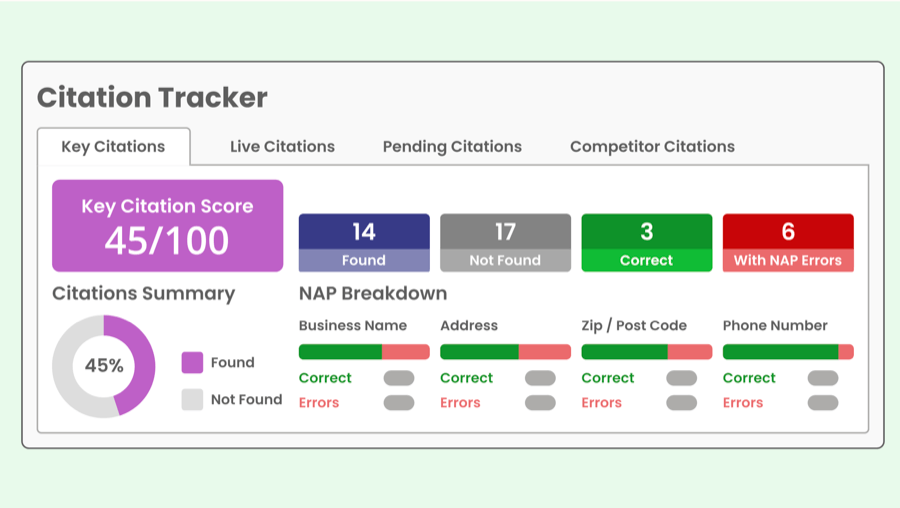
- Scanner tools: run BrightLocal’s Citation Tracker for a fast snapshot (Moz Local does not cover Australian listings, so skip it), and Whitespark’s Local Citation Finder to see where competitors are listed that you are not.
Record every listing in a spreadsheet: platform, URL, the NAP shown, and whether you have login access.
Step 3: Map the inconsistencies
Compare each listing to your canonical NAP and flag every difference, plus any duplicate listings, which split your reviews and confuse Google. Prioritise by authority and visibility:
| Tier 1 (fix first) | Tier 2 (claim once, then leave alone) |
|---|---|
| Google Business Profile | Hotfrog Australia |
| Apple Business Connect | TrueLocal (Thryv-owned, dormant) |
| Bing Places | StartLocal |
| Yellow Pages Australia | White Pages Australia |
| Localsearch | Industry-specific directories |
Step 4: Fix in priority order
Correct your website first, since that is the version you control completely: header, footer, contact page and any location pages. Then your Google Business Profile, then Apple Business Connect and Bing Places, then the core Australian directories. You may need to claim and verify some listings, and some platforms take weeks to update publicly. After each fix, verify it: check at 48 hours, again at a week, and once more at 30 days, because some directories are slow and some quietly revert. Test that the phone number actually connects and that the map pin lands in the right place.
One Australian note: there is no local equivalent of the US data-aggregator model (Data Axle, Neustar/Localeze) that pushes a single update across hundreds of directories. The global location sources (Foursquare, Apple Maps, OpenStreetMap, TomTom, Waze) act as de facto aggregators into many apps and AI products, so check those too, but the active AU directories still need claiming and correcting one by one.
Step 5: Validate the foundation, then keep it clean
While you are in there, make sure your website backs up your listings. Adding LocalBusiness schema states your NAP in a structured, machine-readable way so search engines read your canonical details cleanly. Our list of the best Australian citation sites is a sensible target list once the cleanup is done.
An audit is not a one-off. New listings get scraped, staff create profiles, and details change. Keep it clean with a quarterly spot-check of your main platforms, a Google Alert for your business name with old addresses or numbers, and a simple change protocol: when something changes, update your website and Google Business Profile first, then Apple and Bing, then the directories.
Common citation mistakes to avoid
A handful of mistakes account for most of the damage we see:
- Leaving duplicate listings in place. Duplicates split your reviews and send conflicting NAP signals. Find them by searching variations of your name, old addresses and old numbers on Google Maps. To remove one, open it on Maps, click “Suggest an edit”, then “Close or remove”, and select “Duplicate of another place”. If a duplicate holds reviews you want to keep, claim it first, then ask Google Business Profile support to merge the two. Google will not merge a storefront profile with a service-area profile, so make sure the business type matches on both.
- Chasing volume over quality. Buying a cheap gig to get listed on 150 random directories does nothing useful and can do harm. Fifteen to twenty accurate, complete listings on platforms customers actually use beats a hundred on low-quality ones every time.
- Listing on dead or low-quality directories. Skip directories with no verification process, an ancient copyright date, a broken mobile experience, or pages full of spammy links. They send no traffic and can feed outdated data about you back into the web.
- Using a national or call-tracking number as your main listing. Your primary citations and schema should always carry your real local number. Reserve tracking numbers for specific campaign pages.

Avoid those, keep the foundation consistent, and put your real energy into reviews, your profile and genuinely useful content.
How to know it’s working
You will not see citations move rankings on their own, so do not measure them that way. Instead track:
- Citation accuracy: the share of your listings with identical NAP.
- Local Pack position for your target terms over time.
- Google Business Profile actions (calls, direction requests, website clicks) in your Performance report.
If your citations are clean and consistent and your other signals are strong, the profile actions are where you will see the payoff.
Where Search Scope fits
Citation cleanup is tedious, easy to half-finish, and exactly the kind of foundational work most businesses leave undone. We audit and clean it as part of our broader local SEO services, because there is no point chasing rankings on a foundation Google is not sure it can trust. If you suspect your listings are a mess, and we will tell you what we find and what is worth fixing first.
FAQ
Are local citations still important for SEO in 2026?
Yes, but as a foundation, not a growth lever. Consistent citations confirm your business and keep you out of trouble, and they are increasingly relevant for AI search visibility. But they no longer move Local Pack rankings much on their own. Reviews, proximity and a strong Google Business Profile matter far more.
How often should I audit my citations?
Do a full audit at least once a year, with quarterly spot-checks on your most important platforms (Google Business Profile, Apple Business Connect, Bing, Yellow Pages), and always update immediately when something changes. A wrong number or an old address costs you trust and enquiries from the day it appears.
How many citations do I need?
There is no magic number, and chasing volume is the wrong goal. A couple of dozen accurate, consistent listings on high-quality Australian and industry sites beats a hundred inconsistent ones on low-quality directories.
What’s the difference between structured and unstructured citations?
A structured citation is a listing in a formal directory with defined NAP fields (Yellow Pages, Localsearch, Apple Business Connect). An unstructured citation is a mention of your NAP in an article, blog or social post. Both help: structured listings are the foundation, unstructured mentions build local credibility and are exactly what AI systems pick up on.
Should I use my “Pty Ltd” name on citations?
No. Use your real-world trading name, the one on your storefront, consistently everywhere. Keep the registered entity name for invoices and legal documents, not your public listings.
What’s the difference between a citation and a backlink?
A citation is a mention of your NAP, which may or may not include a link. A backlink is a clickable link to your site. Some citations include a backlink, many do not. Both have value, but they do different jobs.
Do I need a citation management service?
It depends on scale. A single-location business can usually run the audit and cleanup manually. Multiple locations, or a business that has moved or rebranded several times, often benefit from a managed service or tool to keep things consistent at scale.
Does Facebook count as a citation?
Yes. Your Facebook business page carries your NAP and is one of the first places to make sure your details are correct.