
Multi-location SEO: how to rank every location in Australia.
Search Scope runs multi-location SEO for Australian networks: clinics, dental and vet groups, dealerships, retail chains, and trades with branches. The Network Visibility System works the whole portfolio, not the two locations that already rank. One senior operator accountable for all of it, no account managers.
Written by Dorian Menard. Executing SEO since 2013. Based in Perth, working Australia-wide.
- Multi-location SEO is portfolio work. Each location ranks in its own local results or it does not rank at all, and a single site-wide traffic number hides which is which.
- Every location is a separate ranking entity. It needs its own Google Business Profile, its own page, its own reviews, and its own local signals.
- The part almost nobody warns you about: at scale, your Google Business Profiles become a compliance risk. Google merges, flags, and suspends listings, and one suspension can take a location off the map for weeks.
- Australia makes this harder. A business across Perth, Sydney and Brisbane is competing in three separate markets with different competitors in each.
- Get the structure right early. Fixing a messy multi-location setup later costs far more than building it properly the first time.
Multi-location businesses we've worked with






69 locations under management across 5 clients, as at September 2026. Current and recent work includes Google Business Profile consulting for The Local Guys, a national franchise network, and search across a 17-campus early learning group.
Adding a second location feels like it should double your search visibility. In practice it doubles the moving parts, and somewhere around the third or fourth location most businesses notice that one branch has quietly gone invisible. It ranks nowhere, the phone does not ring, and nobody can work out why.
Multi-location SEO is how you stop that happening. Done properly, each location earns its own place in local search and pulls its own weight. Done the way most businesses do it, you end up with a few strong locations, a few dead ones, and a growing suspicion that your marketing spend is leaking somewhere you cannot see.
This guide explains how it actually works, what most businesses get wrong, and the one risk that gets more dangerous with every location you add.
What is multi-location SEO?
Multi-location SEO is the practice of optimising a single business with two or more physical locations so that each location ranks in the local search results for its own area. You will also see it called SEO for multiple locations, or local SEO for multiple locations. It is the same work under different names. That work covers the local map pack, organic rankings, and increasingly the answers that AI search tools give when someone looks for a service near them.
The important shift is this. Google does not rank your business. It ranks each location as a separate entity in its own catchment. A page built to rank for "electrician Fremantle" will not rank for "electrician Joondalup", and a single Google Business Profile cannot appear in the map pack for suburbs it is not physically near. Each location competes locally on its own merits, while your brand's overall authority helps lift all of them.
So multi-location SEO is not local SEO done once and copied. It is a portfolio of local search assets, each one managed on its own, held together by a consistent brand.
Google Business Profile compliance across a location portfolio
This is the section most guides skip, and it is the one that costs businesses the most. When you run five, ten or twenty Google Business Profiles, those profiles stop being a marketing tick-box and become an operational risk you have to manage.
Google's own policy is blunt: you can have only one Business Profile per business, and profiles it considers duplicates will not show on Search or Maps. When you have multiple genuine locations, that policy creates constant edge cases. Profiles get flagged as duplicates. Distinct locations get incorrectly merged. New locations fail verification. And profiles get suspended, sometimes for reasons that are not obvious and not your fault.
Every branch is a separate ranking entity. At scale, it is also a separate compliance liability.
A suspension is not a minor inconvenience. A suspended profile disappears from the map pack completely, which means that location stops generating calls and enquiries until it is reinstated. For a business relying on local search for leads, that is real revenue walking out the door every day the profile is down.
The businesses that handle multiple locations well treat compliance as part of the job, not an afterthought. That means setting profiles up correctly so they are distinct and eligible from day one, keeping details clean so nothing looks like a duplicate, and having a fast, evidence-based process ready for when Google gets it wrong and a legitimate location goes down.
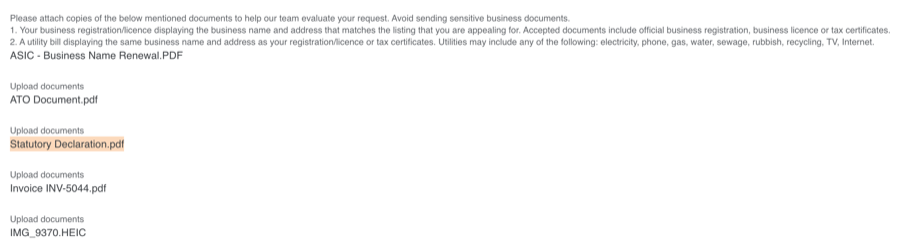
This is where we tend to add the most value. Alongside the everyday local SEO work, we handle the compliance and protection side of a multi-location profile portfolio, and we deal with the suspensions and reinstatements that most agencies quietly hope they never have to. Once you are on a retainer, a suspended profile is fixed as part of the work rather than billed as a separate emergency.
For context on the track record behind that, Search Scope has handled 300 reinstatement cases with 295 reinstated, a 98% success rate, across February 2025 to July 2026. On a single business that is a recovery service. Across a portfolio it is governance: the difference between a suspension being a process with a known path, and a suspension being a month of lost calls at one branch while everyone works out who owns the login.
A plumbing client across one competitive metro area: more than six Google Business Profiles established, rankings improved across the whole footprint, and more than 250 qualified leads a month across all locations, sustained through the first six months of 2026. That is what multi-location SEO can do when the structure and the management are both right.
Which of your locations is quietly invisible?
Thirty minutes with the specialist who does the work. You leave knowing which branches are underperforming and why.
Why multi-location SEO is a different game
Single-location local SEO is a contained job. One profile, one set of reviews, one local market, one page to get right. Multi-location SEO changes the shape of the work in three ways that catch people out. This applies whether you are a franchise network, a group with several branches, or a single brand opening its second and third site.
The workload grows with every location. Two locations means two profiles to manage, two review streams to keep warm, two sets of local keywords, and two competitive markets to watch. Five locations means five of everything, and near certainty that at least one is underperforming at any given time. The admin alone becomes a real job.
The risk grows faster than the workload. Duplicate content across near-identical location pages. Cannibalisation, where two of your own pages chase the same search and neither of them wins it. Inconsistent business details spread across dozens of directories. None of these are a problem with one location. With ten, they are constant, which is on top of the profile risk above.
And in Australia, geography works against you. A business operating across Perth, Sydney, Brisbane and Adelaide is not in one market. It is in four, each with its own competitors, its own search behaviour, and its own local pack to break into. Ranking well in Perth tells you almost nothing about whether you will rank in Brisbane. The distances between our major cities mean there is very little overlap to lean on.
| Single location | Multiple locations | |
|---|---|---|
| Google Business Profiles | One | One per location |
| Review streams to manage | One | One per location |
| Local markets to compete in | One | One per city or region |
| Main risk | Getting found at all | Duplicate content, merged and suspended profiles |
| Where it breaks | Weak profile or thin page | The setup and the ongoing management at scale |
The Network Visibility System
People go looking for a clever trick here and there isn't one. Multi-location SEO rewards the groups that do the fundamentals properly at every location, and punishes the ones that copy the flagship and hope. This is the order we run it in, and the order matters: optimising pages before the ownership question is settled means redoing the work the first time a manager leaves and takes a login with them.
Govern
Settle who controls what before touching a page. One account owning every Google Business Profile with managers added per location, access mapped so a departing practice manager does not walk off with a listing, a standing procedure for openings, closures and relocations, and a suspension playbook so a profile going down is a process rather than a fire drill.
Structure
Fix the architecture so your locations stop competing with each other. One domain with location subfolders, a page per location carrying something only that site can say, LocalBusiness markup per location tied to the matching profile, and cannibalisation resolved so the right page ranks for the right suburb.
Surface
Make every location eligible to rank in its own catchment. Profiles optimised and managed as a portfolio instead of one at a time, name, address and phone kept consistent across every directory at every location, reviews running per branch rather than pooling at the flagship, and pages structured so AI answers can quote them.
Prove
Reporting that shows which locations are working and which are not. Calls and enquiries counted per location rather than as a site total, a geo-grid per branch showing where it actually surfaces on the map, and AI visibility tracked alongside rankings.
One thing worth saying plainly. A multi-location business has an advantage no single independent competitor in each market has: backlinks and brand recognition lift every location at once, and location pages that link sensibly to each other spread that further. Most groups never use it. The reverse is more common, and more expensive: a shared or half-finished profile is the single most common reason a location fails to rank in its own area.
Location pages that actually rank, not doorway pages
It is worth being clear about the line between a useful location page and a doorway page, because a lot of businesses cross it without realising.
The doorway-page trap. Copy one page across twenty suburbs, change the town name, and you have built twenty doorway pages. Google's systems are specifically designed to catch this, and the usual result is that most of those pages never get indexed or ranked.
A location page that earns its keep looks different. It lists the actual services available at that location, names the suburbs and areas it serves, includes real photos of that location or its team, adds genuine local context, and answers the questions someone in that area would actually have. If you removed the place name, the page should still obviously be about that specific location. That is the test.
Use this as a simple checklist for every location page:
- Services actually offered at that location
- Suburbs and areas served, named specifically
- Real photos, not stock images
- Local phone number and address
- Link to the matching Google Business Profile
- Local context, landmarks or details that prove it is a real presence
- Location-specific reviews or testimonials where you have them
Common multi-location SEO mistakes
Most multi-location SEO problems come from a short list of avoidable mistakes. Here are the ones we see most.
Competing with your own pages
Location pages too similar to each other fight for the same searches. Instead of one strong page you get several weak ones splitting the signal.
Thin, duplicated location pages
The most common mistake of the lot. Thin pages do not rank, and enough of them can drag on the quality of the whole site.
One profile stretched too far
A single profile cannot rank in the map pack for areas it is not near, so trying to cover several locations with it leaves most of them invisible.
Inconsistent business details
Different phone numbers, abbreviated addresses and stale information across directories weaken every location’s local signals.
Ignoring reviews on weaker branches
Reviews are local. A glowing profile in your flagship city does nothing for the branch two states away sitting on four reviews.
Website structure: subfolders or subdomains
A question that comes up constantly: should location pages sit in subfolders or on subdomains? For most Australian businesses, subfolders are the better choice.
A subfolder structure keeps everything under one domain, so all the authority you build flows into a single site. Something like yoursite.com.au/locations/perth/ is clean, scalable, and keeps each location's authority contributing to the whole.
Subdomains, like perth.yoursite.com.au, turn each location into a second website to build, link and monitor. Google has said it sees subdomains and subfolders the same in general, so this is not a penalty. It is a cost, and it gives up building on the strength of the main site. We do not recommend them. A flat subfolder structure under one domain is simpler and stronger. Keep it no more than two levels deep and use the suburb or city name as people actually say it.
Extra domains are a separate question and it comes down to economics. A brand-owned domain for a profitable market, including an exact-match name, can be worth building alongside the location page, as long as it is a real local site and not a funnel to another page. Our franchise website structure guide covers when that pays.
- yoursite.com.au
- /locations/perth/
- /locations/sydney/
- /locations/brisbane/
One domain. Every location feeds the same authority.
- perth.yoursite.com.au
- sydney.yoursite.com.au
- brisbane.yoursite.com.au
A second site to build and maintain. Not recommended.
Storefronts, service areas, and the territory with no address
Everything above assumes each location is a real address a customer can walk into. Plenty of multi-location businesses are not built that way, and the rules change when they are not.
A storefront is a staffed premises customers visit: a clinic, a dealership, a shop. It gets its own Google Business Profile showing its address, and everything on this page applies as written. A service-area business travels to the customer instead. Trades, mobile services, in-home care. Google lets those hide the street address and declare the suburbs they cover.
Here is the part that catches people out. Declaring a service area does not move where your profile ranks from. The map pack still works off the address behind the listing, so you can name thirty suburbs and still be invisible in the ones an hour away. That is the proximity wall, and it is the single most common reason a business expanding into a second territory feels like the SEO has stopped working.
The virtual office shortcut. The obvious workaround is renting a mailbox or a coworking desk in the new territory and putting a profile on it. Google treats that as a fake location, and it is one of the fastest routes to a suspension that takes the rest of your portfolio down with it while you appeal.
What actually works is less satisfying and more durable. Map pack visibility follows genuine physical presence, so a territory with no staffed address is not going to win the local pack there. Organic results and AI answers do not have that constraint. So for a new territory, the location page is the asset you have, and it has to be good enough to rank on its own merits: the services you genuinely deliver there, the suburbs you genuinely reach, and the local detail that proves you actually work in that area. If the revenue justifies it later, a real staffed address unlocks the profile and the map pack with it.
The practical test before you open a territory: can you put a person and an address there. If yes, it is a location. If no, it is a service area, and you should be measuring it on organic and enquiries rather than wondering why it is not in the map pack.
How to measure multi-location SEO performance
One overall traffic number hides the thing you most need to see: which locations are working and which are not. Multi-location SEO has to be measured location by location.
Track map pack and local ranking visibility for each location separately. Track the calls, enquiries and form fills coming from each one, not just the site total. Watch Google Business Profile performance per location. The goal is to see, at a glance, which locations are pulling their weight and which are underperforming, so effort goes where it is actually needed rather than being spread evenly across locations that do not all need the same thing.
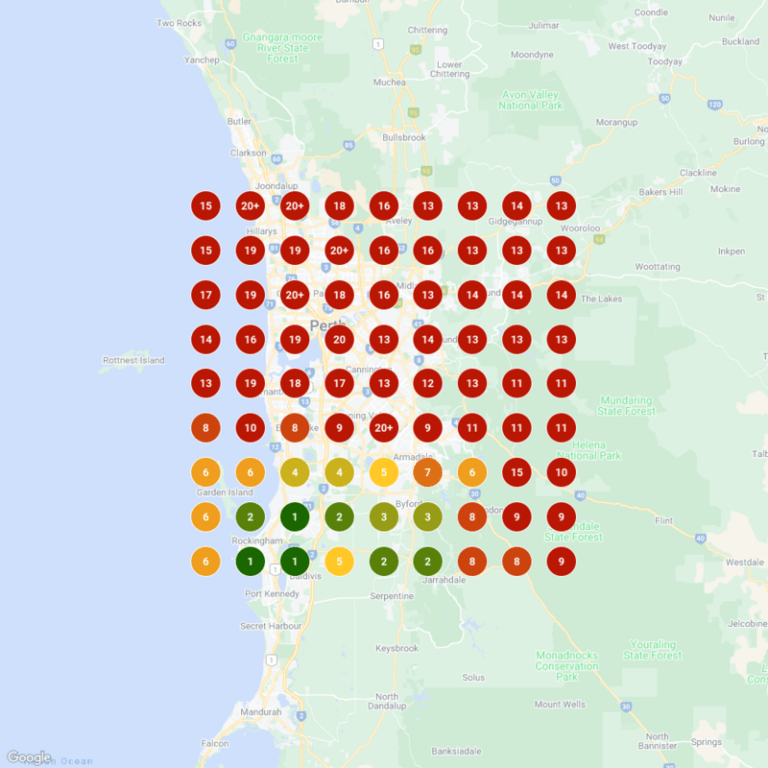 Before
 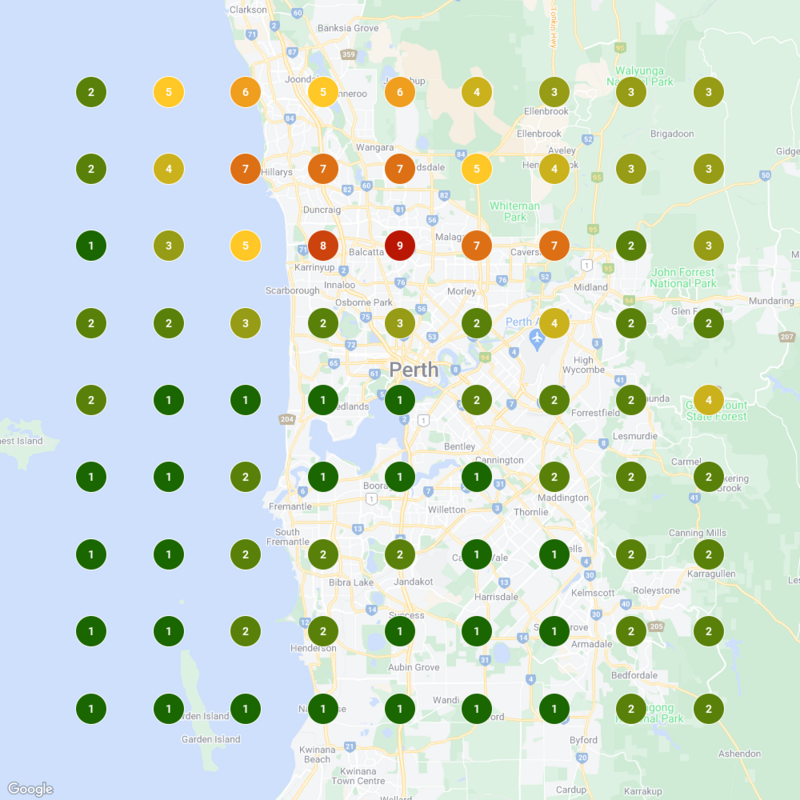 After
After Be realistic about timing. Local SEO across multiple locations is not fast, especially in competitive city markets. New locations take time to establish, and how long depends on the competition in each market, the state of your profiles, and how well the fundamentals are done. Anyone promising guaranteed rankings or instant results across every location is selling you something that does not exist.
One retainer for the whole portfolio.
No per-location rate card. What moves the number is how many locations you run, how competitive each market is, and how much of the setup already exists.
From $5,000 AUD per month
That is the entry floor for a multi-location engagement, not a quote. Five locations in one metro area costs less to run than five spread across five competing city markets, because each city is its own fight. A location that already ranks needs far less work than one starting from a suspended profile and a blank page. You get a fixed number after a short review of your current setup.
Month to month, 30 days notice. No lock-in and no minimum term.
- A Google Business Profile per location, set up, optimised and monitored
- Location pages built to rank, not swap-the-suburb duplicates
- NAP and citation consistency across every directory, every location
- Review generation and response, tracked branch by branch
- Suspended profiles handled at no extra cost while you are on retainer
- Geo-grid and rank reporting per location, not one site-wide number
Top 3 for a 12,000/month national keyword in 6 months. Organic traffic up 3,000%.
"His content marketing and SEO skills brought my client from nowhere to top 3 for our main keyword (competitive national keyword with around 12,000 searches a month) in 6 months only. He helped us increasing organic non-branded traffic by 3,000% in 6 months. Would definitely recommend him."

Doing it in-house versus hiring a specialist
Plenty of businesses run their own multi-location SEO, and if you have the time and someone who genuinely understands it, that is a reasonable path. The honest question is whether that is the best use of your team's time, because the workload is real and it does not stop.
The case for bringing in a specialist is strongest when the number of locations has grown past what one person can keep on top of, when profiles are getting flagged or suspended, or when you can see that some locations are underperforming but cannot work out why. That is usually the point where the coordination, the compliance risk, and the ongoing management outgrow doing it on the side.
- You have two or three locations, not ten
- Someone owns it properly, not as a side task
- Your profiles are stable and none are suspended
- You are not trying to break into new city markets at once
- Locations have outgrown what one person can track
- Profiles are getting flagged, merged or suspended
- Some branches underperform and you cannot see why
- You are expanding into competitive new markets
If you are weighing it up, the fastest way to get clarity is a straight conversation about your specific setup. and you will get an honest read on where your locations stand, what is holding the weaker ones back, and what it would take to fix.

Meet your senior SEO consultant, Dorian Menard
Specialising in SEO since 2013. Founder of Search Scope. I work directly with every client on strategy and execution. No account managers, no offshore teams, no templated retainers.
My work covers multi-location and franchise SEO, organic and national SEO, local SEO, Google Maps, GBP and GMC reinstatement, technical audits, and AI search visibility. I work with established businesses and multi-location networks that want a senior specialist, not a service package.
Where multi-location SEO connects.
Multi-location SEO questions.
The 30-minute strategy call answers the rest. No pitch deck. No proposal at the end unless you ask.
Further reading in the Search Scope research library: practitioner documents on multi-location and franchise SEO.
Ready to make every location show up?
A genuine 30-minute call with the specialist who will do the work, not a salesperson. You leave with a clear view of which locations are underperforming, why, and what it would take to fix the whole portfolio.
Pick a time for the portfolio review.
Thirty minutes on the calendar. Bring your location list and we will go through which branches are underperforming, why, and what it would take to fix the whole portfolio.