
Franchise Website Structure: Where Should Your Location Pages Live?
Where should franchise location pages live? Why we use subfolders on the main domain, skip subdomains, and treat extra domains as a decision about economics.
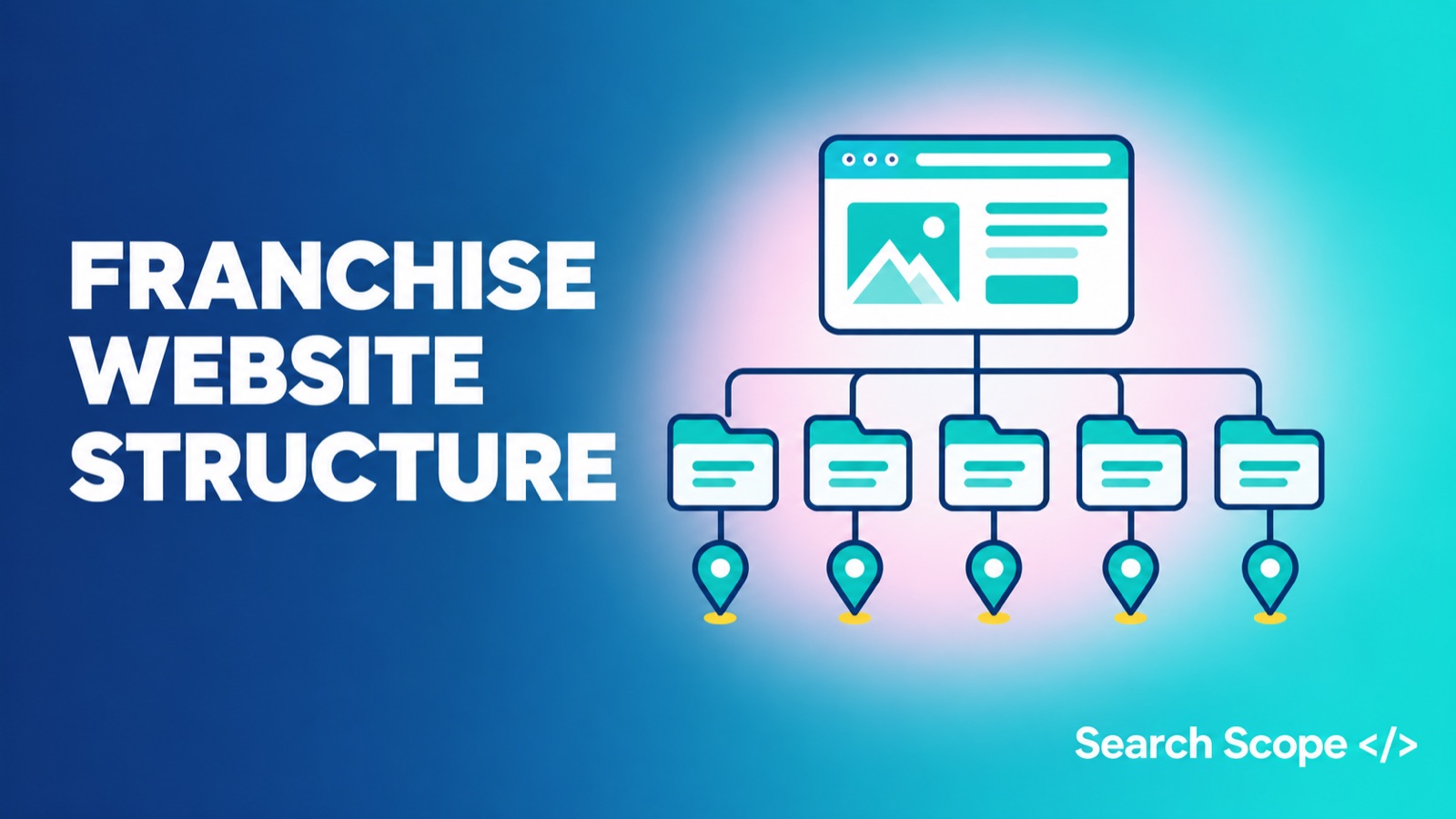
- Put every location page in a subfolder on the brand’s main domain, such as brand.com.au/locations/coburg/. That keeps 1 site, 1 template and 1 team accountable.
- We do not recommend subdomains. Google has said it sees subdomains and subdirectories the same in general, so a subdomain does not cost you rankings by default. The real cost is a second site to maintain, and it gives up the benefit of building on the main domain.
- Extra domains, including exact-match names, are an economics decision. They can be worth building on the side to go after profitable markets, as long as the brand owns them and each one is a real local site.
- The expensive failures in franchise networks are usually about control, not structure: head office does not own the Google accounts behind the Business Profiles, and one account runs dozens of profiles.
- Franchisees who want more map listings need a compliant route to them. Without one, they improvise with virtual offices and fake locations.
Sooner or later every franchise network asks the same question: should each location sit on the main website, on its own subdomain, or on a separate domain? The standard answer on the first page of Google is “subfolders, always”, and it is right more often than not. It leaves out the part that decides the outcome. A franchise is an ownership arrangement as much as a website, and the best structure on paper fails if head office does not control the assets that sit on top of it.
You are probably reading this because one of three things is about to happen: you are adding the next batch of locations and someone has suggested a subdomain, franchisees have started registering their own domains, or you have inherited a network where nobody can say which site belongs to which location. This guide gives you the decision, the reasoning behind it, and the exceptions. It covers where location pages live and who controls them, not how to write the pages.
The short answer: subfolders on the main domain
The best default franchise website structure is subfolders on 1 main domain, and a franchise should move away from it only with a reason.
| Situation | Structure | Why |
|---|---|---|
| Head office runs the website, listings and social for every location | Location subfolders on the main domain | One site to build, secure and report on, with one team accountable for it. |
| Head office owns the website, franchisees contribute local content and manage their profiles | Location subfolders, with a template head office controls | Same benefits, plus local material that makes each page worth ranking. |
| Franchisees run their own marketing or hire their own agencies | Subfolders for the brand’s pages, plus brand-owned separate domains for the franchisee-run work, with written rules | Contains the damage if one franchisee’s marketing goes wrong, without splitting the main site. |
| A profitable market where one page is not enough | Subfolders, plus an extra brand-owned domain if the economics justify it | More assets competing for the same searches. See the extra domains section. |
Search Scope has 69 locations under management across 5 clients as at September 2026, and most of those sit in subfolders on a main domain. In the networks we work on, the brand owns the marketing assets: the website, the social accounts and the Business Profiles. That is the setup this guide is written around.
What Google says, and why we still skip subdomains
Google does not rank franchise subdomains lower than subfolders for being subdomains. Plenty of guides claim subdomains split your authority or get treated as separate sites, but Google’s own comment is less dramatic. In a 2018 office-hours session reported by Search Engine Journal, John Mueller said, “In general, we see these the same.” He added that he would personally keep things together as much as possible, and use subdomains only where things differ.
We still skip subdomains for franchise location pages, for 3 reasons:
- A subdomain is a second website. It needs its own setup, internal linking and monitoring, and a network with a small team ends up doing the same work twice.
- In our experience, pages on the main domain benefit from the strength of the brand’s site, and a subdomain gives that up. We have not run a controlled test of this, so treat it as our position, not a measured result.
- Separation is the only real argument for them, and a brand-owned separate domain gives you that separation more cleanly, without cutting location pages off from the main site.
If a vendor or an old guide tells you subdomains suit franchises with several locations, ask what they gain over a subfolder. The answer is usually containment, and there are better ways to get it.

Subfolders in practice
A franchise website structure built on subfolders gives each location its own path on 1 domain, and all 3 Australian franchise sites we checked work that way. On 6 October 2026 we opened them and read their live URLs:
- Snap Fitness: snapfitness.com/au/gyms/armadale, with each gym under a gyms folder.
- Jim’s Plumbing: jimsplumbing.com.au/locations/melbourne/coburg, with city, then suburb.
- Barry Plant: barryplant.com.au/offices/berwick/, with one page per office.
Each page was reachable, pointed at itself as the canonical version, and sat on the brand’s own domain. We did not see a separate franchisee domain or a subdomain on any of the three. That sample is small. It shows a pattern, and it does not prove subfolders win.
One more observation from the same check. A Subiaco subdomain of LJ Hooker (subiaco.ljhooker.com.au) now redirects to the main ljhooker.com.au domain. We do not know why, and we would not read a strategy into a single redirect. It does show that an old subdomain structure can be folded into the main site later.
Here is what a clean structure looks like. This is an illustration with a made-up brand, not a client:
- brand.com.au/locations/ lists every location and links to each one.
- brand.com.au/locations/perth/ groups the Perth locations.
- brand.com.au/locations/perth/joondalup/ is the page for one location, linked from its region page and from the locations hub.
A franchise location page needs only a hub, a region and a location in its path, and deeper nesting adds nothing. Each location page uses the place name customers actually say, and the Business Profile for that location links to this page and no other.
Once the structure is subfolders, the linking is mostly built in. A locations hub on the main site lists every location, a region or state page groups them, and each location page links back up and across to the services it offers. A location page that nothing links to is a page Google has little reason to find or value. Writing the pages themselves is covered in our location pages guide. Keep every local addition about that location. Copying one page across twenty suburbs is the quickest way to produce doorway pages.
Extra domains: an economics decision
An extra domain for a franchise location is worth building only when the market’s economics justify it and the brand owns it. Subfolders are the base, extra domains sit on top, and building one is a business call. More brand-owned assets gives you more ways to be found for the same search, and in a profitable market that can pay for itself.
We would consider an extra domain in 2 situations:
- A market worth 2 or 3 times the effort. If a territory produces high-value jobs, building a 2nd and 3rd asset aimed at its main searches, alongside the location page, can be worth the cost. If the economics do not justify it, skip it.
- A fully branded franchise that wants to take specific keywords. An exact-match or partial-match domain can help the network rank for the exact phrases customers type, and we have seen exact-match domains perform well in AI search too. That second point is our observation, not a studied result.
3 conditions keep this on the right side of Google’s rules.
First, a domain is not a doorway. Google’s spam policy lists multiple domain names or pages aimed at specific cities that funnel users to one page as doorway abuse. A set of near-identical city domains that all push visitors to the same booking page is that pattern, as Google describes it. An extra franchise domain earns its place when it is a real site for a real location, with its own staff, services, photos and reviews, and nothing in it exists only to push visitors somewhere else.

Second, the domain name is not the business name. Google’s Business Profile guidelines say the name should reflect the business’s real-world name, as used consistently on its storefront, website and stationery, and that unnecessary information in the name is not permitted. If the local domain is a keyword match for the service in a suburb, the Business Profile still carries the brand name, and its website link should represent that individual location.
Third, decide which page wins. If a location has a page on the main domain and its own domain, pick which one the Business Profile links to and which searches each is meant to win. If you cannot answer that for every location, you are not ready to run both.
Who owns the accounts matters more than the structure
A franchise network loses control of its locations through account ownership far more often than through URL structure, and head office should own every Google account behind a Business Profile. These are the failures we see most often:
- Head office does not control the Google accounts. Franchisees open Business Profiles under their own Gmail addresses, and head office never holds the logins. When the franchisee leaves or the login changes hands, the brand cannot get the profile back quickly. Head office should control every Google account that owns a profile, and add franchisees as managers.
- One account runs dozens of profiles. Putting 50 or more profiles under a single Gmail concentrates the risk: one problem with the account can hit every location at once. Split profiles across several accounts so a single issue stays contained, and keep a register of which account owns which location.
- No management routine. There is no naming policy for listings, no compliance checks and no named person responsible. Profiles are named however each franchisee likes, and the ones that drift from Google’s rules are the most exposed when Google tightens enforcement.
- No proper strategy. Locations are added as the franchise grows, with no agreed structure, template or owner. Each one gets built differently.
- Franchisees left out of growth. The franchisee knows the territory and wants more map visibility, and nobody gives them an approved route to it. So they improvise.
That last point leads to the most expensive mistake in franchise Business Profile management. When there is no approved route to more map listings, franchisees rent a mailbox or a coworking desk in the next suburb, or create a second listing for a place the business does not operate from. Google’s guidelines say a business that rents a mailing address but does not operate from it is not eligible for a profile. One suspended profile can hold up the others while the appeal runs.
The compliant answer is a real, staffed location. Where there is none, build a strong organic page for that territory rather than a profile Google will not accept. The multi-location SEO guide covers the profile side in more depth.

How to decide: 5 questions
Choosing a franchise website structure comes down to 5 questions about control, rules, agencies, market value and addresses.
- Who controls the website, the Business Profiles and the Google accounts behind them at every location today?
- Can head office enforce a template and a set of rules on every franchisee?
- Do any franchisees hire their own agency or run their own site, and does the agreement allow it?
- Which markets are valuable enough to justify an extra brand-owned domain?
- Does each location have a real address and staff, or is some of it service-area work?
If the first two answers are head office, subfolders cover you. If the third is yes, add brand-owned domains for that work and write the rules down. If the fifth is mixed, treat storefront and service-area locations separately.
Take stock before you change anything
Whatever you decide, start with an inventory. It takes an afternoon and it tells you which of the situations above you are in.
- List every domain and subdomain the brand or any franchisee uses for a location, and who owns the registration.
- For every Business Profile, record which Google account owns it, who holds that account’s recovery details, and which page its website link points to.
- Mark each location as storefront or service-area, and note whether a real person works from that address.
- Check which locations have two pages competing for the same search, for example a main-domain page and a franchisee site.
Once that list exists, the five questions above mostly answer themselves.
Franchise website structure: frequently asked questions
Are subdomains bad for franchise SEO?
Google has said it sees subdomains and subdirectories the same in general, so they are not a penalty. We still do not recommend them, because they add a second site to maintain and give up the benefit of building on the main domain.
Should each franchisee have their own website?
A franchisee should have their own website only if the brand owns it or sets clear rules for it. A franchisee site that targets the same searches as the main domain competes with it. A brand-owned site with its own content, staff and local proof can be an asset.
Do exact-match domains still work?
In our experience, exact-match domains can work for a franchise, particularly a fully branded one going after specific phrases. Each one has to be a real local site and not a thin funnel to another page, and the Business Profile name still has to match the business’s real-world name.
Who should own the Google Business Profiles?
Head office. Control every Google account that owns a profile, spread profiles across more than one account, and add each franchisee as a manager so they can post, answer reviews and update details. The profile, its reviews and its history then stay with the brand when the franchisee leaves.
Can I change structure later?
Yes, a franchise can change its website structure later. Moving a subdomain into a subfolder needs a redirect plan and a check that every old URL lands on the right new page. Plan the migration before you start.
Getting the structure and the ownership right before you scale
Search Scope runs franchise SEO for networks that need every location visible in Google Maps, organic search and AI answers, with ownership and structure settled first. If you are inheriting a mix of subfolders, subdomains and separate sites, or about to open your next ten locations, and we will tell you what we would change first.