
10 Actionable Steps to Improve Your Local SEO Right Now
Ten practical local SEO steps you can act on now, from an Australian SEO agency: Google Business Profile, reviews, citations, local links and what to skip.

Are you struggling to make your business stand out in local search? You are not alone. As the founder of Search Scope, a Perth SEO agency, I have watched plenty of good Australian businesses lose customers to weaker competitors simply because those competitors were more visible on Google.
This guide is the practical version. Ten steps you can act on now, in roughly the order I would tackle them, with the levers that actually move local rankings in 2026 and a clear note on what to skip. These are the same things we do for clients.
- Your Google Business Profile and your reviews are the two heaviest local ranking levers. Start there.
- Consistency matters: keep your name, address and phone identical everywhere.
- A few quality local links beat dozens of low-quality ones. Build real local relationships.
- Skip the time-wasters: keyword-stuffed names, mass low-quality citations, and chasing an arbitrary review count.
- Local search and AI Overviews increasingly draw from the same signals, so doing this well helps you on both.
Why local SEO matters
Google ranks local businesses on three things it states plainly: relevance, distance, and prominence. You can read its own tips to improve your local ranking for the official version. Distance you cannot change. Relevance and prominence you can, and that is where this list lives.
The payoff is the Map Pack, the block of three businesses shown under the map. If you are not there when someone searches for what you do, you are handing that enquiry to a competitor. Now to the steps.
1. Get your business name right (without stuffing it)
The name on your Google Business Profile (GBP) carries real ranking weight, which is exactly why people abuse it. Do not. Google’s guidelines require your profile name to match your real-world name, and stuffing it with keywords or suburbs is a common trigger for suspension.
If you have a legitimately registered trading name that happens to include a service or location, you can use it. “Smith’s Bakery” trading as “Smith’s Artisan Bakery Subiaco” is fine if that is genuinely your registered name. Inventing it is not. The safe rule: use the name on your signage, consistently.
2. Fix your photos
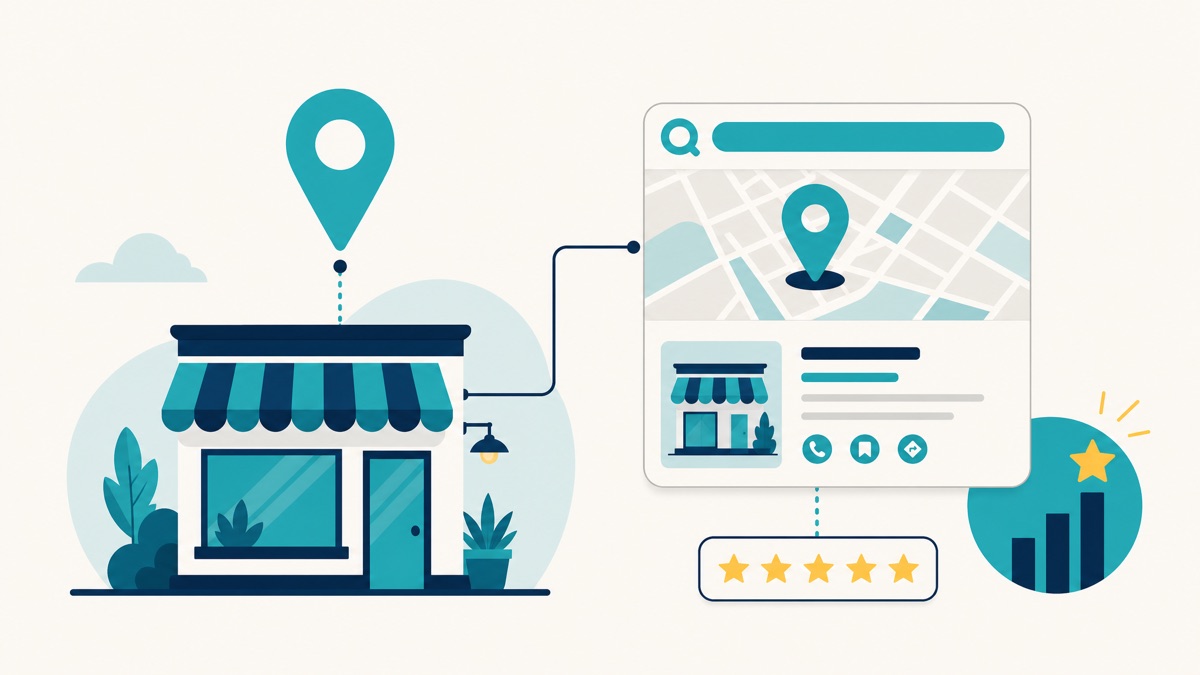
Your profile is often judged by its worst photo. Google’s own guidance on adding photos notes that businesses with photos see more engagement, more clicks, calls and direction requests, because real images build trust before anyone reads a word.
Do a quick clean-up: remove anything outdated, blurry or unflattering, and add at least ten genuine, high-quality images of your premises, work, products and team. Real photos beat polished stock every time, and stock can actually hurt you.
3. Make your landing page earn the click
Your landing page is often the first impression. The area visitors see before scrolling is the part that matters most, so make it immediately clear what you do, where you do it, and why someone should choose you.
Embed a map of your location and show local proof, real testimonials from local customers. A simple test: ask a friend to look at the page for five seconds and tell you what you do and whether they would contact you. If they hesitate, fix it.
4. Tidy up your hours and details
Consistency is foundational. Your name, address and phone (NAP) and your hours need to be identical across your website, your GBP and every directory. Inconsistency confuses Google and customers, which is why we treat NAP consistency as a starting point, not an afterthought.
Use GBP’s special hours for public holidays like Anzac Day and Christmas, and the “more hours” feature if you run different hours for delivery or click-and-collect. It improves the customer experience and shows Google your profile is actively managed.
| Action | Where | Why it matters |
|---|---|---|
| Keep NAP consistent | Website, GBP, directories | A foundational trust signal for Google |
| Set special hours | Google Business Profile | Avoids customer frustration, shows an active profile |
| Add service-specific hours | Google Business Profile | Surfaces you for queries like “open for delivery near me” |

5. Learn from competitor reviews
Your competitors’ reviews are a goldmine of customer intelligence. Read them for patterns: what people consistently praise, and what they complain about. Then fix those things in your own business before a customer has to point them out.
While you are at it, manage your own reputation properly by responding to every review, good and bad. Your review count and ratings feed the prominence signals Google uses to rank local businesses, and a visible reply shows customers you value their feedback. BrightLocal’s 2026 Local Consumer Review Survey found 97% of consumers read reviews for local businesses, so this is conversion work as much as ranking work.
6. Build a few real local links
Backlinks matter, and links from other local organisations are especially valuable because they tell Google you are a genuine part of the community. Think beyond guest posts: sponsor a local footy club, join your Chamber of Commerce, or get a mention in local press.
Quality beats quantity every time. A handful of relevant, local links does far more than dozens of low-quality ones from irrelevant sites, and the low-quality route can actively hurt you. We go deeper in our guide to quality Australian backlinks.
This is consistently the biggest lever we pull. We recently ran a local link campaign for a regional Queensland mortgage broker who was up against much more established players holding press links. A batch of genuinely local links and brand mentions pushed her to the top positions for most of her target keywords, with nothing else about the site changing in that window.
7. Flesh out your Google Business Profile
Your GBP is a tool, not just a listing. One of the most underused parts is the Services section: for every service page on your website, add a matching service entry, described the way customers search.
| Generic description | Better description |
|---|---|
| Plumbing | Emergency blocked drain clearing (24/7) |
| Hairdressing | Blonde foils and balayage colour specialist |
| Accounting | Small business tax returns and BAS lodgement |
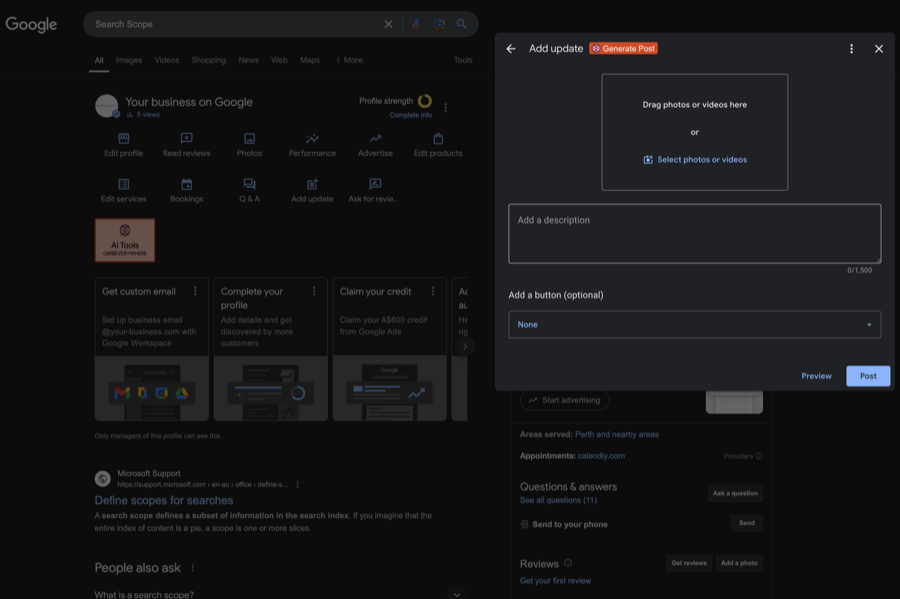
Keep the profile active too: post updates through Google Posts, and use the Q&A section to answer common questions. This is exactly the kind of work we handle as part of Google Maps SEO.
8. Report fake competitors
Not all local competition is honest. Fake or spam listings steal clicks from legitimate businesses, and you are allowed to report them. Look for the red flags: a P.O. Box instead of a real address, or a keyword-stuffed name like “Best Plumber Sydney 24/7 Cheap”.
Search your category and location regularly, and when you spot a suspicious listing, report it through “Suggest an edit” on Google Maps or Google’s Business Redressal Complaint Form. Cleaning up the local results helps every honest operator, including you.
9. Add a few quality citations
Your website and GBP are the cornerstones, but they should not be the only places customers find you. Listings on reputable Australian directories act as citations, corroborating that your business exists and where. Focus on directories that are still actively maintained and indexed: Yellow Pages Australia, Hotfrog Australia, your local Chamber of Commerce member directory, and any industry-specific directory that genuinely sends traffic in your space (Hipages for trades, HealthEngine for clinics, Zomato and TripAdvisor for hospitality) and Word of Mouth, which is still live and active and turns up often in AI answers for Australian businesses. Skip TrueLocal (now Thryv-owned via Sensis and much diminished), which still indexes your details but carries little weight as a 2026 citation. (Word of Mouth was acquired by Oneflare back in 2015; Oneflare itself closed on 30 June 2026 and now redirects to Airtasker.) Claiming the free Yellow Pages listing is worth ten minutes; paid Yellow Pages advertising in 2026 is a very different question.
The key word is quality. A small set of accurate, authoritative citations beats a mass blast of low-value ones, and every listing must carry identical NAP. Our explainer on local citations covers how to do this without making a mess.
10. Sharpen your value proposition
In a crowded local market, what makes you the obvious choice? A generic offer converts poorly. Instead of “great service”, a Perth plumber might promise “an on-time guarantee: we are there when we say, or your call-out fee is free.” Specific, memorable, and it answers a real customer worry.
Ask yourself three things: does it state a clear, unique benefit; does it speak to a real local customer pain point; and is it compelling enough to pick you over the business next door. Even a small improvement here lifts your conversion rate, which is what all the visibility is for.
What about AI search?
One thing has changed fast: an AI Overview now sits above the results for many local searches, and it tends to draw from the same businesses that already rank well and have consistent, trustworthy information. The good news is that the ten steps above are exactly what makes your business clear to those systems too. If you want to get ahead of it, that is the focus of our AI search optimisation work.
Where to start
You will not do all ten today, so start where it counts most. Get your Google Business Profile and reviews right first, fix your NAP consistency, then build a couple of genuine local links. Watch your rankings and enquiries as you go, and keep the ones that move the needle.
Local SEO is ongoing, not a one-off project. If you would rather have it handled properly by a local SEO agency in Perth that does this every day, and we will tell you which of these steps will move the needle fastest for your business.