
How to Get Quality Australian Backlinks: Local Link Building Strategies That Work
Free Australian backlinks from .gov.au sites, council directories, chambers, and tourism platforms. 12 proven local link building tactics that work.

Your competitors are probably earning links from Australian sources you have not tapped yet. None of it needs a big budget or technical skill, just consistency and a bit of patience.
This guide covers the low-budget link-building tactics available to Australian businesses, with a focus on the local .gov.au and .org.au sources most owners overlook.
Why Backlinks in Australia Matter More Than You Think
When someone in your area searches for what you offer, Google looks at who is linking to you and where those links come from, not just your own content.
Australian domains carry extra weight for Australian searches. A backlink from a .gov.au or .org.au domain tells Google that your business is legitimate, locally relevant, and trusted by official sources. That combination is what local rankings are built on.
Links from Australian government websites, chambers of commerce, and established local organisations signal a kind of trust that generic directory links simply cannot match. You would trust a plumber your council recommends over a random ad; Google works much the same way.
Local links do three jobs at once. They feed your Google Business Profile with consistent citations, they support the location-specific queries you actually want to rank for, and they put your business somewhere a customer already trusts, like a council website or a state tourism platform. That is why link work belongs inside a local SEO campaign rather than running as a separate project.
Let me be clear here, you can rank a .com.au domain with US-UK only English links, but those local .au links are going to be really helpful to dominate local searches!
Australia has something most markets don’t: government programs built specifically to promote local businesses. Senior card directories, council business listings, and state tourism platforms all offer free backlinks that many business owners completely overlook.
These are official government websites with genuine authority, where you get both a backlink and a consistent NAP record feeding your Google Maps presence.
One honest caveat before you start. For the Map Pack specifically, links are a minor lever next to proximity and reviews. A closer competitor with fresh reviews will usually beat you in the three-pack no matter how many links you build. Where local links genuinely earn their keep is your organic rankings and overall prominence. And there is no magic number of backlinks: it is relative to your competitors, and one genuinely local, relevant mention beats ten generic directory links. Build for relevance, not quantity.
Government Backlinks Through Senior Card Programs
Very few Australian businesses bother with these, which is exactly why they are worth your time.

Every Australian state and territory runs a seniors card program. These programs maintain online directories of businesses that offer discounts or special deals to seniors card holders. What most business owners don’t realise is that these directories provide legitimate .gov.au backlinks. Of course these links are not going to propel you to the top of Google in 48 hours, but they send trust to your website and are a good place to drop your NAP.
Queensland’s Seniors Card Business Directory, plus the VIC, NSW and WA equivalents, all maintain searchable online databases. When you register your business, you get a profile page with your business details, website link, and a description of what you offer seniors.
The eligibility requirements are straightforward. You need to offer some kind of discount or special offer to seniors card holders. It doesn’t have to be huge, even a 5% or 10% discount qualifies. You’ll need your ABN, business contact details, and a clear description of your offer.
Here’s the submission process: Start with your state’s seniors card website (search “[your state] seniors card business directory”). Most have an online application form where you submit your business details. You’ll describe your business, specify your discount offer, and provide your website URL. Processing usually takes 2-4 weeks.
The WA version, since most of the businesses we work with are here. The WA Seniors Card business partner program sets the bar at a 10% discount for card holders. Meet it and you get listed in the online Discount Directory on a .wa.gov.au domain, which is the part that matters for a link. You apply through the business partner form on that page or by emailing business@seniorscard.wa.gov.au, and the form asks for your business name, ABN, legal entity name, ACN if you are a company, phone, email, website and trade licence where one applies. Get those matching your Google Business Profile before you submit, because the listing becomes another citation, and a mismatched citation is worse than no citation. It is a small, slow, unglamorous link, which is what local SEO in the Perth metro is mostly made of once you get past the obvious directories.
The key to making this work is NAP consistency. Your business name, address, and phone number need to match exactly what’s on your website and Google Business Profile. Any inconsistency can actually hurt your local SEO rather than help it.
Beyond the backlink value, these listings generate real traffic. Seniors represent a significant portion of daytime shoppers and service users in Australia. A cafe offering a 10% seniors discount can see noticeable foot traffic increases from these listings.
One important note: you actually need to honour the discount you advertise. These are government programs, and businesses that don’t deliver on their advertised offers can get removed from the directory. Plus, it’s just good business practice.
Pro Tip: You can get listed on all the directories in the country, and they even have one for New Zealand.
Council business directories
Australian councils maintain business directories that most local businesses completely ignore. This is a mistake because these directories offer high-authority .gov.au backlinks and actually get searched by locals looking for services.

The structure varies by council, but the pattern is similar across Australia. Larger councils like City of Melbourne, City of Sydney, and Brisbane City Council maintain comprehensive business directories. Smaller regional councils often have them too, sometimes called “shop local” directories or business member listings.
Why Council Directories Actually Matter
The backlink is the smaller half of why council directories are worth doing. The context is the rest.
When someone searches for “electrician Parramatta” and finds you listed on Parramatta Council’s business directory, that carries more weight than finding you on a generic national directory. You’re being endorsed by the local government.
Finding these directories takes a bit of detective work. Start with your local council website and search for terms like:
- “Business directory”
- “Local business”
- “Shop local”
- “Business registration”
Not every council makes these easy to find, but most maintain some version of a business listing program.
Standing Out in Your Council Listing
The submission requirements typically include your ABN, business category, contact details, and a business description. This is where you can gain an edge over competitors.
Most businesses submit the bare minimum, a one-line description that says something generic like “plumbing services in Sydney.”
Write a proper description. Explain what you do, who you serve, and what makes you different. Include your service areas if you’re a mobile business. Use natural language that includes location keywords, but don’t keyword stuff. Remember, real people read these descriptions, not just search engines.
The Maintenance Nobody Does (But You Should)
Council directories often require annual renewals or updates.
Set a calendar reminder to check your listing every six months. Businesses close, phone numbers change, and outdated information hurts your SEO rather than helps it.
Some councils charge a small fee for business directory listings, usually around $50-100 annually. Others offer free listings to rate-paying businesses.
The investment is worth it for the authority of the backlink alone, never mind the potential direct traffic. I’ve seen tradies get quality leads straight from council directories, because locals specifically search them when they want to support local businesses or need a verified provider.
Chamber of Commerce and Business Association Memberships
Joining your local chamber of commerce or industry-specific business association provides more than networking opportunities. These organisations typically offer member directories with .org.au backlinks that carry genuine authority.

Most Australian cities have established chambers of commerce. The Fremantle Chamber of Commerce, Wauchope Chamber of Commerce, and hundreds of others maintain online member directories with business profiles and website links. These are trusted local business organisations with their own authority and traffic, not link farms.
Membership costs vary wildly depending on the chamber size and location. Small regional chambers might charge $200-300 annually. Major city chambers can run $500-1,000 or more. You need to weigh the cost against the total value: backlink authority, networking opportunities, member events, and potential collaborations.
Here’s how to maximise your chamber membership for link building purposes:
- Complete your profile thoroughly. Most chambers give you a member profile page where you can add your logo, business description, contact details, website link, and sometimes social media links. Don’t leave this half-finished. A complete profile ranks better in the chamber’s internal search and provides better context for the backlink to your site.
- Participate in member news and events. Many chambers publish member spotlights, success stories, or event recaps on their websites. These create additional backlink opportunities. If you’re hosting a workshop, participating in a community event, or launching something new, let your chamber know. They might feature you in their newsletter or blog, creating another quality backlink.
- Look beyond local chambers. Industry-specific associations often provide even more targeted authority. If you’re a cafe, the Australian Specialty Coffee Association has a member directory. If you’re a tradie, your trade-specific association likely has one too. These industry-specific backlinks carry extra relevance for your niche.
The relationship building aspect matters too. Other chamber members might link to you from their own websites, recommend you to customers, or collaborate on content. I’ve seen this snowball effect multiple times where one chamber connection leads to multiple additional backlinks and business opportunities.
Don’t just join and forget. Attend events, contribute to discussions, and be an active member. The businesses that get the most value from chamber memberships are the ones that show up.
Event Listings That Double as Backlink Opportunities
Running events, workshops, or community activities? You’re sitting on link building opportunities that most businesses never think about.
Australian councils and tourism organisations maintain event calendars that attract significant local traffic. When you list your event, you typically get a backlink to your website. Even better, these events often get syndicated across multiple platforms, multiplying your backlink opportunities.

The Australian Tourism Data Warehouse (ATDW) is the big one here. ATDW serves as the national database for tourism and events, syndicating content to state tourism websites, local visitor information centres, and third-party platforms. When you list an event on ATDW, it can appear on dozens of websites automatically. One thing to check before you plan around it: ATDW is owned by the state and territory tourism organisations and each sets its own fees, so a listing is free in some states and an annual charge in others.
Before you think “but I’m not a tourism business,” consider this: ATDW accepts business workshops, community classes, local markets, specialty tours, tasting events, and much more. A cafe hosting a barista workshop qualifies. A yoga studio running outdoor classes qualifies. A marketing consultant hosting a free business seminar qualifies.
Council event calendars work similarly but on a more local level. The City of Canning in Western Australia, Murrindindi Shire in Victoria, and hundreds of other councils maintain event calendars where local businesses and organisations can submit events for free.
Here’s your workflow for event-based link building:
- Plan events that genuinely serve your community. This isn’t about gaming the system. You’re creating actual value while building links. Free workshops, community days, charity events, or educational sessions all work. The event needs to be real and open to the public (or a defined public group like seniors or families).
- Prepare your event details properly. You’ll need event dates, times, location, description, categories, and contact information. Write clear, engaging descriptions that explain what attendees will experience and why they should come. Include accessibility information if relevant.
- Submit to multiple calendars. Start with your local council event calendar, then look at your state tourism organisation. If your event fits ATDW’s criteria, that submission can syndicate widely. Also check regional tourism associations and community notice boards.
- Include your website link naturally. Most event listings allow you to add a registration link or “more information” URL. This is your backlink opportunity. Make sure the link goes to a relevant page, ideally a dedicated event landing page rather than just your homepage.
- Update and maintain your listings. If event details change, update all your listings. Cancelled events should be removed or marked as cancelled. This maintains your credibility with both the platforms and potential attendees.
The compliance side matters here. Council event calendars typically require events to be appropriate for public listing, non-commercial in nature (or primarily educational/community-focused even if you’re a business), and genuinely open to the public. Don’t try to list a purely sales event as a community workshop.
Beyond ATDW, the state tourism bodies (Destination NSW, Visit Victoria, which replaced Tourism Victoria in 2016, and Tourism and Events Queensland) and your local visitor information centre often run their own listings worth a look. The one rule: only list where you genuinely serve visitors. Stretching a B2B service to sound like a tourist experience does not belong there, and will not last.
Creating or sponsoring events can be really powerful as you can stack quality links from a variety of sources. They often get picked up by journalists, local websites and allow you to compound with powerful networking.
Club and Charity Sponsorships
The highest-relevance local link most businesses never chase is a sponsorship. Sponsor a footy club, a netball team, a school fete or a local charity, and you typically earn a link from their club or .org.au site, tied directly to your area.
Two things make it count. Point the link at a relevant local page rather than your homepage, and be clear-eyed about what it is: money changed hands, so Google expects a sponsorship link to carry rel="sponsored" or rel="nofollow". What you are buying is local relevance, referral traffic and community visibility, not PageRank. Avoid the paid “sporting backlink” marketplaces that have popped up, because they turn a genuine sponsorship into a detectable paid-link footprint.
Which Australian directories are still worth it
Worth saying plainly: most online directories are worthless for SEO in 2026. But some Australian-specific directories still provide value if you choose carefully and use them strategically.
The difference between valuable directories and spam is straightforward. Good directories are actively maintained, regularly updated, have editorial standards, and attract actual users. Spam directories are mass-submission sites with no quality control, thin content, and zero traffic.
Several resources compile lists of worthwhile Australian citation sites. BrightLocal maintains an Australia-specific top citations list focused on high-authority directories that impact local search. Digital Nomads HQ published a comprehensive list of local Australian directories worth submitting to.
These lists get updated periodically as directories come and go. We also maintain a list of the best free Australian citation sites, and a guide to what local citations are and which ones still matter.
The directories worth your time typically fall into a few categories:
- The main Australian directories that are still live and maintained, like Hotfrog and Localsearch. Be selective, though: some old favourites have faded (True Local sits under Thryv and carries little traffic in our own checks, and Yelp told the ACCC it significantly scaled back its operations outside the US in 2016 and has no plans to reinvest in Australia), so check a directory is genuinely active before you spend time on it. Complete each listing fully, with photos and accurate NAP.
- Industry-specific directories relevant to your sector is worth claiming. If you’re in hospitality, tourism-focused directories matter. Professional services have their own. These niche directories often provide more qualified traffic than generic listings.
- Locally-focused directories for your specific city or region. These smaller platforms might not have massive authority, but they can drive local traffic and provide relevant geo-targeted backlinks.
Here’s your submission strategy to avoid wasting time:
- Batch your submissions. Set aside dedicated time to work through 5-10 quality directories rather than sporadically submitting whenever you remember. Prepare your assets first: business description in several lengths (50 words, 100 words, 200 words), logo files, photos, and your standardised NAP details.
- Write unique descriptions for each directory. Don’t copy-paste the same text everywhere. Google can detect duplicate content in citations, and it dilutes the value. Rewrite your description for each submission while maintaining consistent NAP details.
- Track what you’ve submitted. Keep a spreadsheet with directory names, submission dates, URLs of your listings, and login credentials. You’ll need this for maintenance and updates. I’ve seen businesses completely lose track of where they’re listed, making it impossible to update information when phone numbers or addresses change.
- Prioritise based on domain authority and relevance. Use SEO tools to check domain authority before investing time in a directory. A very low-authority directory usually isn’t worth your time unless it’s hyper-local to your service area.
- Be ready to update regularly. Directory SEO isn’t a one-and-done activity. Plan to audit and update your listings at least annually, preferably quarterly for your most important citations.
What about paid vs. free listings? Most directories offer both. The free listing usually gives you the backlink and basic visibility. Paid upgrades add features like photos, extended descriptions, or higher placement.
For established, high-authority directories, the paid upgrade can be worth it. For questionable directories, even free isn’t worth your time.
Finding Link Partners in Your Shoulder Niche
This strategy requires more effort than submitting to directories, but the payoff can be substantial. Shoulder niche link building is about partnering with businesses that serve the same customers but aren’t direct competitors.
Think about who your customers interact with before and after they work with you. A mortgage broker’s customers also need real estate agents, conveyancers, building inspectors, and removalists. An electrician’s customers might need plumbers, builders, interior designers, and appliance retailers. A wedding photographer’s customers need venues, celebrants, florists, and caterers.
These are your shoulder niche partners. They have established websites, serve your target audience, and have no competitive reason not to link to you. They might even be part of your network!
The opportunity here is resource pages, blog content, and vendor/partner directories that many businesses maintain. A wedding venue website might have a “recommended vendors” page. A real estate agency might maintain a blog with home maintenance tips. A fitness studio might write content about nutrition and wellness.
- Start by identifying potential partners. Make a list of 20-30 businesses in complementary niches that serve your target customers. Focus on established businesses with professional websites (not just social media pages) and some existing content or resources.
- Research their websites for link opportunities. Look for resources pages, partner directories, blog posts on related topics, or community/vendor listings. Use site search operators like “site:theirwebsite.com.au resources” or “site:theirwebsite.com.au partners” to find relevant pages quickly.
- Craft personalised outreach emails. This is where most people fail. Generic, templated outreach emails get ignored or deleted. Your email needs to show you’ve actually looked at their website, understand their business, and have a specific reason for reaching out.
Here’s a framework that works:
- Start with a genuine compliment about something specific on their website. Reference a particular blog post, mention their approach to customer service, or note something you genuinely appreciate about their business.
- Explain the connection between your businesses. Be explicit about why a partnership makes sense and how your customers overlap.
- Make a specific, easy request. Don’t ask for “backlinks” or “link exchange”, that sounds like SEO spam. Instead, suggest specific collaboration ideas: contributing a guest post on a relevant topic, being included in their resources page, or partnering on a customer education piece.
- Offer something valuable in return, but keep it off the link. Share their content with your audience, refer customers, contribute something genuinely useful. Straight link swaps are a named link scheme in Google’s guidelines, so a reciprocal link should only ever be incidental to a real relationship, never the deal you struck.
- Follow up once, then move on. If you don’t hear back in a week, send one polite follow-up. If still nothing, let it go. Pestering people doesn’t build relationships.
I’ve seen some businesses take this strategy a step further by creating genuinely useful resource guides that naturally attract links. A builder might create “The Complete Guide to Renovating in [City]” that includes recommendations for electricians, plumbers, designers, and suppliers. When you create valuable content that serves your partners’ customers, they’re more likely to link to it.
The key word throughout this strategy is genuine. You’re building actual business relationships that happen to include backlinks. If you approach this as pure link manipulation, it shows, and it doesn’t work.
Reverse-Engineer Your Competitors’ Backlinks
The fastest way to find realistic link targets is to see who already links to the businesses ranking above you. Pull your top two or three competitors into a backlink tool (Ahrefs Site Explorer, Semrush, or Moz Link Explorer) and run the one report that matters most: the backlink gap, also called Link Intersect. It shows the sites that link to several of your competitors but not yet to you. Those are your warmest targets, because they already link to businesses like yours, so the editorial fit is proven.
Sort what you find into two buckets. Shared links are the ones most competitors have: industry associations, your state chamber, the big regional directories. These are table stakes you should match. Exclusive links are the ones only the strongest competitor has earned: a sponsorship page, an industry award, or coverage in a masthead like The West Australian or The Courier Mail. Be realistic about that last one, since many news sites quote experts without linking to them at all. Those show you the creative plays worth copying.
Two checks save you from chasing links that look strong but do nothing, both of which a raw Domain Rating misses:
- Check the linking page’s own traffic, not just the domain’s DR. A high-DR page with no organic visitors is worth less than a modest page that actually gets read. Ahrefs’ Top Pages report makes this quick. The specific numbers are a judgement call, not a rule.
- Confirm the page is actually indexed. Search
site:theirsite.com.au/pathin Google. If the page is not in the index, the link is invisible, no matter how strong the domain looks.
One framing keeps you honest: chase referring domains, not raw link count. A spread of links from many relevant Australian sites beats a pile of links from a handful. And only ever replicate the genuine, earned links, never the bought or scraped ones. Copying a competitor’s spam just imports their risk.
Guest Posting on Australian Sites (The Right Way)
Guest posting isn’t dead, but the spammy version of it deserves to be. Done properly, contributing content to relevant Australian websites builds authority, drives traffic, and earns quality backlinks.

The challenge is finding legitimate guest posting opportunities. Most “write for us” pages attract low-quality submissions, and many sites that accept guest posts have become nothing more than link farms. You need to be selective.
Google search operators help you find opportunities faster. Try these search queries:
“site:.au inurl:write-for-us [your industry]”
“site:.au inurl:contribute [your topic]”
“site:.au inurl:guest-post [your niche]”
“site:.au inurl:submit-article [your topic]”
These searches find Australian websites actively seeking content contributions. Qualifying them is the next step.
Evaluate potential sites carefully. Check their authority in whichever tool you use, as a rough sort rather than a cutoff. We treat roughly DA 30 as the point below which a site needs some other reason to justify the time. Review their existing content, is it high quality, well-written, and properly edited? Look at their traffic estimates. Read their guest post guidelines to understand their standards.
Two qualifiers that most guest-post checklists miss. They are the same two checks from the competitor section above, and they matter even more here because you are about to spend hours writing. First, weigh organic traffic over Domain Rating: a high-DR site with almost no organic visitors is a vanity metric, because nobody reads it. Paste the candidate URL into the free version of Ahrefs or Ubersuggest and look at the traffic figure before you pitch.
Second, check whether the specific page you’d be linked from is actually indexed. Run site:theirsite.com.au/the-specific-page in Google. If the page doesn’t appear, the link is invisible to Google and to readers, no matter how strong the domain looks. This is the cheapest single check you can run and it kills more low-quality placements than any other filter.
Red flags include: sites with dozens of thin, poorly-written articles; no editorial standards or obvious quality control; irrelevant or spammy existing guest posts; overuse of exact-match anchor text in posts; or sites that charge for guest post placement (that’s literally buying links, which violates Google’s guidelines).
Pitch specific, valuable topics. Don’t send generic “I’d like to write for you” emails. Research what content the site already has, identify gaps, and pitch specific article ideas that would genuinely serve their audience.
Your pitch should include:
| Element | What to Include | Why It Matters |
|---|---|---|
| Personalised Intro | Show you’ve actually read their site, reference a specific article or their content approach | Proves you’re not sending mass emails and separates you from spam pitches |
| Specific Headlines | 3-5 concrete article ideas that fit their existing content style | Saves them work and shows you understand their audience |
| Credentials | Brief explanation of why you’re qualified to write about these topics | Builds trust and shows you have genuine expertise |
| Writing Samples | Links to previous published work (even your own blog counts) | Lets them assess your writing quality before committing |
| Guidelines Confirmation | Explicit statement that you’ve read and will follow their guest post rules | Shows professionalism and reduces back-and-forth |
Write outstanding content that exceeds their standards. If they accept your pitch, deliver something exceptional. Well-researched, thoroughly useful content that their audience will genuinely appreciate. This isn’t the place for thin, barely-rewritten SEO content.
Include a natural author bio with a link back to your website. Most sites allow one contextual link within the article and one in your bio. Don’t push for more, it looks spammy. Worth knowing: if you are writing the piece mainly to place the link rather than to reach the audience, Google treats that as a link scheme regardless of how good the article is, and a publisher who marks contributed links nofollow is within their rights.
Build ongoing relationships. If your first guest post performs well, pitch another article a few months later. Multiple high-quality contributions to established sites build stronger authority than one-off posts scattered across dozens of sites.
Some industries have established blogs, online magazines, or news sites that regularly accept expert contributions. Professional services, tech, hospitality, and retail all have active Australian publications worth targeting. Finding these industry-specific opportunities often delivers better results than general business blogs.
The time investment here is significant. Finding opportunities, pitching, writing, and revising quality articles takes hours per successful placement. But a single guest post on a genuinely read Australian site in your industry is worth more than a long list of directory submissions.
Becoming a Source for Australian Journalists
Journalist source platforms are the closest thing to a shortcut in this guide. Get quoted as an expert in a news article and you can earn a link from a site you could never pitch cold.
Several platforms connect journalists with expert sources. SourceBottle is Australia’s primary platform, connecting journalists seeking sources with experts who can comment. Qwoted and Featured work similarly on a more international scale but include Australian journalists. Help A Reporter Out, the old US default, has had a confusing few years: Cision shut it down under the Connectively name on 9 December 2024, then Featured.com bought the brand and relaunched it in April 2025 as a free email digest. It is running again, leaner and stricter than the original, so it is worth being on but not worth depending on.
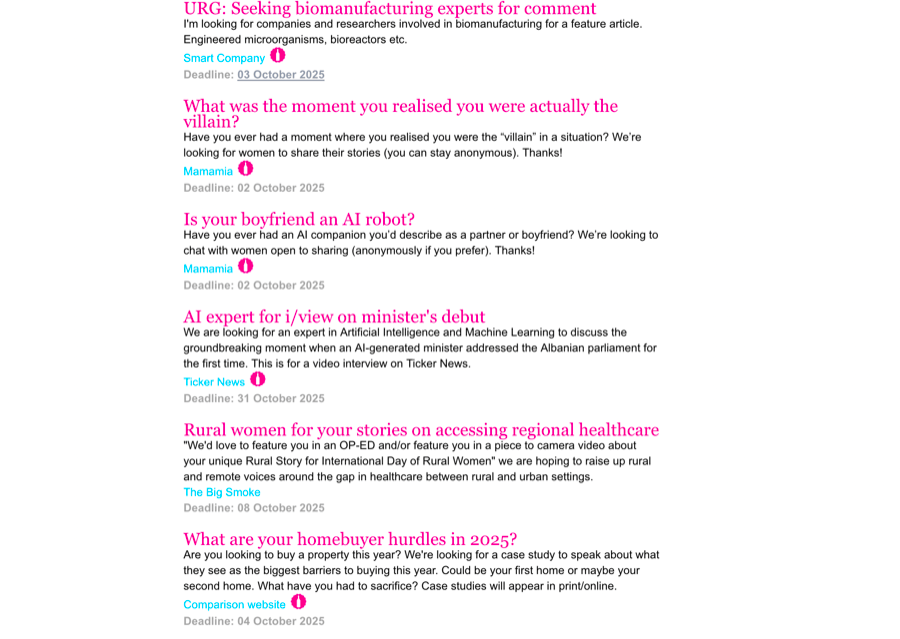
A SourceBottle daily digest: journalists posting the expert quotes and sources they need.
Here’s how these platforms work: Journalists send out requests for expert sources on specific topics. You receive email alerts (usually several times daily) with these requests. If one matches your expertise, you submit a brief pitch explaining why you’re qualified to comment and offering your insights on the topic.
If the journalist selects you, they’ll typically conduct a brief email interview or phone call. Your quotes get included in their article, often with a link back to your website and your title/company.
- Setting up your profile matters. When you join these platforms, complete your expert profile thoroughly. List your areas of expertise specifically (not just “business owner” but “small business marketing specialist” or “hospitality operations consultant”). Add credentials, qualifications, and experience. Include a professional headshot.
- Set smart alerts. You’ll get overwhelmed if you try to respond to every journalist request. Configure your alerts to match your actual expertise areas. Being selective improves your response quality and increases your chances of being selected.
- Respond quickly and thoughtfully. Journalists work on tight deadlines. Many source requests close within hours or a day. When you see a relevant request, respond promptly with a well-crafted pitch.
Your pitch should include: A clear statement of your expertise and why you’re qualified to comment. Specific insights or angles on the topic that demonstrate your knowledge. Availability for follow-up interviews. Contact information.
Provide genuine value, not just promotion. Journalists can spot promotional pitches immediately. They want expert insights that serve their readers, not thinly-veiled advertising. Focus on being genuinely helpful and educational. The backlink comes naturally as a result.
Different platforms have different focuses. SourceBottle tends to cover a wide range of Australian media from major news outlets to niche publications. Qwoted skews more toward business and trade publications. Featured offers opportunities across various industries but requires more competitive bidding for journalist requests.
The link value varies significantly. Getting quoted in The Sydney Morning Herald or The Australian delivers massive authority. Getting quoted in a small regional publication still provides value but less SEO impact. Don’t get too picky though, smaller publications are often easier to land, and multiple smaller mentions accumulate authority over time.
Treat it as a habit rather than a campaign. Consistently answering the requests that genuinely match your expertise beats sporadic bursts, though how much it returns depends heavily on your niche and how contested each request is.
Track your success. Keep a record of journalist requests you respond to, which ones result in quotes, and what articles get published. This helps you identify which types of requests you’re most successful with and where to focus your efforts.
Expect to send a lot of responses per mention landed. That is normal, and it is why this only works as a standing habit rather than something you try for a fortnight.
Keep Your Links Alive
Link building is not one-and-done. Listings go stale, businesses move, sites get redesigned and links break, so a little upkeep protects everything you have earned.
- Keep NAP identical. If your name, address or phone changes, update every listing. Inconsistent details across your profile weaken local SEO rather than help it.
- Track what you have. A simple master spreadsheet (site, listing URL, login, date) lets you update 30 listings in an afternoon instead of hunting them down.
- Audit quarterly. Check links still work and details are current, and watch Google Search Console for sudden link drops. Council and directory listings often need annual renewals; miss one and you can lose a .gov.au link.
- Reclaim brand mentions. Set a Google Alert for your business name. When someone mentions you without linking, ask politely for the link.
Backlinks, Brand Mentions and AI Search
One shift worth knowing for 2026: getting cited by AI answers (ChatGPT, Perplexity, Google’s AI Overviews) is driven less by classic backlinks and more by brand mentions, the times your business name appears across the web, linked or not.
So the digital-PR work in this guide does double duty. A journalist quote, a “best in [city]” listicle, a Reddit thread, or an unlinked write-up all feed the picture these systems build of who you are, even with no link attached.
For AI visibility, prioritise being mentioned in the right places over chasing link count. The unlinked mentions you might once have ignored are now worth earning, and worth reclaiming when you find them.
What Not to Do (Avoiding the Spam Trap)
The internet is full of terrible link building advice that can genuinely harm your business. Let’s talk about what to avoid so you don’t waste time and money on tactics that backfire.
- Mass directory submission services. You’ll see offers to submit your business to “500+ directories automatically” for a low monthly fee. These services blast your information to every garbage directory they can find, regardless of quality, relevance, or authority. The result? Hundreds of low-quality backlinks from spam sites that contribute nothing to your SEO and might actually trigger penalties.
- Private blog networks (PBNs). Some SEO agencies still offer links from networks of websites they control. These networks exist solely to sell links, which directly violates Google’s guidelines. When (not if) Google identifies the network, every site linked from it gets penalised.
- Scholarship link building schemes. Creating fake scholarship pages to attract .edu.au backlinks has been widely exposed as manipulative. Australian universities have largely wised up to it, and it sits squarely inside what Google’s link spam guidance describes as building links primarily to manipulate rankings. The short-term links aren’t worth the long-term reputation risk.
- Exact-match anchor text overuse. When all your backlinks say “Sydney plumber” or “Melbourne cafe,” it looks manipulative. Natural backlinks use varied anchor text: your brand name, generic terms like “here” or “website,” URLs, and occasional keyword-rich text. Over-optimisation with exact-match anchors can actually hurt your rankings.
- Irrelevant link exchanges. Trading links with completely unrelated businesses creates weird link graphs that search engines can detect. A plumber and a dog groomer linking to each other for no editorial reason raises red flags. Link exchanges can work in shoulder niche contexts where there’s genuine relevance, but random link swaps are pointless.
- Paying for links directly. Any service that explicitly sells backlinks (rather than selling services like PR or content that might result in links) is selling something that violates Google’s guidelines. These links get devalued when detected, and if the pattern is egregious, your site can get penalised.
- Content farms and article directories. Sites that accept unlimited submissions from anyone, with no editorial standards or quality control, provide no value. EzineArticles and similar article directories lost most of their search visibility to Google’s Panda update in February 2011, yet some businesses still waste time submitting there.
The fundamental principle: if a link building tactic feels like you’re gaming the system rather than earning links through genuine value, it’s probably a bad idea. Google’s algorithms are specifically designed to detect and devalue manipulative link building. The risk-reward ratio increasingly favours authentic tactics.
How to spot bad link building advice: Watch for promises of quick results, guaranteed rankings, or specific link quantity targets without quality discussion. Red flags include services that won’t tell you exactly where links will come from, guaranteed “high DA” backlinks with no mention of relevance, or tactics that require hiding your involvement.
The opportunity cost of bad tactics is real. Time spent on spammy directories or manipulative schemes is time you could spend on legitimate relationship building, quality content creation, or genuine community engagement that earns valuable links.
Google’s manual review team and algorithmic filters get more sophisticated annually. Tactics that worked five years ago are now the ones most likely to get devalued. The businesses that succeed long-term are the ones that focus on earning links through genuine value creation and authentic relationships.
Will Bad Links Hurt Me? (And the Disavow Question)
Here is the 2026 reality, because the older advice causes needless panic. Google now mostly ignores spammy links rather than penalising you for them, its systems devalue them automatically. John Mueller put it plainly in March 2026: “The disavow file is a tool, not a religion :-). Most sites don’t need it, but that’s not all sites” (Search Engine Journal). The exception he leaves open matters: if you or someone working for you actually bought or built the links, the disavow file is still the right tool.
So unless you have a manual action in Search Console, or you genuinely bought links you now regret, you almost certainly do not need to disavow anything. Obsessing over a “toxicity score” from a third-party tool is wasted effort.
On buying links: Australia has an open market for “guest posts”, “niche edits” and “link insertions”, often sold as “100% white-hat, DA40+ .com.au”. They are still paid links, which Google devalues, and a cluster of optimised-anchor .com.au links is exactly the footprint its systems look for. If you are going to spend, spend on PR and content that earns links, not on the links themselves.
Make Yourself Worth Linking To
Everything above is about going out and getting links. This last part is about being the kind of business that gets linked to without asking.
A genuinely useful local resource, original data from your own jobs, a proper “[service] in [city]” guide, or a simple cost breakdown, earns links from journalists, bloggers and partners on its own, and gives you something concrete to pitch. It is also the easiest link to win from the businesses you already refer customers to: ask them to add you to their “recommended” or “stockists” page, and offer the same back.
Where to Start
You do not need every tactic here. Pick the two or three that fit your business and your week.
- Tradies: council directories and senior card programs, then local sponsorships.
- Hospitality and retail: event calendars and ATDW listings alongside chamber membership.
- Professional services: SourceBottle and genuine guest posting for thought leadership.
Set a simple 90-day goal, a handful of quality directories, your local chamber, and one guest post or media mention, then build from there. The relationships you build this quarter tend to keep producing mentions after the initial one, and your competitors are building theirs either way.