
Is Yellow Pages Advertising Worth It in 2026? An Honest Answer for Australian Businesses
Most Australian businesses are wasting money on Yellow Pages. The real cost, the one exception, and where that marketing budget actually performs.

The renewal invoice has landed, or a Yellow Pages rep has called about a “package” and a “spot” you supposedly cannot afford to lose. You are trying to work out whether to keep paying or walk.
Short version: for most Australian businesses, paid Yellow Pages advertising is no longer worth the money. The audience left, the pricing is hidden behind a sales call, and you cannot properly measure what comes back. There is one narrow exception, and I will be straight about it. But if you are paying real money to Yellow Pages to win customers, that budget is almost certainly working harder somewhere else.
Here is the cost reality, the one situation where a listing still helps, and where the money should actually go.
The short answer, and the one exception
- Paid Yellow Pages advertising: not worth it for the large majority of Australian businesses.
- A free Yellow Pages listing: worth claiming once, purely as a citation that supports local search.
- A well-run Google Business Profile plus targeted local SEO will out-perform paid Yellow Pages for almost every local business.
- Put bluntly: for most small business owners, paid Yellow Pages is the most expensive and least measurable channel they own.
That is the verdict. The rest is the evidence.
What Yellow Pages advertising actually costs in 2026
Start with the warning sign. Yellow Pages does not publish the price of its main advertising tiers. To get a number you have to talk to a salesperson. Any channel that will not show you a price until it has you on the phone is telling you something already.
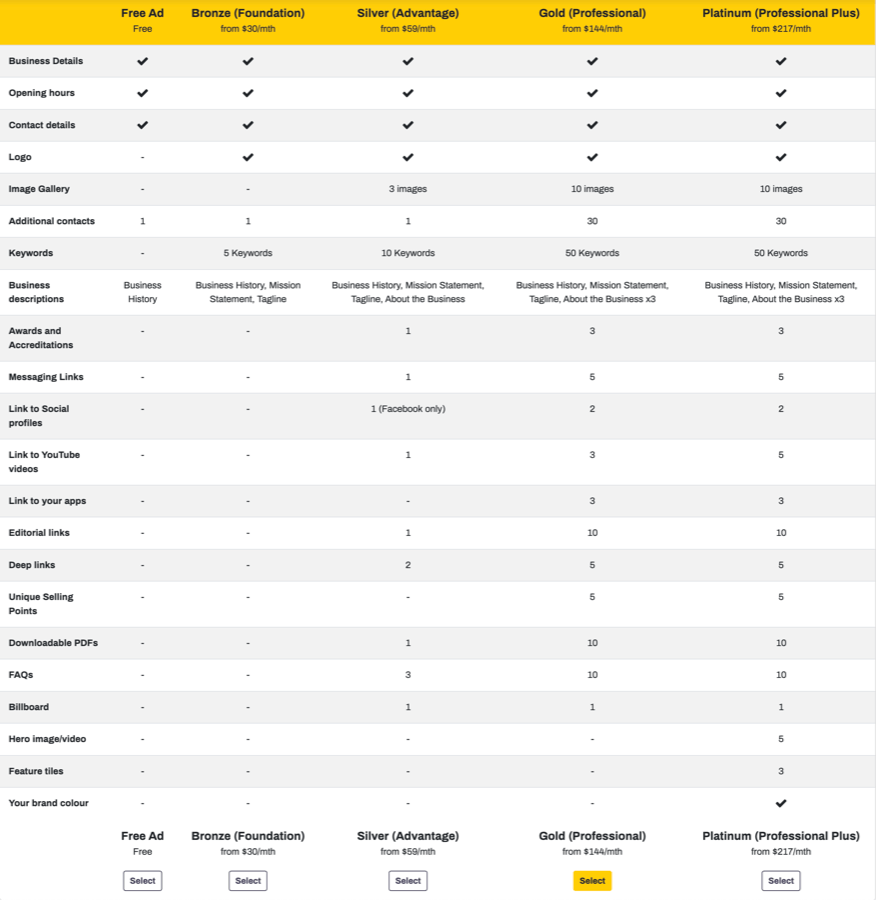
What Yellow does publish gives you the shape of the commitment. Its managed website plans are advertised from $59, $79 and $99 per month, each with a one-off setup fee of $999, $1,199 or $3,999, on a stated minimum period of 12 months, continuing at the latest price after that until you cancel, with cancellation fees if you leave early (yellow.com.au, as at July 2026, and unchanged in archived captures back to December 2020). Worth knowing that the 12 months is a product-page term rather than a universal one: Thryv Australia’s customer terms dated 2 April 2025 set 6 months as the minimum period for websites, SEO and social “unless Your Order says otherwise”, and 12 months for print products, bundles and Connect. Your order is what binds you, which is the whole reason to read it. The advertising packages themselves sit behind a sales call, and the published terms above tell you the shape to expect: a recurring fee, a minimum period, and a cost to get out.
| What you are buying | Headline cost | The catch |
|---|---|---|
| Free listing | $0 | Genuinely free, limited value |
| Managed website plans | $59 to $99 per month | Plus $999 to $3,999 setup, 12-month minimum, cancellation fees |
| Online advertising packages | Not published | Quote only. Thryv’s published terms set a minimum period of 6 or 12 months depending on the product |
| Google Business Profile | $0 | None. Free, and you control it |
The exact dollar figure is not really the point. The point is you are being asked to sign a contract for a channel that will not be upfront about price.
The real problem: you cannot measure it
Cost is only half of it. The bigger issue is what you can see for the money.
With a Google Business Profile or a Google Ads campaign, you can see calls, direction requests, clicks, conversions and cost per enquiry, close to real time. You can turn spend up, down or off based on what the numbers say.
Yellow does offer call tracking and reporting, so this is not a case of no data at all. It is a case of data with the limits written into the contract. Thryv’s own customer terms state that “reports we provide to you may not contain complete data for the reporting period”, that “we may not be able to report on Product performance on Third Party Sites as this depends on data from third parties”, and that it cannot give you “the full phone number of the originating call to the Tracked Number”. Calls it deems not to be genuine business calls are excluded, and the data it does give you is licensed for internal analysis only. Compare that with a conversion you can trace end to end in your own analytics.
Picture a plumber paying a few hundred dollars a month through Yellow. Ask them at the end of a quarter which jobs came from that spend and they cannot tell you. Run the same business through a properly set up Google Business Profile, the kind of setup our local SEO for plumbers starts with, and every call and direction request is logged. One you can defend to yourself. The other you are paying for on faith.
If a rep has told you that cancelling means losing your “spot”, ask them to put the measurable enquiries that spot has produced in writing. Insist on the number of enquiries, not the impression count.
Yellow Pages vs Google Business Profile vs Google Ads
Google Search is where Australians look for local businesses. The ACCC’s Digital Platform Services Inquiry found Google held nearly 94 per cent of the Australian general search market as at August 2024. That lead has eased rather than ended: StatCounter puts Google at roughly 88 per cent of Australian search in 2026, with Bing around 9 per cent. Either way, Yellow Pages is not really competing with other directories any more. It is competing with Google, and a free Google Business Profile already does more than a paid Yellow listing.
| Factor | Yellow Pages advertising | Google Business Profile | Google Ads |
|---|---|---|---|
| Audience reach | Declining directory audience | The ~88% of Australian searches on Google | The same Google audience, on demand |
| Targeting | Industry and location category | Local intent and proximity | Keyword, location, device, intent |
| Cost structure | Fixed fee, lock-in | Free | Pay per click, fully controllable |
| Measurability | Very limited | Calls, directions, clicks tracked | Full conversion and cost-per-lead data |
| Flexibility | Contract, hard to exit | Edit any time | Pause or adjust any time |
In my experience even a Facebook ad set, for all its own issues, hands back more granular reporting than a Yellow package’s monthly summary. Optimise your Google Business Profile properly, support it with Google Maps SEO, and you get more visibility, more measurable actions, and full control, for nothing close to the cost of a Yellow contract.
How Yellow Pages got here, briefly
This is context, not nostalgia. Print directory demand collapsed years ago. When Sensis moved the residential White Pages to opt-in in Sydney and Melbourne in 2011, the print run in each city fell from almost 1.4 million copies to 165,000 (AAP, 18 May 2011). By the end of 2013, a Sensis spokesman put actual requests at 26,000 copies a year in Melbourne and 20,000 in Sydney. Do that arithmetic against 1.4 million and you have the shape of it. Even where the book still landed on doorsteps unrequested, the ABC reported in 2017 that just 36 per cent of Australians had used a phone book in the previous 12 months.

In 2021, Sensis was acquired by US software company Thryv Holdings from Platinum Equity and Telstra. The deal closed on 1 March 2021, and Thryv’s own announcement put the price at approximately US$200 million in cash. The business was renamed Thryv Australia six months later, in September 2021. The Yellow and White Pages brands stayed, but the commercial focus shifted towards subscription software. If what you are offered is broader than the listing you asked about, ask for the itemised terms in writing before you agree to anything.
The one time a Yellow Pages listing still helps
Here is the exception, and I mean it. A free Yellow Pages listing still has minor value as a citation. A citation is just a consistent mention of your business name, address and phone number on a recognised directory. Search engines use these to help confirm a business is real and located where it claims to be, which can lightly support local rankings.
So claim the free listing, fill it in accurately, and make the details match everywhere else. That is a NAP consistency task and it is a one-off. One brick in the foundation, not the house. Beyond the free listing, the paid case does not stack up for most businesses.
Where that budget should actually go
Free up a Yellow Pages spend and the highest-return home for it is usually:
- A fully optimised Google Business Profile, monitored properly.
- Local SEO targeting the searches your customers actually use.
- Google Ads for immediate, high-intent demand while the organic work compounds.
This is the work we do at Search Scope. I have been in SEO since 2013, and the pattern barely changes: businesses paying for directory advertising are nearly always sitting on cheaper, more measurable growth inside Google itself. If you run a local operation, our approach to SEO for Perth businesses and beyond is built around enquiries you can track, not directory impressions you cannot.
Already locked in and want out? Your rights as an Australian business
Most advice on Yellow Pages answers “should I buy it”. The harder question, and the one that fills small-business forums, is “I’m trapped in a contract I regret, what can I actually do”. You have more leverage than the renewal letter suggests.
Start with the precedent. In May 2017 the ACCC accepted a court-enforceable undertaking from Sensis, the entity that traded the Yellow and White Pages brands before it was renamed Thryv Australia, following what the regulator described as “a large number of complaints from small business customers” about exactly this. The ACCC’s finding was that between at least January 2015 and August 2016, Sensis failed to adequately disclose that bundled packages automatically renewed for a further 12 months, and that customers could be charged a cancellation fee equal to the remaining cost of the contract. Sensis acknowledged the conduct may have contravened the Australian Consumer Law and undertook to refund affected customers, publish a corrective notice and amend the terms (ACCC). This was an undertaking, not a court finding or a penalty. You can name that history in a dispute. It establishes that these practices have already drawn regulator action.
A few things worth knowing before you sign anything, or fight anything:
- What you understood and what the contract says can differ. That gap is precisely what the ACCC’s 2017 undertaking was about. So whatever is said on a sales call, do not agree to anything on the call itself. Ask for the full terms in writing, read the auto-renewal and cancellation clauses, and only commit on paper. If you are already in dispute, ask in writing for a copy of any call recording being relied on, along with the signed order.
- Misleading promises are not just annoying, they may be unlawful. If you were signed up on the back of claims that did not hold up, the Australian Consumer Law prohibits misleading or deceptive conduct. That is the same law the ACCC applied to Sensis.
If you are stuck, escalate in this order:
- Complain to the provider in writing, citing the specific term you say is unfair or was not disclosed, and ask for cancellation or a refund.
- The ACCC, for unfair contract terms and misleading conduct. It will not resolve your individual contract, but reports drive enforcement and the site explains your rights.
- The Australian Small Business and Family Enterprise Ombudsman (ASBFEO), which is the right body for a business-to-business dispute. It offers low-cost dispute support and mediation. Information line 1300 650 460.
- Your state or territory fair trading / consumer affairs office, and small claims tribunal as a last resort.
If you are billed after cancelling, or threatened with debt collection: do not pay a “settlement” just to make it stop. Put your cancellation and dispute in writing, keep every dated record, and if a default is lodged on your credit file, dispute it (credit reporting rules require proper notice). Then take it to ASBFEO or fair trading. A common trap is cancelling the print listing but not the separate online or software subscription, which keeps auto-renewing, so confirm in writing that every product is cancelled, not just one.
How to exit a Yellow Pages or Thryv contract
If you decide to leave, do it in a controlled way:
- Check the contract for the minimum term and any cancellation fees before you do anything.
- Cancel in writing and keep a dated copy. Thryv’s terms say you can cancel “by writing, email or phone” and it will be actioned within 14 days, with White Pages Connect the exception at 30 days. Cancelling inside a minimum period still triggers a cancellation fee equal to the remaining price for that period.
- Diarise the renewal date so you are not auto-continued at the latest price.
- Protect your website, domain and Google profile first. This is the step most people miss. Thryv’s own FAQ states that if you cancel the Thryv subscription any time after your initial contract term, it is taken down “including any features associated such as your website”, with a 60-business-day window to reactivate before content is lost (Thryv). Before you cancel: confirm your domain name is registered in your own name (not the provider’s), export or copy all your website content, and make sure you, not the agency, hold owner access to your Google Business Profile and social accounts. If any of those sit under the provider, sort it out before you give notice.
- Set up the replacement first. Get the Google Business Profile optimised before the Yellow listing lapses, so there is no visibility gap.
- Keep all correspondence in case of a billing dispute.
Is the bill even real? Watch for Yellow Pages look-alikes
Worth a quick reality check, because two very different things can land in your inbox. One is a legitimate (if aggressive) Thryv or Yellow invoice for a service you signed up to. The other is an outright scam: fake “directory” operators that copy the Yellow Pages name and walking-fingers logo and send unsolicited invoices, often around $99 a month on a multi-year lock-in, to trick businesses into paying for a listing they never ordered. The ACCC has prosecuted exactly this. In April 2011 the Federal Court imposed $2.7 million in penalties against two overseas companies running a fake “Yellow Pages” directory scam, and the court declared they were in no way affiliated with Sensis (ACCC). The regulator warned about the same racket again in 2013, when the fax on offer was an agreement charged at “$99 per month for a minimum two-year period”. These are third-party imitators, not Yellow Pages itself.
So before you pay any directory invoice you do not recognise: do not call the number printed on it. Verify the sender independently, check whether you actually have a current agreement, and treat any out-of-the-blue “confirm your details” form as a contract until you have read the fine print. The real Yellow Pages will not send you a renewal, by any channel, for something you never agreed to.
FAQ
How much does Yellow Pages advertising cost in Australia?
Yellow does not publish its advertising tier prices, so you only get a figure through a sales call. Its managed website plans are advertised from $59 to $99 per month plus setup fees of $999 to $3,999 on a stated 12-month minimum period (yellow.com.au, as at July 2026), which tells you how the contracts are structured.
Is the free Yellow Pages listing worth keeping?
Yes, as a one-off. It works as a basic citation that supports local search, as long as the details match your other listings exactly. It is not a lead source.
How do I cancel a Yellow Pages or Thryv contract?
Cancel in writing, keep a dated copy, and check the minimum period and cancellation fees first. Thryv’s terms say cancellations are actioned within 14 days, or 30 days for White Pages Connect. Before you cancel, confirm your domain and Google profile are in your own name, because Thryv’s FAQ says the subscription and any website attached to it are taken down when you cancel after the initial term.
I think I was locked into an unfair contract. What can I do?
You have options. Complain to the provider in writing first, citing the term you say is unfair or was not disclosed. If that fails, the ACCC handles unfair contract terms and misleading conduct, and the Australian Small Business and Family Enterprise Ombudsman (ASBFEO, 1300 650 460) provides low-cost dispute support for business-to-business disputes. The ACCC has acted against these practices before, accepting an enforceable undertaking from Sensis in 2017 over auto-renewal and cancellation terms.
I keep getting a Yellow Pages invoice I don’t recognise. Is it a scam?
It might be. Fake “directory” operators copy the Yellow Pages name and logo and send unsolicited invoices for listings you never ordered. Do not call the number on the invoice. Verify the sender independently and check whether you actually hold a current agreement. The real Yellow Pages will not send you a renewal for something you never signed up to.
Is Yellow Pages still worth it in 2026?
For most Australian businesses, no. The paid product is expensive, contract-bound and hard to measure against, while Google takes roughly 88 per cent of Australian searches.
Yellow Pages or Google, which wins for a local business?
Google, clearly. A free Google Business Profile reaches more people, gives you measurable actions and full control. A paid Yellow Pages listing does none of that.
The honest bottom line
Yellow Pages was the default once. It is not now. The paid product is costly, tied to a minimum period, quiet about the price of its advertising tiers, and reported on under terms that admit the data may be incomplete, while the audience has moved to a search engine a free Google Business Profile already plugs you into.
Keep the free listing for citation hygiene. Put the real money where you can see what it returns.
If you want a straight answer on where your marketing spend should go, or email seo@searchscope.com.au. No lock-in contracts, no agency theatre, just a clear plan for enquiries you can actually measure.