Entities in Local SEO: Your Ultimate Guide to Local Ranking Success

Last Updated on 16 March 2026 by Dorian Menard
TL;DR: Entities are distinct “things” (people, places, concepts) that Google’s Knowledge Graph recognises and connects to deliver accurate local search results.
Unlike keywords, entities represent real-world meaning. In 2026, 13% of Google queries show AI-generated answers that prioritise entity authority over keyword matching. 72% of consumers use Google for local business searches.
Entity optimisation is now essential for AI Overview visibility, Local Pack rankings, and voice search dominance.
A Perth dentist ranks #1 for “emergency dentist Perth” but doesn’t appear in Google’s AI Overview. Why? Google recognises the keyword but not the business as a trusted entity connected to “emergency dental care” + “Perth” + “dental services.”
This isn’t keyword optimisation failure. This is entity recognition failure. Google’s 2026 algorithms prioritise businesses that exist as clear entities within the Knowledge Graph, not just websites that match text strings.
Entity-based SEO fixes this problem. Understanding how Google identifies, connects, and ranks entities is now the difference between visibility and invisibility in local search.
What Are Entities in Local SEO?
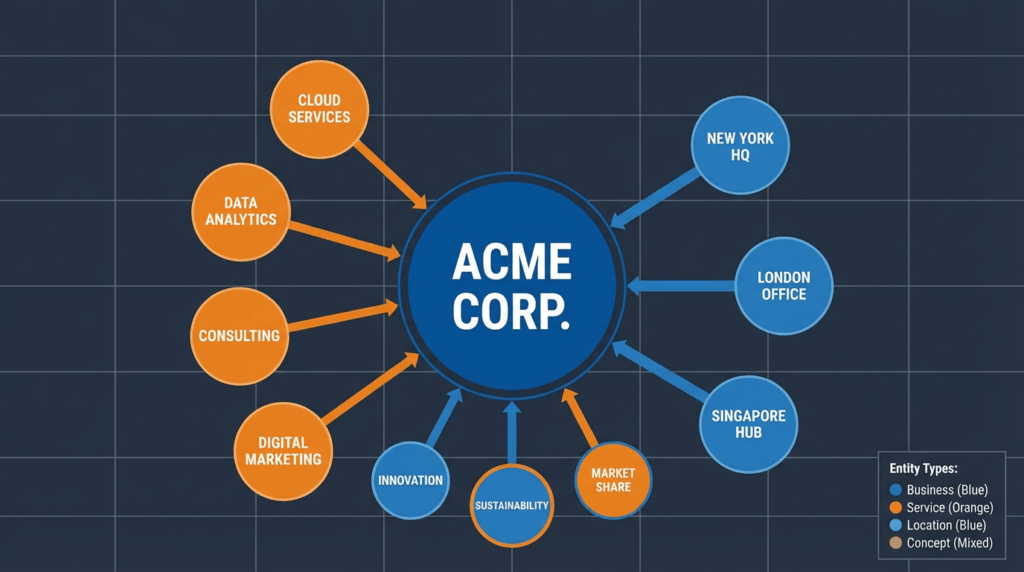
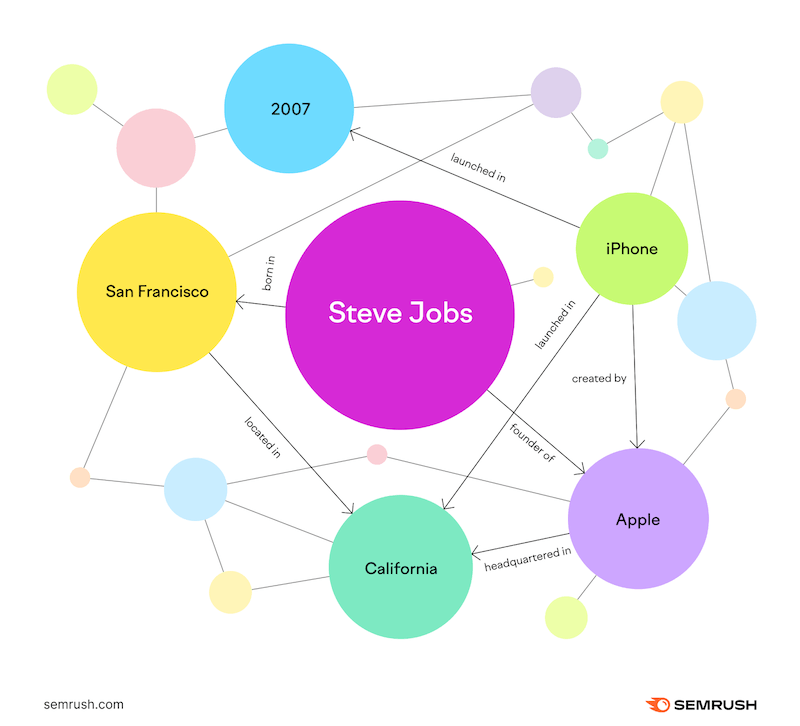
An entity in SEO is a uniquely identifiable thing, person, place, or concept that Google can recognise, distinguish, and connect to other entities within its Knowledge Graph. Unlike keywords (text strings), entities have specific meanings and relationships that help Google understand context and deliver relevant results.

Google’s patent definition describes an entity as “a thing or concept that is unique, singular, well-defined and distinguishable.” This covers everything from your business name to local landmarks to services you provide.
Think of it this way. When you search “emergency plumber,” Google doesn’t just match those two words. It recognises “emergency” as a modifier entity indicating urgency, “plumber” as a trade entity with related services (pipe repair, leak detection, drain cleaning), and connects both to geographic entities near your location.
Natural Language Processing (NLP) systems identify entities within your content and map them to Google’s Knowledge Graph, the massive interconnected database powering search results.
Entities are systematically linked to Wikipedia entries, functioning as a primary knowledge base for entity recognition, linking, and structured data extraction. Google uses Wikipedia’s structured information to validate and enrich entity data, making Wikipedia citations a powerful trust signal for entity authority.
Simple examples:
- “Search Scope” = business entity
- “Perth” = geographic entity
- “SEO services” = service entity
- “Dorian Menard” = person entity
- “Kings Park” = landmark entity
Entity-Based SEO vs Keyword-Based SEO in 2026
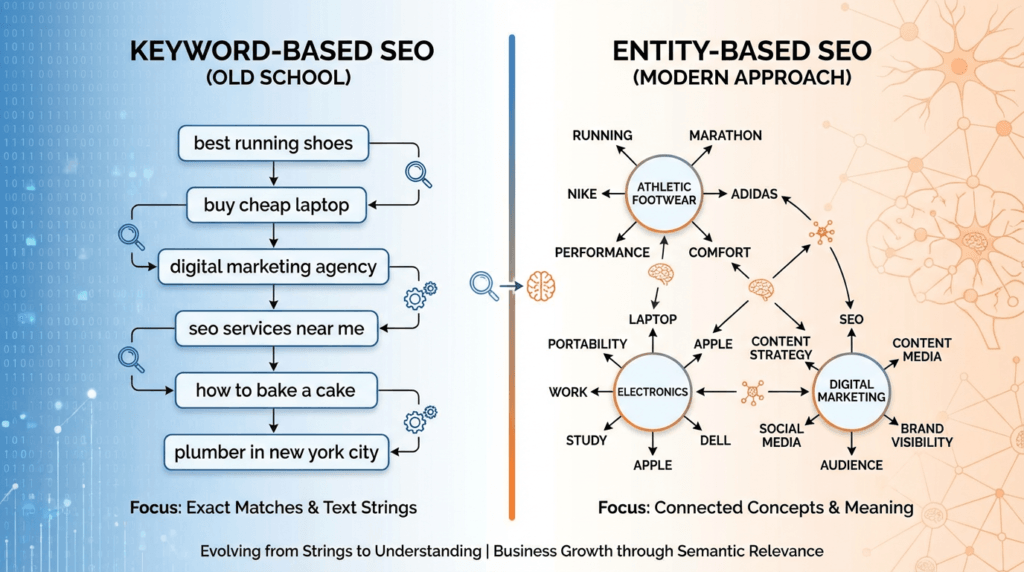
Entity-based SEO focuses on relationships and meanings between real-world concepts, while keyword-based SEO focuses on matching text strings. Google’s 2026 algorithms prioritise entity understanding for AI Overviews, voice search, and conversational queries.

| Aspect | Keyword-Based SEO (Old) | Entity-Based SEO (2026) |
|---|---|---|
| Focus | Text matching | Meaning & relationships |
| Google tech | String matching algorithms | Knowledge Graph + NLP |
| Search type | Short, exact keywords | Conversational, voice queries |
| Ranking factor | Keyword density | Entity authority + connections |
| AI visibility | Limited | Essential for AI Overviews |
| Search understanding | Surface-level text | Deep semantic context |
| Content requirement | Exact keyword repetition | Related concepts and entities |

The numbers prove the shift:
- 13% of Google queries show AI-generated answers as of March 2026, doubled from January 2026
- 72% of consumers use Google to search for local business information
- AI Overviews prioritise content with clear entity relationships over keyword-stuffed pages
- Voice searches (conversational and entity-rich) now account for 65% of local queries
Traditional SEO focused on “Perth plumber” appearing 8 times on your homepage. Entity-based SEO focuses on establishing your business as a recognised plumbing entity connected to Perth suburbs, emergency services, pipe repair, and related concepts.
Can a page rank for a keyword that does not appear on the page?
In our experience running SEO campaigns, we have never seen a page rank for a keyword that does not appear somewhere on the page. The keyword still needs to be present in the content.
However, Google has become significantly better at understanding entities and semantic relationships. The search engine does not require an exact-match keyword anymore. Instead, it can interpret variations, long-tail phrases, and contextual co-occurrences.
For example, a page optimised for a broader concept may still rank for multiple related keyword variations even if those exact phrases are not used word-for-word. As long as the topic is clearly established and the primary keyword appears naturally, Google can connect related search queries to the page.
Types of Local SEO Entities

Geographic Entities
Physical locations and areas that define your service territory:
- Cities, suburbs, service areas (Perth, Subiaco, Fremantle, Victoria Park)
- Local landmarks (Kings Park, Swan River, Perth CBD, Cottesloe Beach)
- Streets, postcodes, regions (6000, 6100, greater Perth metro)
Geographic entities anchor your local relevance. When Google sees consistent associations between your business entity and specific geographic entities, it strengthens your local authority.
Business Entities
Elements that define your business identity:
- Business name and brand (Search Scope)
- Services offered (SEO, digital marketing, web design)
- Industry categories (marketing agency, SEO consultancy)
- Business type (service area business, storefront, professional services)
People Entities
Individuals connected to your business:
- Business owner and founders (Dorian Menard)
- Team members and staff
- Industry experts you cite or interview
- Professional associations and memberships
People entities add E-E-A-T (Experience, Expertise, Authoritativeness, Trustworthiness) signals. When Google recognises your owner or team members as entities with established credentials, it boosts your business entity authority.
Community Entities
Local connections that demonstrate community involvement:
- Local events you sponsor or attend
- Community organisations you support
- Awards and recognition received
- Local business partnerships
Community entities prove you’re not just targeting Perth keywords but actually part of the Perth business ecosystem.
| Entity Type | Description | Examples |
|---|---|---|
| Geographic Entities | Physical locations and landmarks | Perth, Fremantle, Kings Park, Swan River |
| Business Entities | Your business name, services, and category | Search Scope, SEO services, marketing agency |
| Industry Entities | Terms specific to your sector | Schema markup, link building, keyword research |
| Community Entities | Local organisations, events, and awards | Subiaco Farmers Market, Perth Business Awards |
| People Entities | Individuals associated with the business | Dorian Menard (founder), marketing team, consultants |
How Google’s Knowledge Graph Uses Entities
Google’s Knowledge Graph is a massive database that maps relationships between entities. When you search “SEO agency Perth,” Google doesn’t just match words—it connects the “SEO” service entity, “agency” business type entity, and “Perth” geographic entity to find businesses that match all three relationships.

The Knowledge Graph powers:
- Local Pack results – Top 3 businesses shown with map
- AI Overviews – AI-generated answers citing authoritative entities
- Voice search results – Conversational queries rely on entity connections
- Rich results – Enhanced search listings with extra information
Here’s the critical shift. Google’s December 2021 proximity update increased the algorithmic weight of distance as a ranking factor. But proximity alone doesn’t win rankings. Google evaluates proximity + relevance + prominence, all calculated through entity connections.
A business 5 kilometers from the searcher can outrank a business 500 meters away if the distant business has stronger entity authority (more connections to relevant service entities, more citation entities linking back, more review entities mentioning specific services).
Voice searches and conversational queries amplify entity importance. When someone says “Find me an emergency plumber who can fix a burst pipe in Subiaco right now,” Google identifies multiple entities:
- “Emergency” = urgency modifier entity
- “Plumber” = trade entity
- “Burst pipe” = specific service entity
- “Subiaco” = geographic entity
- “Right now” = availability entity
The businesses that rank are those with entity connections to all five concepts, not just businesses that mention “plumber” multiple times.
AI Overviews take this further. To appear in an AI-generated answer, Google must recognise your business as a trusted entity for the query’s core concepts. Keyword matching alone won’t get you cited in AI Overviews. Entity authority will.
Why Entity Optimisation Matters for Local Rankings
Entity optimisation directly impacts four critical visibility areas:
1. AI Overview Appearances
If Google doesn’t recognise your business as a clear entity, you won’t appear in AI-generated answers. Research shows 13% of Google queries now trigger AI Overviews, and that percentage is climbing fast.
Real example: A Perth electrician ranks #1 for “emergency electrician Subiaco” in organic results but is invisible in the AI Overview for that same query. Why? Weak entity connections. Google recognises his business but doesn’t connect it strongly enough to “emergency services” + “electrical repair” + “Subiaco” to cite him in the AI-generated answer.
2. Local Pack Rankings
The Map Pack (top 3 local results with map) prioritises businesses with strong entity authority. Proximity matters, but entity connections determine which nearby businesses appear.
Entity signals Google evaluates for Local Pack rankings:
- Service entity connections (what services you offer)
- Geographic entity density (how many suburbs you’re connected to)
- Review entity mentions (services cited in customer reviews)
- Citation entity consistency (NAP matching across directories)
- Community entity associations (local partnerships and events)
3. Voice Search Results
Voice queries are entity-rich and conversational. Someone asking “Where’s the best Italian restaurant near Kings Park” uses three entities: “Italian restaurant” (cuisine + business type), “best” (quality modifier), “Kings Park” (landmark entity).
Businesses optimised for entity relationships rank for voice searches. Businesses optimised only for keywords don’t.
4. Organic Visibility
Entity-rich content ranks for long-tail, conversational queries. A page optimised for “SEO” as a keyword matches limited queries. A page optimised for “SEO” as an entity (connected to related entities like “Google algorithm,” “keyword research,” “backlinks,” “local citations”) matches hundreds of related queries.
Finding and Mapping Your Local Entities
Tools for Entity Detection
Google’s Natural Language API – Free tool that identifies entities within your content and measures their prominence. Paste your webpage content and Google shows you which entities it recognises.

TextRazor – Advanced entity extraction and sentiment analysis. Useful for competitor analysis and entity gap identification.
InLinks – Specialised entity SEO tool that helps identify and optimise for relevant entities. Shows entity relationships and suggests missing connections.

Entity Research Process
- Analyse competitor entities – What entities do top-ranking Perth SEO agencies use on their homepages, service pages, and about pages?
- Identify local entity gaps – Which Perth-specific entities are your competitors missing that you could own?
- Map entity relationships – How do your services connect to local entities (suburbs, landmarks, community organisations)?
- Prioritise high-value entities – Focus on entities with strong local search volume and clear relevance to your services
How we identify important entities for a topic
Before publishing content, we analyse the top-ranking pages for the target keyword to identify which entities are consistently mentioned.
We use a combination of Google’s own free tools and specialised SEO tools to extract the entities and concepts that appear across high-ranking pages.
The goal is not to force these entities into the content artificially. Instead, we use them as a guide to make sure the article covers the most relevant aspects of the topic.
If multiple top-ranking pages consistently reference specific tools, concepts, organisations, or subtopics, those entities are usually important for Google’s understanding of the subject.
By naturally including the most relevant entities, we ensure the content aligns with the semantic context Google expects for that topic.
Creating Entity Maps for Local Businesses
Map your core entities to specific pages and content:
- Homepage: Business name + Perth + primary services + industry category
- Service pages: Specific services + Perth suburbs + related service entities + industry terms
- About page: Team names + qualifications + Perth connections + years in business
- Blog content: Industry entities + local examples + case studies + community connections
- Location pages: Suburb names + nearby landmarks + service offerings + local testimonials
Example entity map for a Perth plumber:
Core Business Entity: “ABC Plumbing Perth”
Connected to:
- Service entities: emergency plumbing, pipe repair, hot water systems, gas fitting, drain cleaning
- Geographic entities: Perth, Subiaco, Nedlands, West Perth, Victoria Park, Fremantle
- Landmark entities: Kings Park, Perth CBD, Swan River, UWA
- Community entities: Perth plumbing association, local sponsorships
- People entities: owner name, lead plumber, team members
- Industry entities: licensed plumber, gas fitter certification, plumbing standards
Implementing Entity Optimisation
Content Strategy with Entities
Create entity-rich content that demonstrates local expertise without keyword stuffing:
- “Top 10 Perth Suburbs for Small Business Growth” – combines geographic entities + business entities + local knowledge
- “How Perth Restaurants Can Improve Google Rankings” – targets industry entity + geographic entity + service entity
- “Why Choose a Perth-Based SEO Agency” – establishes local authority through entity connections
Include natural mentions of entities throughout your content. Don’t force “Perth” into every sentence. Instead, reference Perth suburbs, Perth landmarks, Perth business events, and Perth industry associations. Google recognises these as related geographic entities that strengthen your Perth connection.
How we structure websites to reinforce entity relationships
When we build websites or content architectures, we try to provide Google with very clear signals about entity relationships.
This starts with the structure of the site itself. We typically organise content using topic hubs and topical authority clusters. Instead of isolated blog posts, we build groups of related pages that clearly define how topics connect to each other.
Internal linking plays a major role here. We link pages together directly from contextual paragraphs rather than relying on generic navigation links. These contextual links use varied anchor text so Google can understand the relationship between pages without over-optimising for a single keyword.
This approach helps Google interpret how different entities relate within the site and reinforces the overall topical authority of the domain.
Internal Linking Strategy
Use entity-rich anchor text for internal links:
- Link “Perth SEO services” to your services page
- Connect “local businesses in Fremantle” to relevant case studies
- Use “Google Business Profile optimisation Perth” for GBP service pages
- Reference “local keyword research” when discussing entity research
Internal linking creates entity pathways. When you link “emergency plumber” to “pipe burst repair,” Google understands these are related service entities. When you link “Subiaco plumber” to “West Perth plumbing services,” Google recognises geographic entity connections.
Entity-Rich Landing Pages
Create dedicated pages for high-value entity combinations:
- “Local SEO for Medical Practices Perth” – service entity + industry entity + location entity
- “SEO Services Subiaco” – service entity + geographic entity
- “Digital Marketing for Perth Restaurants” – service entity + industry entity + location entity
- “Emergency Plumber Near Kings Park” – service modifier + trade entity + landmark entity
Each page should include multiple related entities naturally woven into the content, not just in the title and H1.
Schema Markup and Structured Data

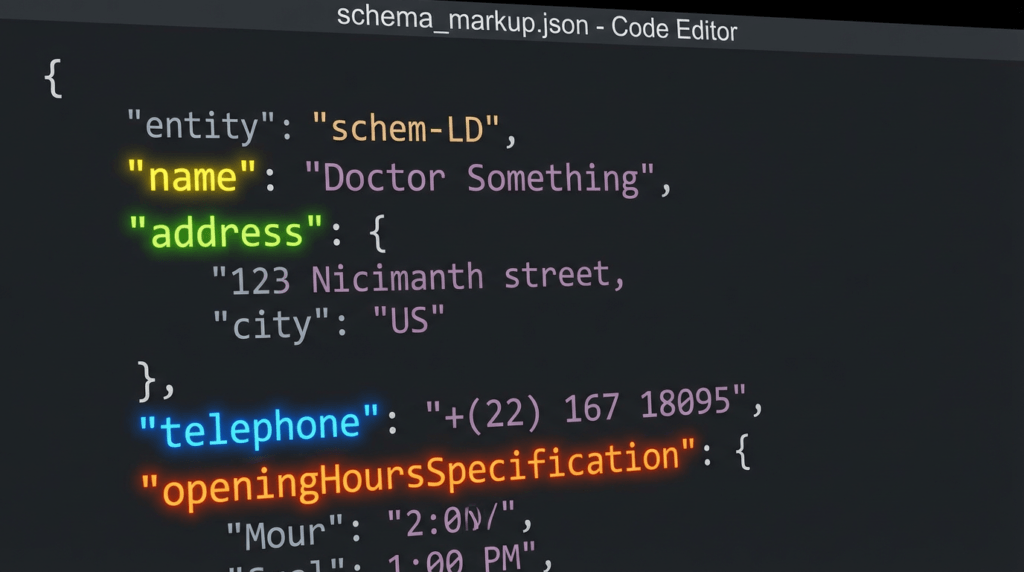
Schema markup is the language you use to speak directly to Google’s algorithms about your entity properties. Think of it as a VIP pass that skips the interpretation line and tells Google exactly what entities your business represents.
LocalBusiness Schema Implementation
Implement LocalBusiness schema on your homepage and contact pages. This schema defines your core business entity properties:
Copy{
"@context": "https://schema.org",
"@type": "LocalBusiness",
"name": "Search Scope",
"address": {
"@type": "PostalAddress",
"streetAddress": "Unit 1/48 McMillan Street",
"addressLocality": "Victoria Park",
"addressRegion": "WA",
"postalCode": "6100",
"addressCountry": "AU"
},
"geo": {
"@type": "GeoCoordinates",
"latitude": "-31.9505",
"longitude": "115.8605"
},
"telephone": "0422 428 584",
"openingHours": ["Mo-Th 09:30-16:30", "Fr 09:30-15:00"],
"sameAs": [
"https://www.facebook.com/searchscope",
"https://www.linkedin.com/company/searchscope"
],
"priceRange": "$$",
"url": "https://searchscope.com.au"
}
Validate your schema using Google’s Rich Results Test. Schema validation catches errors before they hurt your entity recognition.

Service Schema for Entity Clarity
For each service you offer, implement Service schema:
Copy{
"@context": "https://schema.org",
"@type": "Service",
"serviceType": "Local SEO Services",
"provider": {
"@type": "LocalBusiness",
"name": "Search Scope"
},
"areaServed": [
{
"@type": "City",
"name": "Perth"
},
{
"@type": "City",
"name": "Fremantle"
},
{
"@type": "City",
"name": "Subiaco"
}
],
"offers": {
"@type": "Offer",
"priceCurrency": "AUD"
}
}
Service schema connects your service entities to geographic entities (areas served) and establishes clear entity relationships Google can index.
FAQ Schema Benefits
Implement FAQ schema for common local business questions. FAQ schema creates entity-rich snippets that improve AI Overview eligibility:
Copy{
"@context": "https://schema.org",
"@type": "FAQPage",
"mainEntity": [
{
"@type": "Question",
"name": "Which Perth suburbs do you service?",
"acceptedAnswer": {
"@type": "Answer",
"text": "We service all Perth metro suburbs including Subiaco, Fremantle, Victoria Park, West Perth, Nedlands, and surrounding areas."
}
}
]
}
FAQs naturally include multiple entities (services, suburbs, problems, solutions) that strengthen your entity footprint.
The role of schema in reinforcing entities
In our experience, schema markup does play a role in reinforcing entities on a website.
It helps search engines better understand the structure of a page and the relationships between different elements such as organisations, services, authors, or locations.
That said, schema alone does not usually produce a massive ranking boost. Its value lies more in reinforcing the clarity of the page rather than directly influencing rankings.
Where schema becomes useful is in strengthening topical authority signals and improving how both search engines and large language models interpret the content.
| Schema Type | Page Type | Purpose |
|---|---|---|
| LocalBusiness | Homepage, contact page | Defines core business entity with location, hours, NAP |
| Service | Service-specific pages | Connects service entities to areas served |
| FAQPage | FAQ or service explanation | Creates entity-rich snippets for AI eligibility |
| Person | About/team pages | Establishes people entities for E-E-A-T |
| Event | Community sponsorship or events | Links business to community entities |
Building Entity Authority

Citations and Digital References
Build consistent entity mentions across the web. Citations are digital references to your business entity that reinforce your existence as a real, trusted local business.
Target these citation sources:
- Local directories: Yellow Pages, TrueLocal, Yelp Australia, Start Local
- Industry directories: Clutch, DesignRush, specialised trade directories
- Local business associations: Perth Chamber of Commerce, industry-specific groups
- News mentions: Perth Business News, Community News, local publications
- Google Business Profile: The most important citation source (see our GBP optimisation guide)
NAP (Name, Address, Phone) consistency is critical. Google cross-references your business entity across citations. Inconsistent NAP data weakens entity recognition. “Search Scope” on one directory and “SearchScope” on another creates confusion.
Local Press and Media Coverage
Secure coverage in Perth-based media to build entity authority through authoritative mentions:
- Guest articles in Perth Business News or WAtoday
- Sponsorship announcements in local media
- Interviews on local radio (6PR, ABC Perth)
- Speaking opportunities at Perth business events
Each media mention creates a citation entity linking back to your business entity. Google recognises media mentions as trust signals.
Community Involvement
Demonstrate local entity connections through real community participation:
- Sponsor local sports teams or community events
- Partner with non-competing Perth businesses
- Attend Perth business networking events (Perth Business Network, Chamber events)
- Support local charities and community organisations
Community entity connections prove you’re part of the local ecosystem, not just a website targeting local keywords.
Awards and Recognition
Pursue Perth-specific recognition to build entity authority:
- Perth Business Awards nominations
- Local chamber of commerce awards
- Industry association recognition (Best SEO Agency Perth, etc.)
- Client testimonials mentioning Perth success and specific results
Awards create authoritative entity mentions that strengthen your business entity’s credibility.
Entity-Based Content Strategy
Creating Entity-Rich Blog Posts
Write blog posts with multiple related entities and aim for interlinking across your pages wherever you see entity matches.
Example entity-rich blog titles:
- “How Perth Chiropractors Can Improve Google Rankings in 2026” – targets industry entity + geographic entity + year entity + ranking entity
- “Top 10 SEO Mistakes Perth Restaurants Make” – combines service entity + geographic entity + industry entity + problem entities
- “Local SEO Strategy for Perth Medical Practices” – connects local SEO strategy entity + geographic entity + industry entity
Within blog content, naturally include related entities:
- Reference specific Perth suburbs where your service applies
- Mention Perth landmarks near client locations
- Cite Perth business statistics and local market data
- Link to Perth industry associations and local resources
Local Landing Pages
Create dedicated pages for each major suburb or service area. These pages establish strong geographic entity connections:
- “SEO Services West Perth” – focuses on West Perth entity + service entity
- “Digital Marketing Subiaco” – targets Subiaco entity + service entity
- “Perth CBD Web Design” – combines Perth CBD landmark entity + service entity
Each location page should include:
- Geographic entities (suburb name, nearby landmarks, postcode)
- Service entities (what you offer in that area)
- Community entities (local businesses you’ve helped, area-specific case studies)
- NAP data with area-specific contact information if applicable
About Us and Team Pages
Your About page and team pages establish people entities. Google recognises individuals as entities, and connecting your business entity to credible people entities strengthens authority.
Include:
- Full names of owner and team members (Dorian Menard, founder of Search Scope)
- Professional qualifications and certifications
- Years of experience in Perth market
- Industry associations and memberships
- Personal connections to Perth (local resident, local business owner, Perth industry leader)
| Page Type | Entities to Include | Example Implementation |
|---|---|---|
| Homepage | Business name, city, service category | Search Scope Local SEO Agency in Perth |
| Service Pages | Service, suburb, industry terms | SEO for Dentists in Subiaco |
| About Page | Team members, qualifications, city | Dorian Menard, Perth-based SEO expert since 2014 |
| Blog Articles | Industry concepts + local references | How Perth Chiropractors Can Improve Google Rankings |
| Location Pages | Suburb, service, landmarks | Digital Marketing Services Near Kings Park, West Perth |
Advanced Entity Optimisation Strategies
Multi-Location Businesses
For businesses serving multiple Perth areas with physical locations:
- Create location-specific pages for each suburb with unique content
- Implement LocalBusiness schema for each location (separate schema per location)
- Build suburb-specific citations (list each location separately in directories)
- Target location + service entity combinations (“Subiaco SEO” + “Fremantle SEO” as separate entities)
- Create individual Google Business Profiles for each location
Service Area Businesses
If you service all of Perth without a storefront:
- List all service areas in schema markup using areaServed property
- Create suburb-specific landing pages even without physical locations
- Build content around “[service] in [suburb name]” entity combinations
- Target “near me” searches with location-specific content
- Use service area schema to define your coverage without requiring a physical address
Industry-Specific Entity Targeting
Tailor entity strategies by industry:
- Retail: Product entities + Perth shopping areas + retail terms (Hay Street Mall, Murray Street, Westfield Carousel)
- Healthcare: Medical specialty entities + Perth suburbs + healthcare facility entities (hospitals, clinics)
- Legal: Legal practice area entities + Perth courts + law firm type entities
- Trades: Trade certification entities + emergency service entities + Perth service areas
How entity gap analysis improved rankings
We have seen multiple cases where entity optimisation alone improved rankings.
In several campaigns, pages were stuck on page two or three of Google. Instead of building new backlinks or adding internal links, we performed an entity gap analysis against the top-ranking pages.
This process involved identifying entities and related concepts that competing pages covered but our page did not.
After updating the content and naturally adding those missing entities, the pages moved up several positions in the rankings. In some cases, this was enough to push the page onto the first page of results without any additional links.
This suggests that entity coverage can sometimes be the missing piece when a page has solid fundamentals but lacks semantic depth.
The Future: AI Search and Entity Dominance
AI and Entity Understanding
As AI becomes more sophisticated, entity relationships become even more important. Google’s AI Overview feature already prioritises content with clear entity relationships and authoritative local connections.
Businesses that exist as recognised entities within Google’s Knowledge Graph get cited in AI-generated answers. Businesses that are just websites with keywords don’t.
Voice Search and Entities
Voice searches are conversational and entity-rich. “Find me an emergency plumber who can fix a burst pipe in Subiaco right now” contains five entities:
- Emergency (modifier entity)
- Plumber (trade entity)
- Burst pipe (specific service entity)
- Subiaco (geographic entity)
- Right now (availability entity)
Businesses optimised for entity relationships rank for these complex voice queries. Businesses optimised only for “plumber Subiaco” don’t capture the full range of voice search intent.
Local AI Search Features
New AI-powered local search features rely heavily on entity understanding. Google’s AI Overviews for local queries cite businesses with strong entity authority. Expect this trend to accelerate through 2026 and beyond.
The businesses investing in entity optimisation today will dominate AI search visibility tomorrow.
Measuring Entity SEO Success
Track your entity optimisation progress through these metrics:
- AI Overview appearances – Use tools like Semrush to track how often your business appears in AI-generated answers for target queries
- Local Pack rankings – Monitor positions for entity-rich keywords (“emergency plumber Subiaco” vs just “plumber”)
- Google Business Profile insights – Review which search queries trigger your profile (entity-heavy queries indicate strong entity connections)
- Organic traffic from long-tail queries – Entity-optimised content ranks for hundreds of related long-tail queries
- Click-through rates – Entity-rich titles and descriptions in search results typically have higher CTR than keyword-stuffed versions
Set up entity-specific tracking in Google Search Console. Filter queries by entity combinations (“your service + suburb name”) to see which entity relationships drive traffic.
Conclusion
Entity optimisation isn’t optional in 2026. It’s survival. Google’s algorithms already prioritise businesses that demonstrate clear entity relationships and local relevance over businesses that simply match keywords.
The evidence is overwhelming:
- 13% of Google queries show AI-generated answers (and climbing)
- 72% of consumers use Google for local searches
- Voice search queries are entity-rich and conversational
- AI Overviews cite businesses with entity authority, not keyword density
Perth businesses that master entity SEO today will dominate AI Overviews, Local Pack rankings, and voice search tomorrow.
Action steps to implement immediately:
- Map your business entities to Perth connections (suburbs, landmarks, community organisations)
- Implement comprehensive schema markup (LocalBusiness, Service, FAQ, Person)
- Build consistent citations and NAP mentions across directories
- Create entity-rich content with natural entity connections
- Monitor AI visibility and adjust strategy based on which entities drive results
The businesses that treat entity optimisation as a technical SEO task will see marginal improvements. The businesses that treat entity optimisation as a fundamental shift in how Google understands local relevance will own their markets.
Ready to build entity authority for your Perth business? We offer free entity SEO audits showing exactly which entity connections you’re missing and which opportunities your competitors haven’t claimed yet.
Contact Search Scope for your entity audit.
Frequently Asked Questions
What’s the difference between keywords and entities in SEO?
Keywords are text strings that match search queries. Entities are real-world things, people, places, or concepts that Google can recognise, distinguish, and connect within its Knowledge Graph. A keyword is “Perth plumber.” An entity is the actual plumber business with relationships to services (pipe repair, emergency plumbing), locations (Subiaco, West Perth), and credentials (licensed, certified). Entity-based SEO focuses on these relationships, while keyword-based SEO focuses on text matching.
How do I find the right entities for my Perth business?
Start by analysing top-ranking competitors for your target keywords. Use Google’s Natural Language API to identify which entities they reference. Look for patterns: geographic entities (Perth suburbs they mention), service entities (specific services they highlight), industry entities (certifications, tools, associations), and community entities (local events, partnerships). Create an entity map showing how your business connects to Perth suburbs, landmarks, services, and community organisations. Focus on entities with strong local relevance and clear connections to your services.
Does entity optimisation replace keyword research?
No. Entity optimisation complements keyword research. You still need keywords present on your pages to rank. However, Google no longer requires exact-match keywords. A page optimised for the “emergency plumber” entity can rank for “24 hour plumber,” “urgent plumbing repairs,” “after hours plumber,” and dozens of related queries because Google understands the entity relationships. Think of keywords as the foundation and entities as the structure that multiplies your ranking potential.
How long does entity SEO take to show results?
Entity optimisation typically shows initial results within 4-8 weeks for established websites with existing authority. New websites may take 3-6 months to build sufficient entity authority for competitive queries. The timeline depends on factors like existing domain authority, citation consistency, schema implementation quality, and content entity density. AI Overview appearances often happen faster (2-4 weeks) once schema and entity connections are established, while Local Pack movements may take longer as Google validates entity relationships across multiple sources.
Can small local businesses compete with entity SEO?
Absolutely. Entity SEO actually levels the playing field for local businesses. Large national chains have keyword budgets small businesses can’t match, but entity authority comes from local connections, not ad spend. A small Perth plumber with strong entity connections (local citations, community involvement, suburb-specific content, consistent NAP, positive reviews mentioning specific services) can outrank national plumbing franchises in local results. Entity optimisation rewards local relevance and authenticity, not just budget size.