
Checklist for Location-Specific Keyword Targeting (Australian Guide 2026)
Practical AU checklist for location-specific keyword targeting in 2026: research, on-page implementation, tracking, plus the GBP keyword data workaround.
Targeting location-based keywords is essential for Australian businesses aiming to connect with local customers. Here’s the quick summary of how to do it effectively in 2026:
-
Why use location keywords?
- They face less competition and are easier to rank for
- They attract local customers with high purchase intent
- They help your business appear in Google’s local pack and Maps results
-
Steps to optimise for location keywords:
- Find keywords: use tools like Google Keyword Planner, Semrush or Ahrefs to combine your services with Australian location terms (e.g. “dentist in Joondalup”, “plumber in Fremantle”)
- Add keywords to your website:
- Include them in meta titles, descriptions, headings and URLs
- Create location-specific content and landing pages with genuine local detail
- Use LocalBusiness schema markup
- Monitor results:
- Track performance via Google Analytics 4 and Google Search Console
- Triangulate GBP Performance keyword data (which has been throttled in 2025-2026) with GSC for the full picture
- Adjust keywords based on traffic, clicks, and conversions
-
Pro tip: regularly review performance and refine your strategy using analytics tools and competitor insights. With AI Overviews now on 48% of tracked queries (BrightEdge Feb 2026), pair traditional keyword targeting with conversational query variants.
This strategy helps Australian businesses rank in the local pack, attract relevant traffic, and increase conversions. Follow the checklist below.
How To Do Local Keyword Research to Rank #1
Step 1: Finding the right location-based keywords
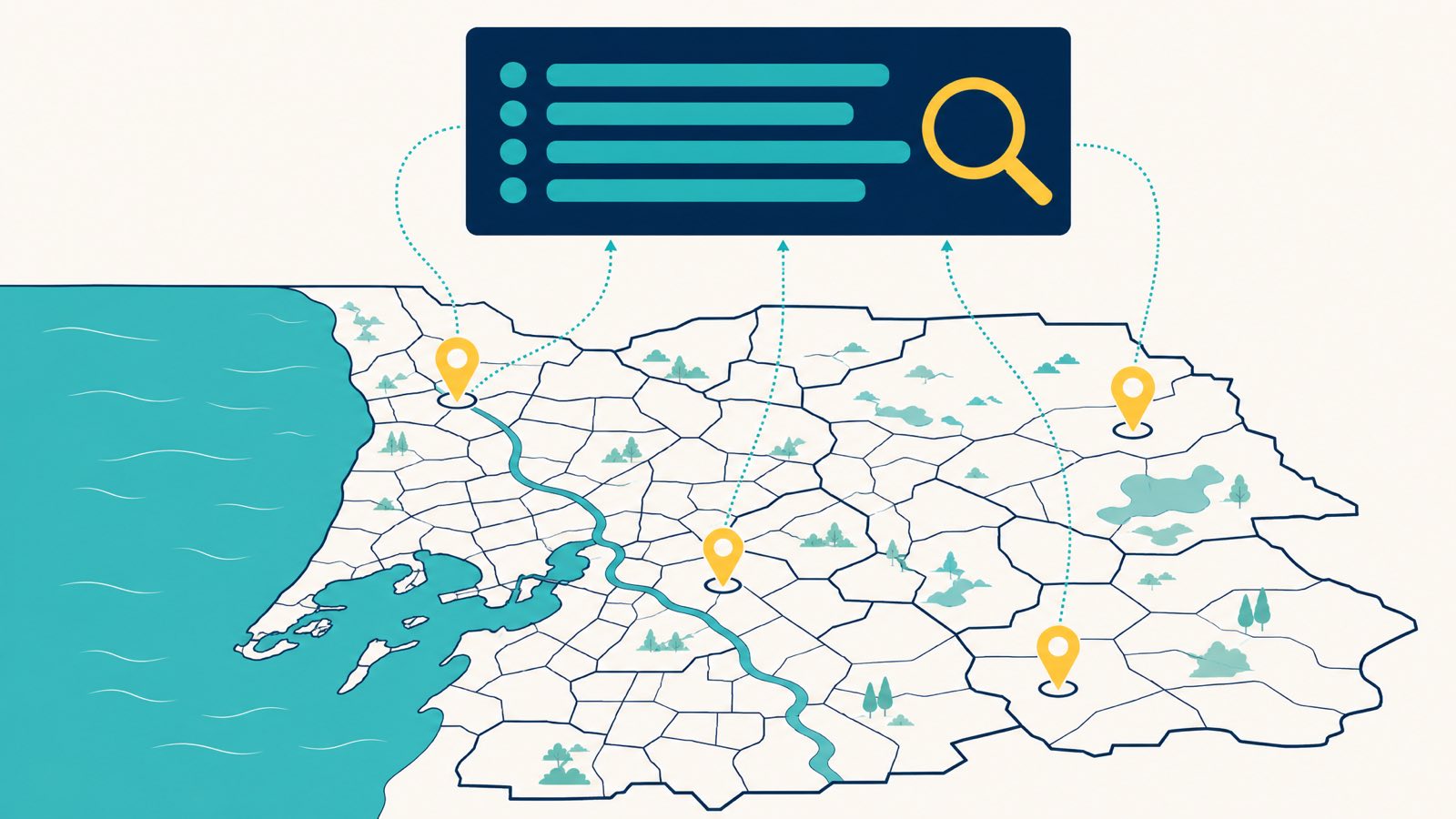
Here’s how to identify local keywords that can help your business stand out.
Brainstorm Keywords Related to Your Services
Start by listing words or phrases that describe your services the way your customers might. Think about both industry-specific terms and everyday language. This approach ensures your keywords match what people are actually searching for.
For example, a dental office might include:
- Dental services
- Teeth cleaning
- Root canal
- Cosmetic dentistry
- Emergency dentist
Don’t forget to add specific treatments, symptoms, or common questions your customers might have. Once you have this initial list, use keyword research tools to refine and expand it.
Leverage Keyword Research Tools
Keyword tools can help you fine-tune your list. Tools like Google Keyword Planner show search volume for specific locations, Semrush provides insights into keyword difficulty in local markets, and Google Autosuggest highlights trending search terms.
For instance, with Semrush’s Keyword Overview tool, you can select a specific city or region to see local search data and competition levels.
Read our article on the top 10 keyword tools for local keyword research.
Add location-specific details to keywords
Make your keywords more targeted by including Australian geographic details. Add suburb and city names (“dentist in Joondalup”), neighbourhood references (“Subiaco dental clinic”), or natural-language phrases like “near me” and “in [suburb]”.
For example, a dental clinic in Perth could optimise for terms like “Perth CBD dentist”, “Fremantle emergency dental care”, “Cottesloe cosmetic dentistry”, or “dentist near Joondalup Shopping Centre” depending on which suburbs they serve and where their patients actually come from.
Once you’ve built and refined your keyword list, incorporate them into your website for better visibility.
Step 2: Adding Location Keywords to Your Website
Once you’ve pinpointed your location-based keywords, it’s time to seamlessly weave them into your website to boost visibility and relevance.
Update meta titles and descriptions
Craft meta titles and descriptions that naturally include your location keywords. Keep meta titles under 60 characters and descriptions between 150-160 characters to ensure they display properly in search results.
For instance, instead of a basic “Bakery | Fresh Baked Goods”, you could write: “Best Bakery in Perth CBD | Fresh Sourdough Daily” or “Subiaco Bakery | House-Made Pastries & Coffee”.
Write location-specific content (the 60% uniqueness rule)
For each location page, focus on including:
- Detailed descriptions of the services offered in that specific suburb or city
- Customer reviews and promotions tailored to the local audience
- Photos taken at or near the actual location
- Up-to-date contact information for that branch or office
The 60% uniqueness threshold matters in 2026. Per practitioner consensus and to stay safely outside Google’s March 2024 Scaled Content Abuse policy and its August 2025 enforcement follow-up, each suburb landing page should include at least 3 paragraphs of genuinely suburb-specific content (landmarks, postcodes, local testimonials, council permit notes, parking specifics, transport access). Without that, the page risks landing in “Crawled, currently not indexed” rather than ranking.
For full coverage on this, see our Location Pages Master Guide on how to write location-specific content that actually ranks.
Optimise URLs and headings with location keywords
Structure your URLs to reflect the location logically:
example.com.au/services/[suburb-name]/[service]
example.com.au/locations/[state]/[city-or-suburb]
For Australian businesses, examples might look like:
example.com.au/services/perth/emergency-plumbing
example.com.au/locations/wa/joondalup
In your headings:
- Use your main location keyword in the H1 tag (e.g. “Emergency Plumber in Joondalup”)
- Add suburb or area-specific terms in H2 subheadings for more context
Tip: avoid cramming keywords into your URLs and headings. Keep them clear and natural for both users and search engines. Google’s spam detection has tightened progressively on stuffed keyword URLs.
With your website tailored for location-based searches, monitor its performance regularly to fine-tune your approach.
Step 3: Monitoring and improving your keyword strategy

Once you’ve added location-based keywords to your site, the next step is keeping an eye on their performance and tweaking your strategy based on what the data tells you.
Track results with analytics tools
Google Analytics 4 (GA4) and Google Search Console (GSC) are essential for tracking local SEO performance. Together they cover geographic traffic, conversions, and keyword performance.
Metrics to keep an eye on:
- Geographic traffic patterns (GA4 → Demographics → Geographic details)
- Conversion rates by location
- Rankings for local keywords (use a geo-grid rank tracker)
- Search impressions and clicks (GSC Performance)
- User behaviour on location-specific pages (Microsoft Clarity layered on top for free heatmaps)
In Google Search Console, the Performance tab lets you filter queries by country and page. Combined with the Queries report, this is the cleanest way to identify which local keywords are actually driving impressions and clicks.
2026 caveat: GBP Performance keyword data has been throttled. Many practitioners now see only the top 5-10 terms per profile in Google Business Profile’s Performance report (sometimes branded-only) where reports used to surface 50+. The workaround: triangulate GBP Performance for head terms + GSC for the long tail + Keyword Planner with tight Australian radius targeting for volume context. Sterling Sky and Whitespark both flagged this throttling through 2025-2026.
Adjust Keywords Based on Performance
Regular reviews of your keyword performance help you fine-tune your strategy. Checking in every quarter works well, as it gives enough time to see the impact of your changes.
Here’s a quick guide to analysing your results:
| Metric | What to Look For | Next Steps |
|---|---|---|
| High Traffic, Low Conversions | Keywords bringing in visitors but not leads | Update content to better match search intent |
| Low Traffic, High Competition | Struggling to rank for competitive terms | Shift focus to long-tail keyword variations |
| High Impressions, Low Clicks | Meta titles and descriptions not drawing clicks | Rewrite meta content to include location-specific terms |
Pro tip: Tools like SEMrush can help you dig into your competitors’ local keyword strategies. This might uncover opportunities you’ve missed or highlight areas where you can improve.
When analysing your data, look for common trends. For example:
“If a certain keyword brings in a lot of traffic but leads to few conversions, it’s a sign that the content or landing page might not align with what users are looking for.”
Experiment with A/B testing for meta titles and descriptions to find what resonates with your audience. For Australian examples:
- “Emergency Plumber in Joondalup, available 24/7” vs
- “Joondalup Emergency Plumber – 30-Minute Response”
This testing helps boost CTR and keeps your local SEO strategy responsive to actual search behaviour. With AI Overviews now on a meaningful share of SERPs, also test conversational query variants (“which plumber in Joondalup is open right now?”) alongside traditional keyword phrasings.
When it makes sense to bring in help
Most of this checklist is genuinely DIY-able for an Australian business with a few hours per week. Where bringing in a local SEO agency typically makes sense:
- You have multiple locations (5+) and tracking + maintaining consistent NAP across them becomes a full-time job
- You’re in a competitive vertical (legal, medical, real estate, trades) where competitors are all running active local SEO and you need to keep pace
- Your business depends on Map Pack visibility and you’ve stalled at position 4-10 despite doing the basics
- You don’t have time to manage GBP reviews, posts, photos and Q&A actively
At Search Scope we run local SEO services for Australian businesses, with a focus on Google Business Profile optimisation, Map Pack ranking, geo-grid tracking, and location-specific content programs. For businesses with reputation issues, we layer in reputation management too.
Typical Australian SMB SEO retainers run $1,200-$1,500/month for active local SEO; more competitive verticals or multi-location campaigns run $3,000-$5,000+. The honest framing: if your average customer is worth $500-$1,000+ and you’re missing 2-5 customers per month due to weak local search visibility, the maths usually works.
Summary and Final Checklist
Key Takeaways
Achieving success with location-based keyword targeting requires careful planning and execution.
This includes using tools like Google Keyword Planner and SEMrush for research, strategically applying keywords across your website, and consistently tracking performance.
These steps work together to boost local search visibility, attract the right audience, and fine-tune your approach based on data. Keep these essentials in mind as you work through the checklist below.
Checklist for Location-Based Keyword Targeting
Use this checklist to streamline your local keyword strategy:
- Keyword Research and Analysis
- Leverage tools like Google Keyword Planner and SEMrush to find promising local keywords.
- Explore variations that pair service terms with location modifiers, neighborhoods, and “near me” phrases.
- Website Optimisation
- Develop and refine location-specific landing pages, naturally incorporating your keywords.
- Keep content readable and engaging while including geographic terms.
- Technical Implementation
- Optimise meta titles and descriptions with location-specific keywords.
- Use location terms in URLs when appropriate.
- Add local business schema markup to improve search engine understanding.
- Performance Tracking
- Track metrics such as local search rankings, traffic from specific areas, conversion rates by location, and keyword position changes.
FAQs
How do I do keyword research for an Australian local business?
To find the right keywords for an Australian local business, you need a focused approach that targets location-specific search terms. Here’s the workflow:
Step 1: combine services with Australian location terms. List all the products or services your business provides, then pair them with location-based terms:
- City or suburb names (e.g. “Perth”, “Joondalup”, “Fremantle”, “Subiaco”)
- Phrases like “near me”
- Neighbourhood references (e.g. “near Cottesloe Beach”, “in Northbridge”)
- Variations like “in [suburb]” and “[suburb] [service]”
Step 2: use SEO tools. Google Keyword Planner, Semrush and Ahrefs all let you set Australian targeting and pull local search volumes. For Australian businesses, also use Google Trends with country=Australia to see seasonal patterns.
Step 3: focus on local intent. Look for keywords that clearly show local intent: terms like “near me”, “[service] in [suburb]”, “best [service] [city]”, or “[service] open now”. These signal users ready to take action rather than research.
Step 4: add keywords to your website. Use them naturally in content and metadata. Don’t stuff. Google’s spam systems have tightened materially on stuffed location keywords through 2025-2026.
For Australian businesses thinking through how to apply this to their own local SEO program, book a 30-minute strategy call or drop us a line and we’ll come back with a scoped recommendation.