
How to Rank in Google Maps When You're Not Near the City Centre
Stuck in an outer suburb? A practical guide to ranking in Google Maps when you're not near the city centre, with Perth and Australian capital examples.

- Google still leans on distance for Maps and the local pack, so a business sitting out in an outer suburb starts at a disadvantage for searches tied to the city centre.
- You cannot always fix the distance problem, but you can close most of the gap by building real presence closer to the centre, mapping your area with suburb pages, and winning on relevance and prominence.
- Reviews are one of the few places a smaller operator can beat a big competitor, by competing on rating, recency and quality instead of raw volume.
- AI search is changing the maths. A strong, well-reviewed business with a wide digital footprint can get surfaced even when its map pin is in the wrong spot.
- This guide is written around Perth, with examples for Sydney and Melbourne, but the approach works for any Australian city.
When someone searches “physio Perth” rather than “physio near me”, Google stops measuring distance from that person’s phone and starts measuring it from the middle of Perth. Your pin does not move, but the point it gets measured against does. If you are twenty kilometres out, you are now twenty kilometres from the thing deciding the result, no matter how close you are to the person searching.

This is one of the most common problems we hear from established businesses. The rankings look fine for your own suburb, then fall apart the moment someone searches from the CBD or names the city in their query. You are not doing anything wrong. Your address is doing it to you.
The good news is that location is only one ranking factor, and the businesses that understand the others can claw back most of the disadvantage. Here is how to do it.
Why your address holds you back in Google Maps
Google’s own guidance is clear that local results come down to three things: relevance, distance and prominence. Google describes these as the main factors it uses to find the best match for a search, and you can read its tips to improve your local ranking for the official version. Most people fixate on distance, because it feels like the one they cannot change.
Distance has shifted over the years, and the shift matters for outer-suburb businesses.
In the early days of Maps, Google leaned heavily on a city “centroid”, a notional centre point, and businesses near it had a real edge. That bias has weakened. For “near me” and unbranded searches, Google now centres results on the searcher’s actual location rather than the middle of the city, a change local SEOs have tracked for years and which Moz documented when it called proximity to the searcher the top local ranking factor.
That sounds like good news, and for some searches it is. If someone in your own suburb runs a “near me” search like “physio near me”, proximity now works in your favour.
The problem is the other kind of search. When someone types a city into the query, for example “physio Perth” or “accountant Perth CBD”, Google measures from the city centre rather than from the searcher, which is the situation that hurts outer-suburb businesses most. Proximity also got heavier after Google’s Vicinity update in late 2021, which pulled businesses that had been ranking across a whole metro back toward their physical address. We break down what changed, and how far your visibility realistically reaches, in Google Maps proximity ranking. If your customers are in the centre and you are not, that is the search that quietly costs you enquiries.
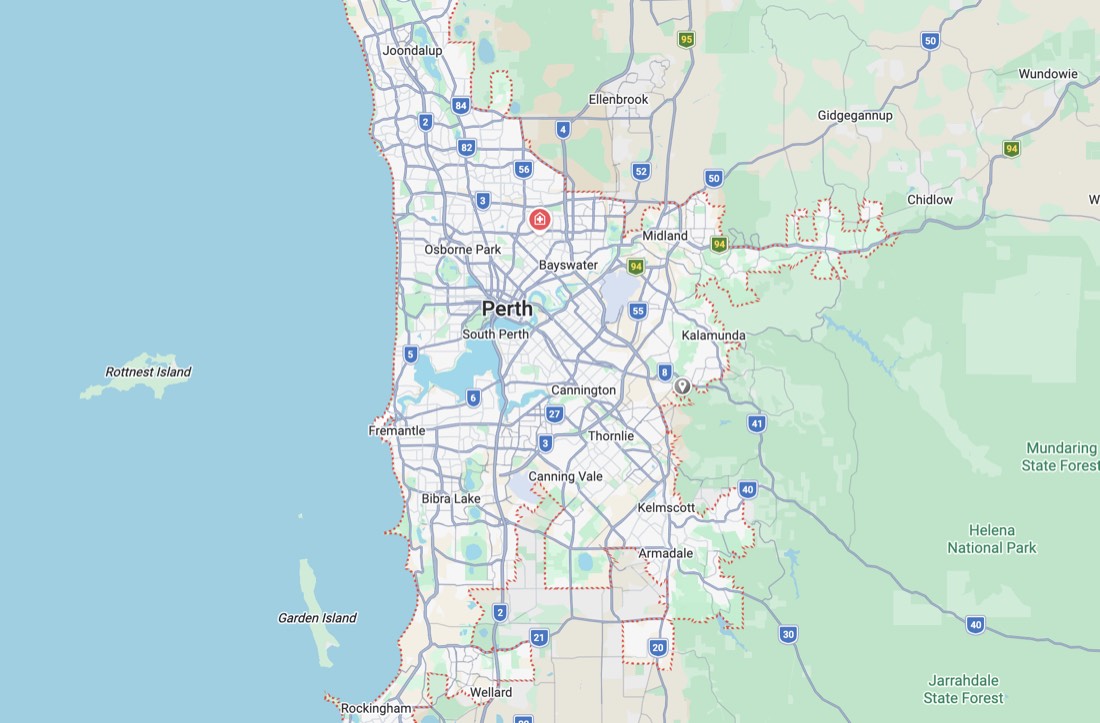
So the goal is not to beat distance head on. It is to reduce how much distance matters by building strength everywhere else, and in a few cases, to get a legitimate pin closer to where your customers actually search.
Fix 1: Get real presence closer to the centre
The only way to make the distance problem disappear completely is to actually be closer to the centre. There are honest ways to do this and there are shortcuts that get businesses suspended. Know the difference before you act.
Move, or open a real second location
Moving your main premises inside the city border is the cleanest fix, and for some businesses it is realistic. For most it is not, which is why a second location is the more common route.
If you open one, it has to be a real location that meets Google’s eligibility rules, otherwise you are creating a new problem instead of solving one. That means a real address, not a PO box or a virtual office, a unique phone number answered by staff at that location, and the place actually staffed during the hours you list. Treat a coworking space as not eligible by default. The narrow exception is a permanently rented private office, staffed by your people during your stated hours, with your own signage and your own phone number, and no other business at that address in your Google category. A hot desk or floating membership does not qualify, and getting this wrong risks suspension rather than just being filtered out.
A second eligible location gives you a second Business Profile and a second pin, closer to the customers you have been missing. Done properly, this is one of the highest-impact moves available to a suburban business. The catch is that every one of those profiles has to survive a Google audit on its own. A second genuinely eligible location is a strong move. Stacking a third and fourth multiplies your suspension exposure, not just your reach, and running several profiles from what is really one base is a well-documented way to lose all of them at once.
A note on using a home address
Service area businesses and multi-location businesses sometimes register a profile at a staff member’s or owner’s home, with the address hidden, to get a pin closer to the centre. This is only legitimate when that home is a genuine operating base, somewhere staff actually work from or dispatch from.
Used purely to move the pin toward a suburb you want to rank in, it breaks Google’s guidelines and is a well-known suspension trigger, and reinstatement is hard because you cannot prove the location is real. If you go anywhere near this, the home has to be a real base for the business. Otherwise leave it alone and put your effort into the fixes below, which carry no risk to your listing.
Fix 2: Map your area with suburb landing pages
If you cannot put a pin in every suburb you serve, your website has to do that job instead. Suburb and location landing pages are how you tell Google, and AI search, which areas you actually cover, and they support both your organic rankings and your service-area visibility.
This is not about spinning up fifty thin pages with the suburb name swapped out. Google does not need those and will not reward them. It is about building proper pages for the areas that matter commercially, each with real local detail: the suburbs and landmarks you work around, the kind of jobs you do there, local considerations that change the work, and real examples or reviews from that area.
For a Perth business, the area you map depends on where you sit and how far you realistically travel. The major non-CBD hubs worth considering are Joondalup to the north, Fremantle to the south west, Cockburn to the south, Rockingham and Mandurah further down the coast, Armadale to the south east, and Midland to the east. Approximate distances from the Perth CBD:
| Centre | Direction | Approx. distance from Perth CBD |
|---|---|---|
| Morley | North east | 10 km |
| Cannington | South east | 13 km |
| Midland | East | 18 km |
| Fremantle | South west | 19 km |
| Cockburn Central | South | 21 km |
| Joondalup | North west | 26 km |
| Ellenbrook | North east | 28 km |
| Armadale | South east | 29 km |
| Rockingham | South south west | 47 km |
| Mandurah | South | 72 km |
The same logic applies in every capital. In Sydney, the centres an outer business builds pages around are usually Parramatta (about 24 km west of the CBD), Liverpool (about 31 km south west) and Penrith (about 52 km west). In Melbourne, the equivalents are Box Hill (about 15 km east), Dandenong (about 31 km south east) and Werribee (about 31 km south west). Pick the hubs you can actually service, and build pages that earn their place.
One rule worth keeping: a location page should describe work you actually do in that area. If you have never taken a job in Mandurah, you do not get a Mandurah page yet.
Fix 3: Win on relevance and prominence
Distance is one pillar. Relevance and prominence are the other two, and this is where a focused suburban business can out-rank a closer competitor who has gone lazy.
Be the specialist, not another generalist
When you offer something less common than the businesses in the centre, Google will often widen its radius to find a relevant answer, which pulls you into searches you would otherwise be too far away to reach.
Say there are ten general electricians inside the city and you are outside it. Competing as the eleventh general electrician is a hard road. Competing as the electrician who specialises in EV charger installation, or solar battery wiring, or heritage homes, is a different game.
The pool of relevant competitors shrinks, and your distance disadvantage shrinks with it. Specialisation can be a service, but it can also be an amenity, a niche you serve, or simply being open when everyone else is closed. Leaning on a niche like this is one of the levers we pull when we rank an electrician business outside its home suburb.
Build relevance and prominence deliberately
Relevance comes largely from your website and your profile. Detailed pages that actually answer what your customers are searching for will out-perform thin competitor pages, even competitors sitting closer to the centre. Prominence comes from how well known your business is across the web: mentions, local citations, links from organisations in the areas you serve, and a profile that is complete and active.
None of this is glamorous. It is the unglamorous work that the AI SEO crowd likes to skip because it does not scale with a button. It still moves rankings, and it is usually the difference between a suburban business that competes and one that does not. If you want a structured way to find where you stand against the businesses beating you, that is exactly what expert local SEO in Perth is built to do.
Fix 4: Out-review the big brands on quality, not volume
If your local pack is dominated by multi-location brands, you have probably noticed they have more reviews than you could collect in years. You are not going to beat them on volume. You do not need to.

Review volume is only one of several reputation signals, and it is not even the most important. Average star rating, the recency of reviews, a steady flow over time, and the actual content of reviews all carry weight. Those are the signals big brands neglect, because a national operator cannot run a personal relationship with every customer. You can.
Beat them on rating
Large operators are famous for letting service slide once they feel untouchable, and their ratings show it. A business that obsesses over the customer experience can hold a higher average than a careless competitor with ten times the reviews. That matters commercially as well as for rankings: in Australia, 98% of consumers read online reviews before making a purchase and 94% consider them trustworthy, and surveys consistently show most people will not seriously consider a business sitting below four stars.
Beat them on recency
Recency is both a ranking signal and the thing customers care about most. Around 85% of consumers consider a review older than three months no longer relevant, because a recent review reflects how you operate now, not how you operated two years ago.
This works in your favour. You do not need a flood of reviews. You need a small, steady stream of fresh ones from your real customers, week after week. Chasing a sudden burst can actually backfire, because Google may suppress reviews that arrive too fast. A handful of real reviews every month beats fifty in one weekend.
Beat them on quality and relevance
This is the part big brands cannot replicate. You know your customers. You can have a real conversation about how a detailed review helps you keep serving the area.
The best reviews for local visibility do three things: they name the specific service, they name the suburb or a local landmark, and they include a photo or short video. A review that says “great service” does little. A review that says “replaced our hot water system in Scarborough the same day, tidy job, photos attached” tells Google exactly what you do and where, and tells the next customer the same thing.
Encourage that kind of detail, respond to reviews in natural language that mentions the service and area, and you build a reputation signal that no national chain can match.
Fix 5: Show up in AI search by building your footprint and reputation
AI search is where the address problem starts to loosen, and it is too important now to treat as an afterthought. AI Overviews, Google’s AI Mode, and tools like ChatGPT and Perplexity answer local questions by weighing what the wider web says about a business: its reviews, its mentions, and how often it turns up as a credible name in your category and area. The map pin matters far less here than it does in the traditional pack, which is exactly why a well-known suburban business can get named in an AI answer it would never win on distance alone. We covered where this is heading in AI is coming for local search.
The catch is that ranking well in normal search does not get you in. A widely cited ZipTie study found that ranking number one organically gives only about a 25% chance of being cited in an AI Overview. What these systems reward instead is a strong, consistent digital footprint and a reputation they can verify from many independent sources. That is the work, and it is not the work the automate-everything crowd likes to sell.
Build your presence on every platform that matters
AI tools build their picture of your business from everywhere you appear, not just your website. The more places that describe you consistently, the more confident they are putting your name forward.
Claim and complete your profiles across every platform relevant to your industry and your city: Google Business Profile first, then Bing Places, Apple Business Connect, Facebook, the major Australian directories, and the niche directories specific to your trade. Keep your name, address and phone identical across all of them. This is unglamorous citation work, and it is one of the strongest signals you can build for both AI search and traditional local SEO. If you are not sure where to start, our list of free Australian citation sites is a practical place to begin.
Build reviews everywhere, not just on Google
Google reviews matter, but AI tools read sentiment across the whole web. A business with strong reviews on Google, Facebook, ProductReview.com.au and the review sites specific to its industry looks far more credible to an AI than one with reviews in a single place.
Spread your review-building across the platforms your customers actually use, keep them recent, and keep the detail high, naming the service and the suburb as covered above. This is the same reputation work that protects you commercially, and it is worth running as an ongoing program rather than a one-off push. For businesses where reputation is the whole game, our online reputation management work is built around exactly this.
Get mentioned where AI is listening
This is the part most local businesses ignore, and it is where the real lift in AI visibility comes from. LLMs and AI Overviews lean heavily on third-party mentions: the places where someone other than you vouches for your business.
The mentions worth chasing:
- Listicles and “best of” articles. When a respected local site publishes “best electricians in Perth” or “top accountants in Fremantle”, being on that list lifts your odds of being one of the names AI returns. Pitch those sites with something actually useful, like data, a case study, or expert commentary.
- YouTube. Video content and mentions get pulled into both AI answers and Google results. A customer reviewing your work, a local creator featuring you, or your own useful videos all add to the footprint.
- Podcasts. Appearing as a guest on a local or industry podcast puts your name in transcripts and show notes that AI tools read, and positions you as a credible voice in your field.
- Local media and community presence. Sponsoring an event, giving expert comment to a local outlet, or getting written up in community news all create the independent mentions AI trusts.
None of this is a quick automation, which is why most businesses skip it. It is the steady work of becoming a name that keeps coming up in your area, and that is what makes a business hard for AI to leave out. If you want this run as a deliberate program rather than guesswork, it is the core of our AI SEO work. You can pressure-test where you stand today with our LLM visibility checklist.
How to know which fix to start with
Not every business needs all five, and doing them in the wrong order wastes money. A business one suburb out from the centre with weak reviews has a different priority list from a real service-area business covering half of Perth. For a lot of suburban businesses, Google Maps visibility is the main issue rather than a side issue, but the only way to know is to look. The work should match the opportunity, which means starting with an honest look at where you actually rank across your target area, who is beating you, and why.
That diagnosis is the part most businesses skip and most agencies gloss over. It is also the part that tells you whether your problem is really location, or whether location is just the easiest thing to blame. If you want that looked at properly, we can audit your search visibility and show you where the actual gap is before you spend on fixing it.
Frequently asked questions
Can a business rank in Google Maps without being in the city centre?
Yes. Location is one of three ranking factors, alongside relevance and prominence. A business outside the centre can still rank well by building suburb pages, earning strong recent reviews, strengthening its profile and entity signals, and showing up in AI search. The disadvantage is real but it is rarely the whole story.
Does Google Maps still favour businesses near the city centre?
Less than it used to. For “near me” searches, Google now centres results on the searcher rather than the city centroid. For searches that name a city, Google measures from that city’s centre, which is the situation that hurts outer-suburb businesses most.
Should I create a Google Business Profile at a home address to rank closer to the centre?
Only if that home is a real operating base for the business. Registering a profile at a home purely to move the pin closer to an area you want to rank in breaks Google’s guidelines and is a common cause of suspension. The safer path is suburb pages, reviews, and stronger relevance and prominence signals.
How many reviews do I need to compete with a larger competitor?
Fewer than you think, if the quality is right. Rather than chasing the volume a national brand has, focus on a higher average rating, a steady flow of recent reviews, and detailed reviews that mention the specific service and suburb. Recency and relevance often matter more than raw count.
Does AI search help businesses with a poor location?
It can. AI Overviews, AI Mode and tools like ChatGPT and Perplexity weigh reviews, mentions and reputation across the web, not just proximity. A business with a strong digital footprint, reviews across multiple platforms, and independent mentions in listicles, local media and video can be surfaced in AI answers it would struggle to win in the traditional local pack.
Where to go from here
Location is a disadvantage, not a sentence. The businesses that win from the outer suburbs are the ones that stop fighting the map pin and start building everything around it: real presence where it counts, suburb pages that earn their place, reviews a big competitor cannot match, and the online footprint and reputation AI search actually surfaces.
If your rankings fall apart the moment someone searches from the centre of the city, that is a fixable problem with the right priorities. Talk to Search Scope and we will tell you, honestly, where the opportunity is and what it is worth chasing.