
How to Rank for “Near Me” Searches: The Complete Guide for Local and Service Businesses
What actually controls Map Pack versus organic rankings for near me searches: GBP categories, proximity signals, schema markup, and AI search visibility.

When someone types “emergency plumber near me” at 11pm on a Saturday, they are not browsing options. They need a plumber right now, they are somewhere in your city, and they are calling the first credible result they see.
That is near me traffic. It is the highest-intent traffic that exists in local search.
Most businesses either ignore it or try to game it with tactics that stopped working years ago. This guide covers the full picture: how Google actually processes near me queries, what controls your Map Pack visibility versus organic results, and every lever that moves rankings in 2026, including how AI has changed the equation.
- Near me searches carry buying intent that informational searches do not. The searcher has already decided what they want and is choosing who to call.
- Google ranks near me results using three factors: Relevance, Proximity, and Prominence. Your strategy needs to address all three, not just one.
- Map Pack and organic near me results are two separate ranking challenges. Adding “near me” to title tags lifts organic rankings. It does not move Map Pack position.
- Service area businesses face a harder near me problem because proximity works against them. There is a specific playbook for SABs that most guides skip entirely.
- In 2026, your GBP and website serve two audiences at once: Google’s algorithm and AI engines like ChatGPT. Same foundations. Higher stakes.
What Near Me Searches Are and Why They Convert Better Than Almost Anything Else
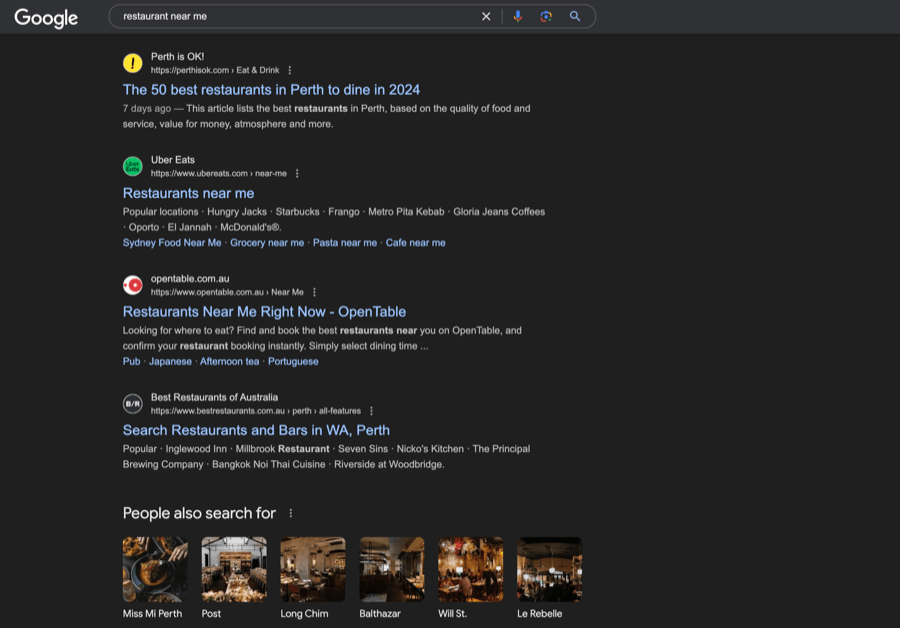
Near me searches are proximity-based queries where a searcher tells Google, explicitly or implicitly, that they want results close to their current location. “Thai restaurant near me” is explicit. “Thai restaurant” is implicit, with Google inferring local intent from device location data.
The numbers explain why this traffic category sits at the top of any serious local SEO strategy.
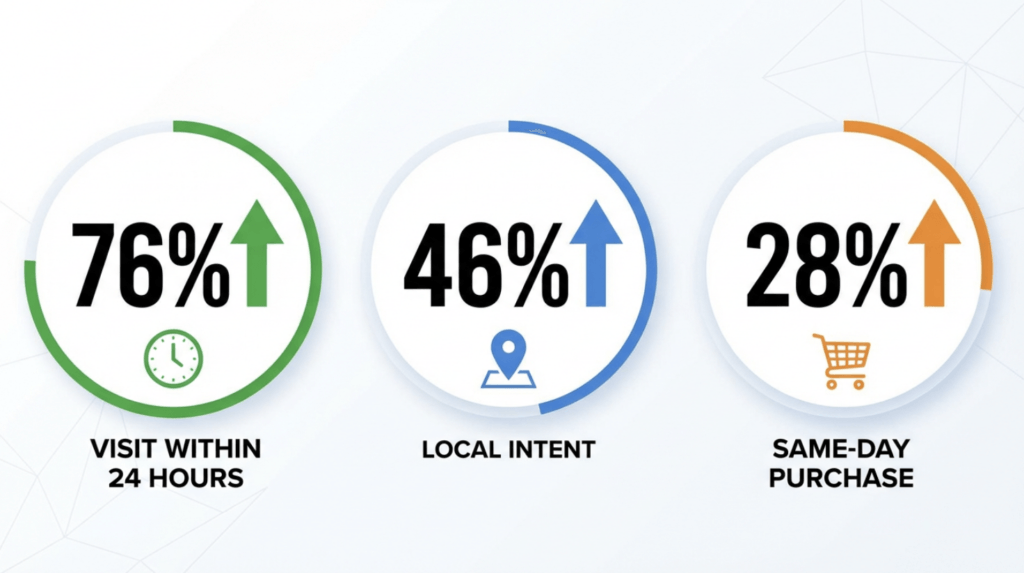
You will see a set of percentages repeated across almost every near me article: 46% of searches having local intent, 76% of nearby searchers visiting a business within a day, 28% of them buying. We have deliberately left them out. The 46% figure traces to a 2018 conference tweet Google never published, and the 76% and 28% numbers come from a single Google study in 2016 whose wording has drifted with each retelling. None of them are safe to plan around in 2026. Your own Search Console data is better evidence anyway: filter Queries for “near me” and compare that segment’s click-through rate against your informational pages.
These are not researchers. They are buyers, usually within travelling distance and often already in the car.
Google determines who appears for near me searches using three ranking factors.
Relevance measures how well your business matches the query. Your GBP primary category, service descriptions, website content, and the keywords embedded in your reviews all feed into this.
Proximity measures how close your registered address is to the searcher. You cannot fake this. A business 2km away has a structural advantage over a business 10km away, assuming similar relevance and prominence.
Prominence measures your overall local authority. Review velocity, citation consistency, local backlinks, and GBP activity all feed into this. It is the tiebreaker when two businesses are roughly equal on relevance and proximity.
Your strategy needs to target all three. Most businesses only address one.
How Google Actually Interprets Near Me Intent
Most businesses optimise the wrong thing because they misunderstand the mechanism. Before you touch anything, understand this.
How Google Knows Where Your Searcher Is
Google uses a combination of IP address, GPS data from the device, Wi-Fi network location, Google account activity history, and previous search patterns to determine a user’s physical location at search time. In most cases that lands within a few kilometres, and on a phone with GPS enabled it is far tighter than that. (You may see a “3 square kilometres” figure quoted here in other articles. That is Google’s minimum area for ad geo-targeting under its privacy rules, not a description of how organic local results are anchored.)
Implicit vs Explicit Local Intent
A searcher does not need to type “plumber near me” for Google to return local plumber results. Search “plumber” in Perth and Google triggers a Map Pack showing local plumbers, because it recognises the query has implicit local intent. The “near me” modifier makes that intent explicit, but Google is already using location data for thousands of query types without it. Capturing that implicit intent before anyone types a suburb name is the core of ranking locally in Perth.
What this means for you: do not force “near me” into every page of your site. But local signals across your website matter regardless of whether you target that specific phrase.
Map Pack vs Organic Near Me: Two Separate Ranking Challenges
This is the distinction most businesses miss, and it is expensive to get wrong.
The Map Pack, the three business listings that appear with a map at the top of local search results, is driven primarily by your Google Business Profile signals: category accuracy, profile completeness, review velocity, and proximity. Organic near me results, the standard blue links below the Map Pack, are driven by your website’s on-page signals, backlinks, and domain authority.
Sterling Sky’s testing found that adding “near me” language to titles, headers and URLs lifts organic rankings below the map pack, while doing nothing for Map Pack position. Their larger 2025 study of 8,186 businesses across 200 cities reinforced the limit: the phrasing “didn’t move the needle at all” for local pack rankings, and genuinely useful landing-page content beat filler phrasing. The two are separate systems, so you need a strategy that addresses both, and you should not expect title-tag wording to buy you Map Pack position.
The Near Me vs Near You Debate
The common objection to putting “near me” in title tags is that it looks unnatural. “Best plumber near me in Perth” reads like no human ever said that aloud. Sterling Sky’s testing found “near you” performs just as well as “near me”, which gives you a more natural-sounding option. “Perth’s most trusted plumber near you in Subiaco” reads naturally and performs the same way. That is the fix.
Google Business Profile: The Primary Near Me Lever
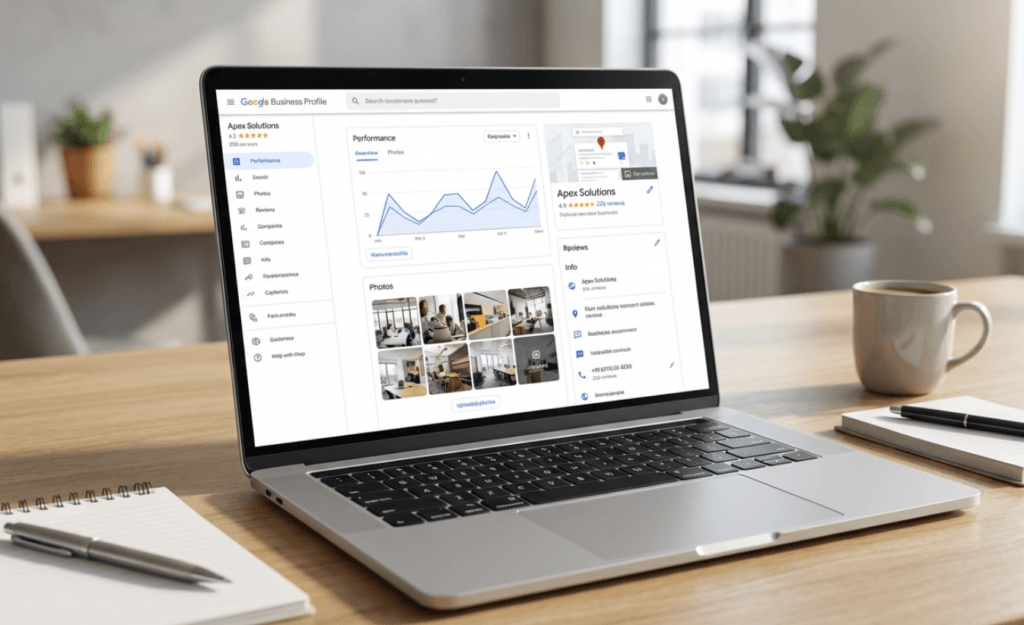
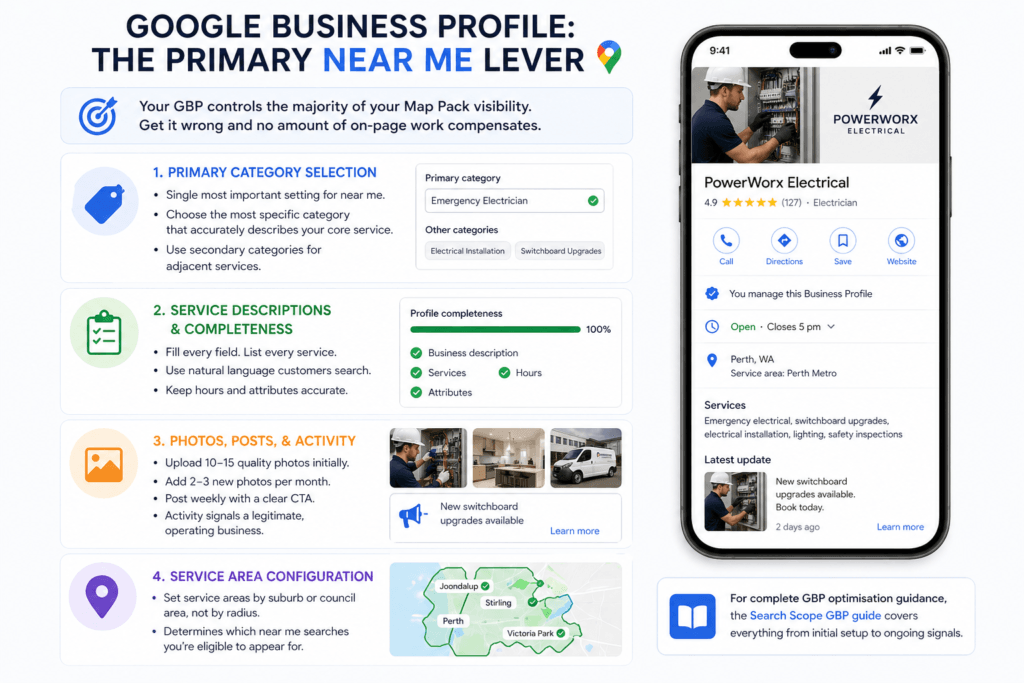
Your GBP controls the majority of your Map Pack visibility. Get it wrong and no amount of on-page work compensates.
Primary Category Selection
This is the single most important GBP setting for near me. Google uses your primary category to determine which searches your profile is eligible to appear for. Choose the most specific category that accurately describes your core service.
A business primarily doing emergency electrical work should list “Emergency Electrician,” not “Electrician.” A Thai restaurant should be “Thai Restaurant,” not “Restaurant.” Use secondary categories to capture adjacent services, but do not sacrifice accuracy in your primary for search volume.
If you are not sure what categories your top-ranking competitors are using, the GMB Everywhere Chrome extension shows you exactly that.
Service Descriptions and Completeness
Every unfilled field in your GBP is a missed relevance signal. Fill in your business description with natural language that matches how customers actually search. List every service. Add every applicable attribute. Keep your hours accurate, especially across public holidays. Businesses with complete and accurate GBP profiles surface significantly more often than incomplete ones.
Photos, Posts, and Activity
Google interprets an active GBP as evidence of a legitimate, operating business. Upload 10 to 15 quality photos during initial setup. Add 2 to 3 new photos per month. Post weekly using the Posts feature with a clear call to action. Most businesses set up their GBP once and leave it. That dormancy shows up in rankings after a few months.
Service Area Configuration
If you are a service area business, set your service areas honestly by suburb or local government area. But be clear on what this field does, because it is the most misunderstood setting in local SEO.
It is display-only. Listing a suburb tells customers you will travel there. It does not make you rank there. Whitespark ran controlled grid tests in 2024 and found that adding service areas made no difference to local rankings.
Ranking in a suburb comes from proximity to your verified pin, your location pages, reviews and links, not from typing the suburb into a box. The full SAB playbook is below.
For complete GBP optimisation guidance, our Perth GBP management service covers everything from initial setup to ongoing signals.
NAP Consistency and Citations
Your business Name, Address, and Phone number, known as NAP, is how Google cross-references your business across the web to confirm you are real and located where you claim.
The problem is not whether your NAP is on your site. The problem is whether it matches across every platform where your business appears.
If your GBP says “Unit 5/124 St Georges Tce” but your website says “124 St George’s Terrace, Suite 5” and your Yellow Pages listing says “124 St Georges Terrace #5,” Google sees three separate signals and its confidence in your business weakens. That directly affects your near me visibility.
Pick one exact NAP format. Use it identically on your GBP, your website footer, your contact page, every citation source, and every social media profile.
For Australian businesses, prioritise these citation sources: Yellow Pages Australia, TrueLocal, Yelp Australia, Start Local, the Australian Business Register (ABR), Apple Maps, your industry-specific directories, and local council and chamber of commerce business directories.
Twenty high-quality, consistent citations outperform 200 inconsistent ones. This is not a volume game.
On-Page Signals That Support Near Me Rankings
Your website needs to communicate your local presence clearly enough that Google can confidently connect your pages to searchers in your area.
Title Tag Optimisation
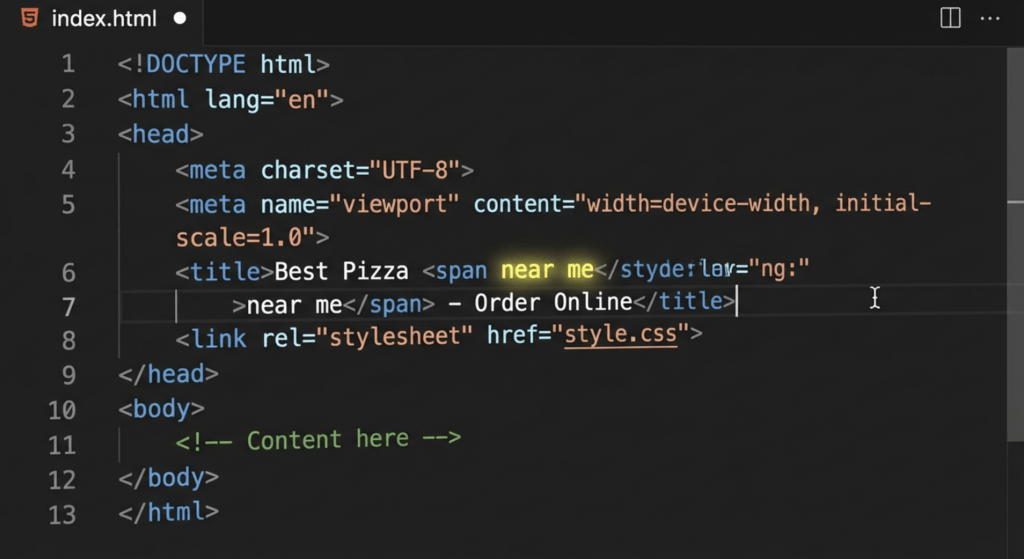
Adding “near me” to title tags can lift organic rankings. It does not move Map Pack position, and it is no substitute for content that actually answers the query. The format that works:
Emergency Electrician Near Me | Bright Spark Electrical Subiaco
Thai Restaurant Near Me | Bangkok Garden Northbridge
Or the “near you” variant, which reads naturally and performs identically per the Sterling Sky research. One instance per title tag. Apply it to your highest-priority service pages and location pages. Do not repeat it across every page on your site.
LocalBusiness Schema Markup
Schema markup is the most direct way to communicate structured information about your business to Google. The LocalBusiness schema tells Google your name, address, phone, coordinates, opening hours, and service area in a format it can read without guessing.
Here is a practical example you can implement directly:
{
 "@context": "https://schema.org",
 "@type": "LocalBusiness",
 "name": "Search Scope",
 "address": {
   "@type": "PostalAddress",
   "streetAddress": "Your Street Address",
   "addressLocality": "Perth",
   "addressRegion": "WA",
   "postalCode": "6000",
   "addressCountry": "AU"
 },
 "telephone": "+61422428584",
 "url": "https://searchscope.com.au",
 "openingHoursSpecification": [{
   "@type": "OpeningHoursSpecification",
   "dayOfWeek": ["Monday","Tuesday","Wednesday","Thursday","Friday"],
   "opens": "09:00", "closes": "17:00"
 }],
 "geo": {"@type": "GeoCoordinates", "latitude": -31.9505, "longitude": 115.8605},
 "areaServed": ["Perth", "Fremantle", "Subiaco", "Northbridge"]
}
Add this to the head of your homepage, or implement it via your CMS schema plugin. For service area businesses, use the areaServed field to list the suburbs and council areas you cover.
Location Pages for Suburb-Level Coverage
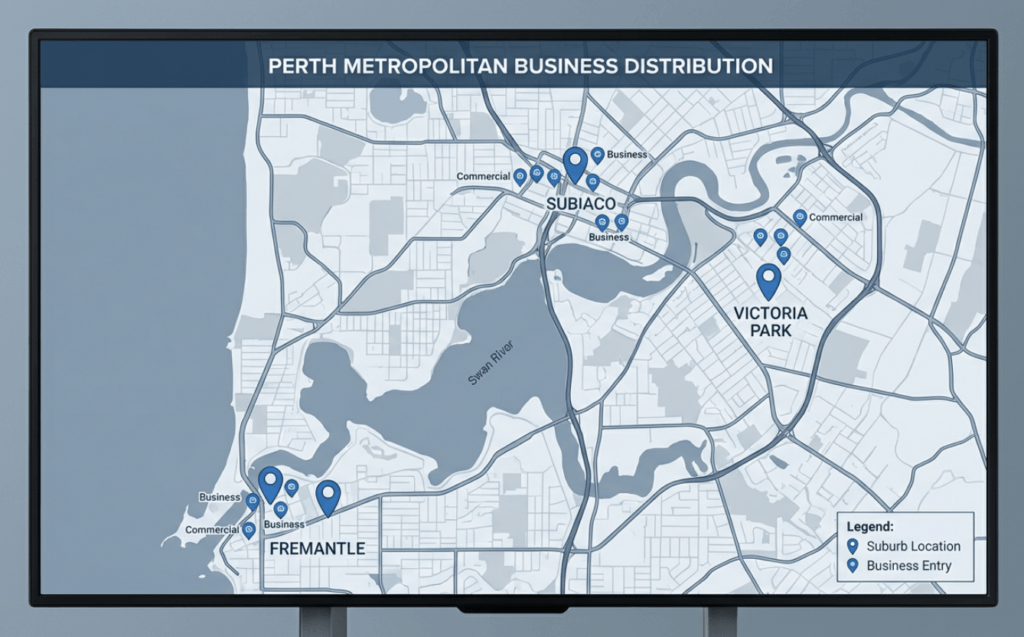
A single “Perth” page will not capture near me visibility across individual suburbs. When someone in Fremantle searches “electrician near me,” Google checks whether you have Fremantle-specific content. If your competitor does and you do not, they win even if you are physically closer.
Build dedicated location pages for your top 5 to 10 suburbs. Each page needs genuinely unique content, your NAP with suburb-specific language, an embedded Google Map, and local references that prove you actually operate there.
Reviews: Velocity Over Volume
A business with 60 reviews and 5 new reviews per month will consistently outrank a business with 200 reviews and no recent activity. Google reads a steady stream of new reviews as evidence of an active, trusted business.
The system is straightforward. Ask every satisfied customer for a review immediately after the job. Send a direct link to your Google review page. One tap from their phone. Respond to every review within 48 hours. Your responses are indexed by Google and contribute to keyword relevance in your review profile.
The reviews that help the most for near me rankings are the ones that are mentionning the suburb where the client is located or where you did the job!
One tactic most businesses overlook: ask customers to include a photo of the completed work. Photo reviews get read more and give a prospect scanning your profile something concrete to judge. What they do not do is pass location data. Google strips metadata from uploaded images, and geotagging photos is comfortably the most persistent myth in local SEO, with controlled tests finding no ranking impact at all. The signal comes from what the customer writes, not from the file.
For a detailed breakdown of how reviews interact with local ranking factors, the Search Scope guide on reviews and local SEO covers the mechanics in full.
Local Authority Signals
Prominence does not come from directory spam. It comes from signals that prove your business is an established part of your local community, and that takes time to build deliberately.
A single link from Perth Now, WAtoday, or the WA Chamber of Commerce is worth more for near me rankings than 50 links from national directories. These local, authoritative links tie your business to your geographic area in Google’s Knowledge Graph.
Practical acquisition methods that work for Australian service businesses: sponsor a local sports team and get listed on their site, pitch your story to local news outlets when you have a genuine angle, join your local business association and get listed in their member directory, participate in or sponsor community events that generate local press coverage.
Google’s algorithm also processes unlinked brand mentions. Local media coverage of your business, even without a link, contributes to your prominence score. It is not just about links.
Near Me Visibility in AI Search
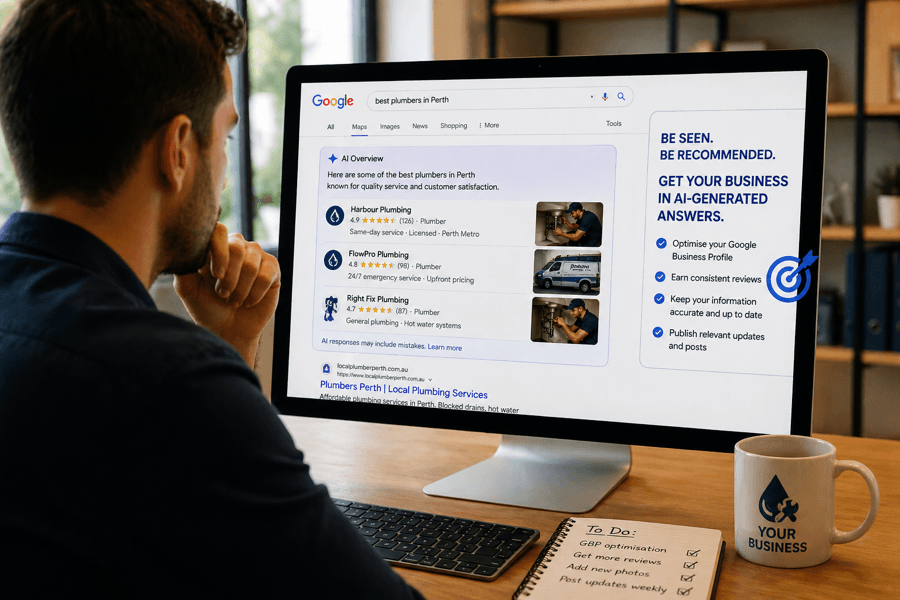
Be precise about where AI Overviews actually show up, because it is not where most people assume. For transactional near me searches like “plumber near me” or “thai restaurant near me”, Google still leads with the Map Pack and an AI Overview rarely appears. Local and brand modifiers strongly suppress them (WebFX).
Where AI Overviews do take over is the informational questions people ask around a local decision: “how much does it cost to…”, “do I need a licensed…”. That is the content to structure for AI. Answer the specific question in a clear 40 to 60 word passage and you have a real chance of being the cited source.
ChatGPT now shows local business results for near me queries in a Map Pack-style format. BrightLocal’s analysis of ChatGPT search sources found business websites make up 58% of the local search sources ChatGPT draws on, ahead of business mentions at 27% and directories at 15%. ChatGPT pulls from GBP data, Yelp listings, and organic sources. Your GBP accuracy and citation consistency now affect your visibility in both Google Maps and AI-generated local recommendations.
Your GBP and your website are now serving two audiences at once. An incomplete GBP or messy citation profile does not just hurt your Maps ranking in 2026, it also removes you from consideration when AI engines respond to someone asking for local services nearby.
For businesses wanting to be visible in AI-generated answers, Search Scope’s AI SEO service covers generative engine optimisation (GEO) and what it means for local visibility.
Service Area Businesses: Your Specific Near Me Playbook
If you are a plumber, electrician, cleaner, landscaper, or any mobile service, the near me problem is structurally harder for you than it is for a business with a shopfront. You do not have an address in every suburb where customers search for you.
When someone in Rockingham searches “electrician near me” and your registered address is in Fremantle, you are at a disadvantage on proximity. You cannot change your address. But proximity is only one of three factors, and you can control the other two. Working the other two factors hard is the core of our electrician SEO approach.
GBP service area configuration. Set your service areas honestly, but remember they are display-only and do not move rankings (see above). The precision that matters is where you focus the things that do: pick the 8 to 10 suburbs that generate most of your calls and concentrate your location pages, reviews and local links there, rather than spreading thin across 60.
The address display decision. If you operate from a residential address, hide it and rely on service area configuration. If you have a commercial address, show it and configure service areas. That combination gives you the strongest local signal.
The proximity ceiling is real. Your verified pin is an invisible leash. In suburban areas a profile realistically ranks within roughly 10 to 15 km of that pin, and less in a dense city centre, no matter how many suburbs you list. For the high-value zones that sit outside that organic reach, geo-targeted Google Ads is the rational way to cover them. (Google’s Local Services Ads are not available in Australia, so here that means standard location-targeted Search and Maps ads, not LSAs.)
Location pages for service suburbs. Build a dedicated location page for each suburb you serve. Each needs unique content, local references, testimonials from that area where possible, NAP with “Serving [Suburb]” language, and an embedded Google Map. A page targeting “electrician Cottesloe” directly supports your near me visibility for searches in Cottesloe.
Review velocity by suburb. Encourage customers to mention the suburb in their reviews. “Sean replaced our hot water system in Cottesloe within the hour” is a stronger local signal than a generic five-star review. Over time, this builds suburb-level keyword relevance in your review profile.
Measuring Near Me Performance
3 tools. 3 data sets. Check monthly.
- Google Search Console. Navigate to Performance, filter Queries for terms containing “near me.” Track impressions, clicks, CTR, and average position. Segment by device. Near me traffic skews heavily mobile.
- GBP Insights. Your dashboard shows the search terms that triggered your profile, directions requests, phone calls, and website clicks. Directions requests are the clearest high-intent signal. Watch this number month over month.
- Local Pack rank tracking. Use Local Falcon or BrightLocal’s Local Search Grid to track Map Pack rankings across different suburbs. These tools show visibility at suburb level so you can see exactly which near me searches you are winning and which you are not.
Common Near Me Ranking Mistakes We Often See
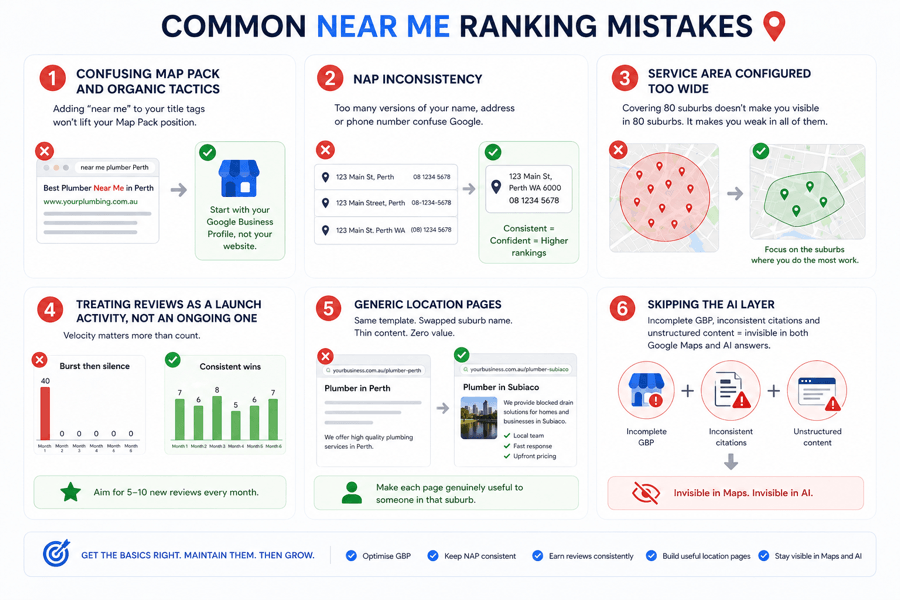
Confusing Map Pack and organic tactics. Adding “near me” to your title tags will not lift your Map Pack position. That is not how Map Pack works. If your Map Pack visibility is the problem, start with your GBP, not your website.
NAP inconsistency. A few mismatches across directories will not tank you. But if you have 20 different versions of your address floating around the web, Google cannot confidently verify your business location. Audit your citations once and fix them. Then maintain them.
Service area configured too wide. This is one of the most common SAB mistakes. Covering 80 suburbs in your GBP service area does not make you visible in 80 suburbs. It makes you weak in all of them. Start with the suburbs where you actually do most of your work.
Treating reviews as a launch activity rather than an ongoing one. Getting 40 reviews in your first month then going quiet for six months is not a review strategy. It is a one-time event. The velocity matters far more than the count. A system that gets you 5 to 10 new reviews per month every month beats a burst of 50 reviews followed by silence.
Generic location pages. You know the ones. Same template, suburb name swapped out, thin body copy that says nothing specific about operating in that area. Google has been penalising this pattern for years. If each location page is not genuinely useful to someone in that suburb, it is not doing SEO work either.
Skipping the AI layer. Incomplete GBP, inconsistent citations, and unstructured website content now make you invisible in both Google Maps and AI-generated local recommendations. These are no longer separate problems.
If you want to know where your business currently stands and what is costing you near me visibility, we offer a free local SEO audit at Search Scope. No pitch. Just an honest look at what is working, what is not, and what to fix first.