
Local Keyword Research for Australian Businesses: The Method and the Tools That Matter
Skip the tool listicle. The local keyword research method we use for Australian businesses, plus the free and paid tools actually worth your money in 2026.

Most articles on local keyword research are just a list of tools. The tool is the easy part. The method is what businesses get wrong, and it quietly costs them leads.
The usual mistake is targeting “[service] + [city]” and stopping there. A plumber builds a page for “plumber Perth” and wonders why the phone stays quiet, while customers are actually searching “blocked drain Mount Lawley”, “hot water system replacement cost”, and “emergency plumber near me at 9pm”. Those are the searches that turn into jobs. Here is the method we use, then the tools worth paying for.
- Local keyword research is about matching how customers actually search, not guessing head terms.
- Google’s own free tools (autocomplete, People Also Ask, Search Console, Keyword Planner) do most of the real work.
- Paid tools add scale and difficulty data. They do not add strategy.
- The highest-value local keywords are usually service plus suburb plus an intent modifier, not just “[service] [city]”.
- Pick a tool that fits your budget, then actually use the data to shape pages and your Google Business Profile.
The method: how to actually do local keyword research

The tool comes last. The order below is what separates research that drives enquiries from a spreadsheet nobody opens again.
1. Start from the money services, not keywords
List what you actually want more of. Not “we do everything”, the specific, profitable jobs. An electrician might want more switchboard upgrades, EV charger installs and emergency callouts. Each of those is its own research track. Keyword research that does not start from commercial priorities just produces traffic you cannot bank.
2. Build the seed list from how customers describe the problem
Customers do not search in your industry’s language. They describe the symptom. “Power keeps tripping”, not “RCD fault diagnosis”. Pull the real wording from sales calls, quote requests, your inbox, and the questions staff get asked every day. That language is your seed list, and most competitors never bother to collect it.
3. Expand with Google’s free signals
Type a seed into Google and read the autocomplete suggestions, the People Also Ask box, and the related searches at the bottom of the results. This is Google telling you, for free, what real people search around that topic. For a single business it often surfaces more useful local terms than a paid tool does.
4. Add the local modifiers that actually convert
This is where most lists stop too early. Layer on:
- Suburbs and regions you serve, not just the city. “Electrician Joondalup”, not only “electrician Perth”.
- Proximity intent: “near me”, “open now”, “after hours”, “emergency”.
- Commercial intent: “cost”, “price”, “quote”, “best”.
- Qualifiers customers actually use: “level 2 electrician”, “licensed”, “same day”.
“Emergency electrician Scarborough” and “switchboard upgrade cost Perth” are worth more than “electrician” ever will be, because the person typing them is closer to hiring someone.
5. Pull volume and difficulty from a tool
Now bring in a keyword tool to add search volume and competition data so you can prioritise. One caveat: volume on hyper-local terms is often low, and frequently understated by the tools. Low volume with high intent still beats high volume with none.
6. Mine Google Search Console for what you nearly rank for
This is the most underused local keyword source there is, and it is free. Search Console shows the queries you already get impressions for. Terms sitting on page two, especially local ones with intent, are often the fastest wins available, because Google already considers you relevant.
7. Map keywords to pages by intent
Group keywords by what the searcher wants, then assign each group one page. Service pages, location pages and Google Business Profile content should not all chase the same term. Three thin suburb pages targeting “electrician [suburb]” with near-identical copy is cannibalisation, not coverage.
How many location pages do you actually need?
This is where the “service plus suburb” research turns into a real decision, and where a lot of businesses go wrong in one of two directions. Some build nothing and rely on a single “areas we serve” page, so they never rank in the suburbs. Others spin up fifty near-identical suburb pages, which Google reads as thin doorway content and which cannibalise each other. Neither works. A keyword deserving a target is not the same as a keyword deserving its own page.
Tier your suburbs instead of treating them all the same:
- Priority suburbs (full pages). The handful of areas that drive the most revenue, or where you most want to grow, get a genuinely useful, distinct page: local proof, real detail, jobs you have done there, the specifics that only apply to that area. These are the pages you actually build links and content around.
- Secondary suburbs (lean but real pages). Worth a page, but only if you can make each one genuinely different, not a find-and-replace of the suburb name. If you cannot say something true and specific about working there, it does not get its own page yet.
- The long tail (handled on the profile, not the site). The dozens of fringe suburbs you serve but cannot write unique pages for belong in your Google Business Profile service-area settings and a single well-built “areas we serve” hub, not in fifty thin pages.
A hub-and-spoke structure keeps this clean: a strong city or service hub absorbs the broad “[service] [city]” term, and each priority suburb page targets its own micro-local terms and links back to the hub. The test for any new page is simple and ruthless: can you make it genuinely useful and distinct? If not, fold the keyword into a stronger page rather than diluting your site with another thin one.
The free tools that do most of the work
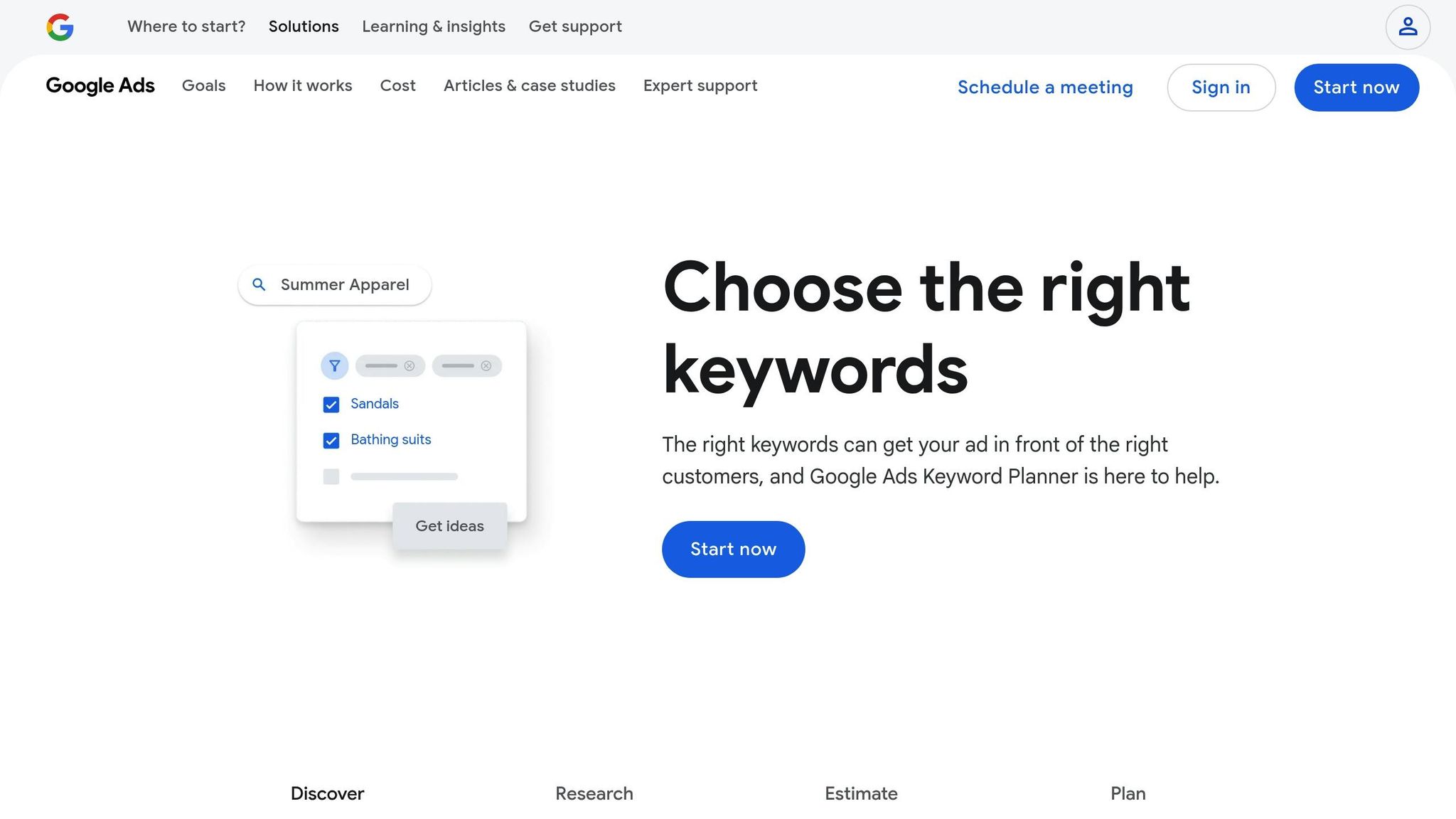
You can run the entire method above on free tools. Most businesses should start here.
Google Keyword Planner. Free, with genuine suburb and postcode targeting, which matters in Australia. The catch: free accounts that are not running ads see volume as broad ranges rather than exact numbers. That is usually enough to prioritise.
Google autocomplete, People Also Ask and related searches. Free, live, and pulled straight from real search behaviour. For a single-location business this is often the highest-signal source you have.
Google Search Console. Your own query data. The terms you already appear for, and the page-two terms you could realistically win, are usually a better roadmap than any third-party estimate.
Google Trends. Good for seasonality and relative interest. If you install air conditioning, Trends tells you when demand for “split system installation” climbs, so your content and ads are ready before the heat, not after it.
The paid tools worth considering
Paid tools add scale, difficulty scoring and competitor visibility. They do not replace the method. Prices below were accurate at the time of writing, so check the vendor before you commit.
KWFinder (Mangools). The best value for most local businesses. There is a usable free plan, then paid tiers on annual billing of roughly US$37.70/mo (Basic), US$52.70/mo (Premium) and US$97.70/mo (Agency), per Mangools’ current pricing. It is strong on long-tail and local SERP data, and it does not require an SEO background to use. For a single business or a small portfolio, this is usually all you need.
Semrush. Deep and powerful, with the Keyword Magic Tool and Position Tracking, but priced for agencies and serious in-house teams, from around US$139.95/mo on the Pro plan, with Guru and Business tiers well above that. For one local business it is overkill. If you already pay for it, use it. If you do not, you probably do not need it just for local keyword research.
Ahrefs and Moz are credible alternatives in the same bracket as Semrush. Check current pricing, and apply the same test: do you have enough work to justify the cost, or is a cheaper tool plus Google’s free data enough.
For most Australian local businesses, the honest answer is the free tools plus KWFinder. The expensive platforms earn their keep at agency scale, not for a single suburb-focused operator.
Using AI for keyword ideas (and the trap to avoid)
AI tools like ChatGPT, Claude and Perplexity are genuinely good at one half of this job and dangerous at the other.
Where they help is ideation and grouping. Paste in your real customer language (a batch of recent enquiries, reviews, or the questions staff get asked) and ask the model to pull out the distinct services and problems, suggest suburb and intent variations, and cluster the lot by what the searcher actually wants. That can save an hour of manual sorting, and it is especially useful for surfacing the symptom-based phrasing customers use that you would never write yourself.
Where they are dangerous is numbers. Language models do not have live search data, and they will happily invent a confident-looking search volume that is completely wrong. Treat any volume, difficulty or “trend” figure an AI gives you as fiction until a real tool confirms it. For the actual numbers, pull fresh data from a proper source: Google Keyword Planner for free, or a current pull from Semrush or DataforSEO when you need granular volume and difficulty at scale. Use AI to find candidate keywords, never to size them.
Is a zero-volume keyword worth targeting?
Here is the most common local keyword question there is: the tool shows “0” or “10” searches for a term you know brings in jobs, so do you target it or not? Volume on hyper-local terms is routinely understated, and the keywords that convert best often barely register. But “low volume” is not a free pass to target everything either. Use signals, not the volume number, to decide.
Tick what is true for your keyword. Two or more signals and it is usually worth acting on.
Zero-volume keyword: go or skip?
Tick every signal that is true for the keyword you are weighing up.
The logic behind the tool: a single weak signal is not enough to justify a page, but two or more (especially Search Console impressions plus real customer language) means the intent is genuine even when the volume tool says zero. Low volume with high intent still beats high volume with none.
What most businesses get wrong
Chasing head terms. “Electrician Perth” feels important and converts poorly next to intent-loaded long-tail searches.
Ignoring intent. A “quote” or “emergency” search is far closer to a booking than a generic term. Volume without intent is a vanity metric in disguise.
Only targeting the CBD. The suburbs you can actually win, where a lot of the demand sits, get skipped because the city term looks bigger.
Cannibalising with thin location pages. Ten near-identical suburb pages fighting each other for the same keyword help no one. One strong page beats five weak ones.
Treating it as one-off. Demand, competitors and the way people phrase searches all shift. Research done once and never revisited goes stale.
How we approach local keyword research for clients
Internally we run a mix of DataForSEO and Semrush every day, and the highest-value work is rarely the head-term list. We mine People Also Ask and autocomplete at scale, run a query fan-out audit on the searches AI systems fire behind a single question (one “best childcare near me” becomes a dozen sub-queries about fees, waitlists and ratios), and deliberately pull from sources the volume tools cannot see: Reddit threads, YouTube comments and other UGC platforms are full of the exact phrasing customers use for problems that show zero volume inside every popular tool. Those zero-volume, high-intent phrases are where the cheap wins live.
We tie every target keyword to commercial intent and to a specific destination: a service page, a location page, or the Google Business Profile. Then we check it against reality. Search Console shows what is already within reach, and a geo-grid tracking scan shows whether the suburbs we are targeting actually have Map Pack coverage worth competing for. Keyword research that is never validated against real visibility is just a list.
This is the front end of the local SEO work we do, and it sits underneath both website rankings and Google Maps SEO. I have been in SEO since 2013, and the pattern holds: the businesses that win local researched how customers actually search and built pages that match, they did not just assemble the longest keyword list. It is the same thinking behind our approach to SEO for Perth businesses, where the suburbs decide the result.
FAQ
What is local keyword research?
Finding the search terms local customers actually use to find businesses like yours, then prioritising them by commercial intent and matching each to the right page or profile. It is keyword research with geography and buyer intent built in.
What is the best free local keyword research tool?
Google’s own stack: Keyword Planner for volume and suburb targeting, autocomplete and People Also Ask for real phrasing, and Search Console for the queries you already nearly rank for. Together they cover most of what a local business needs.
Do I need a paid tool?
Not to start. The method runs on free tools. A paid tool like KWFinder helps once you want faster expansion and difficulty data across many terms or locations. It speeds the work up, it does not replace the thinking.
How many keywords should a local business target?
Fewer than most lists suggest. A focused set tied to your money services and the suburbs you serve, mapped cleanly to pages, beats a sprawling list nobody acts on. Intent quality matters more than count.
How often should I redo local keyword research?
Review it at least yearly, and sooner if you add services, expand your service area, or notice new competitors moving in. Search Console should be checked far more often, since it shows shifting demand in real time.
Where this leaves you
The tools are interchangeable. The method is not. Start from the services that make you money, learn how customers actually describe the problem, layer in the suburbs and intent modifiers, validate against Search Console and real Map Pack coverage, then map it to pages that deserve to rank.
If you want that done properly, tied to enquiries rather than vanity volume, . No lock-in contracts, no agency theatre, just keyword research that points at revenue.