
The Best Geo Grid Rank Tracking Tools in 2026 (Tested by an Australian SEO Agency)
We use geo-grid rank trackers on client campaigns every week. Honest 2026 picks, current pricing, and how to choose, from an Australian SEO agency.

Your Google ranking is not one number. It changes from one street to the next. You can sit in the Map Pack outside your own front door and be invisible three suburbs over, where half your customers are actually searching. A single “you rank 4th” figure hides all of that, and that blind spot is usually what is quietly costing you calls.
A geo-grid rank tracker is how you see the real picture. We run these on client campaigns most weeks, so this is a working view of what is worth paying for in 2026, not a list lifted off vendor homepages.
- A geo-grid tracker checks your Google Maps position from dozens of points across an area, not one spot.
- Best overall: Local Falcon. Most accurate, and the only major one seriously tracking AI visibility yet.
- Best value for agencies and multi-location: Local Dominator.
- Best looking client reports: Whitespark Local Ranking Grids.
- Best if you already pay for an all-in-one: BrightLocal or Semrush.
- The number that matters is your share of local visibility across the area, not a single rank.
What is a geo-grid rank tracker?
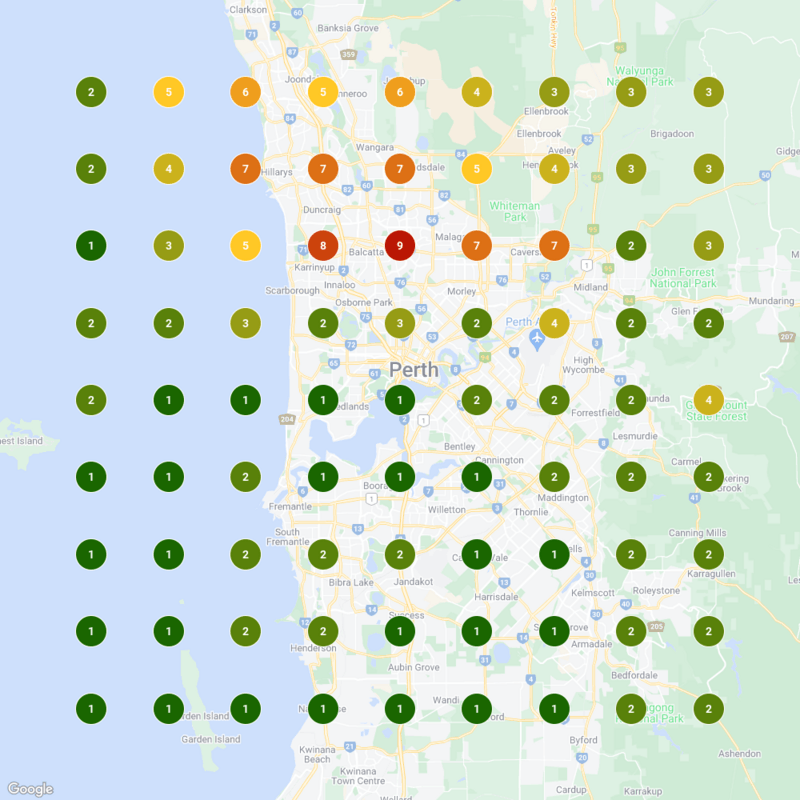
A geo-grid rank tracker checks where your business appears in Google Maps results from a grid of points spread across a geographic area. Picture a set of pins laid over your suburb or city. The tool runs a search from each pin’s exact latitude and longitude, as if a customer were standing there, and records your position for that keyword at that spot.
Put all those points together and you get a heatmap. Green where you rank in the top three, red where you do not show up at all. That map is the truth a normal rank tracker cannot give you. A standard tool reports one position from one location. A geo-grid shows you that you might own the Map Pack near your office and vanish in the postcodes where the real work is.
The single number lies because Google’s local results lean heavily on proximity. The closer the searcher is to your listing, the better you tend to rank. So “average position 4” can mean solid coverage everywhere, or first place at your desk and nowhere across town. This is the same blind spot we untangle in serious Google Maps SEO work: only a grid tells you which one you are living in.
Do you actually need one?
If customers find you through Google Maps or local search, yes. Trades, clinics, hospitality, professional services, anyone with a service area or more than one location. If you sell nationally online and Maps is irrelevant to you, skip this entirely. No tool changes that.
The value is not the heatmap. It is the decision the heatmap forces. The number worth watching is your share of local visibility across the whole area you serve, tracked over time, not whether you nudged from 5th to 4th on one search. That shift in thinking is most of the benefit. You stop chasing a vanity rank and start closing the dead zones where enquiries are walking to a competitor. This is how we frame it inside a local SEO audit: coverage, not a single position.
The tools worth knowing in 2026
A note on pricing. Prices in this space move often, and most tools sell credits rather than flat plans, where one credit usually equals one scanned grid point. The figures below were accurate at the time of writing and are in US dollars unless stated. Check the vendor’s current pricing before you commit.
Local Falcon
Local Falcon was our default for client work for years, and it earned that spot. It was the original geo-grid tool and it still sets the bar for accuracy. (These days we run our own client tracking through a combined seoutils and RingTonic setup, for reasons we explain below, but as a standalone geo-grid tool Local Falcon is still the one to beat.)
Its signature metric is Share of Local Voice, which measures how often you appear in the Map Pack across an area instead of at one point. That is the figure we actually put in front of clients. It also added Falcon AI for optimisation guidance and Apple Business Connect tracking, so you can see Apple Maps visibility that most competitors quietly ignore.
Pricing is credit-based: from US$24.99 a month for 7,500 credits up to US$199.99 a month for Premium, with enterprise packages on request. Pay-as-you-go credits sit around US$0.05 each. It rates roughly 4.7 out of 5 on G2. Unused monthly credits expire at the end of the cycle, so size your plan to the scanning you really do.
If you only trial one tool, make it this one.
Local Dominator
Local Dominator is the value pick, especially for agencies and anyone tracking several locations. It does the core job well and costs less to run at scale.
Plans start around US$39 a month at entry level, then US$59, US$97, US$197 and US$399 as credits and connections climb. Pro and above include rolling credits, so unused credits carry into the next month instead of disappearing. For an agency with uneven client workloads, that one feature can save real money across a year. You also get bulk scanning and white-label reporting, which start to matter once you manage more than a handful of listings.
It is less polished than Local Falcon. For the money, that is easy to forgive.
Whitespark Local Ranking Grids
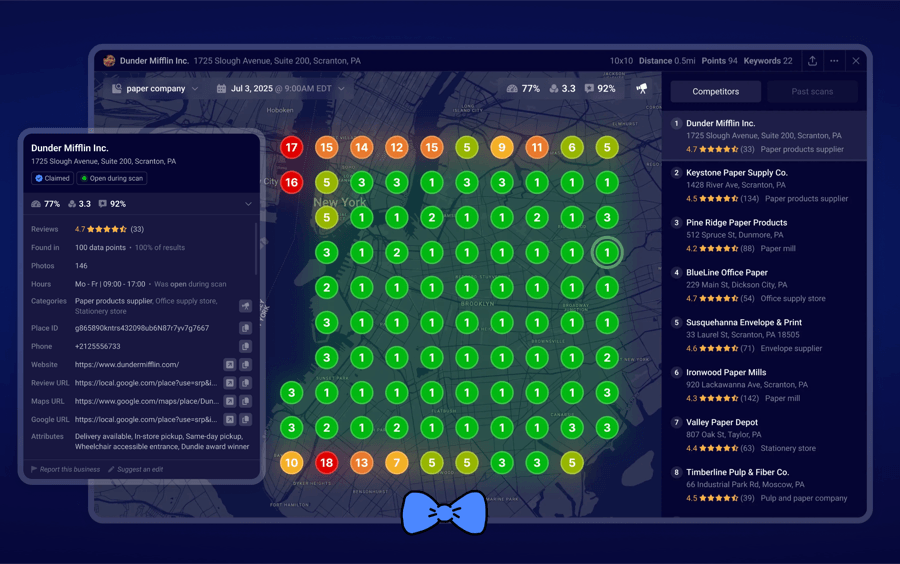
Whitespark launched its Local Ranking Grids in 2025, built by Darren Shaw, who has a long track record in local SEO. It arrived as the best-looking tool in the category, and the substance holds up the design.
You can run grids up to 225 points, and every point carries deep competitor detail: reviews, categories, photos, hours, claimed status and more. That context speeds analysis up a lot. The reports are genuinely client-ready, which is the part agencies will care about most.
Pricing starts at US$10 a month for 2,000 credits at US$0.005 per pin, up to US$300 a month for 100,000. There is a free trial with 200 credits and free migrations from other tools. Credits expire at the end of each billing period, so plan your scan schedule around that. The one current gap is AI visibility tracking, which it does not offer yet.
BrightLocal
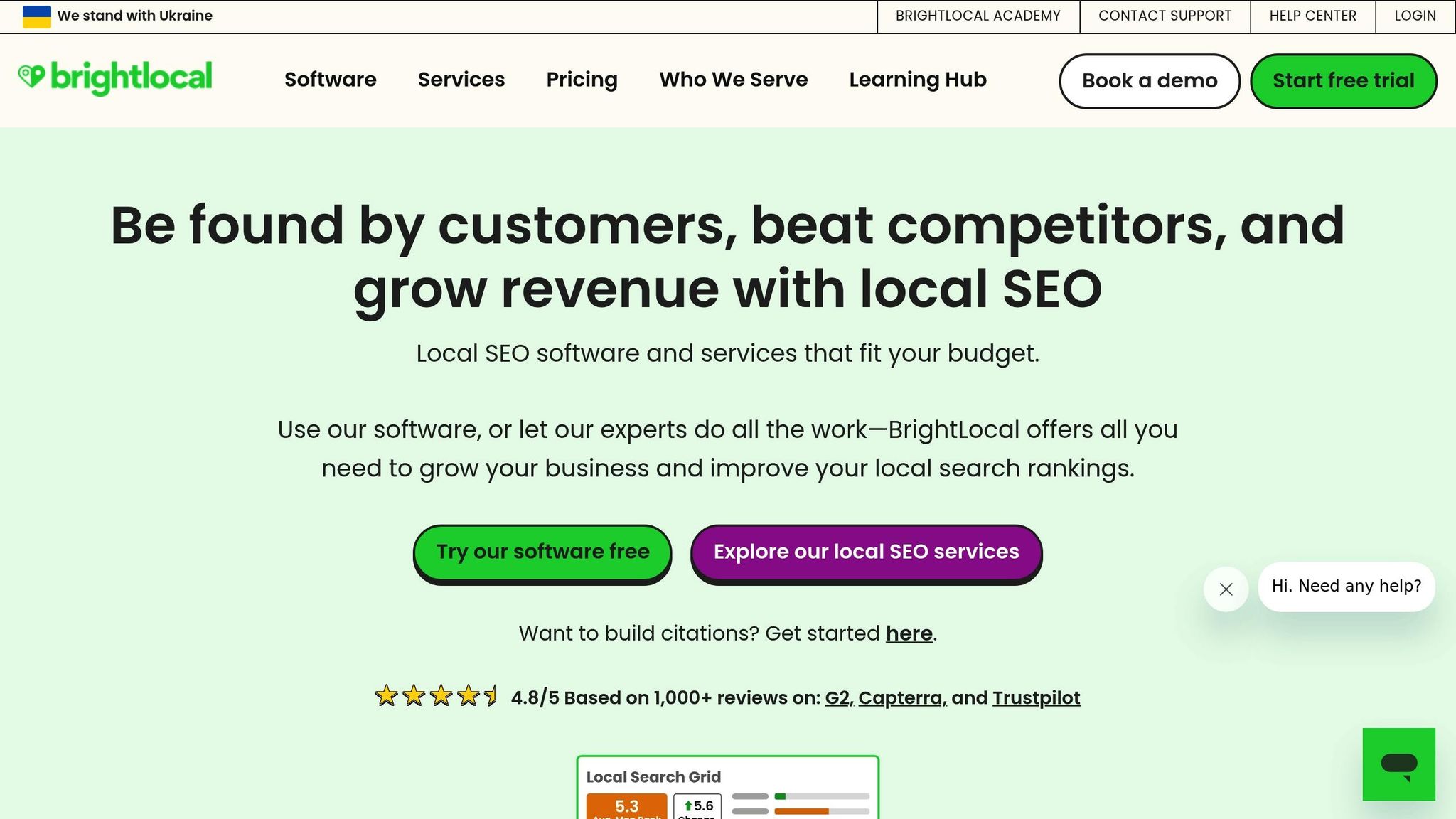
BrightLocal makes sense if you already use it for citations or reputation work. Its Local Search Grid is a solid part of a wider local SEO platform rather than a specialist standalone.
Pricing starts at US$39 a month for the Track plan with one location and scales by location count, with annual billing saving around 25 per cent (BrightLocal raised its prices on 1 July 2026, so these figures are current). Grid sizes are 3x3, 5x5 and 7x7, smaller than the specialists but enough for most single-location businesses, and the competition analysis is genuinely useful.
Semrush Map Rank Tracker
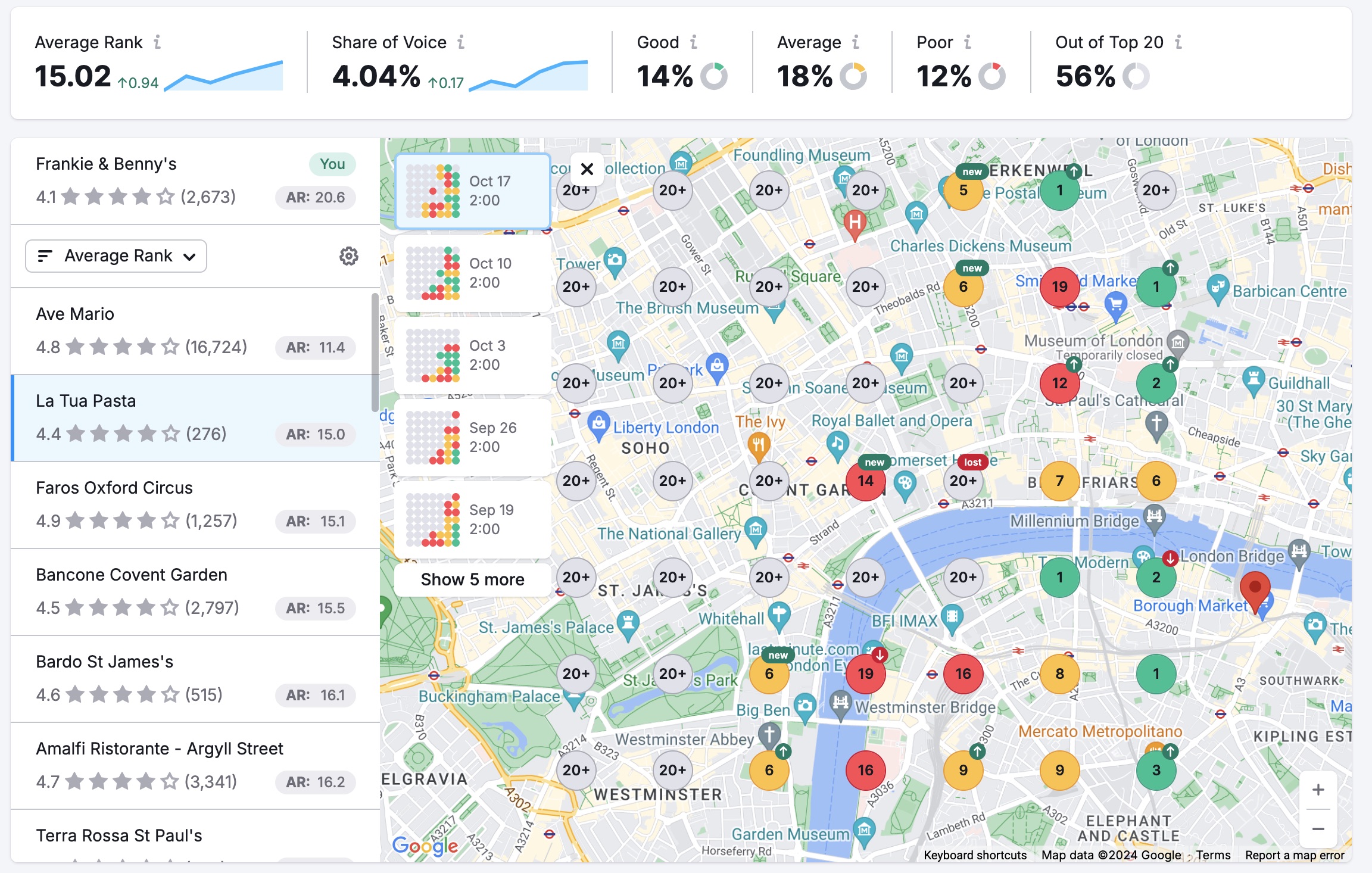
If you already pay for Semrush, its Map Rank Tracker pulls geo-grid tracking into a platform you are using anyway. The integration is the whole argument: rankings, local tracking and the broader toolkit in one login. Check current Semrush pricing, since this is bundled into their plan structure rather than sold on its own. As a dedicated geo-grid tool it is not the most detailed, but the convenience is real if Semrush is already your hub.
Geomapy (Localo)
Geomapy, now Localo, is built for hyperlocal tracking and aimed at brick-and-mortar businesses that need to win their immediate area rather than a whole city. It handles neighbourhood-level tracking and competitor insights. Pricing changes regularly, so check the vendor directly.
Local Viking
Local Viking pairs geo-grid tracking with Google Business Profile management, so you can see rankings and act on the listing from one place. That makes it a reasonable fit for multi-location operators who want management and tracking together. Confirm current pricing on their site, as the tiers shift.
GMB Crush

GMB Crush is built for agencies that want deep competitor benchmarking and lead generation alongside grid tracking. Its strength is showing why competitors rank where they do, not just that they do. Pricing is tiered and changes, so check the current plans before committing.
What a tracker will actually cost you
The headline price (“from US$24.99 a month”) is not the number that bites. These tools sell credits, where one credit usually scans one grid point, and the real monthly spend is grid size multiplied by keywords multiplied by how often you scan multiplied by how many locations you track. A weekly scan of a large grid across a few keywords adds up faster than most owners expect, and on tools where unused credits expire at month end you pay for the data whether you use it or not.
Set your real scanning below to see how many credits a month of tracking burns, and the cheapest monthly plan that covers it on the three specialist tools that publish their credit pricing openly: Local Falcon, Whitespark and Local Dominator. (A couple of all-in-one platforms price by number of locations or feature tier instead of a clean per-credit rate, so they cannot be put on the same axis honestly. More on that under the note.)
Geo-grid cost calculator
One credit ≈ one scanned grid point. Adjust the inputs to match how you would actually track.
Credits = grid points × keywords × scans × locations, where one credit scans one grid point. The figures show the cheapest monthly plan that covers your usage on each tool, at pricing current at the time of writing. Plans bill monthly and on most tools unused credits expire at the end of the period (Local Dominator's Pro tier and above roll credits over instead, and Local Falcon also sells pay-as-you-go credits at about US$0.05 each that never expire, which can undercut a plan minimum for occasional use). Prices change often, so confirm current vendor pricing before committing. These three are shown because they price purely per credit with published credit counts; all-in-one platforms like BrightLocal and Semrush price by locations or bundled plans, so they cannot be compared on the same per-credit basis.
The lesson the calculator makes obvious: a tight grid scanned monthly sits comfortably on an entry plan, while a large grid scanned weekly across several keywords and locations climbs the tiers fast. Decide your scanning rhythm before you pick a plan, not after the first invoice.
How to actually choose
Park the feature lists for a minute and decide on these:
- Budget and credit model. Work out how many scans you genuinely run per month, then price it. A tool that looks cheap gets expensive once you scan large grids weekly.
- Credit rollover. If your usage is uneven, rolling credits like Local Dominator’s Pro tier are worth real money.
- Standalone or all-in-one. If you already pay for BrightLocal or Semrush, their built-in tracker may beat adding another subscription.
- White-label reporting. Non-negotiable for agencies, irrelevant for an owner checking their own coverage.
- AI visibility tracking. Search is shifting, and where you show up in AI answers is starting to count. Local Falcon is ahead here and most others are not there yet. If that matters to you, the shortlist gets short fast.
- Australian and Apple Maps coverage. Make sure the tool handles AU locations cleanly and ideally Apple Maps. Local Falcon’s Apple Business Connect support is a real edge for Australian businesses.
For most Australian businesses starting out, a free Google Business Profile plus a starter plan on Local Falcon covers it. Agencies and multi-location brands will get more out of Local Dominator or the all-in-one platforms.
How we use geo-grid tracking in client work
We do not run these tools for the screenshots. On a Perth business SEO campaign, the first thing we want is the true coverage map: where the business actually shows in the Map Pack across every suburb it wants customers from, not a single headline rank.
That scan usually tells the real story. A business that believes it ranks well often owns a tight green patch around its address and bleeds red across the suburbs where the revenue lives. That gap becomes the plan. We track share of local visibility over time as the work compounds, so progress is measured against coverage and enquiries, not a vanity position.
For years we ran that scan on Local Falcon, and it did the job well. More recently we have moved our own client tracking to a combined seoutils and RingTonic setup, because a coloured pin has a hard limit: it tells you where you rank, but nothing about whether that suburb is worth winning or whether ranking there actually produces calls. We wanted the layers a plain heatmap cannot give us.
So we treat the grid as one layer in a stack.
First, we overlay ABS Census demographics on the grid: household income, homeowner percentage, population density. That separates the suburbs that merely look like coverage gaps from the ones that are genuinely worth the spend. Ranking better in a high-income, high-ownership suburb is worth chasing. Ranking better where almost no one is going to buy is not.
Second, we connect call tracking so call origins sit on top of the ranking grid. We call it the Money Map. Ranking strongly in a suburb that generates no calls is a very different problem from getting calls where you barely rank, and only the overlay shows you which one you actually have.
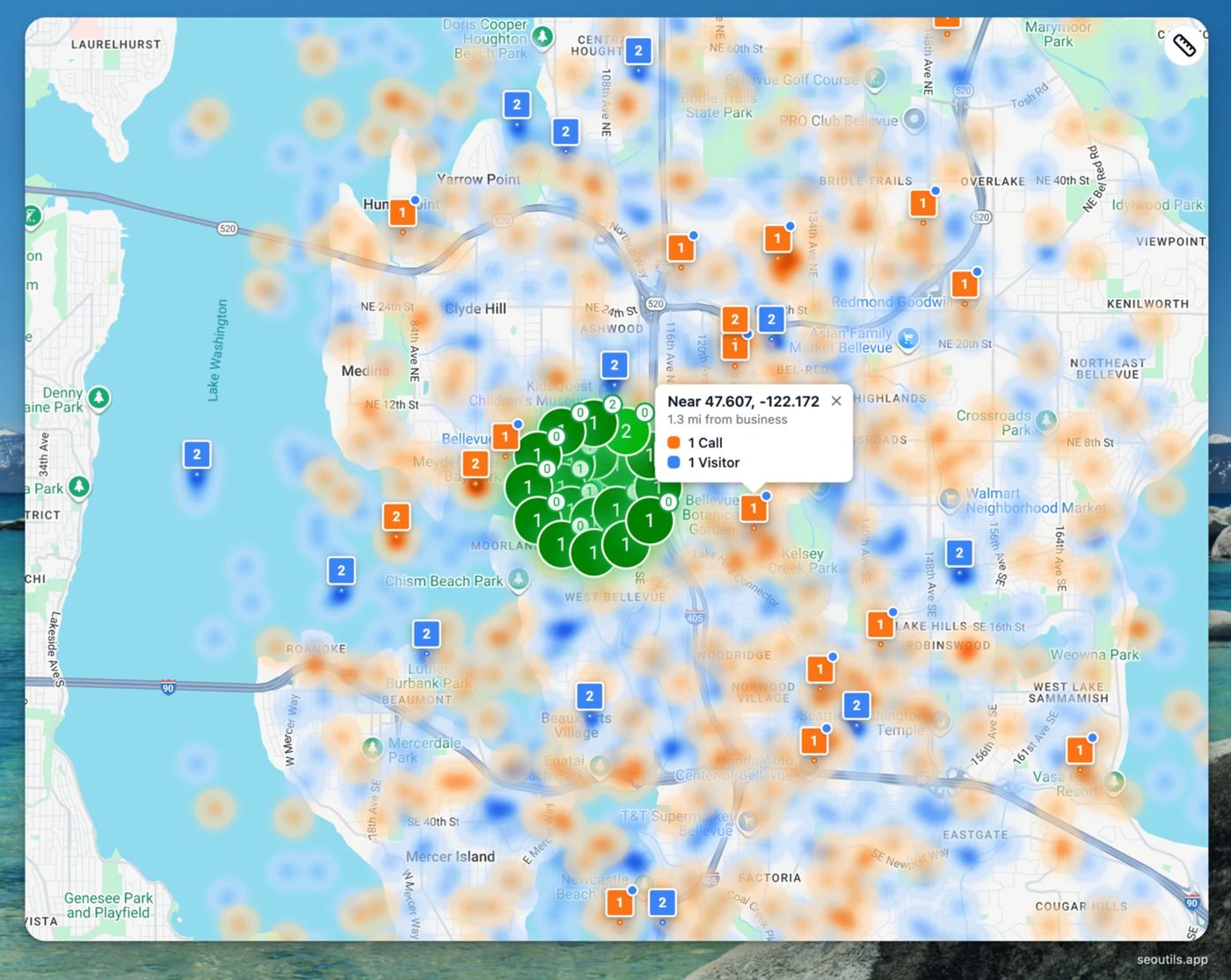
Third, we track AI visibility separately, because a growing share of local research now starts in ChatGPT, Gemini and AI Overviews rather than the Map Pack.
The full picture, and exactly how each layer connects, is in our breakdown of how we track the ROI of an SEO campaign. The heatmap is where the diagnosis starts, not where it ends.
FAQ
What is a geo-grid rank tracker?
A tool that checks your Google Maps ranking from many points across an area and turns the results into a heatmap, so you see where you are visible and where you are not instead of trusting one position.
Do I really need one?
If customers find you through Google Maps or local search, yes. If you only sell nationally online, no. The point is seeing coverage gaps that are quietly costing you enquiries.
Is there a good free option?
Most serious tools are paid, but several give you free trial credits. Local Falcon hands you free credits on sign up and Whitespark offers a free trial, which is enough to map your coverage once before you commit.
How often should I scan?
For most local businesses, monthly is enough to see real movement without burning credits. Scan more often only around a big change, like a new location, a category change, or recovering from a ranking drop.
How is a geo-grid tracker different from a normal rank tracker?
A normal rank tracker reports one position from one place. A geo-grid tracker reports your position from dozens of locations across your service area, which is the only way to see proximity-driven gaps in local search.
Why do two geo-grid tools show me different rankings?
Because there is no single “true” ranking, in the same way two SEO rank trackers rarely agree to the decimal. Each tool samples from slightly different coordinates, at a different zoom level, on a different schedule, and Google itself personalises and shuffles local results constantly. Run the same business through Local Falcon and Whitespark on the same day and you will often see different numbers, and both are honest readings. So do not chase the absolute position. Pick one tool, keep your grid size and settings identical between scans, and watch the trend over weeks and months. Direction of travel is the signal. The exact pin number is noise.
Where this leaves you
The tool is not the strategy. A geo-grid tracker shows you the truth about your local visibility, but closing the red zones is the actual work: rankings, reviews, profile quality and the right local signals over time. It is the same thinking behind our work on SEO for Perth businesses, where the metro sprawl makes single-point rank tracking close to useless.
If you want someone to run the scan, read what it is really telling you, and turn it into more qualified enquiries, . No lock-in contracts, no agency theatre, just a clear read on where you stand and what to fix first.