
Proven Guide: How to Handle Negative Google Reviews in Australia
How Australian businesses respond to genuine negative reviews, report fake ones correctly, rebuild a rating, and stay inside Australian Consumer Law.

Handling a negative Google review well comes down to one decision made early: is this a real customer with a genuine complaint, or a fake/policy-violating attack? The two need completely different responses. Get the diagnosis wrong and you either look defensive in public or waste effort flagging a review Google will never remove.
This guide walks through both paths, responding to legitimate criticism, and reporting reviews that actually breach Google’s policies, plus the constraint that changes the whole approach: under Australian Consumer Law, you cannot simply delete genuine negative feedback, and trying to can land you in more trouble than the review itself.
If you’re dealing with a coordinated or defamatory attack rather than ordinary criticism, our review removal service and broader online reputation management work exist for exactly that situation.
Before Anything: What You Can and Can’t Remove
Not every negative review can, or legally should, be removed. The ACCC’s guidance for business on online reviews is explicit: removing or suppressing genuine negative feedback to mislead consumers can itself breach Australian Consumer Law.
So the only reviews you can legitimately get taken down are ones that breach Google’s prohibited and restricted content policies, such as spam, fake engagement, conflicts of interest, off-topic content, harassment, or hate speech. A genuine “the service was slow and the staff were rude” review from a real customer is not removable. It’s a customer-service problem, not a policy problem.
Suing over a review is rarely the fix owners imagine, either. Australian defamation law now has a serious-harm threshold and a mandatory concerns-notice step before proceedings, and cases against the platform rather than the author have generally gone badly, so litigation tends to be slow, costly and aimed at the wrong target. The detail varies by state and this is not legal advice, so take it to a solicitor before you spend anything. We cover the realistic options further down.
Step 1: Assess the Review, Genuine or Fake?
Start by cross-referencing the reviewer against your records. Can you find a matching customer, booking, or transaction? If yes, treat it as genuine and respond (Step 2). If you can’t, don’t panic, document the discrepancy and look for the red flags of an inauthentic review:
- No specific, verifiable detail about a real transaction
- Generic or hidden reviewer name with little profile history
- An account leaving 1-star reviews for several businesses in your industry, often across different cities, in a short window
- Aggressive, non-specific language that reads as designed to damage the rating rather than describe an experience
A reviewer you can’t place isn’t automatically fake, and a fake one still needs evidence before you report it. One common mistake: replying emotionally to an obvious bot attack. A defensive public reply can read to other customers as if the complaint is legitimate. For inauthentic reviews, stay factual and move to the reporting process rather than arguing. Our guide to combating fake Google reviews covers the patterns in more depth.
Step 2: Responding to Genuine Negative Reviews
Your reply isn’t really for the unhappy customer, it’s for every future customer who reads your 1-star reviews to see how you handle problems. That’s why responding matters: in BrightLocal’s Local Consumer Review Survey 2026, 37% of consumers count an owner response among the things that make a review matter to them, and 74% look for reviews written in the last three months. We aim to reply within 48 hours, which is a house standard rather than a Google requirement.
We use the C.A.R.E. structure because it keeps replies calm, specific, and forward-looking.
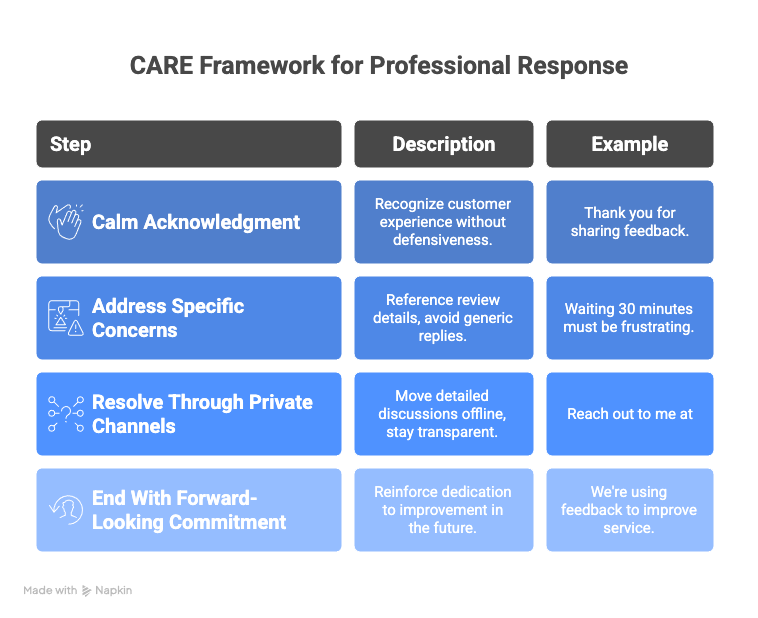
C, Calm acknowledgment
Open by recognising their experience without getting defensive.
“Thank you for taking the time to share your feedback about your recent visit. We take all customer experiences seriously and appreciate you bringing this to our attention.”
A, Address the specific concern
Reference a real detail from their review so it’s clearly not a template.
Instead of “We’re sorry you had a bad experience,” try “I understand how frustrating it was to wait 30 minutes for a table you’d reserved.”
R, Resolve through a private channel
Move the detail offline while staying transparent for other readers.
“I’d like to put this right. Please contact me directly at [email/phone] so we can resolve it properly.”
E, End with a forward-looking commitment
“We’re using your feedback to tighten our service standards and hope you’ll give us another chance to get it right.”
One caveat from experience: this only works if the offline follow-up actually happens. Promising to “make it right” publicly and then not following through tends to produce a second, angrier review. The offline resolution has to be genuine.
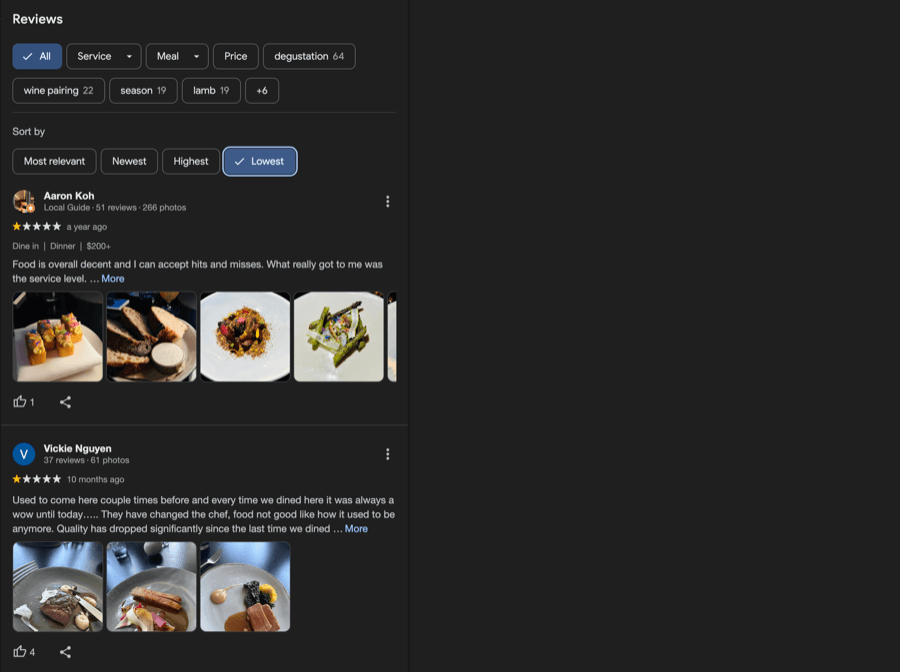
Reply to every review. Negative ones from Local Guides are worth extra care, not because Google weights them differently, but because Local Guide reviews tend to be seen by more people.
Response Templates
Pre-written templates stop you firing off a reactive reply in the heat of the moment. Adapt these to your brand voice rather than pasting them verbatim.
Legitimate product or service failure: “Hi [Name], thank you for bringing this to our attention. We’re sorry your experience with [product/service] fell short of our usual standard. We’d like to make it right, please contact our team at [phone/email] so we can resolve it.”
Misunderstanding or policy issue: “Hello [Name], we appreciate the feedback. We understand the frustration around [policy/issue]. That policy exists to [reason], but clear communication matters to us and we’d like to discuss it. Please reach out at [phone/email].”
No record of the customer: “Hi [Name], we take all feedback seriously but can’t locate a matching record in our system. We’d like to investigate, could you contact us at [phone/email] with an invoice number or visit date so we can look into it?”
For a wider set, see our 15 Google review response templates.
Step 3: Review Report and Escalation: How to Report Reviews That Break Google’s Policies
Reporting works when you map the specific review to a specific policy breach, not when you submit a vague “this is unfair” complaint.
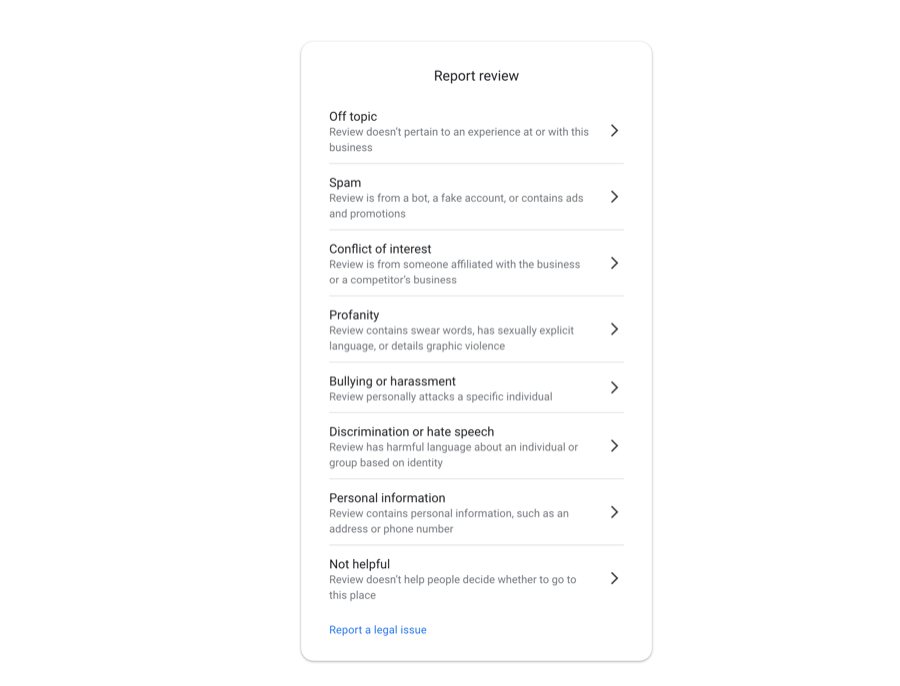
You can’t delete a review yourself, but you can ask Google to remove one that violates policy:
- Open your Google Business Profile and go to the Reviews tab.
- Find the review, click the three dots, and select Report review.
- Choose the category that genuinely matches the violation, Off-topic, Spam, Conflict of interest, Harassment.
Getting the category right is what decides the outcome. A bad review from a former employee is a conflict of interest. A competitor or bot-style review is spam. In our experience a flagged review takes a few days to be assessed, and generic or mass flagging without a clear policy match is usually rejected automatically. For the full escalation walkthrough, see our complete guide to removing Google reviews.
Special Case: Review Extortion (“Pay Us or the 1-Stars Stay”)
There’s a third category that is neither ordinary criticism nor a run-of-the-mill fake review: extortion, which Google has moved on recently enough to build a dedicated form for. The pattern is a sudden wave of 1-star reviews, followed by a message (often WhatsApp, email, or a phone number left in the review itself) offering to “remove” them for a fee, usually demanded in cryptocurrency or gift cards. Google now treats this as a serious policy violation and has a dedicated extortion reporting form for exactly this situation.
Handle it differently from a normal report:
- Do not pay or engage. Paying marks you as a willing target and guarantees nothing. Never call a number left in a review.
- Don’t reply to the fake reviews before you submit the extortion form. The mechanism, as reported by Search Engine Roundtable: the scammer monitors notifications for any reply, reads any reply as a signal that you care, and uses that as the cue to message you with the “we can remove these for $X” pitch. Appearing unbothered until the form is filed is the stronger move. Reply afterwards if at all, and keep it short.
- Document everything immediately. Screenshot the demand showing the date, time, and sender’s contact details, save every message, and collect direct links to the suspicious reviews. The form requires evidence of the demand, so if they have not put the ask in writing yet you may need one short written reply to draw it out. Keep that narrow: in writing only, never by phone, never any indication you might pay, and stop as soon as you have the demand on record. The form does work when the evidence is tight: in one case documented by Search Engine Roundtable, a local SEO submitted it one morning and had all 11 reviews removed by the next. That is a single case rather than a guaranteed turnaround, but it matches what we see on our own extortion submissions, where the clear-cut ones usually resolve in 24 to 72 hours.
- Use Google’s dedicated extortion form, not one-by-one flagging, since it routes to Google’s specialist team. Flag the individual reviews as spam as well while you wait.
- Don’t lash out publicly. If you reply at all, keep it calm: note that you’re aware of an unusual review pattern and have reported it to Google.
- Consider the police. Demanding money under threat is a crime, and a report number helps document the case.
Because these attacks are coordinated and time-sensitive, they usually need the specialist handling described below. We cover the mechanics in more depth in our guides on the new review extortion form and fighting back against review extortion.
A warning about paid “review removal” services
Be very careful about companies that promise to “remove negative reviews from Google” for a fee, particularly for legitimate negative content (Reddit threads, forum posts, BBB-style complaints) rather than policy-violating reviews. Sterling Sky’s Joy Hawkins exposed the pattern in 2025: these companies routinely file fake DMCA copyright takedown notices against legitimate critical content, abuse Google’s DMCA approval process (which often rubber-stamps requests automatically), and get genuine reviews and forum threads suppressed from search. They also coordinate mass-reporting attacks on Reddit and other platforms to force automated removals.
Beyond the ethics, the practical risk is that paying these services exposes you to liability if the false-DMCA-claim trail leads back to your business. The legitimate path for content you genuinely have grounds to remove is direct flagging through Google’s official tools, a report to the ACCC where the conduct is misleading or deceptive under the Australian Consumer Law, or, for genuinely defamatory material, a concerns notice prepared by your solicitor. Not paying a company to file fraudulent takedown notices on your behalf.
When to Escalate (and When It’s Time for Help)
Google’s first-line moderation is automated, and in our experience it rejects plenty of legitimate requests on the first pass, usually with a “doesn’t violate our policies” message. That’s not the end of the road, but it does mean the standard dashboard flow has limits.
Escalation past that point means building a documented case that maps each review to a specific policy breach (and, where relevant, to misleading-conduct provisions under Australian Consumer Law), then getting it in front of a manual reviewer rather than the automated filter. Volume of reports doesn’t matter; quality of the policy-violation evidence does.
This is the point where a coordinated fake-review attack, multiple inauthentic 1-star reviews in a short window, often from accounts also targeting competitors interstate, usually needs specialist handling. Search Scope runs this work on a pay-on-success basis for fake, policy-violating or defamatory reviews, with no upfront fee: you are invoiced only after Google confirms the removal. We have taken down over 500 policy-breaching reviews since 2025 on those terms, and the structure is deliberate, so the risk sits with us rather than you. We do not remove genuine negative reviews, because doing that would breach the ACCC guidance above. We do not turn a case away just because a review reads as authentic either: whether it is genuine is a question we answer with the reviewer’s account history and your own records, not on how it sounds. Google decides every case, some reviews stay up regardless of how well the report is built, and you pay nothing when that happens. If you’re under that kind of attack, our Australian Google review removal service is the place to start.
Step 4: Rebuilding Your Star Rating
Once any policy-violating reviews are handled, the rating recovers through the volume of genuine new reviews. A single 1-star sits in proportion only when there’s a healthy flow of real positive reviews around it, which is why a steady review-generation routine is the actual fix. It also feeds local SEO momentum, since review volume and recency are ranking inputs, not just trust signals.
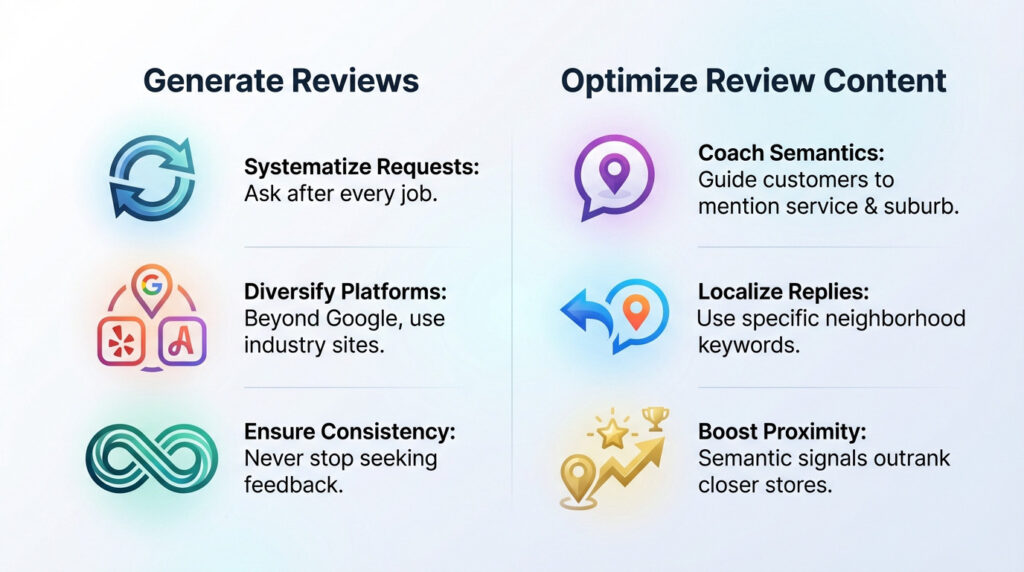
Build review requests into the moment satisfaction is highest, straight after a completed job or a successful transaction, via SMS or email tied to your POS or CRM. Avoid “review gating” (only asking happy customers, or filtering before they reach Google): it breaches Google’s policy and the ACCC’s guidance, and risks your profile. Our guide to how reviews benefit your local SEO campaign covers how to build that routine.
There’s also an AI-search angle worth knowing: AI Overviews and assistant-style results lean on entity reputation. A sudden spike in negative sentiment dents your star rating and can cost you visibility in AI-driven local results at the same time. Reputation work sits inside search visibility now.
FAQs
How do I professionally respond to a negative Google review? Acknowledge the experience, address a specific detail, offer to resolve it offline, and close on a forward-looking note. Keep it short and unemotional, the reply is for future readers as much as the reviewer.
Can I do anything about negative Google reviews? Yes, within limits. Respond to genuine ones, report policy-violating ones with the correct category, and use professional escalation for coordinated or defamatory attacks. You cannot remove a review just because you disagree with it.
Can business owners delete their own bad reviews? No. You can’t delete a review directly. You can only get one removed by demonstrating it breaches Google’s policies, or improve the picture by earning more genuine reviews.
How long does removal take? Google does not publish a turnaround. In our own casework, dashboard flagging comes back within a few days and is often auto-rejected on the first pass, while escalated and well-documented cases take longer but succeed far more often.
What happens when you report fake reviews on Google? Google checks the report against its review policies, not against the number of people who flagged it. If the review clearly breaches a policy, it comes down; if not, it stays and the next step is an escalation with a documented case. In our own casework, first-pass dashboard reports are often rejected, and well-documented escalations succeed far more often.
Does mass-reporting a review get it removed faster? No. One well-evidenced report tied to a specific policy breach is far more effective than many generic flags. Google assesses the evidence, not the number of complaints.
The Bottom Line
Respond to genuine criticism quickly and like a human, report policy-violating reviews precisely, and earn enough real reviews that one bad one stops mattering. A legitimate negative review from a real customer generally has to be answered rather than erased, and trying to force it down usually does more damage than the review itself.
If your business is facing a coordinated fake-review attack rather than ordinary criticism, that’s a specialist problem. . The removal work runs on a pay-on-success basis for fake, policy-violating or defamatory content, invoiced only after Google confirms the review is gone.