
Fake Google Reviews in Australia: The 2026 Detection & Removal Guide
Australian guide to fake Google reviews: detect AI-generated attacks, document evidence, get them removed under Google policy, and stay inside ACL.
In 2026, the most damaging fake Google reviews are not the obvious ones.
The old-school review farms with broken English still exist, but they are no longer the main problem. The bigger threat now is AI-generated fake reviews. They use clean grammar, local details, real service names, menu items, staff names, and just enough believable frustration to look like a genuine unhappy customer. That is why many of them slip through Google’s first filters.
The process for dealing with them is still the same: detect the pattern, document the evidence, report the reviews properly, appeal when needed, then build enough genuine review volume so the next attack does less damage.
What has changed is the speed required, the importance of choosing the right Google reporting category, and the legal risk around fake, incentivised, or manipulated reviews under Australian Consumer Law.
If you are under attack right now, skip ahead to the first hour checklist and the step-by-step removal process. This guide is the same practical framework we use when helping Australian businesses remove fake Google reviews through our pay-on-performance removal service.
TL;DR: detecting and removing fake Google reviews:
- Fake reviews can only be removed if they breach Google’s Prohibited and Restricted Content policy. Genuine negatives stay, by design, and trying to remove them can itself breach Australian Consumer Law.
- The appeal step is the difference between a 30% and a 70% success rate. Most guides skip it.
- Buying positive reviews to drown out an attack is actively dangerous now. Since September 2024, Google can block your new reviews, unpublish the ones you have, or put a consumer warning on your profile if it thinks you have been manipulating.
- ACL maximum penalties were significantly increased in November 2022. Anything still quoting a $10 million figure is out of date.
- Australian businesses now have a credible middle option between DIY reporting and a defamation lawsuit. That is the slot our pay-on-performance removal service is built for.
If You Are Under Attack Right Now: The First Hour
Do not reply in anger. Your reply is for future customers reading your profile next month, not the person who left the review. Get that one thing right and you have already saved the rebuild.
In the next 60 minutes:
- Screenshot every fake review. Capture the reviewer’s profile, the timestamp, the full review text. You will need this if it goes to appeal.
- Cross-reference each reviewer against your CRM, bookings, invoices, or appointment system. A no-match is your strongest piece of evidence later.
- Report each review using the correct violation reason. “Spam” is almost never right for a competitor or ex-employee attack. The right categories are in the removal section.
- If there are more than five reviews in 24 hours and the cluster is still growing, treat it as a coordinated attack. That is the point where DIY effort starts costing more than the help.
If this is more than three reviews and the pattern keeps building, Search Scope’s pay-on-performance removal service was built for exactly this situation. We do not invoice for reviews we do not get down.
Why Fake Reviews Matter More in 2026
Three things have shifted the stakes.
AI Overviews lean on entity reputation
When Google’s AI summarises “best Italian in Subiaco” or “trusted electrician Joondalup”, it is reading sentiment across your full review corpus. Not your star count. A coordinated negative spike can drop you out of AI-driven local results while the algorithm reweights you. That happens quietly. Most owners do not notice until the phone stops.
Threshold effects in the local pack
Crossing below 4.5, 4.0, or 3.5 stars triggers visible UI changes in Google Maps and search. Different colour treatments. Different ranking weight in the Local Pack and broader local search results. A push from 4.6 to 4.2 sounds like a 0.4-star drop. In the local pack it is a different tier, and the businesses sitting above you in that tier are now getting calls you used to get.
The scale
Google blocked or removed more than 240 million policy-violating reviews on Maps in 2024, over 40% more than in 2023 (which was itself up 45% on 2022). It also removed more than 12 million fake Business Profiles and placed posting restrictions on more than 900,000 accounts the same year, figures it publishes in its Maps Content Trust and Safety Report.
The catch is on the consumer side. Consumers have grown warier of reviews they can’t corroborate: BrightLocal’s Local Consumer Review Survey shows the share who trust reviews as much as a personal recommendation has fallen from 79% in 2020 to around half today (49% in 2026, after dipping to 42% in 2025). People still read reviews heavily, they just scrutinise them harder, which is why patterns matter more than star averages. A clean 4.9 with three suspicious 5-stars looks worse to a careful buyer than a 4.6 with visible negatives handled well.
Types of Fake Reviews You Are Actually Facing
The taxonomy matters because each type has a different tell, a different reporting category, and a different fix. Google’s own framing is that every review should reflect a genuine experience at the business. The categories below all fail that test in different ways, which is what gives you the basis to appeal.
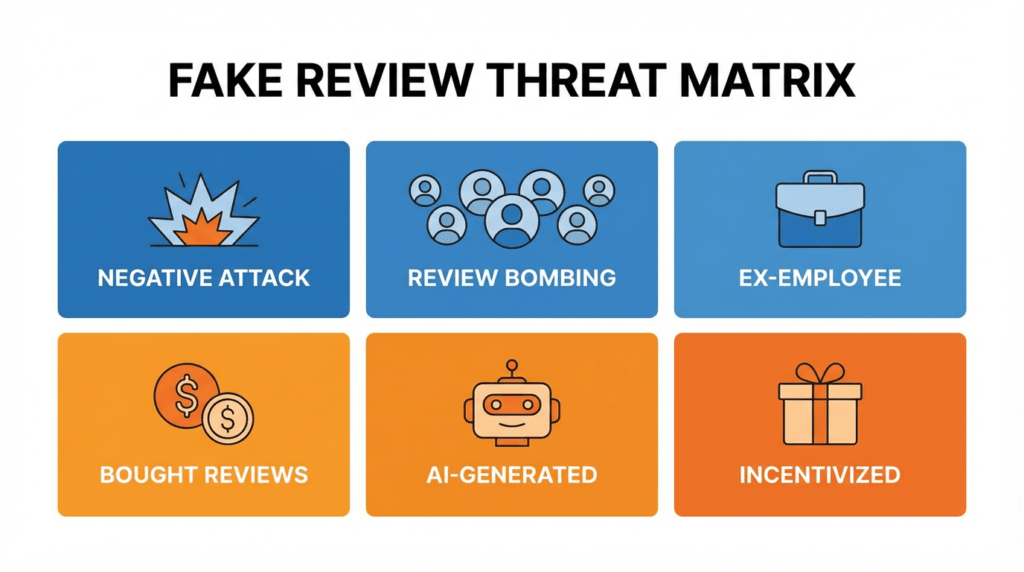
| Attack type | Tell | Google policy category | Fix |
|---|---|---|---|
| Competitor attack | Cluster of 1-stars timed to your ranking jump or their promo. Emotional language, no specifics. Fresh accounts targeting only your industry. | Rating Manipulation (Conflict of interest) | Report each review; appeal with evidence of coordinated pattern |
| Review bombing | Dozens of 1-stars in hours, often tied to a perceived public misstep. Accounts in cities you do not serve. | Fake Engagement | Report; ask trusted colleagues to also flag; document the volume spike |
| Ex-employee | Posted within weeks of termination. Real internal detail but the angle is not customer experience. | Rating Manipulation (Conflict of interest) | Report as conflict of interest, not spam. Google’s policy explicitly names “current or former employment” |
| Bought positive (on a competitor) | Sudden 5-star spike with similar phrasing across accounts. | Fake Engagement (paid in kind) | Report on the competitor’s profile; do not try to buy your way out |
| AI-generated | Perfectly clean grammar. Paragraph rhythm hits the same three or four beats across multiple “reviewers”. Posted in a tight window. | Fake Engagement (not based on a real experience) | Report each, lean heavily on the pattern in your appeal |
| Incentivised | ”Leave a review, get 10% off”. Breaches Google’s policy. Breaches ACL when the incentive is positive-conditional. | Rating Manipulation (incentive) | Report; if it is on your own profile, stop the practice immediately |
| Scam pay-to-remove | Reviewer leaves fake 1-stars, then DMs you offering removal for payment. Contact details often visible on their profile. | Fake Engagement plus Personal information | Do not pay or reply. Use Google’s dedicated extortion report form, document the demand, and report the user profile. |
A note on AI-generated reviews specifically. Modern language models can scrape your website, write a context-aware review that name-drops real menu items or staff, and vary the tone across accounts so a cluster does not look templated. Google now uses AI to fight back, it has called AI “a pivotal tool” in detection, but the attack side scales on the same technology.
That is why the appeal step matters more than it used to. Automated triage catches the obvious ones; the sophisticated ones get through unless you make the pattern visible, which is what the detection signals below are for.
How To Tell If a Review Is Fake
There is no single signal. There is a pattern. Looking at one review in isolation, you will probably get the call wrong. Looking at four or five together and asking what they have in common, the answer is usually obvious inside two minutes.
Cross-reference first
Before anything else, check your CRM, booking system, invoice records, or appointment calendar. Can you find a matching customer, transaction, or booking? If yes, the review is genuine, even if the rating stings. Respond on its merits. If no, document the discrepancy. That is the strongest piece of evidence you will carry into the appeal.
Reviewer profile red flags
- Fresh account with no review history or only reviews in your industry
- Default avatar or a profile photo with a phone number or email overlaid (that overlay is itself a Google policy breach)
- Reviewing businesses in cities far from each other within a short window
- Account that only ever leaves 1-stars or only ever leaves 5-stars
Content red flags
- Generic, emotional language without the kind of specifics a real customer would naturally include
- No reference to staff names, products, services, or details you would expect from someone who walked through the door
- Suspiciously perfect grammar paired with mechanical paragraph rhythm
- Phrasing that recurs across reviews supposedly written by different people
Timing red flags
- Multiple 1-stars within minutes or hours
- Posted after a specific external event: your ranking jump, a competitor’s promo launch, a public stance you took, a former staff member’s last day
AI-generated specific signals
- Every “reviewer” hits the same three or four discussion points in the same order
- Paragraph length is uniformly tidy across accounts
- High-school essay structure: introduction, three points, conclusion
- No idiomatic Australian phrasing where you would expect it. No “the staff were lovely”. No “great service”. Just oddly formal openers.
One caveat that catches people out. A reviewer you cannot place is not automatically fake. Some people use Google accounts under different names to their booking. Some pay with a partner’s card. Some come through a third party. Document the discrepancy. Do not accuse anyone publicly. The appeal lives or dies on whether the pattern is convincing, not on whether you are personally sure.
How To Remove a Fake Google Review (Step-By-Step)
The biggest mistake we see is picking the wrong report category. Most people go straight to “Spam”. For a competitor or ex-employee, that is almost always wrong, and it costs you the first review pass. Each fake review violates a specific Google policy section, and the appeal succeeds or fails on whether you matched the right one.
Pick the right category
| What you click in the Google UI | The Google policy section that backs it | Use this when |
|---|---|---|
| Spam | Fake Engagement | Multi-account or bot-like reviews not based on a real experience |
| Conflict of interest | Rating Manipulation (Conflict of interest) | Competitor, ex-employee, or someone with a personal or commercial stake |
| Off-topic | Off-topic | Review is about a different business or unrelated to the experience at your place |
| Personal information | Personal information | The review or reviewer profile contains private contact details, addresses, or full names of staff |
| Harassment or bullying | Harassment | Threats, intimidation, or targeted attacks on individuals |
| Discrimination or hate speech | Hate speech | Slurs or attacks based on protected characteristics |
| Profanity | Obscenity and profanity | Profanity used to offend or amplify criticism |
You can read the full list in Google’s Prohibited and Restricted Content policy.
Report Category & Appeal Builder
Picking the wrong category is the single most common reason a report fails on the first pass. Tell the tool what you’re dealing with and it returns the category to select, where to report it, and a factual appeal draft you can adapt. Our walkthrough of how to remove a Google review covers the same reporting flow for reviews that are not part of a coordinated attack.
Report category and appeal builder
Report each review through your Business Profile
From your Google Business Profile, open Read reviews, find the review, click the three-dot menu next to it, and select Report review. Match the category to the policy section, not to whatever feels closest. If the reviewer is a former staff member, “Conflict of interest” beats “Spam” every time. The wrong pick will not stop your report being looked at, but it will weaken your case on appeal.
Use the Google Reviews Management Tool
The Reviews Management Tool lets you report a review, check the status of one you have already reported, and submit an appeal in one place. Bookmark it. If you manage multiple profiles, this is faster than the in-profile flow.
Ask trusted colleagues to flag the same review
Multiple reports of the same review raise the signal in Google’s automated triage. Ask a couple of colleagues or trusted contacts to also report the review using the same category. Do not orchestrate this at scale and do not coach people to leave reviews of any kind. The goal is two or three reports, not twenty.
Document everything
Save the screenshot, the URL, the timestamp, the reviewer profile URL, and the result of your customer database check. You will need this for the appeal in roughly half of cases. The version of “everything” that gets removals approved is specific. A screenshot is worth more than your memory of what the review said three days ago.
Then wait, but do not ignore
Obvious violations are usually removed within 24 to 48 hours. Borderline cases can take up to two weeks. Google does not publish official service-level agreements on any of this, so treat any “guaranteed in 48 hours” claim from a service with caution.
While you wait, respond once in public, calmly. We cover the response in the public reply section and in detail in our Google review response templates.
When Google Rejects Your Report: The Appeal Flow
Google rejects a meaningful portion of first-pass reports. We’ve removed over 500 negative reviews from Australian and international profiles since early 2025, and most successful cases involved at least one appeal round before Google confirmed. That is not a reason to give up: the appeal step is where most removals actually happen, even though it is slow and unglamorous.
Where to appeal
Open the Reviews Management Tool, choose “Check the status of a review I have already reported”, find the rejected review, and click Submit an appeal.
What to write in the appeal box
You have a small text box. Treat it like a brief, not a complaint letter. Three sentences is usually enough.
A worked example for a competitor attack:
This review breaches Google’s Rating Manipulation policy under Conflict of Interest. The reviewer “[Name]” is not present in our customer database, booking system, or invoice records for the past 24 months. The same account has left identical-pattern 1-star reviews for three other [industry] businesses in our suburb within the same week, all of which are direct competitors to a single business operating at [address].
For an ex-employee:
This review breaches Google’s Rating Manipulation policy under Conflict of Interest, which explicitly covers current or former employment. The reviewer was employed by [Company] from [start date] to [end date]. We can provide internal HR records on request. The review references internal operational matters and was posted four days after the reviewer’s last shift.
For an AI-generated cluster:
This review breaches Google’s Fake Engagement policy as it is not based on a real experience. The reviewer is not present in our customer database. The same paragraph structure, sentence rhythm, and reference points appear across four 1-star reviews posted between [date] and [date], all from accounts created within the same week with no other review history.
Stay factual. Name the policy breach. One or two concrete pieces of evidence is enough. Skip the emotion. The person on Google’s end is paid to assess whether the policy was breached, not to take sides. Give them the policy section, the breach, and one piece of evidence per sentence.
If the appeal also fails
Escalate via the Business Profile support contact form if the volume justifies it, document the pattern, and work out whether bringing in help is faster than another round of DIY. We get to that decision in When To Bring In Help.
Don’t Respond In Anger: The Public Reply
Your reply is for future customers, not the reviewer. If the reviewer is fake or a bot, they are not reading it anyway. Everyone else is, including the careful buyer who scrolls down to see how you handle complaints.
Three sentences is enough.
Hi [Name], thanks for the feedback. We have checked our records carefully and cannot find any interaction matching this account. If you have engaged us under a different name, please email us at [email] so we can look into it directly.
What not to do:
- Do not publish any customer name, phone number, or order detail in the reply. That has privacy implications and breaches Google’s policies on personal information.
- Do not accuse the reviewer of being fake in public.
- Do not promise to “take this offline” without giving them a way to actually contact you.
- Do not reply more than once. The aim is calm, not engagement.
For the full response framework we use with clients, including the C.A.R.E. structure, see our guide to handling negative Google reviews.
Australian Consumer Law: What Is Actually Illegal in 2026
The penalty regime here changed materially in late 2022, and a lot of the SEO content still in circulation quotes a figure that is no longer accurate.
What is illegal
Under the ACCC’s online reviews guidance and Section 18 of the Australian Consumer Law, it is illegal for a business to:
- Create fake or misleading reviews about itself
- Arrange for others to create fake or misleading reviews
- Selectively suppress or remove genuine negative reviews to mislead consumers
- Offer incentives conditional on a positive review
Each of these can be a stand-alone breach of Section 18, and each can violate Google’s Fake Engagement and Rating Manipulation policies in parallel. You can be wrong with the platform and wrong with the regulator at the same time.
Incentives are allowed if they apply equally regardless of whether the review is positive or negative, and the incentive is clearly disclosed. “Leave a review and get 10% off, whatever you say” is fine. “Leave a 5-star review and get 10% off” is not.
The penalty regime (effective 10 November 2022)
The Treasury Laws Amendment (More Competition, Better Prices) Act 2022 increased ACL penalties roughly fivefold. The current maximums:
For corporations, the greater of:
- $50 million, or
- 3 times the value of the benefit obtained from the conduct, or
- if the benefit cannot be determined, 30% of adjusted turnover during the breach period.
For individuals: up to $2.5 million per contravention.
These are maximums, not expected outcomes. Courts apply them based on the seriousness of the conduct, the harm caused, and the deterrent effect required. The ceiling matters because it shapes settlement positions and ACCC enforcement priorities, not because most cases come close to it.
A real example. In late 2024, the Federal Court ordered Bloomex Pty Ltd to pay $1 million in penalties for misleading star ratings on its website and other misconduct, after ACCC action. The detail is in the ACCC’s media release on the Bloomex penalty.
What the ACCC actually does (and does not do)
The ACCC investigates systemic or serious misconduct. It does not resolve individual review disputes. It does not act as a referee between a business and a single reviewer. Complaints that show a pattern of misleading conduct are more likely to attract enforcement attention than one-off matters.
The trap on your side is just as important. Removing or suppressing genuine negative reviews to mislead consumers can itself breach the ACL. That is why our removal service only touches fake, policy-violating, or defamatory content. Genuine negatives are off-limits for us, by design, because helping a client remove them would be helping them break the law.
Can You Sue? Australian Defamation in Plain English
This is the question we get most often. The answer is more nuanced than most guides admit.
What changed in 2021
Most Australian states adopted Stage 1 of the defamation reforms on 1 July 2021 (NSW, Victoria, South Australia, Queensland, Tasmania, ACT). Western Australia and the Northern Territory have not adopted the Stage 1 reforms, so the serious harm threshold and the corporate standing rule below do not currently apply in either jurisdiction, businesses there are still governed by the older, unreformed defamation rules. Check with a local defamation lawyer before assuming the rest of this section applies to you.
Two changes matter for fake reviews.
Who can actually sue
Corporations can sue for defamation only if:
- They have fewer than 10 employees, and
- They are not associated entities of another corporation.
That excludes most franchised businesses, most groups, and most companies with a moderate headcount. Individuals (you personally, named staff members) can sue, but the corporate entity often cannot. This catches a lot of business owners by surprise. If you operate as a Pty Ltd with 14 employees, the company has no standing. You as a director, and any named staff member in the review, may still have standing personally.
The serious harm threshold
Even where a corporation can sue, it must now establish that the publication caused, or is likely to cause, serious financial loss. Individuals must establish serious harm to reputation. The threshold is decided by a judicial officer before the trial begins, and the bar is meaningfully higher than it used to be. A single 1-star review with no demonstrable customer drop-off is not enough. A coordinated attack that costs you a major contract or a measurable revenue dip is the kind of evidence that gets traction.
The concerns notice
Before commencing proceedings, you must serve a concerns notice on the publisher. The notice identifies the defamatory imputations, the harm you say has been caused, and the outcome you are seeking. A well-drafted concerns notice often produces a takedown without litigation, which is usually the practical step. Sprintlaw has a reasonable plain-English summary of how it works.
When defamation is actually worth pursuing
In practice, defamation is the right path when:
- The review contains specific false statements of fact, not just negative opinion
- The reviewer is identifiable or can be identified through legal process
- The harm is serious and demonstrable
- The named staff or the small-business entity has standing
- A platform removal has already failed
Litigation is expensive, slow, and public. Even a concerns notice and lawyer letter often costs more than a removal service, and the success rate depends on whether the reviewer is reachable. For most fake-review attacks, defamation is the third option, not the first.
When Fake Reviews Trigger a Google Business Profile Restriction
This is the risk most owners miss, and it is the reason “drown them out with bought 5-stars” went from unethical to actively dangerous in September 2024.
What changed in September 2024
Google added a policy on Business Profile restrictions for policy violations. If Google decides that a Business Profile has violated its Fake Engagement policy, it may apply one or more of the following restrictions:
- Block the profile from receiving new reviews or ratings for a set period
- Unpublish the profile’s existing reviews or ratings for a set period
- Display a consumer-facing warning on the profile stating that fake reviews were removed
Google notifies the business owner by email if a restriction is being applied. There is an appeal pathway, but the appeal is a separate process and the restriction takes effect while you wait.
The industry shorthand for this is “review jail”. Google does not use that term. Its actual language is “Business Profile restrictions for policy violations”, and that is the language to use when appealing or talking to support.
Why this matters for fake-review victims
It is a two-way trap.
If you buy Google reviews or coordinate a flood of positive reviews to dilute a competitor’s fake 1-star attack, Google’s pattern detection can read the spike as your manipulation. You end up with the restriction, your competitor walks away clean, and the consumer warning on your profile stays visible during the worst possible weeks for your reputation.
If a competitor floods you with fake 5-stars deliberately, Google’s automated triage can misread the pattern in the other direction. You end up with the restriction even though you did nothing.
This is one of the reasons we take a hard line on never buying reviews under any circumstances, even in response to an attack. The risk has shifted. The platform now actively punishes the response that used to be the obvious one, and the punishment is visible to the consumer.
When restrictions escalate to a suspension
A restriction can escalate to a full Business Profile suspension if the pattern continues. A suspended profile disappears from Google Maps and search entirely. That is a different problem, and it is the one our Google Business Profile reinstatement service was built for.
Recovery there runs with a money-back guarantee: the fixed fee is paid upfront and fully refunded if we don’t get the profile back, with a 98% success rate across 230 of 234 Australian profiles since early 2025.
When To Bring In Help: DIY vs Service vs Lawyer
There is no single right answer. It depends on the scale, the type of attack, and how much of your week you want to spend on it.
| Situation | DIY makes sense | Removal service makes sense | Lawyer makes sense |
|---|---|---|---|
| One or two fake reviews, clear policy breach | Yes | Probably not worth it | No |
| Coordinated attack (5+ in days) | Possible but slow | Yes | Only if defamatory |
| AI-generated cluster | Possible if you have time | Yes (pattern evidence is the win) | No |
| Repeated Google rejections | If you have the patience | Yes | No |
| Defamatory content with named staff | No | Maybe alongside legal | Yes |
| Threats or criminal allegations | No | No | Yes |
| Small business (<10 employees) with serious financial loss | No | Maybe in parallel | Yes |
A few honest notes on the middle option.
Search Scope’s service to get fake Google reviews removed exists for the gap between DIY and litigation. The structure is straightforward:
- We only take on fake, policy-violating, or defamatory reviews. Not genuine negatives. ACCC compliance is non-negotiable.
- Risk sits with us. Pay-on-performance means we do not invoice for reviews we do not get down.
- The work is operator-led, not automated. Each review gets a category match, an appeal-text-ready evidence pack, and follow-up.
That is the offer, framed honestly. It is not the right fit for every situation. It is the right fit when DIY effort is costing you more than the help would, and when the scale or technical complexity of the attack means a wrong category pick could sink the appeal.
Prevention: Build a Profile That Absorbs the Hit
The most underrated defence against fake reviews is structural. A profile sitting on 4.7 stars across 600 genuine reviews absorbs three fake 1-stars almost invisibly. A profile sitting on 4.7 across 30 reviews drops to 4.4 from the same attack. Volume is not a vanity metric. It is shock absorption.
Build genuine review volume
Ask every customer for a review on Google after a successful interaction. Make it easy. Use the Google review short link, send it the same day, and follow up once if there is no response. The full breakdown is in our guide to earning more Google reviews.
Do not condition the ask on a positive rating. Do not pre-screen. Do not “review gate” by asking happy customers to leave a review and unhappy ones to email you directly. That is a Google policy breach, an ACCC misleading-conduct risk, and it shows up in the data once you scale it. Google is the primary review platform that matters for most Australian local businesses, but the same principle applies on Facebook, Yelp, or any industry-specific platform you use.
Monitor weekly
Set a recurring 15-minute slot to:
- Open your Business Profile and scan new reviews
- Note any unusual patterns: clustered timing, accounts with no other reviews, reviewers in cities you do not serve
- Check your average rating trend in the dashboard
A Google Alert on your brand name catches mentions off-platform. If you have multiple profiles, the ongoing online reputation management work we do for clients covers the monitoring layer plus the response and removal layer.
Do not selectively suppress genuine negatives
This is the ACCC trap. If you have a system, a process, or a person whose job is to remove or hide genuine negative reviews to keep the average up, you are exposed under Section 18 of the ACL. Respond to genuine negatives. Learn from them. Let them sit. They build trust with the next customer reading.
BrightLocal’s 2025 US survey found 89% of consumers expect business owners to respond to both positive and negative reviews. That figure tracks roughly with what we see in Australian buyer behaviour, even allowing for the sample. Responses do more for trust than the rating itself. A 4.4 with thoughtful owner responses to negative reviews often converts better than a 4.8 with no replies at all.
Frequently Asked Questions
Can Google actually remove fake reviews?
Yes, but only reviews that breach Google’s Prohibited and Restricted Content policy. Genuine negative reviews from real customers cannot be removed and should not be removed. Trying to suppress them can itself breach Australian Consumer Law.
How long does Google take to remove a fake review?
Obvious violations are typically removed within 24 to 48 hours. Borderline cases can take up to two weeks, and some reports are rejected outright. Google does not publish official service-level agreements, so treat any “guaranteed timeframe” claim with caution.
What should I do if Google rejects my report?
Use the Reviews Management Tool to submit an appeal. State the policy breach, give one or two concrete pieces of evidence (no record in your customer database, or a pattern of multi-business targeting), and stay factual. The appeal step is where most removals actually happen, but most guides skip it.
Is it illegal to post a fake Google review in Australia?
Yes. Under Section 18 of the Australian Consumer Law, posting fake reviews about your own business or arranging for others to do so is misleading or deceptive conduct. Maximum penalties for corporations are the greater of $50 million, 3 times the benefit obtained, or 30% of adjusted turnover. Individuals face up to $2.5 million.
Can I sue someone over a fake Google review?
Possibly. Corporations can only sue if they have fewer than 10 employees and are not associated entities of another corporation. Individuals (you personally, named staff) can sue, but you have to establish serious harm and serve a concerns notice before commencing proceedings. Defamation is rarely the first step. A concerns notice and lawyer letter usually comes first.
Can a competitor’s fake reviews get my Google Business Profile suspended?
Indirectly, yes. Since September 2024, Google has applied Business Profile restrictions for policy violations, which can include blocking new reviews, unpublishing existing ones, or displaying a consumer warning. If a competitor floods you with fake 5-stars and Google misreads the pattern as your manipulation, you can be hit with a restriction. Recovering from that is possible, but it is a separate problem.
Can you trace who left a fake Google review?
Sometimes. Some attackers leave footprints: other reviews on competitor profiles, identifiable phrasing patterns, public profile detail. Google does not give you IP-level data, and a VPN can hide the reviewer’s location entirely. Tracing usually means circumstantial evidence, which can be enough for a concerns notice but is rarely enough for a court.
How much does it cost to remove a Google review?
DIY is free, but it costs your time. A pay-on-performance removal service like ours does not charge for reviews we do not get down. A defamation lawyer’s concerns notice typically starts in the low thousands, and litigation runs into tens of thousands. The right option depends on the scale and the type of attack.
Bottom Line
Fake Google reviews are not going away in 2026. AI has made them faster to produce and harder to spot. Google’s detection has improved at the same rate, but the obvious ones get caught and the sophisticated ones survive.
The DIY playbook works on isolated cases. The appeal step matters more than the initial report. Australian Consumer Law is on your side as a target, and constrains you as a business operator, in roughly equal measure.
If you are under coordinated attack and the DIY effort is starting to cost more than the help, our pay-on-performance removal service was built for this slot. We only take on fake, policy-violating, or defamatory content, and the risk sits with us. If the attack has already triggered a Business Profile restriction or suspension, restoring the profile is the next step.
If you want to talk through what kind of attack you are facing and which option fits, or email seo@searchscope.com.au.