
How to Use Google Posts for Seasonal Promotions Without Looking Spammy
How to run seasonal Google Business Profile Posts for an Australian business without the spammy feel: AU calendar, cadence, what to post, and how to measure.
A well-timed seasonal Google Business Profile Post can put your business in front of a customer at exactly the moment they are searching for what you do. A poorly timed one looks like noise and gets ignored, or worse, makes your profile feel cluttered. The line between the two is mostly planning.
This is the practical version for Australian businesses: how to align Google Posts with the AU calendar that actually matters (Boxing Day, EOFY, Anzac Day, Melbourne Cup, Fringe World, the AFL Grand Final), what to actually write in each post, how often to post, and how to tell whether any of it is working. For the broader case on whether Google Posts move rankings at all (short answer: they support engagement and visibility, the ranking effect is indirect), our Google Business Profile Posts guide goes deeper.
TL;DR — using Google Posts for seasonal promotions:
- Plan the posts around the AU calendar, not the US one. Boxing Day, EOFY, Australia Day and Melbourne Cup pull more local intent than Black Friday for most AU businesses.
- One main message per post, with a real photo (not stock), a clear action, and no hashtag soup.
- Weekly is enough for a baseline cadence. Lift to two or three a week in the lead-up to a major seasonal event.
- Anzac Day is a remembrance day, not a sale event. Acknowledge respectfully or stay quiet.
- Track the metrics in your Business Profile Performance report (views, calls, direction requests) to see what actually drove action.
The Australian seasonal calendar that matters
The Australian retail and search calendar does not mirror the US one. Customers here search around the dates that genuinely move them, which means Boxing Day matters more than Black Friday, the End of Financial Year (EOFY) matters more than Tax Day, and Anzac Day matters more than Memorial Day, in a very different tonal register.
A practical posting calendar for an Australian business:
| Season | Dates worth posting around | Tone and content angle |
|---|---|---|
| Summer (Dec to Feb) | Christmas, Boxing Day, New Year, Australia Day, Back to School | Sales and post-holiday clearance through January; back-to-school in late January |
| Autumn (Mar to May) | Easter, Anzac Day, Mother’s Day | Easter trading hours, Mother’s Day promotions, Anzac Day handled with respect, not as a sale |
| Winter (Jun to Aug) | EOFY (30 June), school holidays, Christmas in July | EOFY tax planning for services, EOFY clearance for retail, winter-specific service offers |
| Spring (Sep to Nov) | AFL Grand Final, Father’s Day, Melbourne Cup, Click Frenzy, Black Friday and Cyber Monday | AFL and Melbourne Cup for hospitality and event venues; Father’s Day promotions; Click Frenzy is the AU-specific sale window |
Two notes on tone. Anzac Day: do not run a Boxing-Day-style sale post. If you post at all, it is a quiet acknowledgement. Many AU businesses simply do not post anything that day. Black Friday and Cyber Monday: these now do drive AU search traffic (Click Frenzy in particular has educated AU shoppers on the late-November sale window), but they sit on top of Boxing Day, they do not replace it.
What a good seasonal post actually looks like
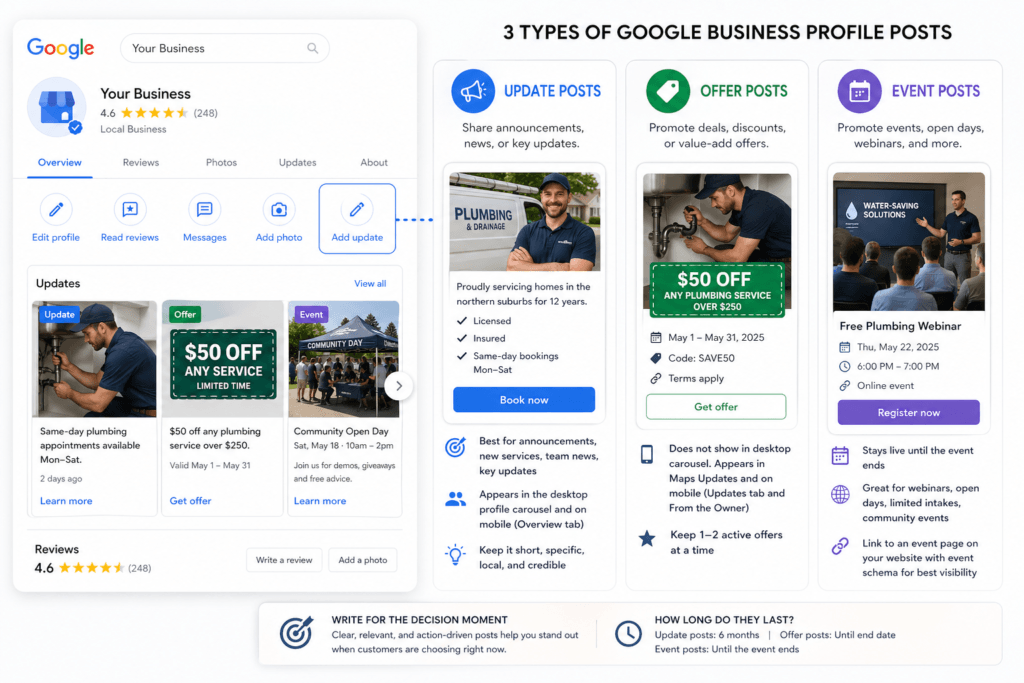
The structure of a high-engagement Google Post is consistent across categories:
- One main message. A single, clear offer or update. “20% off all winter coats until Sunday” outperforms “Winter is here, check out our latest range plus our new arrivals plus our gift cards”.
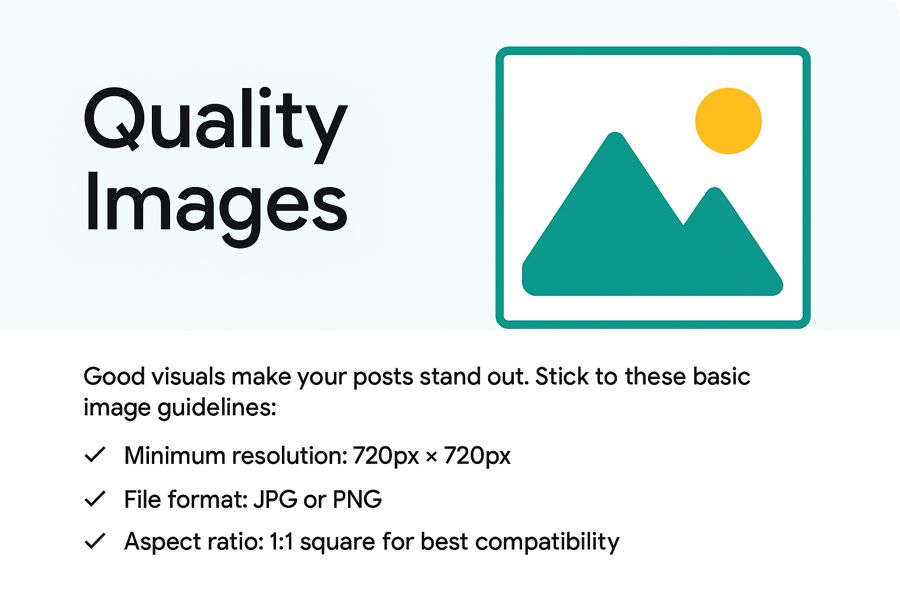
- A real photo. Your shop, your team, your work. Stock images are a tell, and Google’s own photo guidance notes that real photos drive more engagement. Aspect ratio: square (1:1) or 4:3 displays cleanest; minimum 720x720 pixels; JPG or PNG.
- A short headline. Aim for under 60 characters so it displays cleanly in mobile previews. “EOFY Tax Planning, Free 30-Min Consult” reads better than “End of Financial Year is approaching and we are offering free 30-minute tax planning consultations to all our local clients in the Perth area”.
- A clear call to action. Google Posts offer specific action buttons (Book, Order online, Buy, Learn more, Sign up, Call now). Pick the one that matches the post.
- No hashtags or emoji clutter. Google Posts are not Instagram. One or two emoji at most if it fits your brand voice; zero hashtags. Customers do not click hashtags on Google.
A few examples that work for AU businesses:
| Business type | Seasonal post that works |
|---|---|
| Mechanic | ”Pre-roadtrip safety check from $89, before Christmas trips out west” with a real photo of a car on a hoist |
| Cafe | ”Fringe World late-night menu, 9pm to midnight, open through the festival” with a photo of the actual late-night setup |
| Accountant | ”EOFY checklist for sole traders, free download, book a consult by 30 June” with a clear date |
| Plumber | ”Winter pipe-burst emergency cover, $200 fixed callout, weekends and after-hours” with a real “before/after” photo |
How often to post
Cadence is one of the biggest sources of overdoing it. Practitioner consensus and our own data across Search Scope clients line up roughly as follows:
- Baseline cadence: one post a week, every week, regardless of season. This keeps the profile looking active without saturating.
- Pre-event ramp: two to three posts a week in the seven to ten days before a big seasonal event (Boxing Day, EOFY, Mother’s Day, Father’s Day, Melbourne Cup for hospitality). One announcement, one reminder, one last-call.
- Post lifespan: Google Posts visually expire after about seven days for most categories (Offers and Events post types have explicit start and end dates). If you are running an Australia Day promotion, start the campaign five to seven days before the date and refresh it the day before, do not post once on the morning of and hope.
Past a certain point, more posts hurt rather than help. We have seen profiles where the owner posts daily for a month and Performance metrics drop because customers stop engaging.
Schedule posts natively, no third-party tool required
Until 2025, scheduling Google Posts ahead of time meant paying for a third-party social media tool. Google rolled native scheduling and repeating-posts features directly into the Business Profile dashboard through late 2025 and early 2026 (Grand Cru Digital walkthrough).
Two practical implications:
- Sit down once a month and schedule the next four weeks. Pick the post type, write the headline and body, attach the photo, choose the CTA, then use the new “Schedule” toggle below the post description to pick the publish date and time.
- Set evergreen offers to repeat. If you have a standing “10% off first booking” offer or a weekly “Friday late-night menu” Event, set it as a repeating post so it republishes automatically as newer posts push it down the profile. This keeps the offer at the top without manual re-creation.
Both features are free and built into the dashboard. The old workflow of pasting drafts into a third-party social scheduler each week is obsolete for Posts in 2026.
What to track
Open your Business Profile Performance report and look at four metrics for each post:
- Views. How many people saw the post in Search or Maps.
- Clicks on the action button. Did the Book / Order / Call now actually get used?
- Calls and direction requests during the post window. Did profile actions go up while the post was live?
- Search terms during the post window. Some seasonal posts pull in different search queries than your baseline; the Performance “search terms” view shows you which.
Be honest about the limits here. Google’s Performance report has been progressively throttled through 2025 and 2026 for smaller profiles, so for a low-volume business you may only see the top handful of terms. Triangulate with Google Search Console queries for your matching landing pages and conversion tracking on your site for what actually converted from those clicks.
The other thing worth doing: write down which posts you ran in a simple spreadsheet (date, post type, headline, photo used, action button) so when you look at the metrics three months later you can spot what worked. Posts older than six months are archived from the dashboard view by default; if you only rely on what you can see today, you lose the comparison.
Where Posts fit in AI search (the 2026 angle)
The reason consistent posting matters more in 2026 than it did in 2022 is that the same Post content now feeds two systems instead of one.
Google’s Local Pack is system one. AI Overviews, ChatGPT, Perplexity and Gemini’s “Ask Maps” feature are system two, and they actively pull Business Profile data, including recent Posts, when someone asks an AI assistant a local question.
Two practitioner sources have confirmed this in 2026:
- Digital Applied’s analysis of the March 2026 Core Update found profiles publishing at least two posts per month showed measurably higher GBP completeness scores post-update, and completeness now directly affects pack visibility.
- SEO Sydney’s 2026 GBP guide documents the same pattern: AI Overviews, ChatGPT and Perplexity all reference Business Profile + Google Maps data when answering “best emergency electrician near Leichhardt” type queries, and stale profiles get deprioritised.
Practically: an Offer Post running for Boxing Day shows up in Search and Maps for the seven days it is visually prominent. It also becomes the freshest “what’s this business doing right now?” data point an AI assistant can quote when a Perth customer asks ChatGPT for a Boxing Day deal in their suburb.
That is a new reason to keep the cadence steady.
A note on what Google Posts do not do
The definitive practitioner data on this comes from a 9-week, 441-keyword controlled study Sterling Sky ran on whether Google Posts directly improve Local Pack rankings.
The finding, now cited across multiple 2026 local SEO writeups: zero direct ranking impact. Posting weekly will not move you up the pack on its own.
What the study (and the 2026 Whitespark Local Search Ranking Factors survey) does support is the indirect effect. Posts drive clicks, calls and direction requests, and those behavioural signals are now a meaningful ranking input, climbing fast in the Whitespark 2026 weighting.
So Posts work, but as a behavioural-engagement lever rather than a freshness-signal lever. The cadence advice in this guide is calibrated for that reality: post often enough to keep the engagement surface alive, not often enough to chase a non-existent ranking bonus.
What they do is:
- Keep the profile looking active, which is a soft trust signal
- Give customers a reason to tap and engage (calls, direction requests), and behavioural engagement is increasingly a ranking input
- Surface time-sensitive offers in Search and Maps without paid spend
- Give you a content surface to test seasonal messaging cheaply before scaling it to ads or email
Treat them as part of the broader GBP optimisation work, not as a standalone tactic.
The trap most businesses fall into
The single most common pattern we see on neglected Australian profiles is a posting flurry, two weeks of daily posts after the owner reads an SEO article, followed by six months of silence. Both halves of that pattern are unhelpful. Consistency beats intensity.
The second most common trap is recycled stock-photo posts with vague “Visit us today!” CTAs. Generic posts do not pull engagement; specific ones do. “Open until 9pm tonight for AFL Grand Final” beats “Visit us today” every time.
Where Search Scope fits
We build the seasonal posting plan and run it as part of our Google Business Profile optimisation work for clients. If your profile is sitting quiet between sales events and you would rather have someone keep it active with posts that actually drive calls, book a call and we will map a 12-month posting plan around your real calendar.