
How to Get More Google Reviews for Local SEO (Australia, 2026)
A practical, ACCC-compliant playbook for Australian local businesses: build review velocity, ask the right way, automate without breaching policy, and turn Google reviews into local ranking signal.

Reviews used to be social proof. They still are, but in 2026 they’re also one of the clearest entity signals Google has about a local business, and they feed directly into AI Overviews and the assistant-style answers that increasingly sit between you and the customer. Review count, recency, rating, response rate and the actual language inside the reviews all get parsed and used. BrightLocal’s 2026 Local Consumer Review Survey found 97% of consumers read reviews for local businesses, and AI tools like ChatGPT have jumped from 6% to 45% as a source of business recommendations in a single year.
That changes the goal. You’re no longer collecting stars for a sidebar widget. The job is building a steady, compliant stream of genuine feedback that tells Google, and the models reading Google, what your business does, where you do it, and how well. That’s what it actually means to get more Google reviews in 2026: not one big push, but a stream that holds up over months. This guide is the playbook for doing that without breaching Google’s policies or, more relevantly in Australia, the ACCC’s guidance for business on online reviews.
If you’d rather have someone run this for you, our online reputation management service does exactly that.
What Actually Moves Local Rankings
Google has never published a precise weighting for reviews, but the patterns are clear enough. The 2026 Local Search Ranking Factors study by Whitespark, the closest thing the industry has to a consensus, puts review signals at 20% of map pack ranking weight and 16% of AI search visibility, second only to on-page content for AI. That’s not a small lever.
Four levers matter more than the rest.
Review velocity. A business getting two or three reviews a week looks alive. A business that got 80 reviews in 2022 and nothing since looks dormant. Velocity matters more than total count past a certain threshold. Momentum is the signal.
Recency. Reviews decay, and consumers behave the same way. BrightLocal’s 2026 data (US panel, but the pattern travels) shows 74% of consumers only consider reviews written in the last three months, and 32% only look at reviews from the past two weeks. A glowing five-star from 2021 is doing very little for you in 2026.
Response rate. Replying to reviews, every review, not just the easy ones, is a sign of an active, monitored business. 80% of consumers say they’re more likely to use a business that responds to all its reviews, and 42% are actively put off by silence. It also gives you a second pass at including service and location language in a way the model can read.
Average rating, with caveats. Volume without quality breaks. A 3.4-star average sinks click-through regardless of how many reviews you have. In 2026, 31% of consumers say they’ll only use a business with 4.5 stars or more, up from 17% the year before. The practical trust zone for most categories sits between 4.2 and 4.7: above the threshold most consumers now screen on, below the 5.0 that increasingly reads as bought.
Anyone telling you there’s a magic number of reviews to “unlock” the local pack is making it up. The signal is the pattern, not a count. BrightLocal does flag one number worth knowing: 47% of consumers won’t use a business with fewer than 20 reviews. Below that threshold, you’re working uphill regardless of rating.
Plan Your Review Velocity
Velocity is the lever, so it helps to see the maths for your business. Plug in your numbers and this estimates how many reviews a week you’ll earn and when you’ll hit your target.
Review velocity planner
The Complete Review Profile
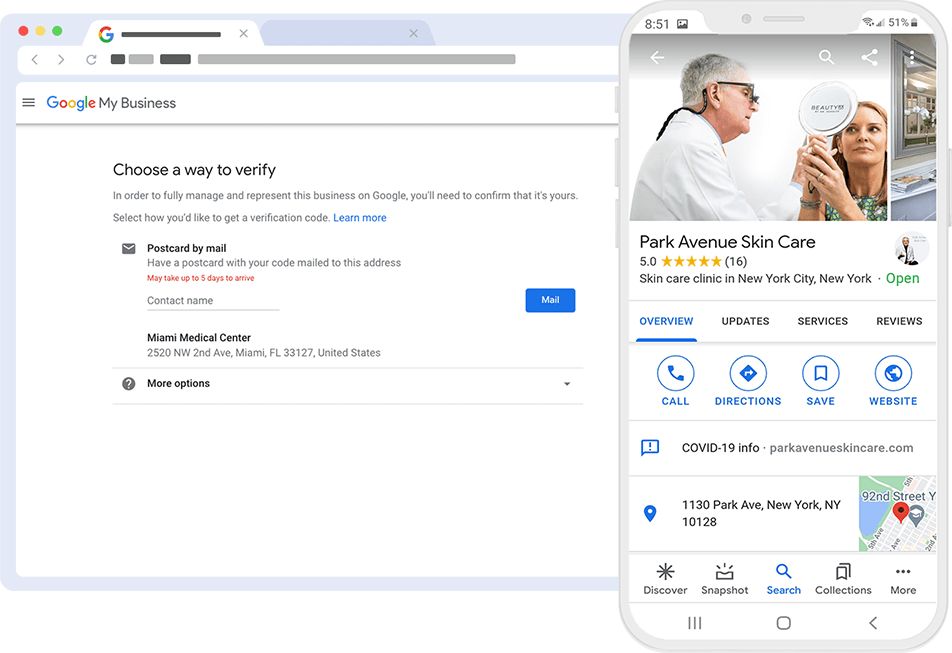
Before reviews can do their job, your Google Business Profile has to give them somewhere to land. A half-finished profile dilutes every review you earn.
The non-negotiables:
- Verified. Google won’t show your full profile or let you respond to reviews until verification is complete. Video verification is the current default for most categories.
- NAP consistency. Name, address and phone identical across your website, GBP, and major directories. Mismatches confuse the entity graph.
- Categories. Primary category set to the closest match for what you actually do, plus secondary categories for genuine adjacent services. Keywords in your selected services jumped 75 positions in the 2026 LSRF, so this is one of the higher-impact things to get right.
- Services and products. Each service listed with a short, plain-English description. This is where Google picks up keyword associations that match the language inside reviews.
- Photos. Exterior, interior, team, work-in-progress, finished result. Profiles with more photos earn more clicks.
- Hours, including public holidays. Wrong hours generate negative reviews on their own. Someone drove to your shop, found it closed, and now you’re a one-star. Business open at the time of search is now a top-five map pack factor in the 2026 study.
This is the foundation. Reviews land on top of it.
How to Ask Without Breaching ACCC or Google Policy
This is the section most “get more reviews” guides get wrong. In Australia, the rules sit in two stacked layers, and you have to clear both.
Google’s review policies prohibit incentives (“get $10 off when you leave a review”), buying reviews, soliciting from people who aren’t actual customers, and review gating, which is funnelling happy customers to Google while diverting unhappy ones to a private form. The full list sits in Google’s prohibited and restricted content policies.
The ACCC’s guidance goes further. Under Australian Consumer Law, businesses cannot:
- Offer incentives, discounts or freebies in exchange for reviews
- Filter or screen feedback so only positive reviews reach the public
- Remove or suppress genuine negative reviews to mislead consumers
- Publish reviews written by yourself, staff, family or contractors without disclosing the relationship
The penalties for breaching ACL on reviews are real. The ACCC has pursued businesses for misleading-conduct on review handling, and treats it as an ongoing compliance priority. Treating reviews as a Google-policy issue only is the wrong frame in this market.
What you can do is ask for reviews. Politely, directly, at the right moment, with no strings attached. And it works. BrightLocal’s 2026 data shows 78% of customers were asked for a review in the past 12 months, and 65% of those asked actually wrote one. Asking is the single biggest lever you have.
Sample script for retail and hospitality:
“If you’d be open to leaving us a quick Google review, it genuinely helps other locals find us. Either way, thanks for coming in today.”
For trades and home services:
“Glad we got that sorted. If the work’s holding up the way it should over the next few days and you’d be open to leaving us a Google review, it really helps us out. No pressure.”
For professional services at end of engagement:
“It was good working with you on this. If you’ve got a minute and you’d be happy to leave a Google review covering what we worked on, it helps the next person finding us know what to expect.”
No discount, no promise, no “only if it’s five stars.” The “either way” or “no pressure” framing matters. It makes clear there’s no consequence to saying no, which is what keeps you on the right side of ACL.
Timing rules of thumb:
- Retail and hospitality: within 24 hours of the transaction, while the experience is fresh
- Trades and home services: three to five days after the job is complete, once the customer has seen the result hold up
- Professional services: at the end of the engagement, when the outcome is clear
- Bookings and appointments: the next day, with a direct link
For more variations by industry, our sister post on how to ask your clients for Google reviews goes deeper.
Where to Put Your Review Link
You can find your direct review link inside Google Business Profile Manager. Sign in, go to the profile, click Read Reviews, then Get more reviews. Google generates a short link and a downloadable QR code on the same screen. Copy the link, run it through a free shortener if you want it to fit on physical material, and save the QR file for print. Google’s tips to get more reviews covers the same path if you’d rather follow their wording.
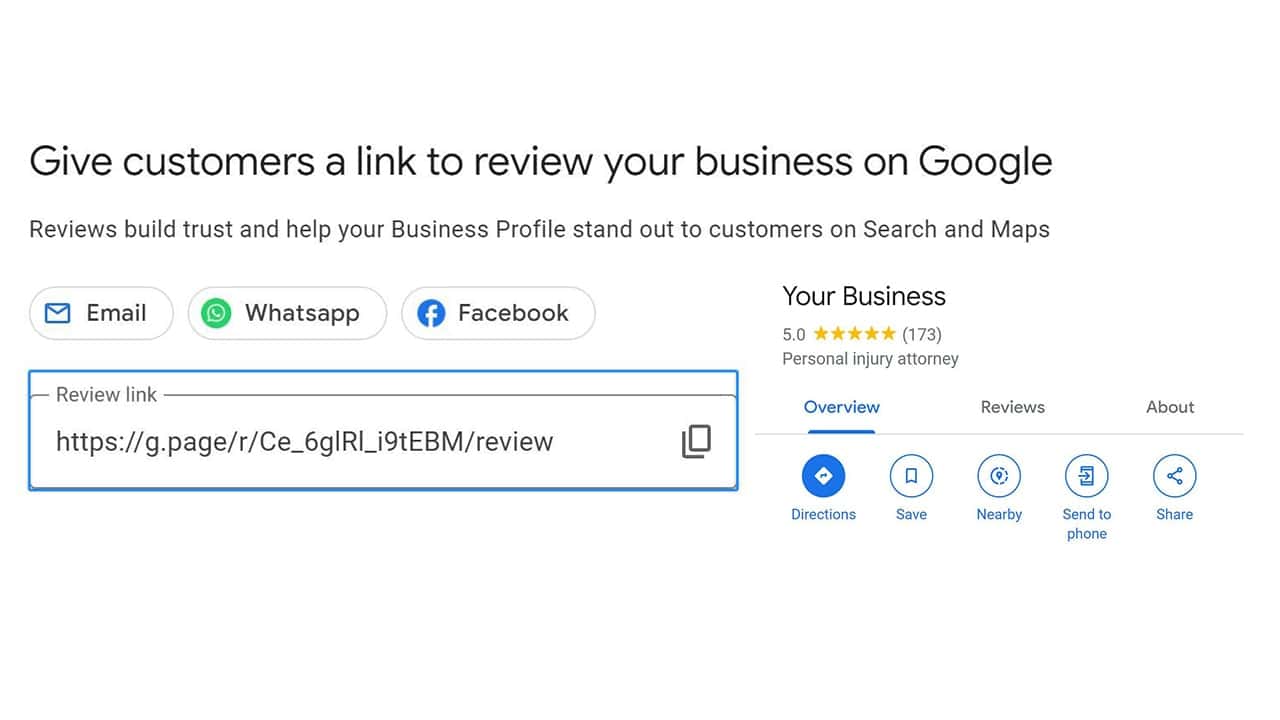
Then put it everywhere a customer naturally interacts with you. The point isn’t to nag. It’s to make leaving a review easy for customers in the moment they actually want to say something.
Digital touchpoints:
- Email signature, every team member
- SMS follow-up the day after a transaction or job
- Order or booking confirmation emails
- Website footer and contact page
- Receipt or invoice PDFs
Physical touchpoints:
- QR code at the counter, on a table tent, or near the exit
- QR code on receipts, invoices, business cards
- QR code stickers on service vehicles, weather-proofed if they live outside
- Thank-you cards in packaging
The QR codes do real work in Australia. They’ve been embedded in daily life since 2020 and most customers will scan without hesitation. Keep them at least 3 × 3 cm so they read on a phone camera in low light.
Automation: What Works, What to Avoid
For anything past a handful of reviews a month, manual asks fall apart. Automation makes it consistent.
Channel choice matters more in Australia than it does elsewhere. Australian businesses report SMS response rates of 25-40% on review requests, compared to roughly 3-5% for email. The gap is wider here than in most markets, partly because most Australians read SMS within minutes and partly because email-fatigue is high. If you can only set up one channel, set up SMS. Email can be a secondary follow-up 2-3 days later to anyone who didn’t respond to the text, not the lead channel.
A practical AU automation stack for small trade and service businesses, all locally proven: ServiceM8 or Tradify as the job-management trigger (the job closes, the workflow fires); Make.com as the automation engine (a 24-hour delay, then the SMS); MessageMedia as the Australian SMS delivery provider (locally compliant, AU mobile numbers). If you already use a different CRM or booking platform, the same pattern works, the trigger just changes. For businesses without job-management software, a Google Sheet with a Make.com webhook works just as well; the bottleneck is the cadence, not the tooling.
For an authoritative AU government source on the review-acquisition rules, the business.gov.au guidance on online reviews is worth bookmarking. It covers the ACCC rules in plainer language than the legal documents and is the cite to send if a vendor pushes a tactic that sounds dodgy.
The honest version of the tool market: Podium, Birdeye, NiceJob, Swell and similar platforms all do roughly the same thing. They hook into your POS, CRM or booking system and trigger an SMS or email asking for a review a defined window after the transaction. The differences are in pricing, integrations and reporting. Pick on integration fit, not feature lists.
What automation should look like, set up correctly:
- A single trigger per customer per transaction, no repeat hammering
- Plain text SMS or email, short, polite, direct review link
- Consistent timing tied to transaction completion
- Suppression for customers who’ve already left a review
- The same message goes to everyone, regardless of expected sentiment
That last point is where most “review automation” platforms quietly cross the ACCC line. More on that next.
A reasonable default cadence by business type:
| Business type | First request | Follow-up (if no response) |
|---|---|---|
| Retail | Same day | 3 days later |
| Hospitality | Within 24 hours | 48 hours later |
| Trades and services | 3 days after job | 7 days later |
| Professional services | End of engagement | 2 weeks later |
One follow-up is fine. Three is harassment.

The Review-Gating Trap
This is the part that needs to be said directly, because half the “smart review automation” advice on the internet recommends it.
Review gating is sending customers a satisfaction survey first, then only inviting the happy ones (four to five stars) to leave a public Google review while diverting the unhappy ones to a private feedback form. It’s sold as “filtering for your best customers” or “protecting your rating.”
Review gating is generally prohibited by Google, and in Australia it can expose a business to misleading or deceptive conduct risk under consumer law, especially where it suppresses genuine negative feedback or creates a misleading impression of customer sentiment.
On the Google side, all customers are entitled to an equal opportunity to leave reviews publicly, and Google can suspend profiles that manipulate that. On the consumer-law side, the ACCC’s guidance on online reviews has long warned that screening out genuine negatives to present a rosier picture of sentiment can amount to misleading conduct. Either way, the safe path is the same: ask everyone.
Most “review automation” platforms we audit have a pre-screen step turned on by default. Switch it off, or change platform. If your agency set it up that way, change agency. The compliant version is dead simple: send everyone the same review request at the same point in the customer journey, with the same link, regardless of how you think they’ll rate you. No pre-screen, no filter, no two-track funnel.
To make the line clearer:
| Compliant in Australia | Breaches ACCC or Google policy |
|---|---|
| Asking every customer the same way, with the same link | Sending a satisfaction survey first and only routing the happy ones to Google |
| A polite “if you’d be open to a quick review” with no incentive attached | ”Leave us a five-star review and get $10 off your next visit” |
| Responding to every review, positive and negative, within 48 hours | Reporting genuine negative reviews simply because you don’t like them |
| Asking staff to mention reviews naturally during checkout | Telling staff to hit a review-count quota or to write reviews themselves |
| Following up once if a customer hasn’t responded | Repeated nudges, escalating language, pressure during the transaction |
It feels riskier asking everyone. In practice, businesses with strong service get strong reviews when they ask consistently. The customers who’d have rated you one star were going to rate you one star whether you sent the link or not. Gating just adds legal risk on top.
How to Respond, Briefly
Response strategy is its own topic and we’ve covered it in depth in how to handle negative Google reviews and 15 Google review response templates. The short version:
- Respond to every review, positive and negative, within 48 hours. BrightLocal’s 2026 data shows 89% of consumers expect a response, and 19% expect one the same day, up from 6% the year before.
- On a positive review: thank by name, mention something specific, and let one service or location keyword land naturally.
- On a negative review: acknowledge, address the specific complaint, take it offline, don’t argue in public. How you respond to negative reviews in public is half for the reviewer and half for every future customer reading them.
- On clearly fake reviews: stay factual, don’t engage emotionally, and follow our guide to combating fake reviews for the reporting path.
Measuring What’s Actually Working
Three numbers tell you whether the customer reviews system is working, and they’re the only three most businesses need to track monthly. Customer feedback is the input. Velocity is the output.
Review velocity. New reviews per week, plotted over rolling 4-week and 12-week windows. Trending up means asking is working. Flat means the ask is missing somewhere between transaction and follow-up.
Response rate and response time. What percentage of new reviews are getting a reply, and how quickly. Target 100% within 48 hours.
Rating distribution, not just average. A 4.6 average made of mostly fives with a few threes is healthy. A 4.6 average made of all fives with one one-star outlier reads as suspicious to both consumers and Google.
If you want to go deeper, layer in conversion impact: track GBP “calls” and “direction requests” before and after a sustained run of new reviews. In our work with clients, the visible lift, when service quality holds up, usually shows in 60 to 90 days, assuming the rest of the profile and on-page local SEO are in reasonable shape.
When to Bring in Help
Most businesses can run a compliant review system in-house once it’s set up. Where it tends to break is in three places:
- Volume. Past about 30 transactions a week, manual asking falls off and automation has to be configured properly without slipping into gating.
- A reputation problem already in motion. If you’re sitting at a 3.8 with a cluster of recent negatives, or you’ve been hit with a coordinated fake-review attack, getting back to a healthy rating requires sustained velocity of real reviews and, where relevant, policy-based escalation of fake ones.
- Integration with broader local SEO. Reviews on their own move the needle, but the bigger gains come when review velocity sits inside a full local SEO and Google Maps SEO program: categories, prominence, citations, on-page, GBP posts, the lot. Reviews amplify the rest, they don’t replace it. For a deeper look at how reviews fit into local SEO specifically, see how reviews benefit your local SEO campaign.
This is where our online reputation management service sits. Dorian has been doing SEO since 2013, and since founding Search Scope in 2021 we’ve helped clients generate over $5 million in tracked revenue and more than 30,000 qualified leads, a chunk of that from local-pack lifts where review velocity was the lever. We do not run review-gating funnels and we do not buy reviews, because both are dead ends and in Australia both carry real legal risk under consumer law.
If you want to talk through what your review profile looks like and where the gaps are, book a 30-minute strategy call or email [email protected].
FAQs
How many Google reviews do I need to rank in the local pack? There’s no fixed number. Pattern matters more than count. Businesses ranking in the 3-pack typically show steady recent review velocity, a healthy distribution of ratings, and active owner responses. One useful floor: BrightLocal’s 2026 data shows 47% of consumers won’t use a business with fewer than 20 reviews, so below that threshold you’re working uphill on conversion as well as ranking.
How do I reach 100 Google reviews? Steady weekly velocity gets you there, not a single push. At two reviews a week, you’re at 100 inside a year. At three a week, you’re there inside eight months. The asking system has to be set up once and then run quietly in the background, with no incentives and no pre-screening of customers.
Is 4.7 out of 5 a good Google rating? Yes. 4.7 sits comfortably in the trust zone consumers expect. BrightLocal’s 2026 survey found 31% of consumers will only use a business with 4.5 stars or more, and 68% require four stars or more, both numbers up sharply year on year. A 4.7 reads as real, well-managed, and above the threshold most consumers screen on. A 5.0, by contrast, increasingly reads as suspicious to both consumers and Google.
Can I offer a small discount in exchange for a review? No. Both Google’s policy and Australian Consumer Law prohibit incentives in exchange for reviews, including discounts, freebies, entries into prize draws, or loyalty points. The ACCC treats incentivised reviews as misleading conduct because the resulting feedback isn’t genuinely independent.
Is “send a survey first and only ask the happy ones for a Google review” allowed? No. That’s review gating. Google prohibits it, and in Australia it risks misleading-conduct exposure under consumer law, especially when it suppresses genuine negative feedback. The compliant approach is to send the same review request to every customer at the same point in the journey.
What do I do about an obvious fake one-star review? Don’t argue with it publicly. Report it through your Google Business Profile under the specific policy it breaches (spam, conflict of interest, off-topic). For coordinated attacks, the patterns and escalation path are covered in our guide to combating fake Google reviews.
How long before review velocity affects rankings? In our experience, usually visible within 60 to 90 days of sustained new reviews, assuming the rest of your profile and on-page local SEO are in reasonable shape. Reviews on their own won’t outrank a competitor with a stronger overall prominence profile. They amplify the rest of the work.
The Bottom Line
Reviews in 2026 are an entity signal, not a star rating. Build the system to earn them steadily, ask everyone the same way at the same moment, respond to every one within 48 hours, and stay clear of incentives and gating, both because Google will catch it and because the ACCC has been warning Australian businesses about it for the better part of a decade.
If you want a hand putting this together, book a strategy call or look at the online reputation management service. Either way, start asking properly this week. The velocity compounds.