
How to Delete or Remove Google Reviews in Australia (Google Maps)
Delete your own Google reviews in Google Maps in 30 seconds. To remove a bad review someone else left on your Business Profile, here is what qualifies, how to report it, and what to do when Google says no.

You cannot delete a Google review yourself. No button does it, and no agency can promise it gone. A review only comes down when it genuinely breaches Google’s review policies or crosses into unlawful conduct under Australian law, and even then removal is Google’s call, not yours.
That is the honest starting point, and most articles on this topic will not say it. Here is what can realistically be removed, how to report it properly, the legal route and its limits, and what to actually do when the review is just a bad opinion you do not like.
- If you wrote the review, you can delete it yourself in about 30 seconds from Google Maps. Skip to the steps below.
- If someone else wrote it about your business, you cannot delete it. Only Google can, and only when the review breaks a content policy.
- Report the review through your Google Business Profile, cite the specific policy it violates, and escalate to a manual review if the automated check rejects it.
- A legal route exists for defamatory or misleading content, but it is slow, can be costly, and is never guaranteed.
- If it is a genuine bad experience, removal is not the play. A good response plus more real reviews is.
Can you delete a Google review?
The answer splits 2 ways depending on who wrote the review, and almost every guide on this topic answers only half the question.
If you wrote the review, yes. You can edit or delete your own review at any time from your Google account, and nobody needs to approve it. The steps are in the next section and take about 30 seconds.
If someone else wrote it about your business, no. A business owner cannot delete a Google review, full stop. You have exactly 2 levers: reply to it publicly, or report the review to Google for breaching a content policy. Whether it comes down is decided by Google’s systems, and on escalation by a human reviewer at Google. Any service claiming a guaranteed takedown is overpromising, because the decision is not theirs to make.
That distinction runs through the rest of this guide.
How to edit or delete a Google review you wrote
30 seconds, no approval needed, and it works the same whether you left a 1-star or a 5-star.
On a computer:
- Open Google Maps and make sure you are signed in to the Google account you used to leave a review.
- Click the menu icon in the top left.
- Click Your contributions, then open the Reviews tab.
- Find the review, click the 3 dots beside it, and choose Edit review or Delete review.
On mobile:
- Open the Google Maps app.
- Tap Contribute at the bottom, then View your profile.
- Scroll to See all reviews and find the one you want.
- Tap the 3 dots and choose Delete review, then confirm.
2 things worth knowing. Editing rather than deleting is often the better move if a business has since fixed the problem, because an updated review carries more weight with future readers than a missing one. And deleting your review removes your star rating from that business’s average immediately, which is exactly why business owners sometimes ask customers to do it.
If you are on the receiving end rather than the author, the rest of this guide is for you.
Which Google reviews can be deleted, and which cannot
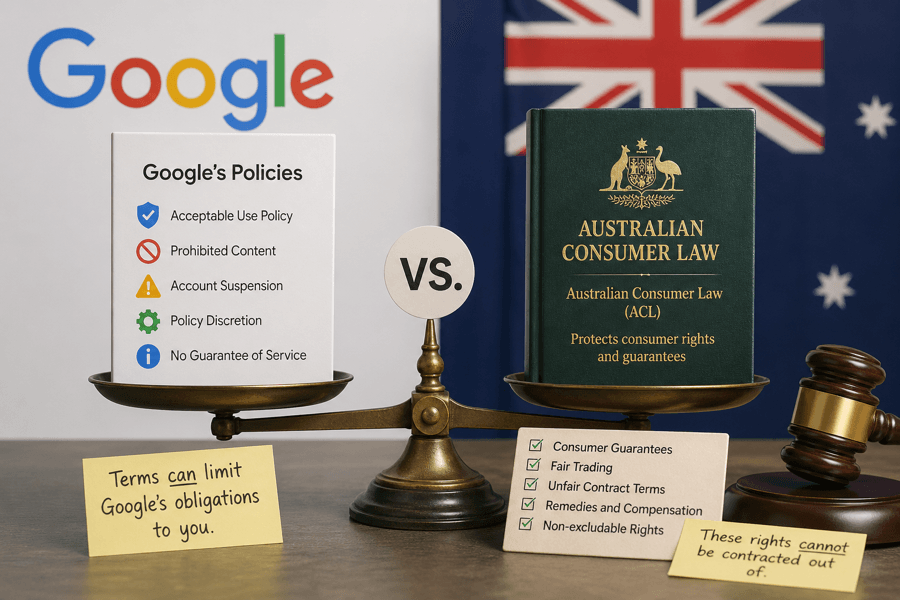
Google deletes a Google review on 1 basis only: it violates a review content policy. Google does not remove reviews a business disagrees with. That distinction is the whole game, and it is why negative Google reviews from real customers almost never come down.
| Type | Why it can be removed | Example |
|---|---|---|
| Fake or competitor review | Not a genuine customer experience; conflict of interest | A competitor, or someone who was never a customer |
| Spam or irrelevant | Not about a real experience with your business | Promotions, links, unrelated rants |
| Off-topic | Not about your business at all | A complaint meant for a different company |
| Hate or harassment | Breaches Google’s content policies | Slurs, threats, abuse |
| Personal attack or personal information | Targets or exposes an individual | Naming and attacking a staff member, posting private details |
| Conflict of interest | Self-reviews or reviews from connected parties | An ex-employee or owner reviewing the business |
A truthful negative opinion about a real experience is not on this list. “Slow service, would not return” from an actual customer is allowed to stand, even if you remember the day differently. Google does not referee customer-service disputes.
How to remove a Google review from your Business Profile
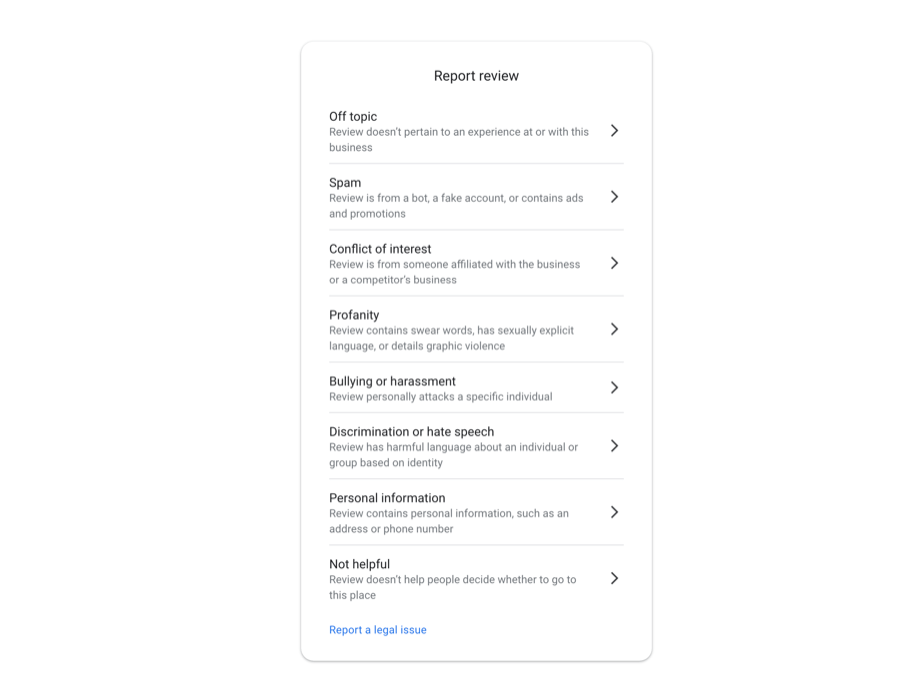
If a review genuinely breaches the policies, report it. 4 steps, and it costs nothing:
- Find the review on your Business Profile, in Google Search or Maps.
- Open the 3 dots next to the review.
- Select Report review.
- Choose the category that most accurately matches the breach.
Then track it in your profile’s review management tools. If the automated check comes back “no violation found”, request a manual review so a person looks at it.
Keep the language plain and factual. Name the policy that is breached and why, with dates or evidence. Emotional, rambling reports get skimmed. A short, specific one tied to an actual policy gives you the best shot.
Fake and competitor reviews
A coordinated fake Google review campaign is its own problem, and evidence is what moves them. 3 signals matter most:
- You have no record of the reviewer as a customer.
- Several one-star reviews landed at once from new or low-history accounts.
- The reviewer has been reviewing your direct competitors.
Document all of it before you report, and reference it factually in the manual review.
If someone leaves bad reviews and demands payment to take them down, that is extortion. Do not pay. Paying invites repeat attacks and rarely ends it. Document the communication, report it through Google’s spam channels, and consider reporting it to the police and the ACCC. Our guide on combating fake Google reviews and the breakdown of review extortion scams cover the patterns and what to gather.
The legal route in Australia (and why it is rarely the answer)
When a Google review is not just unkind but genuinely defamatory, or amounts to misleading or deceptive conduct, Australian law can in theory give you a basis to act. The Defamation Act in your state or territory and the Australian Consumer Law are the usual references. But be clear-eyed about how this actually works, because the popular idea of “suing Google” is mostly a myth, and threatening it tends to make a business look naive rather than serious.
First, you almost certainly cannot sue Google over a review. In Google LLC v Defteros [2022] HCA 27 the High Court held that Google is generally not the “publisher” of material it merely links to (High Court of Australia). The realistic target of a defamation claim is the person who wrote the review, not the platform, which usually means you first have to know who they are.
Second, the bar is deliberately high. Since the 2021 defamation reforms a plaintiff must clear a “serious harm” threshold, and a business small enough to sue at all (broadly, one with fewer than 10 employees) has to show the review has caused, or is likely to cause, serious financial loss, not just embarrassment (Queensland Crown Law). You also cannot simply file: a written concerns notice, setting out the defamatory imputations and the harm, is now a mandatory step before any proceedings.
That concerns notice is the genuinely useful part, and it is the 1 legal step that regularly gets a Google review deleted without a courtroom. A properly drafted letter from a solicitor to the reviewer is often enough to get a clearly defamatory review removed without anyone going near a courtroom. Full litigation, by contrast, is slow, can be very expensive, draws publicity you usually do not want, and a genuine opinion (even a harsh one) is generally not defamation. For most small businesses, suing is not the play. Treat the legal route as a narrow lever for the rare review that contains provably false statements of fact, get advice from a defamation lawyer before doing anything, and ignore anyone promising a guaranteed legal takedown for a fixed fee.
Can the eSafety Commissioner remove a review? Almost never, and it is worth knowing so you do not waste a week chasing it. eSafety is the body many owners assume can order takedowns, but it states plainly that it “is not able to deal with purely reputational damage, bad online reviews, strong opinions or banter”, and points you to defamation law instead (eSafety Commissioner). The only exception is a review that also crosses into adult cyber abuse, content that is menacing or harassing and intended to cause serious harm, which can fall under its scheme.
Why a deleted Google review came back, or a real one vanished
2 things blindside owners that almost no guide explains, and both concern a Google review you thought was settled.
A review you had removed has reappeared. Removal is not always permanent. The same person can post it again, and reviews sometimes resurface after a profile is re-verified or merged with a duplicate. If a review you previously had taken down comes back, report it again, and in the manual review note that Google already removed it once and attach the original removal email. That history strengthens your case.
A genuine review you wanted has disappeared. Sometimes your total review count barely moves but a real review drops out of the public list. This is usually Google’s spam filter quietly hiding it rather than a permanent deletion, and it tends to come in waves across many businesses at once. Before you panic, check whether the review is still visible on the reviewer’s own profile or in your notification email. If it is, it has most likely been filtered, not deleted, and the fix is patience, not a flurry of support tickets. Genuine reviews from established accounts usually return once the filter settles.
When the review is legitimate, which is most of the time
Most reviews that upset business owners are not removable, and in our experience that covers the majority of cases that reach us. It is a real customer who had a bad day, or a genuinely bad experience. You usually cannot make those disappear, and trying to game it tends to backfire. The durable answer is volume and consistency, which is why review strategy and local SEO outcomes end up being the same conversation.
When a Google review is legitimate, the play that works is unglamorous. Write 1 calm, professional public response. It is not for the angry reviewer, who has already made up their mind. It is for the next 100 prospects who will read how you handled it. Acknowledge, state your standard, offer to sort it out offline, and stop.
Then keep earning genuine positive reviews so a single one-star stops defining your rating. 1 bad review against 15 is a story. 1 bad review against 200 is noise. Our guide on how to handle negative reviews goes through the response approach in detail.
Asking a customer to delete the review themselves
Asking the reviewer is the 1 route that bypasses Google entirely, and it is badly underused.
Only the person who wrote a Google review can delete it, which is exactly 1 person. If you genuinely resolve their issue offline, it is reasonable to ask whether they would consider updating or deleting it. Do not pressure them, and never offer payment or a discount in exchange, because incentivising review changes breaches Google’s policies and the Australian Consumer Law provisions on misleading conduct.
Make it easy: send them the 4 steps to delete a Google review at the top of this guide. Most people do not know they can edit a review rather than delete it, and an updated review that says the business fixed it is worth more to you than a deletion.
Some customers will, some will not. Fixing the underlying experience is what makes the ask reasonable in the first place.
Where Search Scope fits
Search Scope is honest about this because Google review removal attracts a lot of operators who are not. We assess whether a review actually qualifies for removal under Google’s policies or Australian law. If it does, we handle the reporting and escalation properly so it has the best chance.
If it does not qualify, we say so rather than take your money chasing a takedown that will not happen, and the work shifts to response strategy and steadily growing genuine reviews. That sits within our online reputation management work, and if you want a specific damaging review assessed, the remove a negative Google review service page explains how we approach it. No guarantees, because nobody can honestly give one.
FAQ
Can a business owner delete Google reviews?
No. A business owner cannot delete a Google review left by someone else. You have exactly 2 options: reply to it publicly, or report the review for a policy breach. Deletion is Google’s decision, not the business’s, and not an agency’s.
Can I delete someone else’s Google review?
Not directly, and this applies whether you are the business owner or another customer. Exactly 2 parties can delete a Google review: its author, and Google. What anyone else can do is report the review as inappropriate and cite the content policy it violates. If Google agrees that it is a policy violation, Google removes it. This is review removal by request, not by deletion, and the distinction matters because it is why nobody can promise you an outcome.
How do I delete a Google review I posted myself?
Open Google Maps signed in to the Google account you used, go to Your contributions, then Reviews, click the 3 dots beside the review and choose Edit review or Delete review. It takes about 30 seconds and no one has to approve it. The same route lets you delete reviews you left for any business, one at a time. Full steps for desktop and mobile are near the top of this guide.
Can I get a review removed if the customer is lying?
Sometimes, but it is hard. Google does not verify facts in service disputes, so you have 2 realistic paths. Your realistic paths are proving the person was never a customer, so it is fake, or escalating a genuinely defamatory false statement of fact through legal channels. A different recollection of events is not enough.
How long does Google take to remove a review?
There is no fixed timeframe for Google to delete a review. Automated checks can clear in a few days, manual reviews and escalations take longer, and many reports come back with no action at all. Anyone quoting you an exact timeline is guessing.
Can I sue Google over a bad review in Australia?
Effectively no. In the 2022 case Google LLC v Defteros the High Court held Google generally is not the publisher of content it links to, so a defamation claim targets the reviewer, not the platform. Even then you must clear a serious-harm threshold, a small business has to show serious financial loss, and a mandatory concerns notice comes first. For most businesses a solicitor’s concerns notice to the reviewer is the realistic lever; full litigation rarely is. Get proper legal advice first.
Why did a review I had removed come back?
Deleting a Google review is not always permanent. The reviewer can repost it, and old reviews can resurface after a profile is re-verified or merged. We see this most often within 30 days of the original removal. Report it again and tell Google in the manual review that it was previously removed, attaching the original removal email.
What should I do if Google will not remove the review?
A first rejection is normal and is usually automated, not a final human decision. Most successful removals take 2 rounds. Reply to the rejection through the review management tool with additional evidence, and be specific about which content policy the review breaches rather than restating that it is unfair. If a second pass also fails and the review is genuinely defamatory rather than merely negative, that is the point to take legal advice. If it is a real customer with a real complaint, stop pushing and work the response and volume angle instead.
What if the review is just negative but true?
You almost certainly cannot delete a Google review that is negative but true, and you should not try to. Write 1 professional public response for the benefit of future readers, fix whatever caused it, and keep earning real reviews so the Google review stops carrying weight.
The bottom line
Removing a Google review is possible only in specific cases: it breaches Google’s policies, or it is unlawful. Everything else is a reputation problem, not a removal problem, and the honest fix is a strong response and a steady flow of genuine reviews. Be wary of anyone guaranteeing a takedown, because the people who actually decide do not work for them.
If you have a review you genuinely think qualifies, or you want a clear-eyed read on whether it does, . Straight assessment, no false promises.