
Google Business Profile Reinstatement Case Study: How We Recovered a Suspended Profile (Australia 2026)
A real case: two denials, a re-suspension, and the escalation route that finally worked. The documents used, the timeline, and what we would do differently.

In late July, a landscaping contractor in Queensland came to us with a suspended Google Business Profile. He’d let the suspension sit for a couple of weeks before reaching out. The calls had stopped, the map pin was gone, and at that point he wanted someone else to take it off his desk.
We took the case. It ran almost three weeks, two appeals were rejected outright, the profile got re-suspended a few days after we won the first reinstatement, and then it came back permanently. That’s longer than our average reinstatement (most close in 24-72 hours), but the case is worth walking through end-to-end because the failure points are where you actually learn something. Anyone weighing up whether to DIY a reinstatement or hire help should read what a real one looks like, not the polished version, the actual one.
This is also the case we point to when people ask how our process holds up when the standard appeals tool says no. Since early 2025 we’ve reinstated 295 out of 300 suspended profiles, a 98% success rate on done-for-you reinstatements. Of the five we didn’t recover, three traced to something no appeal could fix, review manipulation or an account-level trust flag. The other two had clean documentation and never got an explanation. The Queensland one nearly became the sixth. It didn’t.
The Suspension
The owner runs a sole-trader landscaping operation servicing the south-east Queensland corridor. His Google Business Profile had been live for years, ranked locally, and was the main source of inbound calls. Then one morning it disappeared from search and Maps.
He logged in, saw the “suspended” notice on the dashboard, and did what most owners do: he stared at it, googled what to do, read three contradicting forum threads, and then ignored it for a couple of weeks. By the time he called us, the leads were dry and he was about to start running paid ads to plug the gap.
There was no email from Google explaining why. There rarely is. Google’s reinstatement guidance tells you to submit an appeal and wait. It doesn’t tell you what specifically tripped the suspension. That’s your job to work out before you submit anything, because filing a sloppy appeal is what gets you the second rejection.
Step 1, Initial Audit and Document Preparation
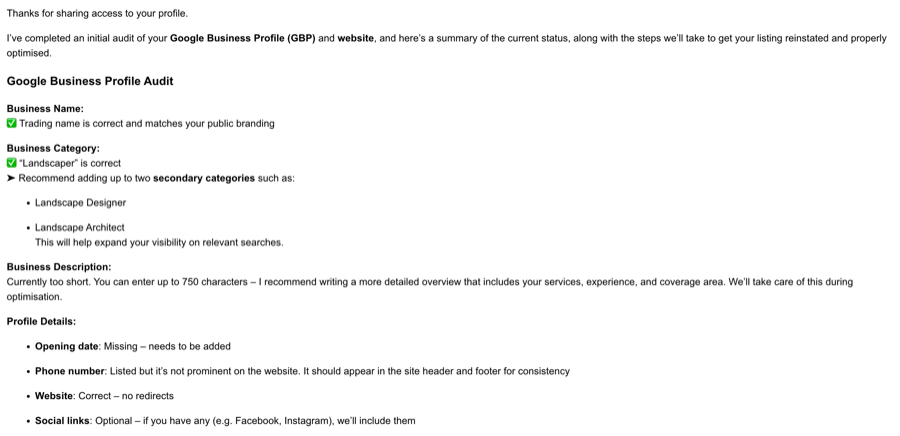
Before we touched the appeals tool, we audited the profile and the website. We were looking for the policy violation Google had likely flagged on, plus any others sitting there waiting to trip the second appeal. This is the step most DIY owners skip, and then they can’t understand why they keep getting denied.
The audit surfaced one obvious issue: the business name on the profile, the website, the ABN record, and the ASIC business name register did not match. The owner used a simplified, marketable trading name in his branding, while his legal entity carried a longer, more formal version. To a human reviewer the connection would have been obvious. To Google’s automated review system, it looked like two different businesses.
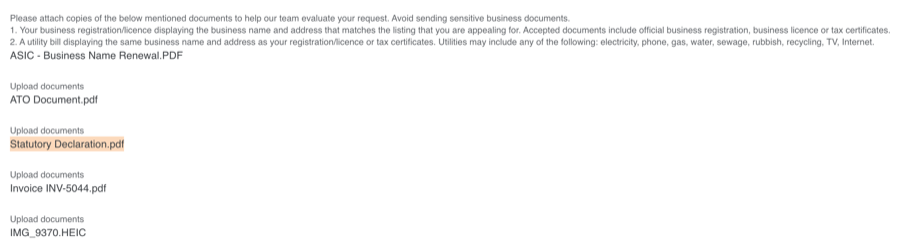
We then guided him through assembling the evidence pack:
- ASIC business name renewal: confirming the trading name was current, registered, and tied to him
- ATO documentation: including the ABN record from the Australian Business Register
- Utility bills: electricity and internet at the registered service address
- Business invoices: recent customer invoices issued under the trading name
The point of this stack isn’t volume, and with hindsight it wasn’t the ATO paperwork or the invoices that mattered. Google’s reviewers, automated or human, are looking for an unbroken chain of evidence linking one legitimate Australian business to one trading name at one address. The whole case turned on the name: the owner used a simplified, marketable trading name in his branding, but it didn’t match the formal legal name on his ASIC and ABR records, so to Google’s systems he looked like two different businesses. That mismatch, not a shortage of documents, was the real trigger. These days we lead an Australian appeal with the ASIC business name registration as the headline document and keep the pack tight, because ATO extracts, BAS, and invoices add little and can muddy the chain. We flagged the name alignment as the thing to fix for the second appeal.
Step 2, First Appeal (Denied)
We submitted the first reinstatement appeal with the document pack. Google rejected it.
We expected the rejection. The first appeal almost always hits an automated review system, and an automated reviewer is not going to reconcile a name mismatch on goodwill. Sterling Sky and Whitespark have both written about how first appeals in 2024-2026 are largely processed by automation, Whitespark’s Darren Shaw walked through his own 7-step reinstatement publicly and confirmed the pattern. The first appeal exists to see whether the obvious case can be machine-resolved. Anything more complicated rolls down to the next layer.
We knew the name inconsistency was the likely cause, but we still wanted to see Google name it in the rejection. They didn’t. The rejection email was the standard “we’ve reviewed your profile and have decided not to reinstate it” template. No reasoning. That’s normal, and it’s one of the most frustrating things about the suspension system. It’s also why you can’t afford to file an appeal that’s anything less than airtight.
Step 3, Second Appeal with Stronger Evidence
For the second appeal we tightened everything that had been loose. Three things changed:
- A Commonwealth statutory declaration, a sworn statement, witnessed by a qualified person under the statutory declaration guidelines, confirming the trading name and the legal name referred to the same person operating the same business at the same address.
- Accountant-certified copies, the ATO and ASIC documents were re-issued and certified by the client’s accountant, adding a third-party evidentiary layer.
- Government record alignment, we updated the ASIC business name register so the trading name and the service address were perfectly consistent with the profile, the website, and the invoices.
We submitted with all of it.
Google denied it again.
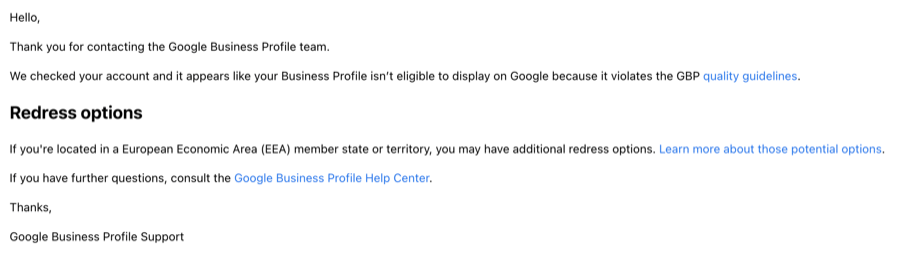
What we did get this time was the redress option email. When standard appeal channels are exhausted, Google sends a redress notification offering a route to escalate the case beyond the appeals tool. It’s not a public process, but it’s available to operators who know how to ask for it and who’ve already exhausted the standard paths. That email confirmed where we stood: standard reinstatement was off the table, and escalation was the only path left.
Step 4, Escalation to Google Support
We escalated the case to a human reviewer through Google Business Profile support. This is the step DIY owners almost never reach, because they don’t know it exists or how to trigger it, and the forum threads on the topic are full of half-correct guidance.
We presented the audited evidence pack, the statutory declaration, the certified ATO and ASIC documents, the redress correspondence, and a written case summary explaining the name inconsistency and why every document now pointed at one legitimate business. The escalation took about a week to work through their queue.
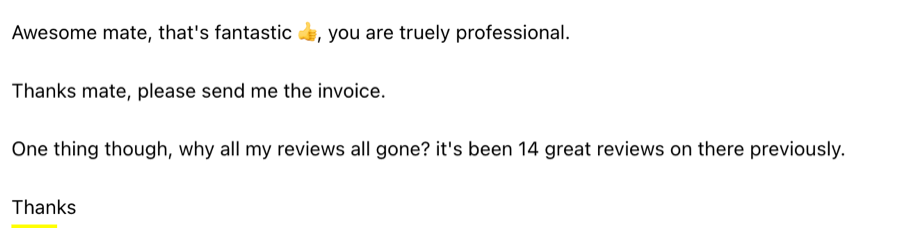
On 13 August the profile was reinstated. The pin came back on Maps, the listing returned to search, and the owner started getting calls within hours of going live again. Not every review came straight back either, which is common enough that we wrote up what to do when Google reviews are not showing separately.
Step 5, Unexpected Re-Suspension and Final Resolution
A few days after reinstatement, Google suspended the profile again. No notification. No reason. The owner messaged us mid-afternoon, understandably furious.
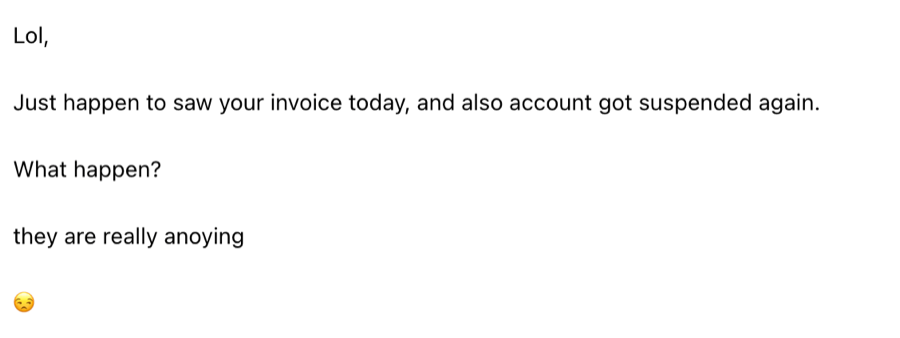
Re-suspensions like this aren’t common, but they happen. Sometimes Google’s systems flag a recently-reinstated profile for a second-pass review and the automated layer trips on something the human reviewer had already cleared. The fastest way through it is not to start the appeal cycle from scratch. It’s to go back to the same escalation channel with the original case attached and the new suspension flagged for what it is.
We initiated a second escalation and re-submitted the full compliance documentation alongside the original case record. Within days the profile was fully reinstated. This time it stayed up.
Total time from first contact to final reinstatement: just under three weeks.
Outcome
- The business regained its local search visibility and lead flow.
- The total process, from first appeal to final reinstatement, ran just under three weeks despite two rejections and a re-suspension.
- The client received a free audit of his GBP and local rankings post-recovery, so the policy and consistency issues that caused the original suspension wouldn’t reappear.
- The profile has remained live and compliant since.
I’ll be honest about something: we didn’t promise the client a specific lift in calls or a specific rankings recovery, and I won’t quote one here. The honest answer is that he came back into search where he’d been before, his usual lead flow returned, and we didn’t have to do it twice. That’s the outcome that matters. Growing from that baseline is a separate job, and it runs on ordinary local search optimisation across Australia rather than anything reinstatement-specific.
Why This Case Took Longer Than Most
Most Search Scope reinstatements close inside 24-72 hours. This one ran almost three weeks. Two specific factors made it slow:
- The name inconsistency was foundational. Until we got ASIC, ATO, the profile, the website, and the invoices all naming the same business in the same way, no appeal, automated or human, was going to clear. Fixing that required the client to update government records, which takes its own time outside Google.
- The re-suspension reset the clock. A profile that’s been re-suspended once gets extra scrutiny on the second escalation. That’s reasonable from Google’s side, but it adds days for the operator.
If you bring us a profile suspended for a clear-cut reason, wrong category, misclassified service area, a flagged keyword in the business name, an address that doesn’t match a verifiable service location, we typically file the appeal within 24 hours and Google reinstates inside three days. The 24-72 hour figure is our normal. Three weeks is our worst-case for cases we still recover, and even that worst case beats the typical DIY trajectory, which is “denied, denied, denied, gave up”.
What This Case Tells You About DIY vs Professional Help
If your suspension is straightforward and you’ve got time to read the documentation properly, you can file a successful appeal yourself. Plenty of business owners do. The two situations where DIY breaks down are the ones this case illustrates.
- You don’t know why you were suspended. Filing an appeal without a diagnosis is how you burn your first attempt for nothing. A proper audit names the violation before you touch the form.
- You’ve already been denied. Once Google has rejected an appeal, your next submission needs to be stronger than the first, not the same evidence resubmitted, which is what most owners do. A second rejection makes the third attempt materially harder.
For owners in those situations, the comparison isn’t really “DIY vs hire”. It’s “burn a third appeal vs get it right once”. We charge $550 for done-for-you reinstatements, reinstated or refunded, $350/hr if you want consulting while you handle the appeal yourself, and $999/hr for agency work. Reinstated or refunded: the fee is paid upfront and fully refunded if we don’t reinstate the profile.
Key Takeaways
- The first rejection isn’t fatal. Most first appeals hit automated review. A denied first appeal often just means the case needs human-grade evidence.
- Documentation has to be consistent across every source. ASIC, ATO, utility bills, invoices, the profile itself, and your website all need to name the same business at the same address. Inconsistency is the single most common hidden cause of suspension we see in Australian cases.
- Escalation paths exist beyond the appeals tool. The redress option is real. Most owners never reach it because they give up after the second denial.
- Re-suspensions happen and aren’t the end. A second escalation with the original case record attached usually clears it.
- A free post-recovery audit is non-optional. If you don’t fix what caused the suspension in the first place, you’ll be back here in six months. We cover the underlying policy work in our breakdown of Google’s compliance guidelines.
This case is one of the harder ones we’ve handled. The fact that it still resolved inside three weeks, and that the profile has remained compliant since, is why our structured process exists. From audit, to overturning a rejected appeal, to direct escalation, every step has a purpose and a fallback. That’s the difference between a 98% success rate and the DIY pattern of denial-on-denial.
Need Help With a Suspended Google Business Profile?
If your Google Business Profile has been suspended and you’re losing leads while you sit on hold in a help forum, don’t wait. At Search Scope we specialise in reinstating suspended profiles fast, and our $550 done-for-you tier is reinstated or refunded: you pay upfront and get a full refund if we don’t reinstate. Dorian personally supervises every case.
Speak to a recovery expert or start the onboarding form to get moving fast, or read more about why we’re the team businesses come to when their first appeals haven’t worked.