
Google Business Profile Suspension Statistics: What 300 Australian Cases Tell Us (2026)
Original data from 300 Australian suspension cases: which triggers actually dominate, the configuration errors underneath them, and where reinstatement fails.

Most Google Business Profile suspension statistics you’ll read are American, unsourced, or recycled from a 2019 forum thread. That’s the problem we wanted to fix when we sat down to publish this piece.
Search Scope has supervised 300 Google Business Profile suspension cases since 1 February 2025. 295 came back online. Five didn’t. That’s the dataset behind every number in this article, and every pattern we walk through is something we’ve seen often enough to call it a pattern rather than an anecdote.
If your profile is suspended right now, the Google Business Profile reinstatement service is where you should go, and the very first thing to do is stop editing it. Every save you make while a profile is suspended hurts the case. Read the rest of this article before you touch anything else.
For everyone else, owners, marketing managers, agency principals, marketing teams trying to understand why GBP suspensions surged through 2025 and 2026, this is the data piece. Triggers, appeal timelines, and where reinstatement actually fails.
What this article covers
- How we counted (methodology)
- Why Google Business Profiles get suspended in 2026 (the data)
- The triggers: what 300 GBP suspension cases actually showed
- Configuration errors hiding inside a clean profile
- The appeal process: timelines, reinstatement rates, and where most owners lose
- When reinstatement fails: the five that didn’t come back
- The 2026 shift: policy updates and the June spam update
- How to protect a Google Business Profile (and recover visibility after)
- FAQ
How we counted (methodology)
Worth stating up front, because most suspension statistics on the web don’t.
- Dataset. Every Google Business Profile suspension case Search Scope took on between 1 February 2025 and 31 July 2026. 300 cases. No sampling, no exclusions, no cases still open at the cut-off.
- Who they are. Australian businesses, all verticals, mostly single-location owner-operators with a tail of multi-location clients.
- Denominator. Percentages are share of the 300 cases handled, not share of the 295 reinstated. So a category’s percentage tells you how often that trigger appears, and its recovery rate tells you how often we got it back.
- “Reinstated” means the profile returned to public visibility on Google Search and Maps, confirmed in the dashboard. Not “appeal filed”, not “Google replied”.
- Classified by Dorian Menard, from the audit file on each case. One primary trigger per case, so the trigger table sums to 300. The configuration-issues table is a separate cut: it records the single most significant underlying problem found on audit, which is often not the same thing as the trigger that fired.
- How a trigger is established. Google does not expose an edit history, to owners or to anyone acting for them. For the edit-velocity category in particular, what was actually changed is usually only knowable because the owner tells us, on the intake call or in a screen recording. The audit corroborates that account by showing what the profile looks like now and what no longer matches the public record, but it cannot replay the edits. Where the owner cannot say and the audit is not decisive, the case is classified on the strongest available evidence, and that is a judgement rather than a log.
- Small categories. Where a category holds fewer than ten cases, treat the percentage as indicative. One case moves it a long way.
- Supersedes the earlier edition of this page, which covered the first 234 cases. Categories were reclassified for this cut, so the two sets of figures are not directly comparable. Where they differ, these are the ones to use.
Why Google Business Profiles get suspended in 2026 (the data)
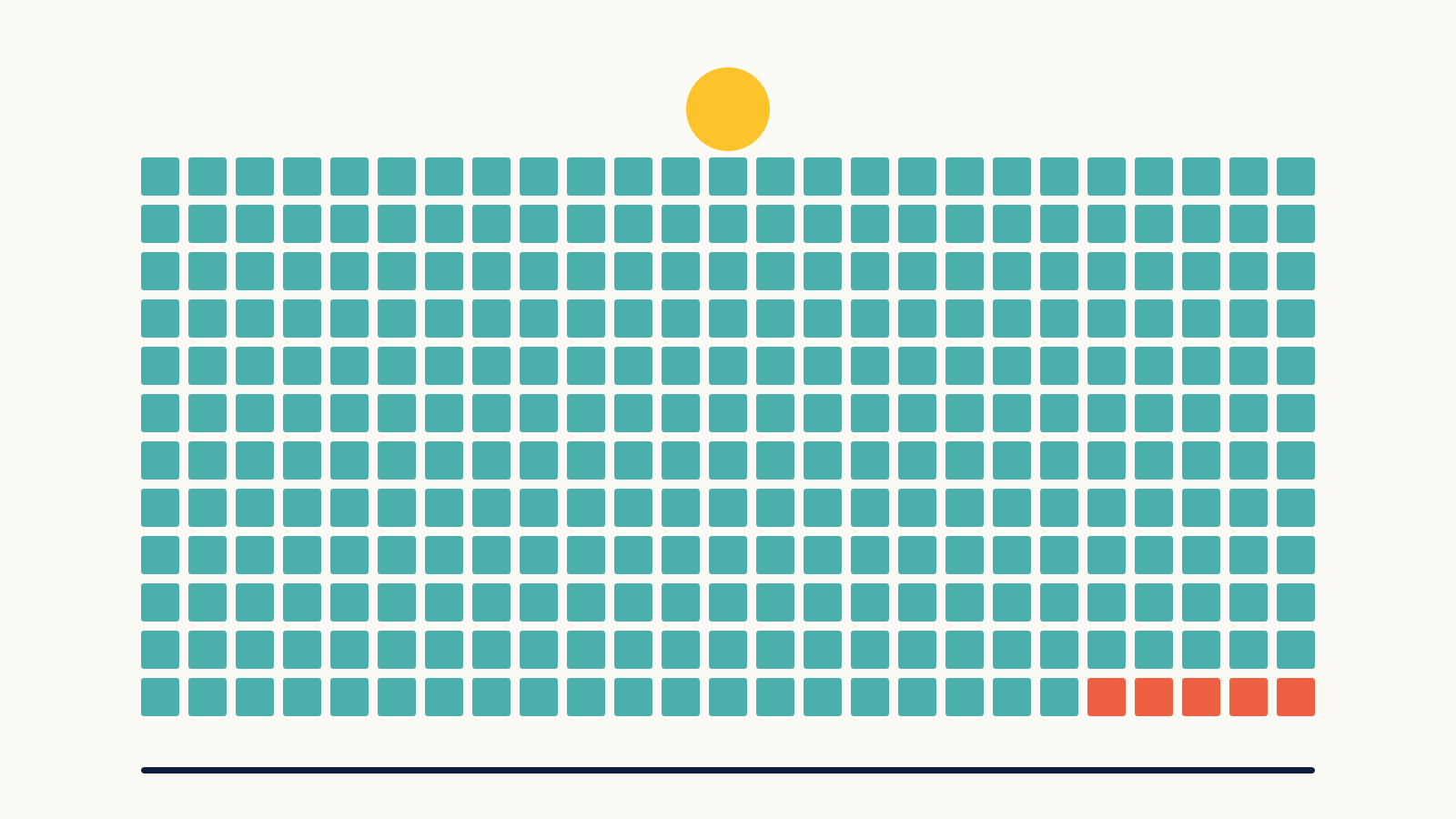
Two things have shifted since 2023, and both of them explain why suspensions feel like they’re everywhere in 2026.
The first is volume. Google’s Maps Trust & Safety Report for 2024 put the numbers in writing: more than 240 million policy-violating reviews removed, over 12 million fake business profiles removed or prevented, and 70 million abusive contributions blocked. Most of that detection is automated, running at submission time without human review. When you scale enforcement that aggressively, false positives are guaranteed, legitimate businesses get swept up alongside the spam.
The second is sensitivity. Mike Blumenthal documented the first 2025 surge at Search Engine Journal in March 2025. Community forum complaints had spiked to their highest level since mid-2023, and appeal times had blown out from the five days Google quotes to closer to five weeks. By late 2025 it was running again, and Sterling Sky’s most recent playbook, updated March 2026, records appeals taking five to six weeks for clients who hit the queue in early 2025.
That’s the macro picture. The micro picture, what 300 Australian suspended profiles look like when you actually open them up, is more useful, and it’s where we’ll spend most of this article.
Soft suspension vs hard suspension
Before the data, the distinction that matters more than most owners realise.
| Soft suspension | Hard suspension | |
|---|---|---|
| Listing visible to customers | Yes, but flagged as unverified | No, removed from Search and Maps |
| Owner management access | Lost | Lost |
| Typical cause | Re-verification needed on a specific field | Material policy violation, ineligibility, or trust check failure |
| First move | Fix the flagged issue, request reinstatement | Stop editing, gather evidence, appeal |
Joy Hawkins explains the underlying mechanic well. Your profile lives across two databases. The GBP database is what you edit in the dashboard. The Maps database is what customers see. A suspension severs the connection between them. Your edits aren’t reaching the public listing anymore, that’s why “just keep editing until it works” fails so badly, and that’s why we tell every suspended client to put the dashboard down.
Soft suspension is annoying. Hard suspension stops the phone ringing. Both need the same first response, which is to stop touching the profile.
The triggers: what 300 GBP suspension cases actually showed
One primary trigger per case, classified from the audit file. This is the whole dataset, not a selection.
| Suspension trigger | Cases | Share | Reinstated | Not reinstated |
|---|---|---|---|---|
| Business information and guideline compliance | 86 | 28.7% | 84 | 2 |
| Too many or too fast profile edits | 69 | 23.0% | 69 | 0 |
| Address and service area issues | 57 | 19.0% | 56 | 1 |
| Duplicate listings | 36 | 12.0% | 36 | 0 |
| Toxic Gmail or Google account trust issues | 31 | 10.3% | 30 | 1 |
| Reverification after business changes | 15 | 5.0% | 15 | 0 |
| Fake reviews or spam signals | 6 | 2.0% | 5 | 1 |
| Total | 300 | 100% | 295 | 5 |
Three things jump out of that table before we get into any of it.
The top two triggers are half the dataset between them, 155 of 300 cases. Both are self-inflicted and both are avoidable, which is the whole argument for the prevention discipline further down this page.
Reinstatement rates barely move across the first six categories, 96.8% at worst. The exception is the smallest group: fake reviews and spam signals, where one case in six didn’t come back. That is the only category in the dataset where the underlying problem is something Google treats as intent rather than error.
And duplicate listings, 36 cases, is a category that didn’t exist in our previous cut of this data. Every one of those 36 came back, but they cost weeks each, because the fix is a merge or a removal before the appeal, not the appeal itself.
28.7%: business information and guideline compliance
86 cases, the largest single trigger. This is the profile contradicting itself or contradicting the public record: a name that doesn’t match ASIC or the signage, services listed that the business doesn’t deliver, a description written for keywords rather than customers, a category that doesn’t describe what the business actually is.
The common thread is that none of it looks dramatic from inside the dashboard. Each field looked reasonable when it was filled in. It’s the combination that fails, and it usually fails months after the edit that created it.
84 of the 86 came back. The two that didn’t are covered further down.
23.0%: too many or too fast profile edits
69 cases, and the cleanest pattern in the dataset. An owner decided to tidy the profile on a Tuesday afternoon, changed the phone number, swapped the website, added a category, updated the description, refreshed the photos, and saved it all in twenty minutes.
The system doesn’t see a diligent owner. It sees a pattern statistically indistinguishable from a takeover. The suspension is a security lock. The lock is meant to protect the asset; it ends up locking you out of it.
This is also the one category with a perfect record: 69 filed, 69 reinstated. Nothing is actually wrong with the business, so once the evidence pack lands the case resolves. Painful, slow, and almost always recoverable.
Perth carries most of this category
Cutting this trigger geographically changes the picture. 112 of the 300 cases are Greater Perth metropolitan businesses, by registered business address, and 41 of those 112 were edit-triggered.
| Group | Cases | Edit-triggered | Share |
|---|---|---|---|
| Greater Perth metro | 112 | 41 | 36.6% |
| Rest of Australia | 188 | 28 | 14.9% |
| National | 300 | 69 | 23.0% |
Perth is 37.3% of the dataset and carries 59.4% of its edit-triggered suspensions, roughly two and a half times the rate of the rest of the country. All 112 Perth cases were reinstated. We have not established why the gap exists and we are not going to guess at it. The Perth cut of this dataset sets out what the geography does and does not show.
Patience is the only safety net. One change, then leave it alone for several days. Plan the edit list, then spread it over a week or ten days. And when you do touch core fields, the front-end edits only doctrine, making recent changes through the public-facing Maps interface rather than the dashboard, cuts the risk further.
The 5 Kings (NAPUC)
Across 300 cases the same five fields keep doing most of the damage, whichever trigger they fire. We call them the 5 Kings, by the acronym NAPUC: Name, Address, Phone, URL, Categories.
| Field | What gets profiles suspended | Safer approach |
|---|---|---|
| Name | Adding services, locations, or descriptors (“Smith Plumbing | Emergency 24/7 Perth”); using a name that doesn’t match ASIC registration or the signage | Use exactly what’s on your signage and your ASIC business name record. Nothing else. |
| Address | P.O. boxes, virtual offices, unstaffed coworking desks, addresses that don’t match the business documents | Real physical address with permanent signage. If you’re service-area, hide the address and set a realistic radius. |
| Phone | 1900 premium numbers, central call-centre redirects, numbers that don’t appear on the website or signage | A real Australian local number, 02, 03, 07, 08, or a 04 mobile for sole traders. |
| URL | Link shorteners, social profiles as primary, third-party booking platforms (Cliniko, Calendly, Booksy) as primary, URLs that 404 or redirect | Your own domain, dedicated landing page, returns 200, crawlable. |
| Categories | Too many; primary swapped to something more “lucrative”; keyword-bait categories | One primary that completes “This business IS a [X]”. Up to three closely related secondaries. |
Edits to any other field, hours, photos, services, attributes, cause far fewer problems. The 5 Kings are the trust signals Google weights heaviest. Touch one and the profile gets reviewed. Touch three on the same Tuesday and the review escalates fast.
19.0%: address and service area issues
57 cases. Two flavours, and both come from the same misunderstanding of what a service-area business is.
The first is a service-area business publishing a street address it shouldn’t. No customer-facing storefront, no permanent signage, but the address is on the profile anyway. That’s a direct guideline violation, and the quality issues flag tends to hit this group first.
The second is over-extension. Claiming a whole state, an entire metro region, or zones beyond a couple of hours’ drive. Google’s automated systems don’t believe a single van services Perth, Mandurah, Bunbury, and Geraldton with same-day response. The system flags it, the listing falls over.
56 of 57 came back.
12.0%: duplicate listings
36 cases, and the newest pattern in this dataset. A legacy profile from a previous owner, a franchise listing created centrally while the operator created their own, a “fresh start” profile someone opened during an earlier suspension, an old listing at a previous address that was never removed.
Google’s duplicate detection doesn’t care which one you consider real. It suspends to resolve the conflict.
Every one of the 36 was reinstated, but these were the slowest cases in the dataset. The appeal isn’t the work. Identifying every duplicate, establishing which profile carries the review history and the verification, and getting the others merged or removed is the work, and it happens before you file anything.
10.3%: toxic Gmail and Google account trust issues
31 cases. Account-level problems rather than profile-level ones: the Gmail or Workspace account controlling the profile picked up a flag, and the profile inherited it.
A suspension on a Manager account is especially toxic. It behaves like a virus. If the agency Gmail managing five locations gets flagged, all five can go down regardless of how clean the individual profiles were.
30 of 31 came back, which is the lowest recovery rate of any category with meaningful volume. When the problem lives in the account rather than the listing, you’re negotiating for something you don’t fully control.
5.0%: reverification after business changes
15 cases, and the least alarming category in the dataset. A genuine change happened, a move, a rename, a category change, an ownership transfer, and Google wanted the business re-proven rather than punished.
15 filed, 15 reinstated. Sometimes Google also forces re-verification with no change at all behind it. It isn’t personal and it isn’t a signal of wrongdoing, it’s automated portfolio sampling, part of how they police the platform without doing 12 million manual reviews per year.
2.0%: fake reviews and spam signals
Six cases, and the only category where reinstatement is genuinely uncertain. Five came back, one didn’t.
Small numbers, so read the count rather than the percentage. But the direction is consistent with everything else we see: suspicious activity suspensions tied to review manipulation are the hardest single thing to argue your way out of, because Google isn’t assessing whether you made a mistake.
Configuration errors hiding inside a clean profile
Triggers are what causes the suspension. Configuration errors are what we find once we open the profile up. Most were sitting there for months beforehand. They’re the reason a routine trigger turned into a full lockout instead of a soft re-verification.
This is a separate cut of the same 300 cases: the single most significant underlying problem found on audit, which is often not the trigger that fired.
| Configuration issue found on audit | Cases | Share |
|---|---|---|
| Business information and guideline compliance | 142 | 47.3% |
| Address, service area, and SAB compliance | 82 | 27.3% |
| Toxic Google account (Gmail trust issues) | 43 | 14.3% |
| Duplicate or legacy listings | 23 | 7.7% |
| Multiple combined compliance issues | 10 | 3.3% |
| Total | 300 | 100% |
Shares are rounded to one decimal place and sum to 99.9%.
The gap between the two tables is the useful part. Business information problems trigger 28.7% of suspensions but sit underneath 47.3% of them. Account trust issues trigger 10.3% and sit underneath 14.3%. In both cases the profile was already non-compliant, and the trigger was just the thing that made Google look.
Two specifics worth naming, because they account for a large share of what lands in the business information bucket.
NAP inconsistency. Different name, address, or phone across the website, the profile, and the directories. Each discrepancy looks minor; together they break the trust link between the entity and its digital footprint. Whitespark’s Local Search Ranking Factors 2026 still has NAP consistency in the top tier of signals for exactly this reason, and a clean digital footprint matters as much for nationwide local SEO as it does for suspension prevention.
Primary URL problems. Broken URLs, wrong redirects, links pointing to the wrong page, or primary URLs that fail the business links policy update Google rolled out in September 2025. That update banned link shorteners, social media profiles, and third-party booking platforms as primary URLs.
What this tells us, when we line it up: the vast majority of suspensions are not Google being capricious. They’re the algorithm doing its job on a profile with quietly broken configuration, triggered by an owner who edited too many fields too quickly.
The appeal process: timelines, reinstatement rates, and where most owners lose
Knowing what triggered the suspension is one thing. The actual reinstatement battlefield is another.
Clean cases: 24 to 72 hours
When the documentation is right the first time, the evidence is consistent, and the profile is genuinely compliant, the window is tight. Appeals get filed within 24 hours of the brief, and Google’s automated review usually responds within 24 to 72 hours. That’s the best-case scenario, and it’s what most clean reinstatements look like.
Manual escalation: 48 hours to three and a half weeks
When the first appeal gets bounced, or when the profile is complex enough that we don’t push the appeals tool button without escalation, the window stretches. Two days to two weeks covers most of them, and the tail runs longer. Our fastest manual escalation in 2025 came back in two days. The longest was 3.5 weeks, held up by a client who couldn’t get hold of a utility bill in their business name for ten working days.
Manual escalation routes through a Google Product Expert in the Google Business Profile help community, or through specialist channels for agencies. Direct Google support for end-user GBP cases barely exists anymore in 2026, the appeals tool is the front door, the Product Expert path is the second door, and that’s about it.
Why most owners lose on their own
About 75% of our clients reach out only after they’ve already lost a self-appeal. By the time they hit us, the case requires manual escalation and a Product Expert path, not the standard appeals tool.
They fail for three reasons. They don’t know which specific rule they broke. They submit weak or inconsistent evidence. And then they spam Google support with repeat reinstatement requests, which actively damages the case.
The most common DIY mistake we see isn’t sending too little evidence. It’s sending too much. The more documents in the bundle, the higher the chance of an inconsistency Google’s automated system can flag. You’re not dealing with a human; you’re dealing with a pattern-matcher.
That’s exactly where our Google Business Profile reinstatement service steps in, or start the onboarding form to get moving fast. $550 done-for-you on the standard tier, paid upfront and fully refunded if we do not get the profile reinstated. $350 per hour for consulting if the client wants to drive but needs a strategist. $999 per hour for agency emergency work where the suspension is bleeding leads by the day.
When reinstatement fails: the five that didn’t come back
Five of the 300 stayed down. Here’s where they sat:
| Trigger category of the failed case | Failures | Cases in that category |
|---|---|---|
| Business information and guideline compliance | 2 | 86 |
| Address and service area issues | 1 | 57 |
| Toxic Gmail or Google account trust issues | 1 | 31 |
| Fake reviews or spam signals | 1 | 6 |
| Total | 5 | 300 |
The raw counts flatter the wrong categories, so read the last column with them. Two failures out of 86 business information cases is a 2.3% failure rate. One out of six fake review cases is 16.7%. The category with the fewest failures in absolute terms is by far the most dangerous one to be in.
That’s the single most useful thing in this dataset. Ordinary compliance problems, even bad ones, almost always come back. Anything Google reads as intent rather than error is a different conversation.
What triggered the suspension is not what sank the recovery
Worth separating, because the two don’t line up and almost nobody publishes both. The table above is what got each profile suspended. This is what stopped us getting it back:
| What sank the recovery | Cases |
|---|---|
| No explanation given, documentation was clean | 2 |
| Fake or manipulative review practices | 2 |
| Google account trust issue | 1 |
| Total | 5 |
Line the two up and something falls out of the arithmetic. Only one case was suspended over fake reviews, but two were sunk by review manipulation. So at least one profile came to us suspended for something entirely ordinary, a compliance or address problem, and only became unrecoverable once the review history underneath it surfaced during the appeal.
That is the pattern we’d want an owner to take away from this whole page. The thing that takes your profile down is usually not the thing that decides whether you get it back. A messy service area is an inconvenience. A review history you can’t defend is a different outcome entirely, and it doesn’t announce itself until you’re already appealing.
The failure rate across the whole 300 isn’t magic either, it’s case selection. We refuse cases we can’t win. If the initial audit flags one of the patterns below, we tell the client up front and we don’t take payment on a case where the verdict is already in.
- Strong suspicion of review manipulation. Bought 5-star reviews. Coordinated review trading. Google’s review-spam detection is genuinely good now, and a flagged review history is the hardest single thing to recover from.
- Compromised Workspace or Gmail account. If the controlling account was breached, Google often takes the listings offline as a user-protection measure. The path back is months, not days, and sometimes it’s permanent.
- Manager or agency account on Google’s bad list. Guilt by association. If the agency Gmail managing the profile was flagged elsewhere, the profile inherits the problem.
Two of the five failures didn’t fit any of those patterns cleanly. The documentation was right. The businesses looked legitimate. Neither owner had touched a fake review. Google rejected the reinstatement with no explanation and stopped responding when we escalated. Our best guess is that the controlling Gmail had picked up an internal flag we couldn’t see. There’s no way to verify that from outside Google.
The lesson: in terminal cases, Google goes silent. You get a generic rejection and the door shuts. Manual escalation doesn’t move the verdict. That finality is why avoiding those three patterns is worth more than any reinstatement service we sell.
For a worked example of how the process plays out end-to-end on a successful case, our GBP recovery case study walks through one we published with the client’s permission.
The 2026 shift: policy updates and the June spam update
Two policy shifts and one algorithm shift have changed the suspension picture since mid-2025.
September 2025: the business links policy update. Search Engine Land covered the change when it dropped. Primary website URLs can no longer be link shorteners, social media profiles, app store links, or third-party booking platforms. They have to point to a dedicated, crawlable landing page that returns a 200 status. The month after the update was the busiest stretch in our queue all year.
June 2026: the spam update. Google released the June 2026 spam update on 24 June 2026, applied globally and to all languages, with a rollout Google said would take a few days. No new policy documentation came with it. The enforcement threshold simply shifted, a tighter application of the existing rulebook rather than a fresh one.
Ongoing: agency and manager account risk. If you’ve added an agency to your GBP and you don’t know what other accounts they manage, you’ve inherited their risk profile. We’ve seen entire portfolios of legitimate businesses go offline because the agency Gmail controlling them was flagged for activity on an unrelated client.
For the deeper read on how Google’s enforcement system actually weights signals, our piece on decoding Google’s compliance guidelines is the long-form companion to this one.
How to protect a Google Business Profile (and recover visibility after)
The protection playbook in 2026 is shorter than most guides make it out to be. Five things.
Treat the 5 Kings (NAPUC) like ATO data. Name, Address, Phone, URL, Categories. One save at a time. Days between saves. No batching. If you can edit from the front-end Maps interface instead of the dashboard, do that.
Get the Australian evidence pack on file before you need it. The five items Google will accept from an Australian business are: ASIC business name registration, a recent utility bill in the business name, the relevant industry licence if applicable, the commercial lease if you have a storefront, and clear photos of permanent signage and premises. That’s the list. Don’t pad it with an ABN extract, a tax invoice, a BAS, photo ID, or a public liability certificate, Google doesn’t weight those as primary evidence for GBP, and adding them just gives the automated system more surface area to find a mismatch on. Use what counts, leave the rest out.
Match the profile to the regulator. Your business name on GBP needs to match ASIC. Your phone needs to be a real Australian local number, 02, 03, 07, 08, or a 04 mobile for sole traders. Your address needs to match the documents and have permanent signage you can photograph.
Audit your access list quarterly. Every Gmail with manager access is an attack surface. Use a dedicated business Gmail for the GBP. Don’t mix personal and business. Remove ex-staff and ex-agencies the day they leave.
Build the prevention discipline before you need the cure. Our full prevention playbook lives at how to avoid a GBP suspension before it happens, the 5 Kings, the front-end edits doctrine, the 30-minute self-audit, all of it.
If the suspension has already happened, the steps to appeal a GBP suspension page walks you through the DIY path. If you’ve already burned an appeal or the case is bleeding leads, send us the file. Email seo@searchscope.com.au or and we’ll tell you within the call whether the case is winnable.
After reinstatement, you start on the back foot. Local rankings dropped during the downtime, and the broader SEO signal recovery takes longer than the listing reactivation. Upload fresh photos, reply to every recent review, drop a Google Post, get the website schema right. If you can afford to bridge the gap with Google Ads while local search visibility rebuilds, that’s the cleanest short-term play. Prove to the algorithm that the listing is active and trustworthy again. Full visibility returns over weeks, not days. We tracked what that rebuild actually looks like on a 175-point grid in a local SEO case study of a reinstated profile, where grid coverage roughly doubled over three months while the profile still held no top-three positions.
What happens to your Google reviews while you’re suspended
The single most common panicked question from a suspended client is “have I lost my reviews?” Worth answering directly, because the truth is more reassuring than the rumour.
- Soft suspension. Reviews stay visible on the listing while it’s flagged unverified. They keep accruing, but new ones may not appear publicly until you’re reverified. Old reviews are intact.
- Hard suspension. Reviews are hidden along with the rest of the listing for as long as the profile is offline. They are not deleted. When the appeal succeeds and the profile reinstates, the existing reviews come back with it. Joy Hawkins at Sterling Sky has written about this GBP-vs-Maps database split at length, the listing data is held; only the connection to public Maps is severed.
- Permanent removal. Only when Google decides the business itself can’t be reinstated do the reviews go with it. That outcome landed on 5 of our 300 cases, 1.7%, and the risk concentrates heavily in profiles with a flagged review history or a compromised controlling account.
- What you should NOT do. Don’t open a duplicate profile to “rebuild reviews”. Google’s duplicate-detection will catch it inside a fortnight; the new listing won’t inherit reviews from the suspended one; and now you’ve got two profiles in violation rather than one to reinstate. We see this once a month and it’s always avoidable.
The practical implication: stop refreshing the listing in panic. Get the evidence pack in order, file the appeal, and the review history comes back with the profile. The only thing that loses a review pool is a parallel listing or a “fresh start” Gmail change that breaks the audit trail.
FAQ
Why would a Google Business Profile get suspended in 2026?
In our 300-case Australian dataset, the largest trigger is business information and guideline compliance at 28.7%, meaning the profile contradicts the public record or itself. Second is too many or too fast profile edits at 23.0%. Then address and service area issues at 19.0%, duplicate listings at 12.0%, toxic Gmail or account trust issues at 10.3%, reverification after a genuine business change at 5.0%, and fake reviews or spam signals at 2.0%. It rarely feels like a deserved suspension to the owner, but the trigger is almost always identifiable.
How many times can you appeal a suspended Google Business Profile?
Practically, you get one good shot through Google’s appeals tool. Re-submitting the same appeal with the same evidence after a rejection just buries the case. The path after a failed first appeal is manual escalation to a Google Product Expert, the community forum, or, if you’re working with a specialist, direct escalation channels. We file every appeal within 24 hours of the brief and bring escalation in when the first response isn’t clean.
How long does it take to recover from a Google Business Profile suspension?
Clean cases reinstate within 24 to 72 hours from the moment we file. Cases that need manual escalation typically take 48 hours to 2 weeks. Our fastest manual escalation came back in 2 days; the longest was 3.5 weeks, held up by client documentation delays. Outside Search Scope’s queue, Sterling Sky and Mike Blumenthal have both reported appeal timelines stretching to 5 to 6 weeks for some cases queued in early 2025.
What documents do I need to provide to get reinstated in Australia?
The Australian evidence pack is ASIC business name registration, a recent utility bill in the business name, the relevant industry licence if your trade requires one, the commercial lease if you have a storefront, and clear photos of permanent signage and the premises. Don’t substitute an ABN extract, tax invoice, BAS, photo ID, or public liability certificate, Google doesn’t weight those the same way. The business name on every document must match the GBP exactly.
Should I just create a new GBP instead of fighting the suspension?
No. Creating a new GBP loses every review and ranking signal the suspended profile accumulated. Worse, Google’s duplicate-detection will almost certainly flag the new profile and suspend it too. The reinstatement path on the original profile is the only correct answer, even when it feels slow.
Why does my Google Business Profile keep getting suspended for deceptive content?
“Deceptive content” suspensions are almost always tied to a mismatch between what the profile claims and what the website, signage, or regulator records show. Name keyword-stuffing, services that the business doesn’t actually deliver, or categories that don’t match the primary trade are the usual causes. Repeat suspensions for the same reason mean the underlying violation wasn’t fixed between appeals, the algorithm sees the same flag, takes the same action.
Can a suspended Google Business Profile still appear in search results?
A soft suspension keeps the listing visible to customers but flags it as unverified, and local search rankings drop sharply. A hard suspension removes the listing from Search and Maps entirely. In both states, the owner loses management access. If you can still see your listing in Maps but it shows unverified or has lost the trust signals, you’re in soft-suspension territory and the fix is usually re-verification rather than a full appeal.
Suspensions in 2026 aren’t random bad luck. The 300 cases we’ve supervised since February 2025 say the same thing in 300 different ways: triggers are knowable, configuration errors are auditable, and the difference between a 24-hour reinstatement and a 5-week appeal queue is almost always the quality of the evidence pack and the discipline of the editing history.
If you’re suspended right now, the Google Business Profile reinstatement service is built around exactly this dataset, 295 of 300 reinstated, and the done-for-you tier is reinstated or refunded, Dorian personally supervises every case. If you’re not suspended yet, or email seo@searchscope.com.au. A profile audit before the suspension is cheap. After it, it isn’t.