
LinkedIn Statistics You Need to Know in 2026
LinkedIn 2026 statistics: 1.3B members, ~310M MAU, 17M in Australia. Checked against Microsoft SEC filings and the Q3 FY26 earnings call, Datareportal and NapoleonCat.

The short version. LinkedIn has surpassed 1.3 billion registered members, a figure Satya Nadella stated on Microsoft’s Q3 FY26 earnings call in April 2026 and which LinkedIn’s own pressroom carries. Microsoft’s quarterly releases report LinkedIn revenue growth only, not membership, so anyone citing a press release for a member count has not read it. Active usage is third-party estimate: around 310 million members visit monthly, and roughly 134 million are estimated to be active daily, the latter derived from a 16.2% assumption rather than measured (Business of Apps). In Australia, NapoleonCat puts the local user base at 16.99 million as of April 2026, roughly 61% of the population.
Most “LinkedIn stats” articles still recycle 2023 figures. This one is rebuilt against Microsoft’s FY2025 10-K and Q3 FY26 filings and earnings call, Datareportal’s Digital 2026 Australia report, NapoleonCat’s Australia tracker, and the small handful of independent estimates that publish methodology. Where a number traces only to an aggregator, it is labelled as such.
If you’re sizing a 2026 B2B plan or recruiter budget, these are the sources worth trusting and the figures worth planning around.
- Global LinkedIn Overview
- LinkedIn Usage in Australia in 2026
- Demographic Breakdown
- LinkedIn Engagement and Behaviour Trends
- Content and Publishing on LinkedIn
- LinkedIn’s Role in Job Search and Recruiting
- LinkedIn Advertising and Business Impact
- LinkedIn for B2B Marketing
- Challenges and Limitations
- Trends Shaping LinkedIn in 2026
Global LinkedIn Overview
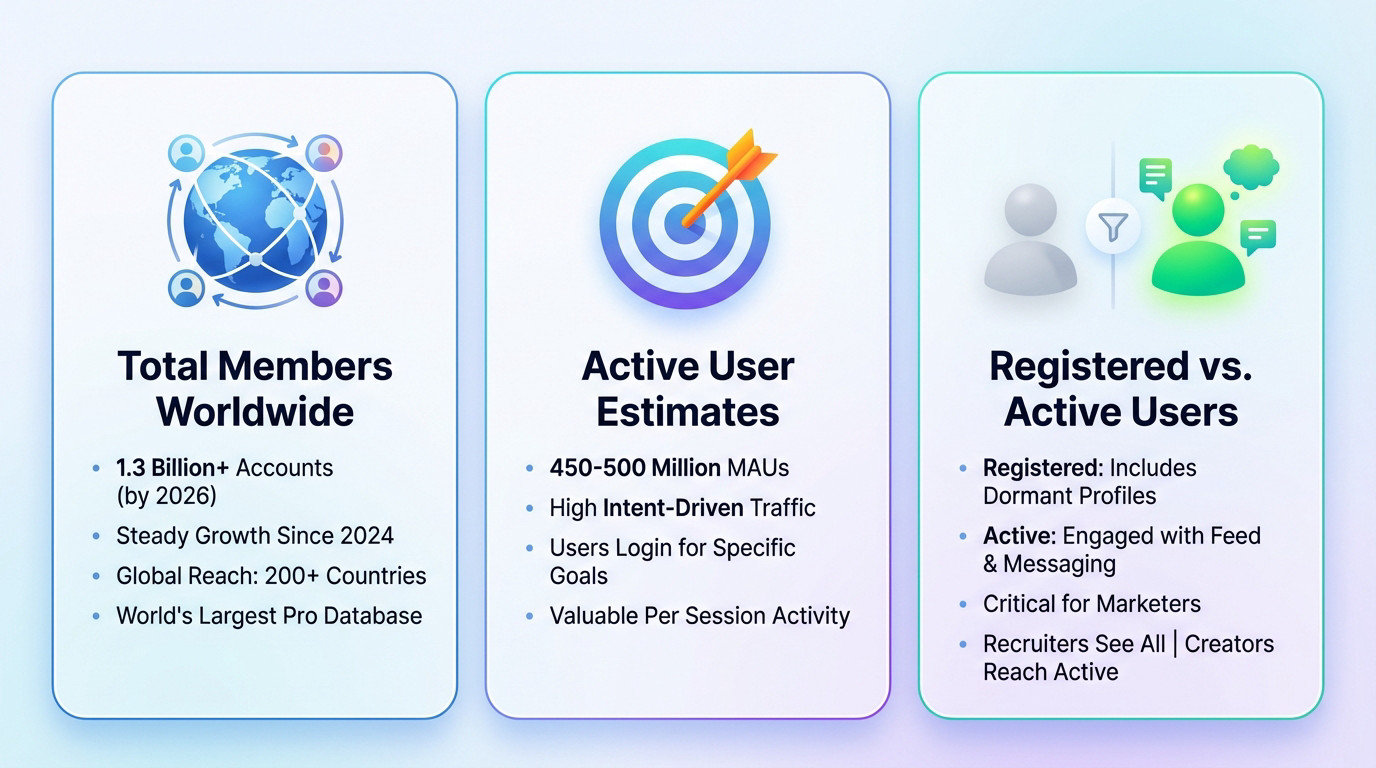
LinkedIn doesn’t publish monthly active user counts the way Meta does. The official numbers Microsoft discloses are registered members and revenue; everything else is third-party estimate, so we’ll flag each one with its source.
Registered members worldwide
LinkedIn has surpassed 1.3 billion registered members, per Satya Nadella on Microsoft’s Q3 FY26 earnings call: “LinkedIn has 1.3 billion members and we are seeing increased depth of conversation.” The counter first showed 1.3B+ in late 2025. Microsoft stopped disclosing exact member counts once LinkedIn cleared a billion, so precise year-on-year member growth cannot be derived from any published source, and figures quoted to the million elsewhere are false precision. What is disclosed is revenue, the fastest growth among major Western social platforms on a per-member basis.
The platform spans more than 200 countries and its interface is available in 36 languages, though not every language is supported across ads, help and mobile. Asia-Pacific is the largest single region at roughly 353 million, ahead of EMEA (322M), North America (270M) and Latin America (135M), per DataReportal’s 2026 figures as compiled by Posterly. Those regional numbers are advertising-reach estimates rather than registered-member counts, which is why they do not add up to the global total.
Monthly and daily active users
Third-party estimates converge on around 310 million monthly active users and 134 million daily logins (Business of Apps; see also TechRT’s February 2026 compilation). That puts active usage at roughly 24% of registered members in any given month.
Some legacy estimates cite “600 million MAU”. That figure isn’t supported by current third-party tracking and reads like a forward projection treated as fact. We’ve avoided it.
Compare LinkedIn’s activity profile to the broader social media sector in our Social Media Statistics for Australia report. LinkedIn sessions are less frequent but on average more commercially valuable than entertainment-platform sessions, which is what matters for B2B.
Why “registered” and “active” diverge
“Members” includes dormant resumes that haven’t been touched in years. Active users are the ones engaging with the feed or messaging. For recruiters and Sales Navigator users, the full database is still searchable regardless of activity, which is part of why LinkedIn Talent Solutions drives roughly 60% of total revenue (AIM Group via Posterly).
For content creators and ad buyers, only the active 310 million are reachable in practice. That gap is the single most useful number in this report.
LinkedIn members by region (early 2026)
Asia-Pacific is now LinkedIn's largest single region by member count, ahead of EMEA and North America. Source: Posterly's May 2026 compilation using LinkedIn-published regional figures.
LinkedIn Usage in Australia in 2026
How many Australians use LinkedIn
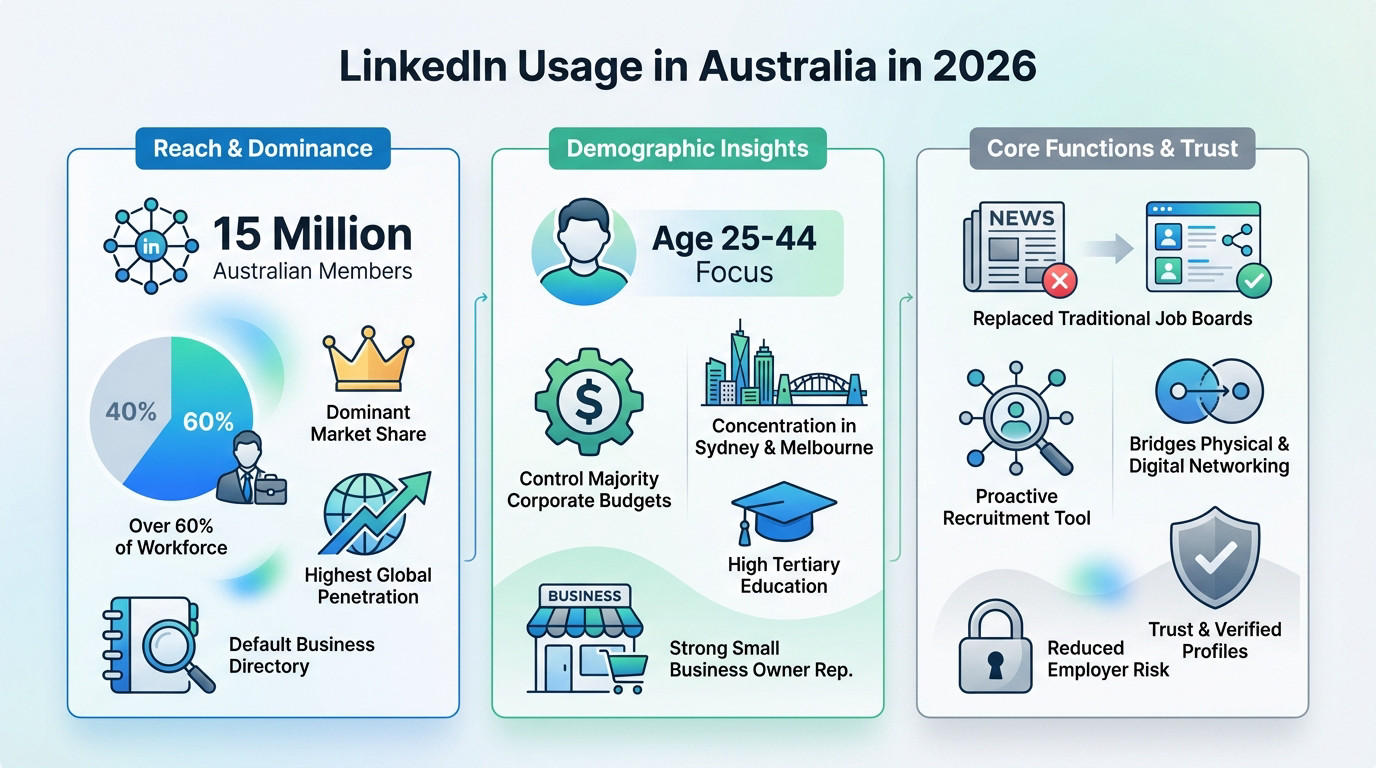
NapoleonCat’s tracker puts Australian LinkedIn users at 16,990,000 as at June 2026, roughly 61.1% of the total population, while DataReportal’s Digital 2026 Australia report puts LinkedIn’s Australian ad reach at 18.0 million. Both are advertising-reach estimates based on registered members, and here is the check nobody runs on them: Australia’s entire labour force was about 15.5 million in June 2026 (ABS). Both figures exceed every working Australian, which tells you exactly what these counts include: dormant accounts, duplicates, and people who have long since moved overseas. World Population Review’s May 2026 dataset also lists Australia at 17 million members. That ranks Australia 10th globally by user count.
The active subset is much smaller. SocialMediaNews Australia estimates around 6.5 million monthly active Australian users, which is closer to 40% of the registered base than the roughly 24% the global figures imply. Treat that gap with caution rather than as a finding: the Australian estimate and the global one come from different methods, and the same tracker still quotes a 10 million registered base elsewhere on its own page.
The local Australian market reach is unusually deep relative to population. For context on penetration, see our Search Engine Usage Statistics Australia for 2026 report and our Australian Internet Statistics 2026 deep dive.
Who’s actually on the platform locally
NapoleonCat’s demographic breakdown for Australia identifies the 25-34 age band as the largest at roughly 46% of the local base, about 7.8 million. The bands it publishes are 18-24, 25-34, 35-54 and 55+, so the second-largest group is the broad 35-54 band at around 28%.
Sydney and Melbourne dominate by absolute user count, but per-capita penetration is high across Perth, Brisbane, Adelaide and Canberra too, reflecting Australia’s white-collar geography. Tertiary education and senior role concentration on LinkedIn are well documented, though the underlying research is American: Pew’s US data, compiled by Posterly, notes 37% of college graduates use LinkedIn vs only 15% of those without tertiary education, and 37% of $100K+ households vs 17% of sub-$30K households. The Australian skew is directionally similar.
Recruitment in Australia: LinkedIn vs traditional job boards
LinkedIn isn’t quite the only game, but it’s the dominant one. SEEK still wins on volume of listings in trades, hospitality and large-blue-collar categories; LinkedIn wins on professional, technical and senior roles, and is the default tool for passive-candidate outreach.
Candidates now research the company page before applying. A neglected page actively deters tier-one candidates, especially in tech, finance and professional services. The “Easy Apply” feature has dramatically increased application volume per role, which has shifted recruiter workload toward screening and ranking rather than sourcing.
For employer-brand purposes, employee advocacy (staff sharing roles and culture content) remains the highest-leverage organic lever. People trust people more than logos.
Demographic Breakdown
Age distribution globally
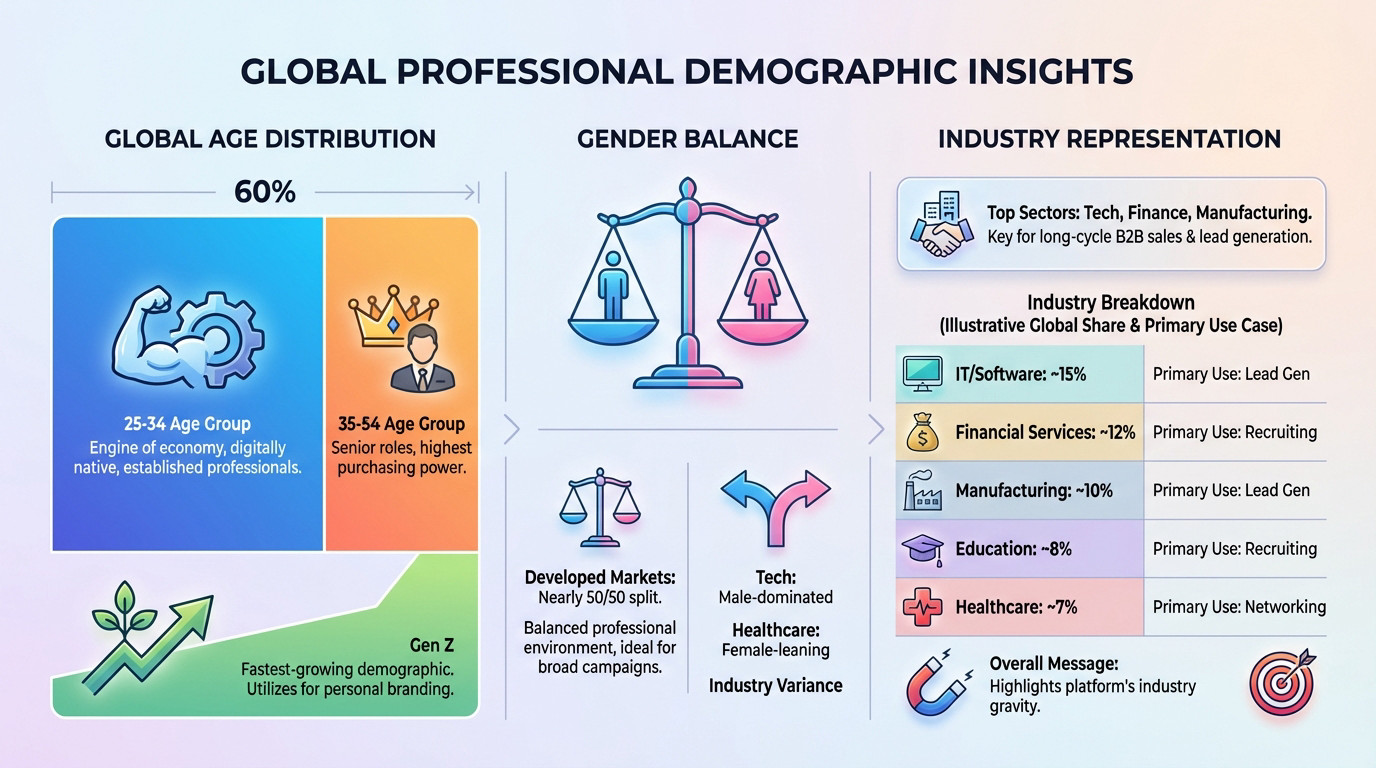
A persistent online claim that “60% of LinkedIn users are 25-34” doesn’t survive checking. The 25-34 age band is the largest single cohort, but the actual share is closer to 47% globally (Posterly’s May 2026 demographics compilation citing DataReportal). The 35-54 segment is also material and is where most senior decision-makers actually sit.
The Gen Z (18-24) cohort is the fastest-growing segment by percentage. They’re using LinkedIn earlier than millennials did, often building a profile during their final year of study.
Gender balance
The global gender split sits at roughly 57% male / 43% female (Posterly 2026), with sector variance. Tech and engineering tilt male-heavy, while healthcare, education, HR and PR tilt female-heavy. Some markets are closer to parity than others.
Industry representation
Technology, finance, and professional services dominate by membership. These sectors run long-cycle B2B sales, which is why LinkedIn ad spend and Sales Navigator subscriptions concentrate here.
LinkedIn’s advertising materials have long put the platform at roughly 65 million decision-makers and 10 million C-level executives, though that figure dates to around 2020 and has not been refreshed publicly since. One number worth correcting while we are here: the widely repeated “98% of Fortune 500 CEOs are on LinkedIn” drops the denominator. Influential Executive’s research found that 98% of Fortune 500 CEOs who use any social platform at all use LinkedIn, and that 74% of them use any platform. So the real figure is closer to three quarters. The seniority concentration that justifies LinkedIn’s higher CPCs is real, it is just not near-universal CEO coverage.
The table below shows the high-density sectors where most of the platform’s gravity sits.
| Industry | Global Data / Trend | Primary Use Case |
|---|---|---|
| IT/Software | High Saturation | Lead Gen & SaaS Sales |
| Financial Services | Major Sector | Investor Relations |
| Manufacturing | High | Supply Chain B2B |
| Education | Growing | Student Recruitment |
| Healthcare | Growing | Talent Acquisition |
LinkedIn Engagement and Behaviour Trends
Frequency of activity
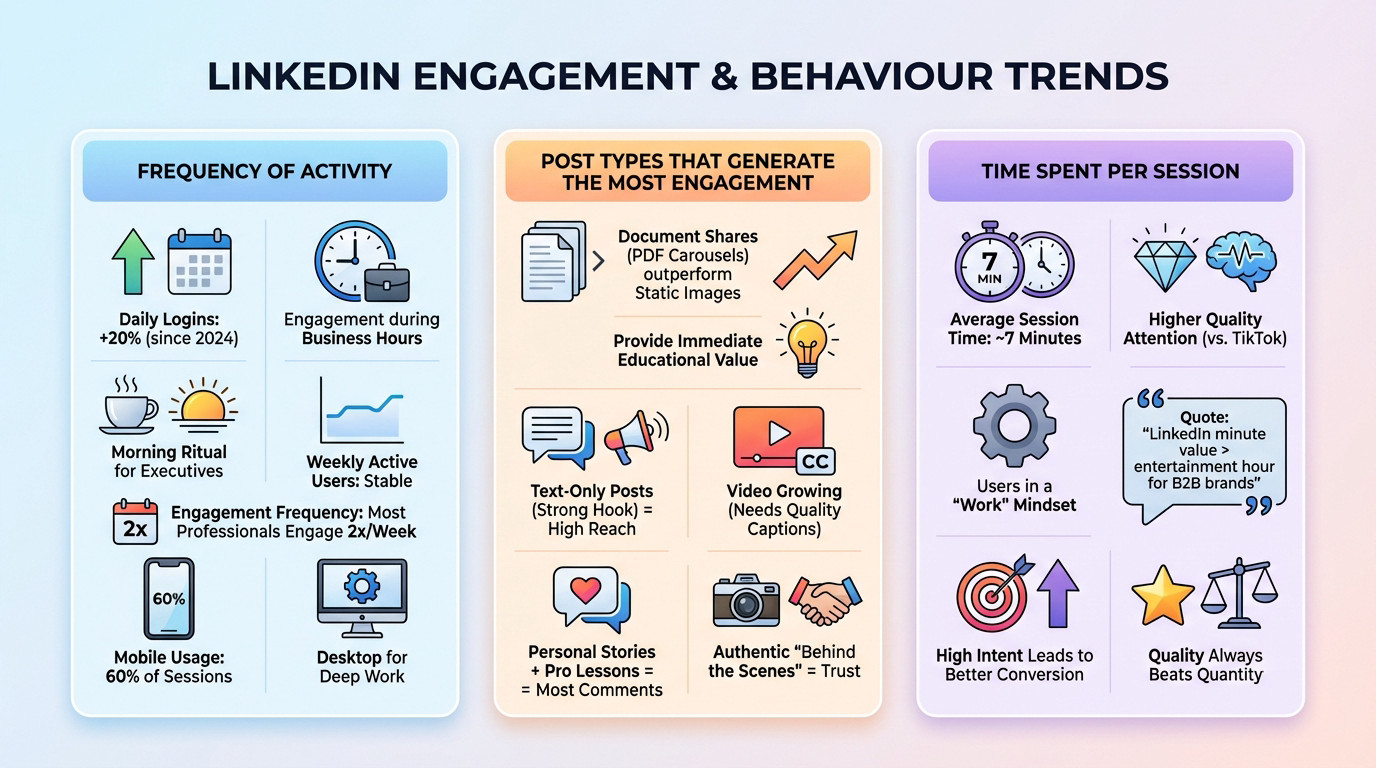
About 70% of LinkedIn activity now comes from mobile (BlankSpaces via Posterly). Time on platform is where most LinkedIn stat posts go wrong: the widely repeated “33 minutes a day” is Instagram’s number, lifted from the wrong row of a comparison table. The figure that survives tracing to a primary tracker is session length, and Similarweb puts the average visit at a little over seven minutes as at June 2026. Short sessions, but frequent ones.
Daily logins (~134 million globally) are concentrated in business hours and overlap heavily with commuter time. The morning-coffee scroll has become genuinely common across senior cohorts.
Post types that generate the most engagement
Document carousels (native PDF uploads) continue to outperform static images on a per-impression basis, because they offer save-for-later value. Text-only posts with a strong opening line still pull strong organic reach. Native video is growing, with mandatory captions because most users watch sound-off.
Personal-but-professional storytelling, the “what I learned when X happened” format, consistently earns the highest comment counts. Pure promotional posts get the least, which is the pattern practitioners have reported consistently for years.
Time spent per session
That seven-minute session is well below TikTok’s, but the quality of attention is different: people are in work-mode, scanning for utility rather than entertainment.
The value of a LinkedIn minute is vastly higher for B2B brands than an hour of entertainment-first scrolling.
That delta is why LinkedIn ads, despite costing more per click, can still deliver lower cost-per-qualified-lead in B2B than the cheaper alternatives.
Content and Publishing on LinkedIn
Daily publishing volume
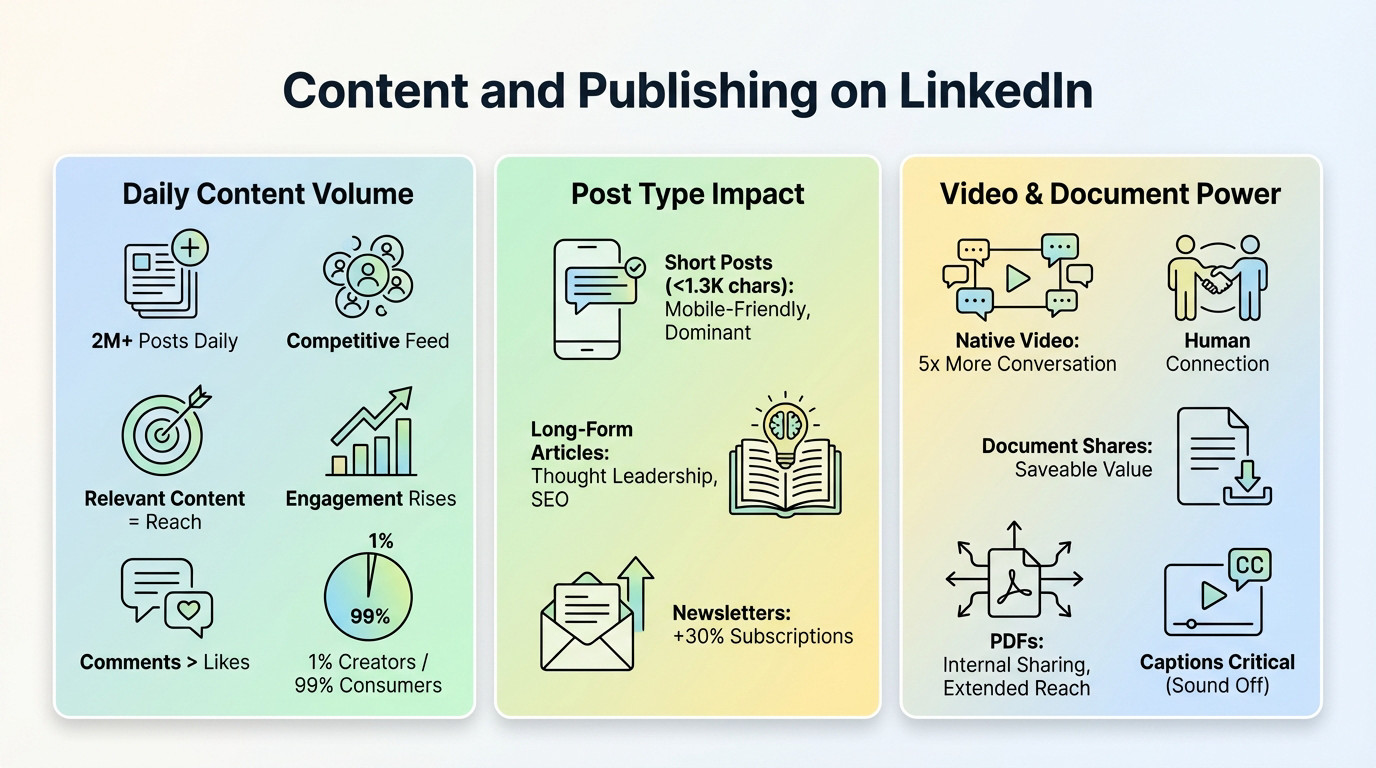
The often-quoted “2 million posts a day” is a LinkedIn figure from around 2017 that aggregators have recycled unchanged ever since, while the member base tripled. Treat it as a floor, not a current number. The feed is genuinely competitive: comments and saves are weighted more heavily than likes, so engagement quality matters more than reach numbers.
Around 1% of users post regularly, with the rest reading rather than publishing. That ratio comes from LinkedIn session data published in 2019, off a member base less than a quarter of today’s, so treat the exact number as indicative. The creator-to-lurker pattern itself holds across every large platform, and it is why consistent posting is still a competitive advantage.
Long-form articles vs short posts
Short posts dominate the daily feed because mobile is the primary surface. Long-form articles and LinkedIn Newsletters serve a different purpose: they’re searchable, archivable and indexed by Google, which gives them a long tail.
LinkedIn Newsletters have continued to grow in subscriber adoption through 2025-2026, with consistent practitioner reports of higher open and click rates than equivalent external email lists for the same authors.
Native video and document carousels
Native video consistently outperforms static images on conversation per impression, and document carousels (PDFs uploaded directly) outperform external link posts on save rate. The reason for both is the same: LinkedIn’s algorithm rewards content that keeps users on the platform.
Captions are non-negotiable for video. The majority of in-feed video plays happen with sound off, which is why LinkedIn auto-generates captions in supported languages.
LinkedIn’s Role in Job Search and Recruiting
Employers using LinkedIn for hiring
LinkedIn is the top social channel for recruiting, with 71% of talent acquisition professionals using it or planning to (Employ Recruiter Nation Report 2024, surveyed by Zogby Analytics across 1,200+ North American decision makers). You will see “87%” or “90%” quoted instead: that traces to a 2016 Jobvite question about which channel recruiters found most effective for vetting candidates, not about usage. For senior, technical and professional roles, LinkedIn is the first port of call ahead of traditional job boards.
Talent Solutions (LinkedIn Recruiter, Recruiter Lite, jobs slots) accounted for roughly 60% of LinkedIn’s total revenue in FY2025, the largest single segment (Posterly citing AIM Group). The platform’s agentic AI hiring products have “already surpassed a $450 million annualized revenue run-rate”, per Satya Nadella on Microsoft’s Q3 FY26 earnings call.
Candidate behaviour trends
Candidates research company pages before applying. They look for social proof, recent posts from employees, and signals of values alignment. A neglected page deters top candidates, especially in technical and senior roles where talent has options.
“Easy Apply” has dramatically increased per-role application volume. The unintended consequence has been more time spent screening and ranking, less time spent sourcing.
LinkedIn Learning and upskilling
LinkedIn Learning has seen a surge in AI-related course enrolment through 2025-2026 as professionals try to keep pace with the technology covered in our AI Statistics 2026 report. Completed certificates display on profiles and feed into recruiter search filters.
Skill Assessments no longer exist. LinkedIn retired them and removed the badges from member profiles during 2024, saying hirers found examples of applied skills more valuable than an assessment badge. Nothing replaced them directly: verification now runs through skills attached to real roles, projects and credentials. Any 2026 guide still telling you to take skill assessments is working from pre-2023 data.
LinkedIn Advertising and Business Impact
Advertising reach globally and in Australia
LinkedIn ads can reach more than 1 billion professionals globally. The targeting precision is genuinely unique to LinkedIn: job title, seniority, company size, years of experience, school, skill, function. None of those filters exist with equivalent fidelity on Meta or X.
In Australia, ad reach is quoted against the full registered base of roughly 17 million, not the active subset, which is worth remembering when you model impressions. The targeting itself does go deep, filtering down to small clusters such as mining operations managers in Perth or civil engineering principals in Brisbane.
Revenue, ad spend trends and ROI benchmarks
LinkedIn generated $17.81 billion in FY2025, up 9% year on year (Microsoft’s FY2025 10-K, revenue by product and service table). The most recent quarter, ended 31 March 2026, hit $4.83 billion, up 12% (Microsoft’s Q3 FY26 10-Q). Worth noting the constant-currency figure is 9%, so the headline 12% flatters the growth slightly.
CPCs on LinkedIn are higher than Facebook or Google search on most categories, often $5-10 in technical sectors. For B2B with five and six-figure customer LTVs, the math still works. For low-LTV consumer, it rarely does.
Compare this with our Perth SEO approach, which is organic search rather than paid. The simplified frame: Search captures existing intent, LinkedIn builds awareness and pipeline inside identified target accounts.
LinkedIn for B2B Marketing
Lead generation efficiency
The often-quoted “LinkedIn is responsible for 80% of B2B social media leads” line originally comes from a LinkedIn-published stat in 2017. It’s old, but GetAFollower’s 2026 compilation and Microsoft’s own earnings commentary indicate the underlying dominance hasn’t changed. For most professional services, technology and industrial B2B categories, LinkedIn outproduces Meta and X for qualified pipeline by a wide margin.
Lead Gen Forms reduce mobile friction by pre-filling fields from the profile. They generally outperform link-out landing pages on mobile, particularly for top-of-funnel content downloads.
Brand content performance
Brands posting 2-3 times a week see the highest engagement lift per post. Consistency signals an actively managed presence rather than dormant brand. Educational and “how we approach X” content consistently outperforms direct promotion.
Tagging employees in company updates increases organic reach by routing into individual networks. The single highest-leverage organic lever for most B2B brands is structured employee advocacy.
Why employee advocacy works
Companies using employee advocacy programs see materially higher click-through rates on shared posts vs corporate accounts posting the same content. The reason is structural: people trust people more than logos, and LinkedIn’s algorithm weights personal accounts more generously than company pages.
“The most useful B2B brands on LinkedIn act like publishers, not advertisers, providing constant value to their niche.”
The compounding effect (each post seeds the next via algorithm signals) is what makes consistent posting pay over months, not weeks.
Challenges and Limitations
Lower consumer engagement
LinkedIn isn’t an entertainment platform. People don’t log in here to relax. The mindset is professional and transactional, which means casual lifestyle products and B2C campaigns generally fail.
Attention windows are shorter than on TikTok or Instagram. Content has to deliver utility in the first sentence or it gets scrolled past.
Higher cost per click
Global CPC averages sit around $5.74 for sponsored content in 2026, with technology and finance running higher, which makes LinkedIn a premium environment. For businesses with low customer LTV, the math rarely works. For B2B with $20K+ deal sizes, it usually does.
Precision matters. A poorly targeted LinkedIn campaign burns budget fast, and the platform’s targeting depth is wasted unless you actually use it (job title, seniority, company size, function).
Audience growth plateau in mature markets
In the US, EU and Australia, LinkedIn’s white-collar workforce is largely saturated. Net new growth is increasingly coming from emerging markets, particularly India (now ~161 million members and the fastest-growing major market) and Southeast Asia. For Australian marketers, this means depth of engagement now matters more than reach extensions.
Competition for feed attention is high. Standing out requires either genuine expertise or genuinely useful information. The “post for the algorithm” hacks have diminishing returns as the algorithm itself filters for quality signals.
Trends Shaping LinkedIn in 2026
AI-driven content recommendations
LinkedIn has published research on 360Brew V1.0, a 150-billion-parameter ranking model built on top of Mistral’s Mixtral 8x22B. Be careful how you read it: LinkedIn describes it as a pre-production research model evaluated on offline metrics, not as the system currently ranking your feed. What practitioners consistently observe, which is a different kind of claim, is that specific niche-deep content gets distributed while generic AI-written posts do not.
The implication for content strategy is the same as the implication for SEO: write something that demonstrates actual knowledge of a specific topic, and the algorithm will route it to the people who care about that topic. See our piece on Entities in Local SEO for how the same entity-mapping logic applies elsewhere.
Professional content communities
Groups is still called Groups, in every market, and it is still live. What is telling is the neglect: LinkedIn’s Groups documentation has sat largely untouched for around three years while the company actively retired neighbouring features. The trend practitioners report anyway is that a small, engaged, niche audience converts better than a large public follower count, which is a reason to build a focused following rather than a reason to bet on Groups specifically.
Integration with CRM and sales tools
LinkedIn’s integrations with Salesforce, HubSpot and other CRMs are now mature enough that buyer-intent signals (page visits, content engagement, profile views from target accounts) flow into the same dashboards where sales pipeline lives.
For B2B GTM teams, this is the most consequential 2025-2026 shift: LinkedIn activity is no longer a vanity surface, it’s a sales input. Account-based selling teams that wire LinkedIn engagement into Salesforce alerts get earlier signal on which target accounts are warming up.
if you want to talk through how to apply this to your own B2B funnel, or tell us about your project and we’ll come back with a scoped recommendation.
FAQ
How many registered members are on LinkedIn in 2026?
LinkedIn has surpassed 1.3 billion registered members, stated by Satya Nadella on Microsoft’s Q3 FY26 earnings call in April 2026. Microsoft no longer discloses exact member counts, so treat any precise growth percentage you see quoted as an estimate rather than a reported figure.
How many monthly and daily active users does LinkedIn have?
Third-party estimates converge on around 310 million monthly active users and 134 million daily logins. LinkedIn itself doesn’t officially publish these figures; the numbers come from Business of Apps, DemandSage, Expandi and TechRT 2026 compilations.
How many LinkedIn users are there in Australia in 2026?
NapoleonCat’s April 2026 tracker puts Australian LinkedIn users at 16.99 million, or about 61.2% of the population. SocialMediaNews estimates roughly 6.5 million monthly active Australian users.
What’s the actual age breakdown on LinkedIn?
The 25-34 cohort is the largest at about 47% globally, not the 60% commonly claimed. The 35-54 cohort is also substantial and is where most senior decision-makers actually sit. Gen Z (18-24) is the fastest-growing segment by percentage.
Do document carousels really beat video on engagement?
Native document carousels (PDFs uploaded directly) consistently outperform static images on save rate, and roughly match native video on engagement per impression. The reason both formats work is the same: they keep users on LinkedIn rather than routing them out.
Where do you check whether LinkedIn stats are current?
For the official platform numbers, Microsoft’s quarterly earnings releases are the only first-party source. For Australia-specific user counts, NapoleonCat and SocialMediaNews publish monthly. For ad benchmarks, Hootsuite and Sprout Social refresh annual averages; treat anything older than 18 months as soft.