
Social Media Usage in Australia (2026): The Big Picture
2026 Australian social media stats: YouTube 21M, LinkedIn 17M, Facebook 17.7M, Instagram 15.2M, TikTok 10.9M, plus how the under-16 ban shifts the numbers.

Sources: Datareportal Digital 2026 Australia and Meltwater 2026, October 2025 snapshot.
The short version. Australia hit 21 million social media user identities by October 2025 (77.7% of the population) per Datareportal Digital 2026 Australia. YouTube and Facebook still lead by audience reach, but the year-on-year movement is concentrated in TikTok (+13.9%), Reddit (+179% on ad-platform reach), and a meaningful drop in X (-5.4%).
This update is built against Datareportal Digital 2026 (October 2025 snapshot, published November 2025), Meltwater, We Are Social, NapoleonCat’s April 2026 Australia tracker, Sprout Social’s April 2026 Australia report, SocialMediaNews AU April 2026, and Content Hype’s cross-checked April 2026 ranking. Every figure carries a date qualifier; older “social media statistics Australia” articles still recycle 2023-2024 baselines that no longer hold.
One material change to plan around: Australia’s under-16 social media ban took effect 10 December 2025. It covers ten platforms (Facebook, Instagram, Threads, TikTok, Snapchat, YouTube, X, Twitch, Kick and Reddit), carries penalties up to $49.5M, and Reddit is challenging it in the High Court. The next Datareportal update will be the first reporting cycle to reflect it. Expect headline user numbers to drop 5-15% on Instagram, TikTok and Snapchat through 2026, with Facebook largely unaffected.
Most popular social media platforms in Australia (2026)
Ranking by Australian audience reach (October 2025 snapshot)
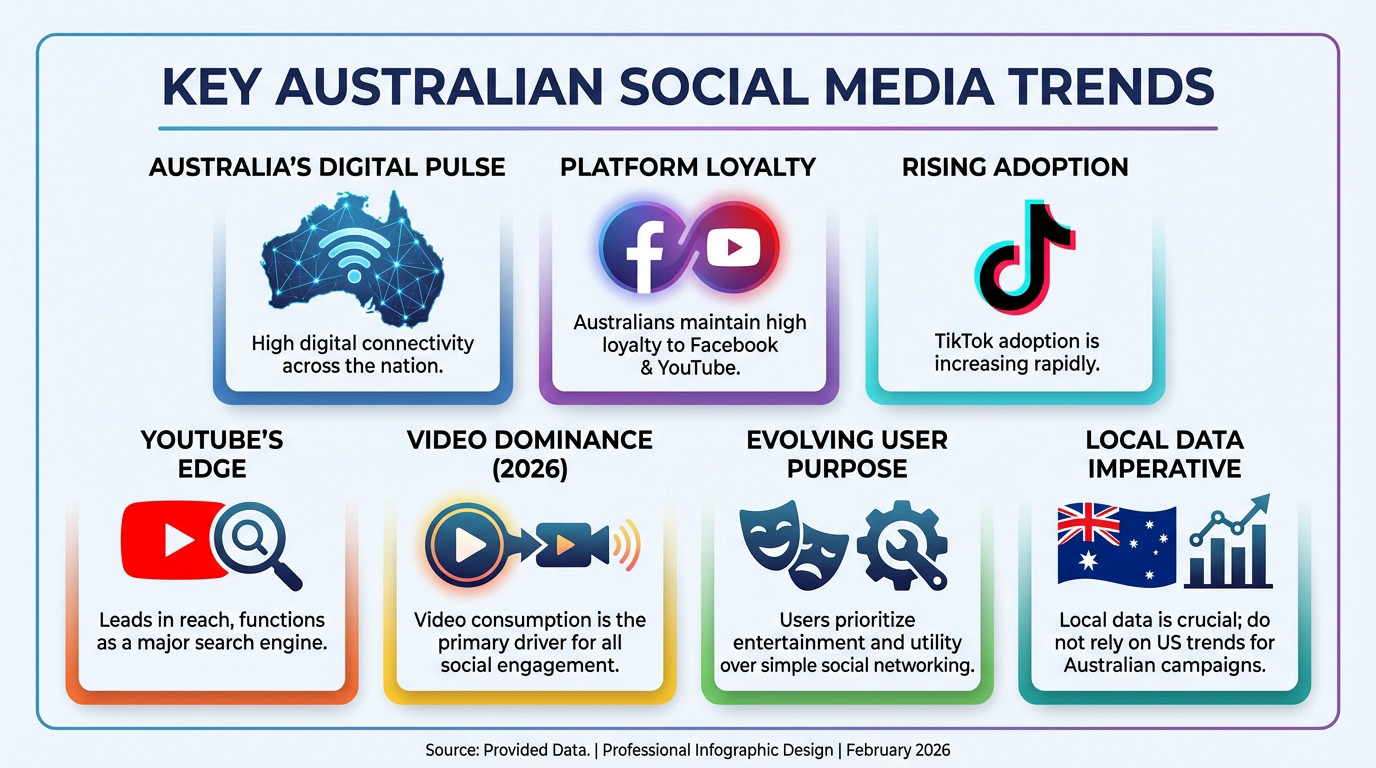
YouTube and Facebook lead by audience scale, but the picture is more diverse than the legacy “Facebook leads” narrative suggests. Per Datareportal Digital 2026 Australia cross-checked against Content Hype’s April 2026 ranking:
Australian social media platforms by user reach (Oct 2025)
YouTube leads by ad reach, with LinkedIn and Facebook close behind. TikTok grew fastest among the major platforms at +13.9% YoY; X dropped 5.4%. Reddit's ad-platform reach (estimated, not verified MAU) showed extraordinary +179% YoY growth. Source: Datareportal Digital 2026 Australia, October 2025 snapshot.
Reach figures combine advertising audience estimates and platform-reported users. Reddit, X and Threads use ad-platform reach which can run 30-60% above verified MAU.
YouTube’s “social media” status is a useful reframe. Datareportal treats it as such because of comments, likes and channel subscriptions; functionally it operates as Australia’s second-most-visited website after Google and as a major answer engine for product research, particularly among under-35s.
The other big year-on-year movements: TikTok +13.9% (+1.33M users), Instagram +8.6% (+1.2M), Facebook +4.4% (+750K). X dropped -5.4% to 4.74M reach, the only major platform to lose ground. Reddit’s reported ad reach grew +179% YoY to 23.3M, which DataReportal puts at 86.2% of the total population. Treat that as an artefact rather than a finding: it is 2.3 million more than the 21.0 million total social media identities in the same report. The safe read is that Reddit’s ad API changed what it counts, not that four in five Australians joined Reddit in a year. Reddit is also one of the ten platforms covered by the under-16 obligations and is challenging them in the High Court, so its next figure will not be comparable either.
Social media demographics by age in Australia (2026)
Reach tells you the ceiling; age tells you which platform actually fits your customer. Usage stays near-universal up to about 44, then falls away with each older band. Roughly speaking: Gen Z (16-29) lives on TikTok, Instagram and YouTube; Millennials (30-45) on Facebook, Instagram and LinkedIn; Gen X (46-61) on Facebook, YouTube and LinkedIn; Baby Boomers (62+) on Facebook and YouTube (Sprout Social Australia, April 2026).
Social media usage by age band
| Age band | Active on ≥1 platform monthly | Average weekly time (by generation) |
|---|---|---|
| 18-24 | 98% | Gen Z (16-29): 8h 40m |
| 25-34 | 97% | Millennials (30-45): 6h 10m |
| 35-44 | 94% | (Millennial / Gen X crossover) |
| 45-54 | 88% | Gen X (46-61): 4h 20m |
| 55-64 | 76% | (Gen X / Boomer crossover) |
| 65+ | 62% | Boomers (62+): 3h 5m |
Usage percentages: roi.com.au against Datareportal 2026. Weekly time: Sprout Social Australia (Deloitte data), April 2026. The practical read: the 25-54 bracket is the reliable performance-advertising sweet spot (high intent, established income), while the 35-44 cohort’s shift onto short-form video is the change most media plans haven’t caught up with.
Largest age group and gender skew, by platform
| Platform | Largest age group | Gender split (AU) | Reads as |
|---|---|---|---|
| 25-44 (43.6%) | 50.9% F / 46.6% M | Broad adult, community and groups | |
| YouTube | Spread 18-65+ (women 65+ the top single segment, 8.9%) | 50.8% F / 49.2% M | Cross-generational, every adult band |
| 25-34 (women 25-34 = 15.2%) | 54.8% F / 44.6% M | Younger Millennial and Gen Z, female-lean | |
| TikTok | 25-34 (men 25-34 = 26.3%) | 46.4% F / 53.6% M | Adult-majority, no longer a teen platform |
| 25-34 (men 25-34 = 20.6%) | 47.2% F / 52.8% M | Professional 25-54 | |
| Snapchat | 18-24 (women 18-24 = 20.0%) | 51.4% F / 48.2% M | Youngest adult skew |
| 25-34 (32.7%) then 18-24 (27.6%) | ~72% F | Female-led, planning intent | |
| X | 25-34 (26.9%), men 35-49 (17.6%) | 70.7% M / 29.2% F | Male-skewed, niche |
Age and gender breakdowns: NapoleonCat April 2026 and Datareportal 2026, via Sprout Social Australia. One caveat worth carrying into any media plan: these are advertising-audience compositions, so they describe who a platform can reach, not a verified census of who logs in.
Facebook Statistics in Australia
User base and demographic shifts
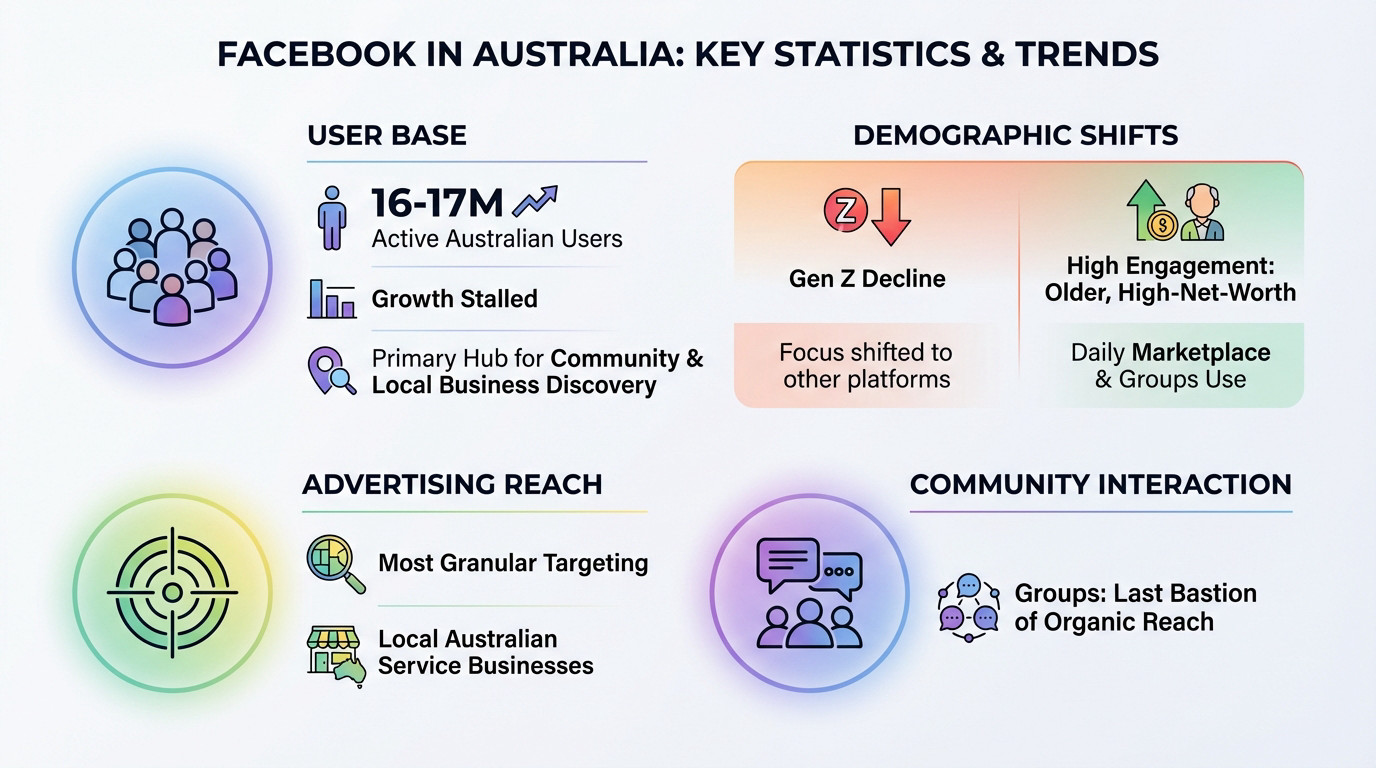
At 17.7 million Australians (65.3% of the population), Facebook is the depth play, not the growth story, per Meta’s ad planning tools cited by Datareportal Digital 2026. It added roughly 750,000 Australian users year-on-year (+4.4%), with a slight female majority (50.9%). Across our own WA client work in trades and local services, Facebook plus Marketplace still returns a lower cost-per-lead than any emerging platform, which is why we keep weighting spend here.
Younger demographics are drifting elsewhere, but the platform retains depth with older, wealthier users. The 25-54 cohort dominates by absolute numbers and remains the most reliable performance-advertising audience. For broader Australian internet context, see our Australian internet statistics report.
Marketplace and Groups continue to drive a substantial share of Facebook activity in Australia. Buy-Swap-Sell groups in particular have absorbed a lot of the activity that previously sat on Gumtree.
For service-based businesses, Facebook’s advertising reach still offers strong targeting depth (interest, demographic, lookalike audiences), which is why local services, trades, real estate and home improvement categories continue to weight spend here over emerging platforms. Groups remain one of the few surfaces where organic reach holds up, though that’s diminished progressively over the past few years.
YouTube Statistics in Australia
The largest single platform by reach
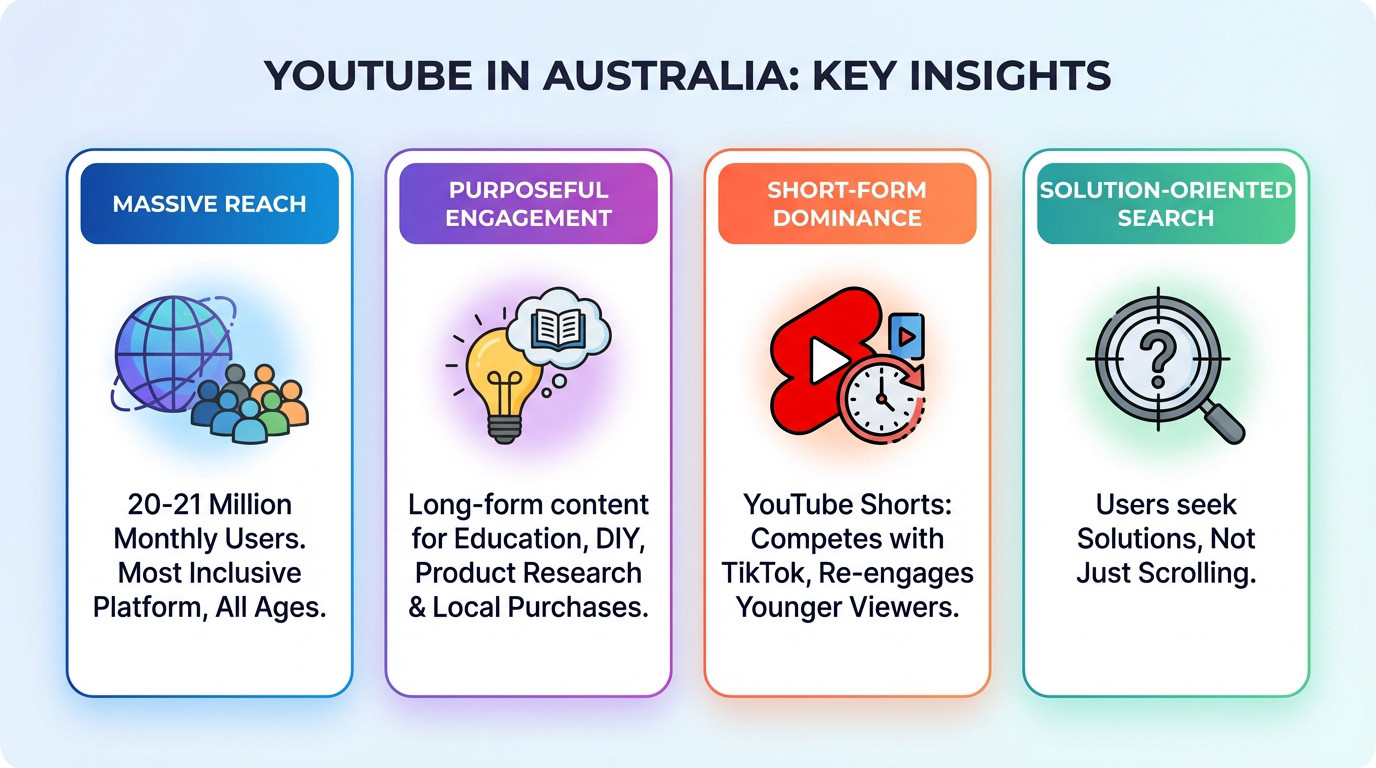
YouTube reaches 21.0 million Australians (77.7% of the population) per Google’s advertising data cited by Datareportal Digital 2026. That makes it the largest single platform by audience reach in Australia, alongside being the second-most-visited website overall after Google.com.
Australians spend roughly 1 hour 12 minutes per day on YouTube on average, per Meltwater 2026, second only to TikTok at 1h 14m. The long-form format anchors product research, how-to content, and a fast-growing share of Connected TV viewing now that YouTube on smart TVs has become standard.
YouTube Shorts has caught up to TikTok on engagement among younger viewers, helping Google retain attention that might otherwise have moved entirely off-platform. For brands, this means short-form content distributed across both Shorts and TikTok is now a baseline expectation, not an experiment.
YouTube remains the default search engine for how-to and product research among under-35s. The implication for SEO: a product or service question answered with a short YouTube video, optimised with proper VideoObject schema, often outperforms a written guide in mixed-media SERPs.
Instagram Statistics in Australia
Visual commerce and brand discovery
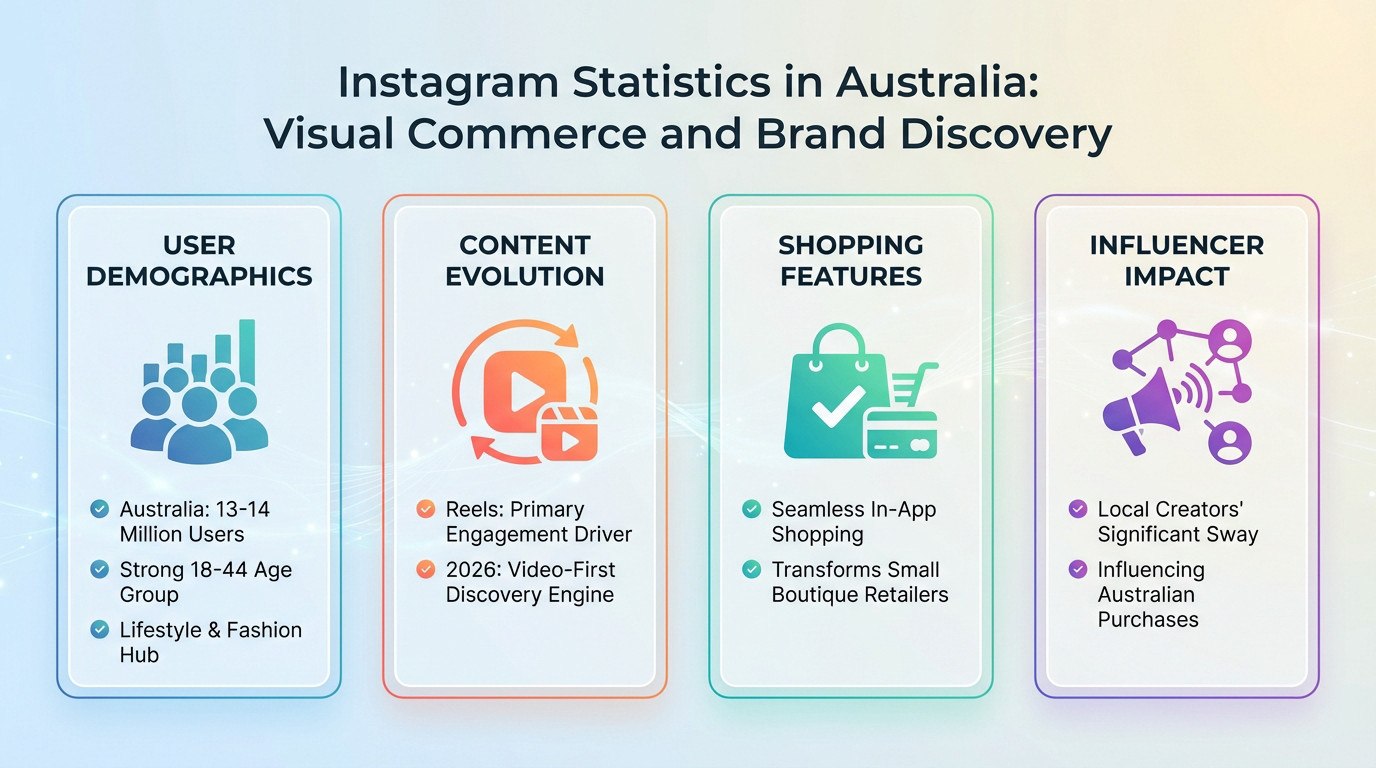
Instagram’s Australian base sits at 15.2 million per Meta’s ad planning tools, with 69.2% of adults 18+ on the platform at the end of 2025 and roughly 1.20 million users added year-on-year (+8.6%).
Reels have largely displaced the static feed as the main engagement surface; static photos still work for established brands with strong visual identity, but for everyone else, short-form video is the primary growth lever.
In 2026, Instagram operates more as a video-first discovery engine than a photo-sharing app, with Reels driving the bulk of organic reach.
In-app checkout has continued to mature, particularly for boutique retailers in apparel, beauty and homewares. The frictionless flow from discovery to purchase, without leaving the app, is one of the clearer e-commerce wins of the past two years.
Local creators retain strong influence on Australian purchasing, especially in beauty, fitness, food and lifestyle. One pattern we see hold up repeatedly: creator credibility comes from consistent posting and real usage of the products they recommend, and the more obvious the sponsored arrangement, the lower the conversion.
TikTok Statistics in Australia
The fastest-growing major platform
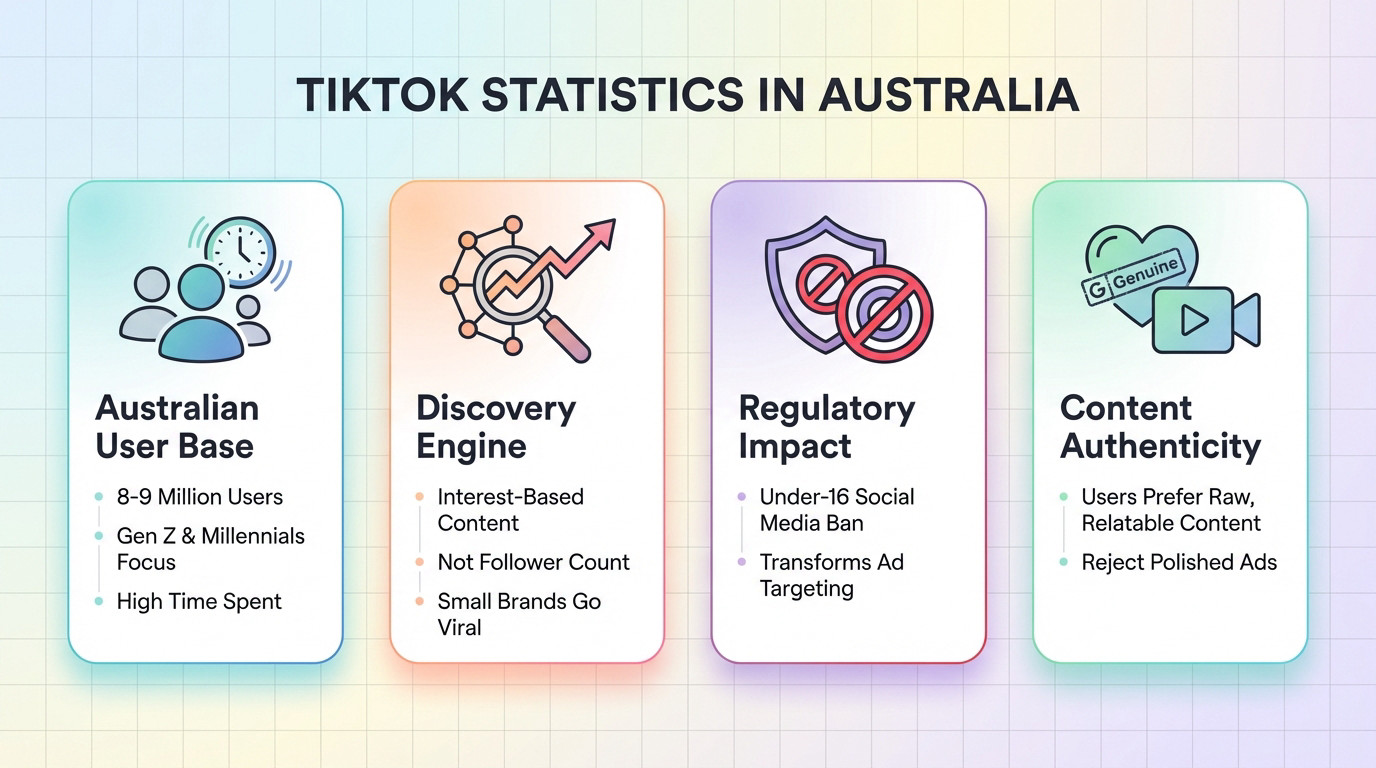
TikTok reaches 10.9 million Australian adults (18+) per its own advertising data, equivalent to 51.2% of all adults aged 18 and above. Growth was +13.9% (+1.33M users) year-on-year, the fastest of any major platform.
Daily time spent is the highest of any platform in Australia at roughly 1 hour 14 minutes per user (Meltwater 2026). Almost 74% of the user base is under 34, and per WARC research cited by Sprout Social, 86% of TikTok users aged 15-29 use the app for search on a weekly basis, increasingly as a substitute for Google for restaurant reviews, product research, and how-to queries.
The TikTok algorithm is content-merit-weighted, which is why unknown Australian brands can earn real reach without a legacy audience. The trade-off cuts the other way for big spenders: highly polished corporate ads consistently underperform creator-led, in-feed-native content.
The under-16 social media ban (effective 10 December 2025) has removed the 13-15 cohort from compliant targeting. The 5-month retrospective shows mixed enforcement effectiveness, but the legal targeting surface has shifted regardless. The Datareportal Q1 2026 update will be the first to show measured impact on TikTok’s headline AU numbers.
LinkedIn Statistics in Australia
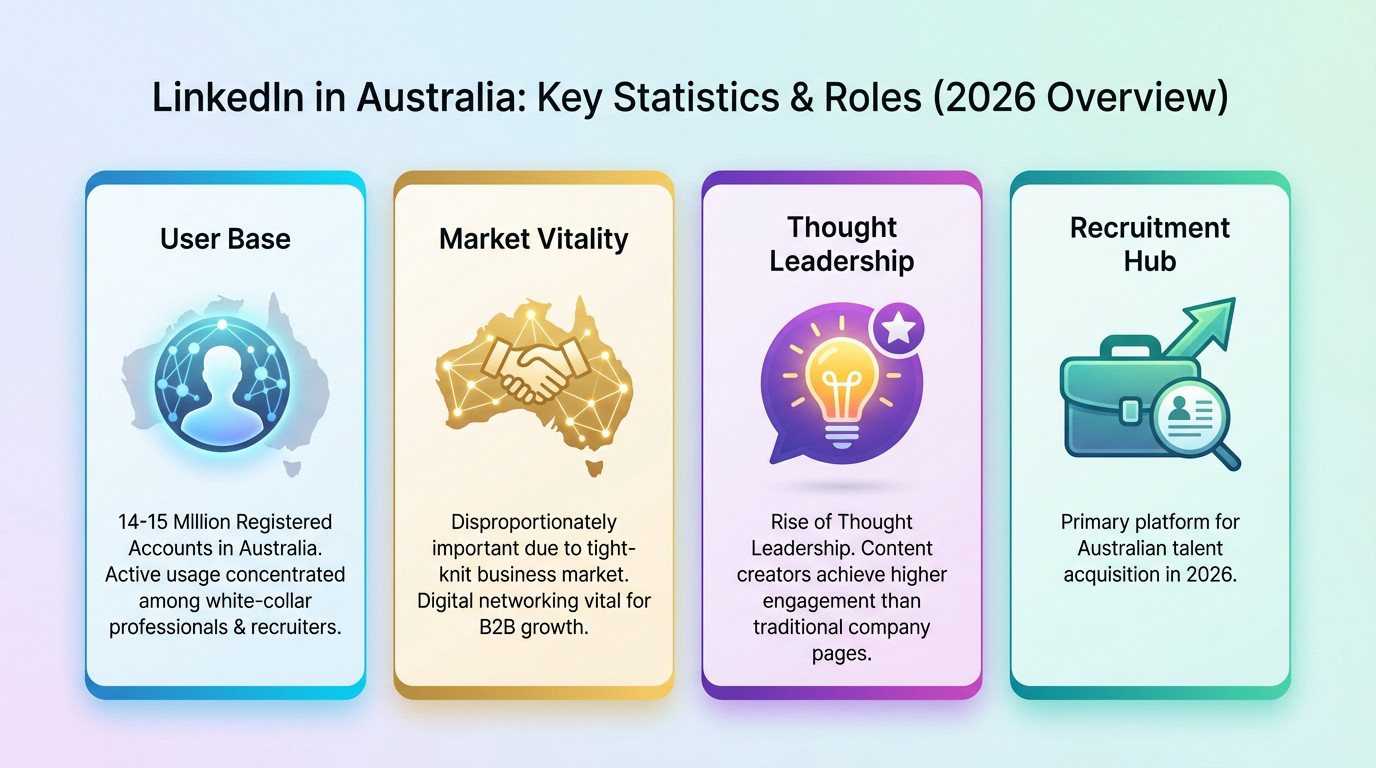
LinkedIn’s Australian footprint is bigger than most “social media stats” articles credit. NapoleonCat’s tracker (June 2026) puts Australian LinkedIn users at 16.99 million (61.1% of the population), and ad-audience-basis figures cited by Sprout Social and Posterly reach up to 18 million for advertising reach. Active monthly usage runs lower at roughly 6.5 million MAU per SocialMediaNews Australia April 2026, so about 38% of registered locals log in in a given month.
For deeper context, see our full LinkedIn statistics 2026 report.
Professional networking and B2B reach
The active subset is concentrated in white-collar professional, technical, finance and senior cohorts. NapoleonCat’s tracker shows the 25-34 age band as the largest at 45.9% of the local LinkedIn base, with 35-54 following. Do not convert that share into a headcount: 45.9% of 16.99 million would be 7.8 million Australians aged 25-34, and there are only about 3.8 million people in that band in the entire country. That gap is the whole lesson of LinkedIn’s numbers, which count registered profiles including dormant, duplicate and expatriate accounts.
For B2B in Australia, LinkedIn is the only platform where you can target by job title, seniority, company size and function with any real depth. The CPCs are higher than Meta or X but the conversion quality on high-LTV B2B usually justifies it. Individual thought-leader accounts now consistently outperform company pages on organic reach, which is why employee advocacy programs continue to scale faster than corporate page investment.
Snapchat Usage in Australia
Youth engagement and AR trends
Snapchat’s 8.17 million Australian users (Datareportal Digital 2026, up 2.4% YoY) skew heavily to the under-25s, where it works as a primary daily messaging utility alongside, and often instead of, SMS. The behaviour is sticky but shallow: short, frequent sessions rather than long scroll patterns.
The focus is on direct, private communication rather than public broadcasting, which is part of why Snapchat has held its position while X has declined. The ephemeral chat model continues to suit younger users’ privacy expectations.
Augmented Reality Lenses are now a serious commercial surface, particularly for beauty, eyewear and fashion brands running “virtual try-on” experiences. The AR investment is no longer experimental: Snapchat’s AR ads convert better on intent metrics than equivalent video pre-rolls in many lifestyle categories.
Per Snapchat’s public response to the under-16 ban, the company had locked 450,000 underage Australian accounts as at late March 2026, with ongoing enforcement. Expect Snapchat’s headline AU numbers to drop in the Datareportal Q1 2026 update.
X (Twitter) Usage in Australia
Real-time news and public discourse
X is the only major platform to lose Australian reach over the past year, dropping -5.4% YoY to 4.74 million per Content Hype’s April 2026 ranking against Datareportal data. The active core (journalists, politicians, sports commentators, niche enthusiast communities) remains, but mass-market reach has clearly thinned.
Small business relevance has dropped substantially since the platform’s 2022-2024 changes, and many local Australian brands have reallocated ad spend to Meta, TikTok and LinkedIn. The structural concern for advertisers is moderation volatility rather than reach per se.
X’s utility still peaks during live events: AFL grand finals, federal elections, weather events. Nothing else captures real-time Australian commentary in the same way, which is why journalism workflows continue to depend on it even as reach softens. For most Australian brands, X is now a presence-to-monitor rather than a primary acquisition channel.
Threads (Meta’s X alternative) reaches roughly 1.35 million Australians per Datareportal, much smaller than X but growing.
Pinterest Usage in Australia
Planning, lifestyle, and intent-based search
Pinterest reaches roughly 5.68 million Australians per Datareportal Digital 2026, up 7.5% YoY. It’s a future-focused planning surface rather than a feed-style social platform: users curate boards for upcoming renovations, weddings, travel, fashion and home projects, often weeks or months before purchasing.
The commercial intent on Pinterest is unusually strong because the platform’s mechanics surface users who are actively planning a purchase. For home improvement, wedding services, interior design, and certain travel categories, Pinterest can capture demand earlier in the buying cycle than search or social.
The user base skews female (~70%) and concentrates in household-spending-decision demographics, which is part of why home improvement, beauty and lifestyle brands continue to invest disproportionately here despite the smaller user base.
Pins compound over time. Visual search keeps older content discoverable for months after publishing, which makes Pinterest one of the few platforms where evergreen content quality has a long tail rather than a short half-life.
Messaging apps: WhatsApp and Messenger in Australia
Private messaging as a channel
WhatsApp and Messenger rarely headline a “social media statistics” piece, yet both out-reach several platforms that do. WhatsApp has no advertising platform, so nobody publishes an Australian user count for it. What is sourceable is usage share: it is used by 52.2% of Australian social media users (Meltwater 2026), at about 29 minutes per day of average use. Messenger runs higher on usage again: 68.0% of Australian social media users are on it (Meltwater 2026), second only to Facebook itself for staying connected.
Meta reports Messenger’s advertising reach unreliably, which is why it sits out of the ad-reach table below; the usage percentage is the better gauge of its footprint.
For businesses, the point is that a growing share of the buying conversation now happens in private threads. Plenty of final decisions land in Messenger, WhatsApp or Instagram DMs well after the ad impression that started them, which last-click attribution misses entirely. Click-to-message ads and a staffed inbox tend to convert better here than one more post in the feed.
Social media advertising reach in Australia
Paid reach vs active engagement
Ad-platform reach figures (Meta’s 17.7M, LinkedIn’s 18M, TikTok’s 10.9M) are addressable audience estimates, not verified monthly active users. They’re useful for media planning but typically run 30-60% higher than verified MAU per the methodology notes in Content Hype’s April 2026 cross-check.
The current ad-reach picture across major Australian platforms (Datareportal Digital 2026, October 2025 snapshot):
| Platform | Est. Ad Reach (millions) | Primary Audience | Best Use Case |
|---|---|---|---|
| YouTube | 21.0 | All ages, broad | Brand awareness, product research, education |
| 18.0 (ad audience) | Professionals 25-54 | B2B leads, recruitment, thought leadership | |
| 17.7 | Adults 25-54 | Lead gen, local services, retargeting | |
| 15.2 | Adults 18-44 | Visual commerce, Reels, brand discovery | |
| not reported (52.2% of AU social users) | Adults, broad | Private/group messaging, click-to-message, service | |
| TikTok | 10.9 (18+) | Adults under 30 | Discovery, viral reach, search-engine usage |
| Snapchat | 8.17 | Under 25 | AR commerce, daily messaging surface |
| 5.68 | Adults 25-45 (female-skewed) | Planning, home/lifestyle, evergreen | |
| X | 4.74 | Niche professional & enthusiast | News, real-time events |
| Threads | 1.35 | Early adopters | X alternative, still maturing |
On ad costs, we don’t run paid social ourselves, so we won’t quote you a CPM figure: published AU benchmarks vary widely by format, audience and season, and any single number here would be secondhand. What holds across every source is the relative order: TikTok generally runs cheapest for broad reach, Meta sits in the middle, and LinkedIn runs notably higher, justified by audience precision. Get a current quote from whoever runs your media buying rather than planning off a blog benchmark, ours included.
The practical takeaway for Australian brands: Australians use an average of 6.6 social platforms per month (Meltwater 2026), and the days of single-channel social strategies are gone. Most successful AU brands now run primary spend on 2-3 platforms with secondary presence on 2-3 more.
Key social media trends in Australia for 2026
The behavioural shifts that matter for planning the rest of 2026:
Social as a search engine
Younger Australians now use TikTok and Instagram (and YouTube) to research restaurants, products and local services instead of Google. WARC research cited by Sprout Social puts TikTok-as-search at 86% weekly usage among 15-29-year-olds. Sprout Social reports 33.8% of Australians visit social networks to look for information about products and brands. The implication: GBP optimisation still wins for over-35s; for under-25s, TikTok presence and Instagram content optimisation matter as much as traditional SEO.
Video-first content
Reels, Shorts, TikTok native video and increasingly LinkedIn video all converge on the same format: vertical, short, captioned. Static-image content continues to work for established brands with strong visual identity, but for new growth, short-form video is the only growth lever that reliably scales.
Creator-led authenticity
Polished corporate ads consistently underperform creator-led in-feed-native content across TikTok, Instagram and increasingly YouTube. The Australian market has been particularly quick to filter “obvious ad” content out, which is why creator economy investment has continued to grow even as overall ad budgets fragment.
AI scale, human judgement
AI tools help with content production volume and ideation, but human judgement remains decisive for local nuance. A bot doesn’t understand WA-specific context (FIFO rotations, seasonal patterns, local references). The agencies producing the best Australian social work in 2026 use AI for first drafts and ideation, then layer human editing for local resonance.
Comments and DMs as part of the funnel
Engagement-as-customer-service has consolidated as a standard expectation. Brands that respond to comments and DMs within hours consistently outperform brands that treat engagement as a separate workflow. Per BrightLocal’s 2026 consumer survey, a US and UK panel rather than an Australian one, 89% of consumers expect business owners to respond to reviews; the same expectation now extends to social.
Putting the 2026 data to work
The 21-million-Australian social media user base is real, but the productive question for Australian businesses is which 2-3 platforms actually fit your customer base, and which 2-3 you should run secondary presence on for brand visibility.
The platform-fit framework that holds up across our client base:
- Local services, trades, real estate, home improvement: Facebook primary (lead gen + Marketplace), Instagram secondary (visual proof)
- Hospitality, retail, lifestyle, beauty: Instagram primary, TikTok secondary, Pinterest tertiary for planning categories
- B2B, professional services, technology, finance: LinkedIn primary, YouTube secondary (long-form thought leadership)
- E-commerce broad consumer: Meta primary (FB + IG), TikTok secondary, YouTube tertiary
- News, public commentary, niche enthusiast: X secondary (active community only)
For Australian businesses thinking through how to apply the 2026 social media landscape to their own funnel, or drop us a line and we’ll come back with a scoped recommendation.
FAQ
How does YouTube’s reach compare to Facebook in Australia in 2026?
YouTube reaches 21.0 million Australians (77.7% of the population) per Google’s advertising data via Datareportal Digital 2026, ahead of Facebook at 17.7 million (65.3%). Both are at audience-saturation levels in their respective demographics; the real differentiation is use case rather than reach (YouTube wins long-form video, Facebook wins lead gen and Marketplace).
Is TikTok growing faster than Facebook in Australia?
Yes. TikTok’s Australian adult ad reach grew +13.9% (+1.33 million users) over the year, the fastest growth of any major platform per Datareportal. Facebook grew +4.4% (+750K). Instagram grew +8.6% (+1.20M). The fastest-growing platform overall on ad-platform reach metrics was Reddit at +179%, though that figure uses Reddit’s ad-API estimate which typically overshoots verified MAU.
What’s the difference between reported ad reach and active user counts?
Ad-platform reach is the addressable audience a platform sells against; verified MAU is the active user count. Verified MAU typically runs 30-60% below ad-platform reach per Content Hype’s April 2026 methodology note. For media planning, ad reach is the right number. For market sizing, verified MAU (where published) is the safer baseline.
Which Australian platform has the highest daily time spent per user?
TikTok at roughly 1 hour 14 minutes per day, narrowly ahead of YouTube at 1 hour 12 minutes, then Instagram at 1 hour 3 minutes, Facebook at 46 minutes and WhatsApp at 29 minutes (Meltwater 2026 Digital Australia report).
How will the under-16 social media ban affect these numbers?
Australia’s ban took effect 10 December 2025. The next Datareportal update will be the first to reflect the impact. Expect headline AU user numbers to drop 5-15% on Instagram, TikTok and Snapchat through 2026, with Facebook largely unaffected.