
Google Maps Statistics in Australia (2026)
2026 Google Maps AU stats: 2.3B global MAU, ~5.9M weekly Australian iOS users, Ask Maps + Immersive Navigation rollout. SensorTower and Google data verified.

Google Maps has surpassed 2 billion monthly active users globally (Google, 2025). It now sits in Google’s billion-user tier alongside Search, Gmail, Chrome, YouTube and Android.
The Australian numbers are smaller but tell a clearer story about local search behaviour. SensorTower’s Q3 2025 iOS data puts Google Maps at roughly 5.9 million weekly active users in Australia, vs Waze at 1.05 million, a roughly 5.6:1 lead that has held for years.
The platform’s origin story is Australian: the foundational technology was developed by Sydney-based Where 2 Technologies before Google’s 2004 acquisition. Two decades later, Maps is the default way Australians find restaurants, services, directions and almost any local information.
This guide unpacks the verified 2026 numbers behind that position, with a particular focus on what’s changed since Google’s March 2026 rollout of Ask Maps and Immersive Navigation.
Google Maps in Australia: the big picture
Google Maps reaches a near-saturated Australian audience. Per Datareportal’s Digital 2026 Australia report, internet penetration is now 97.1% (26.2 million Australians online), and Maps is preinstalled on Android and available as a free download on iOS.
Globally, Maps now exceeds 21 billion installs on Android alone (AppGoblin, April 2026) and its catalogue lists 250 million businesses and places across 220+ countries.
A useful integration metric: BuiltWith counts around 301,000 Australian sites currently using Google Maps, a signal of how deeply embedded it is in the local business web.
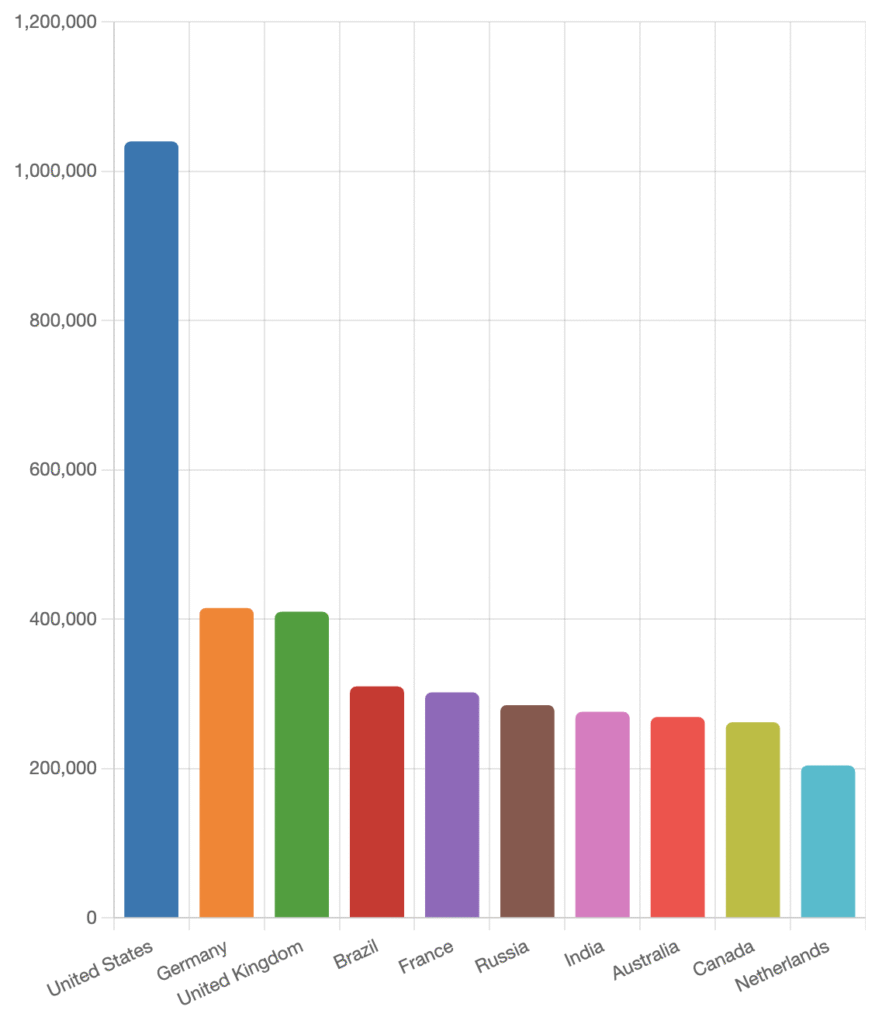
Websites Embedding Google Maps API: Global Top 10
Australia’s adoption pattern is unusual on two fronts: very high per-capita active use, and very low alternative penetration. Waze runs a distant second, Apple Maps barely registers in published navigation app tracking despite iOS’s substantial Australian market share.
Usage Patterns: how Australians use Google Maps
Usage skews to short, frequent sessions rather than long dwell time, the look-up-and-go behaviour you’d expect from a navigation app rather than entertainment use.
The most recent SensorTower data shows Google Maps weekly active iOS users in Australia at approximately 5.9 million as of Q3 2025, up materially from earlier “unified” (iOS+Android combined) tracking that put the figure at 2.61 million in Q3 2024. Methodology shifted, so direct year-on-year comparison is unreliable. The dominance ratio against competitors has remained stable: Maps consistently runs 5-6x ahead of Waze on weekly active users in Australia (SensorTower Q3 2025).
Mobile dominates almost entirely. Desktop usage exists for trip planning and detailed business research, but the everyday “where’s the closest X” behaviour is overwhelmingly phone-led.
The most common Australian use cases:
- Navigation and route planning (still the primary use case)
- Business discovery and reviews, with local intent driving a large share of all Google searches
- Real-time traffic, road incidents and ETA updates
- Crisis information (bushfire alerts, flood warnings, air quality monitoring)
- Sustainable transport (eco-friendly route options, petrol price comparison, EV charging)
Google Maps vs the competition
The most recent SensorTower data (Q3 2025 iOS, Australia) makes the local picture clear: Google Maps ran at approximately 5.9 million weekly active iOS users by end of Q3 2025; Waze finished the quarter at roughly 1.05 million. That’s a 5.6:1 lead, almost identical to the ratio observed in earlier quarters.
Apple Maps notably does not appear in SensorTower’s “top 5 navigation and maps apps in Australia” reporting. Despite being pre-installed on every iPhone, its usage is too low to crack the published rankings. The most cited reason is weaker local business data and slower feature parity with Google Maps.
Weekly active users in Australia: navigation apps (iOS, Q3 2025)
Google Maps runs roughly 5.6x ahead of Waze on weekly active iOS users in Australia. Apple Maps doesn't reach SensorTower's top-5 published rankings. Source: SensorTower Q3 2025 iOS data, Australia.
Apple Maps shown at ~0 because no public WAU figure is published; usage is below the top-5 reporting threshold.
The competitive dynamic hasn’t changed much in recent years. Waze remains a strong second among people who specifically want crowdsourced traffic and incident reporting, particularly among commuters in Sydney and Melbourne. Google Maps’ lead is built on the ecosystem: integrated business discovery, reviews, Street View, place data, and now Gemini-powered conversational search.
Business Integration and Local SEO
Google Maps remains the backbone of local SEO and business discovery in Australia. A large share of all Google searches carry local intent (around 46%, per Google via Search Engine Roundtable), which is what makes Map Pack visibility the single highest-leverage ranking lever for most physical-location businesses.
The 300,000-plus Australian websites embedding Google Maps show how deeply Maps is integrated into the business web in Australia, from small local services to major retailers and government agencies. For most local businesses, the Maps embed on the contact page is now treated as a default rather than a nice-to-have.
Maintaining strong online reputations through Google Business Profile listings is now standard practice for any local business operating in Australia. Review count, recency and response rate all feed into Google’s local ranking signals; reviews mentioning specific products, services or suburbs feed into entity matching for query-specific rankings.
Google Maps optimisation is now a distinct discipline from broader local SEO. The mechanics, geo-grid ranking, proximity bias, category competition, photo and Q&A management, are different enough from traditional organic SEO that most agencies now treat it as its own deliverable. Our State of SEO and marketing in Australia report covers the broader investment picture.
The most-reviewed locations in Australia
Among the most-reviewed restaurants in Australia, Dosa Hut in Harris Park, NSW consistently ranks at the top with around 14,400 reviews and a 4.6-star average as of late 2025. The cluster of Indian restaurants in Harris Park and the broader Western Sydney corridor punches well above its weight on review volume.
A few honest observations from the data:
- Suburban venues can accumulate review counts that rival CBD locations, particularly when they become community hubs for a specific community
- Multicultural dining venues with strong word-of-mouth bases consistently dominate the highest-review-count lists
- Iconic tourist attractions (Sydney Opera House, Queen Victoria Market in Melbourne, MONA in Hobart) carry thousands of reviews each, but per-customer review rates are typically lower than at neighbourhood hospitality venues
The practical implication for operators: review volume scales with customer count and prompting quality, not location prestige. A genuinely popular suburban restaurant that asks well can outpace a high-traffic tourist site that doesn’t.
Feature Adoption and Technical Innovations
Google Maps’ feature set continues to evolve. Real-time traffic remains the most-utilised advanced feature, fed by anonymised data from billions of Android devices and Waze users. Globally, Google reported providing 1 trillion kilometres of directions in 2024.
Augmented Reality navigation (Live View) has continued to roll out in major Australian cities. It’s particularly useful for pedestrian navigation in dense urban environments (Sydney CBD, Melbourne laneways, Brisbane river precinct), where street-name signage doesn’t match phone-orientation expectations.
Crisis response features are now treated as core utility in Australia, with the platform providing real-time bushfire alerts, flood warnings, evacuation routes and air quality monitoring. These functions have moved from experimental to expected during the past several fire and flood seasons.
Eco-friendly routing now calculates fuel-efficient routes by default, which matters given Australian fuel prices and long inter-city distances. Petrol price comparison is integrated into search results across most metropolitan and regional service stations.
The contributor base has grown significantly. Google’s March 2026 Ask Maps announcement cited 500 million+ community contributors worldwide, up from the long-cited “120 million Local Guides” figure. The broader contributor count includes anyone who has added photos, reviews, missing-place edits or other content, not just opted-in Local Guides.
Google Maps’ role in the Australian digital economy
Google Maps functions as infrastructure for Australia’s local digital economy. Its API powers over 10 million websites and apps globally, with a substantial Australian share across logistics, real estate, food delivery, government services and small business websites.
The downstream effect on local businesses is direct: a properly optimised Google Business Profile that ranks for relevant local queries materially affects foot traffic, phone calls and direct customer acquisition. The relationship between Maps visibility and revenue is one of the few digital marketing levers where the causal chain is genuinely short.
Voice search continues to play a role, particularly for in-car and walking-mode navigation queries (estimated by LocalDigital’s 2025 research at around 33% of Australians using voice search daily). Voice queries skew strongly toward location-based and “where’s the nearest” questions, which is exactly the use case Maps is built for.
Conversational and question-based queries are growing as users get used to typing full sentences rather than keywords. This is the trend Google’s March 2026 Ask Maps launch is explicitly built for, and it changes how businesses should think about content that gets cited in Maps responses.
Demographics and behavioural insights
Google doesn’t publish detailed demographic breakdowns of Maps usage. What public data exists suggests usage spans all age groups, with mobile dominating almost entirely.
Voice search skews younger. The age gap is roughly: under-35s use voice for routine “where’s the nearest” queries; over-55s tend to type even when voice would be faster.
Regional Australia uses Maps differently from metro Australia: per-capita session counts are slightly lower, but session length tends to be longer (longer drives, fewer alternatives, less local knowledge of the area). For businesses in regional areas, this means Maps visibility carries even more weight than it does in cities, since locals and visitors alike are more likely to depend on it.
User segments use Maps for different purposes:
- Commuters: real-time traffic and route optimisation, repeat trips
- Tourists: reviews, photos, opening hours, Immersive View for landmarks
- Business owners: GBP management, competitor monitoring, geo-grid rank tracking
- Delivery and rideshare drivers: turn-by-turn navigation with rerouting, address accuracy
Google Maps in crisis and sustainability
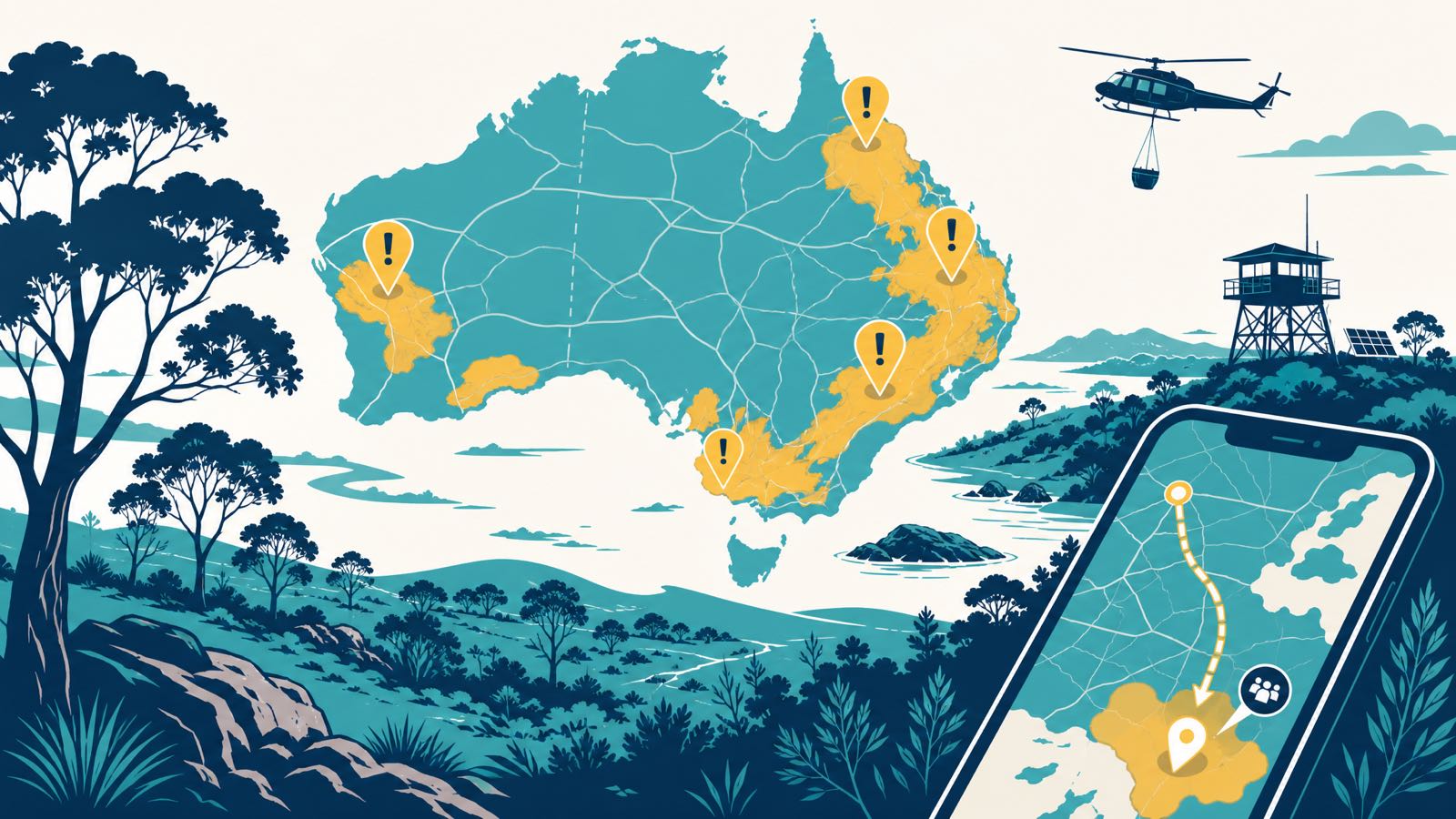
Australia’s exposure to bushfires, floods and extreme weather has positioned Google Maps as a working crisis response tool, not just a navigation app. The bushfire alert layer, evacuation routing, and air quality monitoring features all activate routinely during fire seasons.
Air quality monitoring is also relevant for non-fire pollution events: Sydney’s hazard reduction burn smoke, Melbourne’s winter wood-heater PM2.5 spikes, Perth’s dust days. The Maps integration with AirNow-equivalent data sources means most Australians now check Maps for air quality the way they check it for traffic.
Sustainable transport features include fuel-efficient route options, EV charging locations and (in some markets) transit options that prioritise lower-emission modes.
Beyond natural disasters, Maps provides routine traffic incident reporting, road closure updates and emergency service notifications. The bushfire and flood examples just happen to be the highest-stakes use cases.
Ask Maps and Immersive Navigation: the March 2026 shift

On 12 March 2026, Google announced two Gemini-powered features that change what Maps actually does: Ask Maps and Immersive Navigation (GigaNectar coverage, ALM Corp analysis).
Ask Maps turns the search box into a conversation. Instead of typing “coffee”, users can ask “where can I get good coffee with a quiet corner to take a call?” and get a Gemini-reasoned response drawn from 250 million+ places and the reviews, photos and edits of 500 million contributors. The Gemini icon has replaced the Google Assistant icon in the Maps app, signalling the deeper integration.
Immersive Navigation replaces the flat 2D map with a real-time 3D rendering of roads, buildings and terrain, built from Street View and aerial imagery. It’s the biggest visual overhaul Maps has had in over a decade.
Both features launched first in the US and India on iOS and Android. The Australian rollout date has not been confirmed at time of writing, but historical rollout patterns suggest Australia typically gets these features within 3-6 months of US launch.
For Australian businesses, the implication is significant. Ask Maps surfaces specific businesses in response to natural-language queries, which means visibility now depends on:
- Detailed, accurate Google Business Profile attributes (the same ones Gemini reasons over)
- Reviews mentioning specific qualities the user asks about (“quiet”, “outdoor seating”, “kid-friendly”)
- Photo and Q&A content that gives Gemini something concrete to summarise
- Categories and services that match the way real people describe what they want, not just industry jargon
This is the next phase of the “entity SEO” shift we covered in our Entities in Local SEO guide, now applied directly to Maps.
The competitive moat for Google Maps continues to widen with this rollout. Waze remains strong for crowdsourced traffic; Apple Maps continues to lag on conversational AI; no other player has anything close to the scale of contributor data Gemini draws on for Ask Maps.
Key takeaways and what to do with them
The data points worth keeping in mind:
- Scale: over 2 billion global MAU; 5.9M weekly active iOS users in Australia (SensorTower Q3 2025)
- Competition: 5.6:1 lead over Waze; Apple Maps doesn’t make the published top-5 in Australia
- Mobile-dominated: desktop matters for trip planning, mobile dominates daily use
- Integration: 300,000+ Australian sites embed Maps; the platform is part of the local business web
- Crisis utility: bushfire alerts, flood warnings and air quality monitoring are core features now
- AI shift: Ask Maps and Immersive Navigation (March 2026) move Maps from search tool to conversational discovery surface; Australian rollout pending
For businesses: Google Maps optimisation now sits between local SEO and entity SEO. Old-school GBP basics (categories, hours, NAP consistency, photos) still matter, but the new ranking inputs are review semantics, attribute completeness, and how well your profile matches the natural-language questions Gemini will be answering. We cover the operational mechanics in our Google Maps SEO service page.
Full source list and further reading
- Google Blog AU – 20 Years of Maps
- Google Blog – Ask Maps and Immersive Navigation launch (March 12, 2026)
- Business of Apps – Monthly Active User App Data (April 2026)
- SensorTower – Top 5 iOS Navigation Apps in Australia Q3 2025
- AppGoblin – Google Maps Android analytics (April 2026)
- DataReportal – Digital 2026: Australia
- GigaNectar – Google Maps Ask Maps and Immersive Navigation (March 14, 2026)
- ALM Corp – Google Maps New Icon & Gemini AI Features 2026
- AInvest – Google Maps AI and 500M user contributor flow
- Howmany.is – Google Maps user statistics (March 2026)
Appendix: key statistics summary
- Weekly Active Users (Australia, iOS, Q3 2025): ~5.9 million
- Monthly Active Users (global): over 2 billion (Google, 2025)
- Australian Websites with Maps Integration: ~301,000 (BuiltWith)
- Android Installs (global): 21+ billion (AppGoblin, April 2026)
- Global Daily Location Searches: 5+ billion
- ETA Accuracy: ~97%
- Internet Penetration (Australia): 97.1% (Datareportal Digital 2026)
- Most-Reviewed Restaurant in Australia: Dosa Hut, Harris Park (~14,400 reviews)
- Community Contributors (global): 500+ million (Google, March 2026)
More internet statistics for Australia.
Conclusion
Google Maps is now the default infrastructure for how Australians find local businesses, navigate, and check on their physical world. The numbers in this report (over 2 billion global MAU, ~5.9 million weekly active iOS users in Australia, a 5.6:1 lead over Waze) all point in the same direction: this is a platform whose Australian market position is structurally durable for the foreseeable future.
The March 2026 Ask Maps and Immersive Navigation rollout is the most significant product change in over a decade. For Australian businesses, it means the optimisation work that’s already paying off (complete GBP profiles, meaningful reviews, accurate attributes, useful photos) is about to matter even more, because the same data feeds Gemini’s answers.
If you want help putting that into practice, our Google Maps SEO service lays out exactly how we approach it for clients, or and we’ll walk through your current Maps visibility.