
Google Maps Ranking Factors in 2026: What Actually Moves the Local Pack
Relevance, distance, prominence, plus the specific levers that actually move Google Maps rankings in 2026, from an Australian SEO agency. No fluff.

Ranking on Google Maps comes down to three things Google itself names: relevance, distance and prominence. That is the honest starting point, and also where most advice stops being useful. “Relevance, distance, prominence” is too vague to act on, and a fair amount of the tactical advice still circulating is years out of date.
This is the current picture, based on the best public data, written for business owners who want to know what to fix first rather than read a list of forty tips.
- Relevance, distance and prominence are Google’s own framework, straight from Google Business Profile Help.
- In Whitespark’s Official 2026 ranking factors data, the single biggest Local Pack lever is your primary Google Business Profile category.
- Proximity to the searcher is the second biggest factor, and you cannot fully control it.
- Reviews and a complete, accurate profile do real work. Profile signals carry roughly a third of Local Pack weight.
- Citations and NAP consistency are hygiene, not a growth lever. Keyword stuffing your business name is a fast way to get suspended.
The three pillars, in Google’s own words
Google explains local ranking through three factors in its Business Profile Help documentation: relevance, distance and prominence.
Relevance is how well your business matches what someone searched. Distance is how far you are from the searcher, or from the area they searched in. Prominence is how well known and trusted your business looks, online and off.
That framework is accurate. It is also the headline, not the instructions. The useful question is which concrete signals feed those three pillars, and how much each one actually counts. That is where current data earns its keep.
How to rank higher on Google Maps in 2026: what actually moves the needle
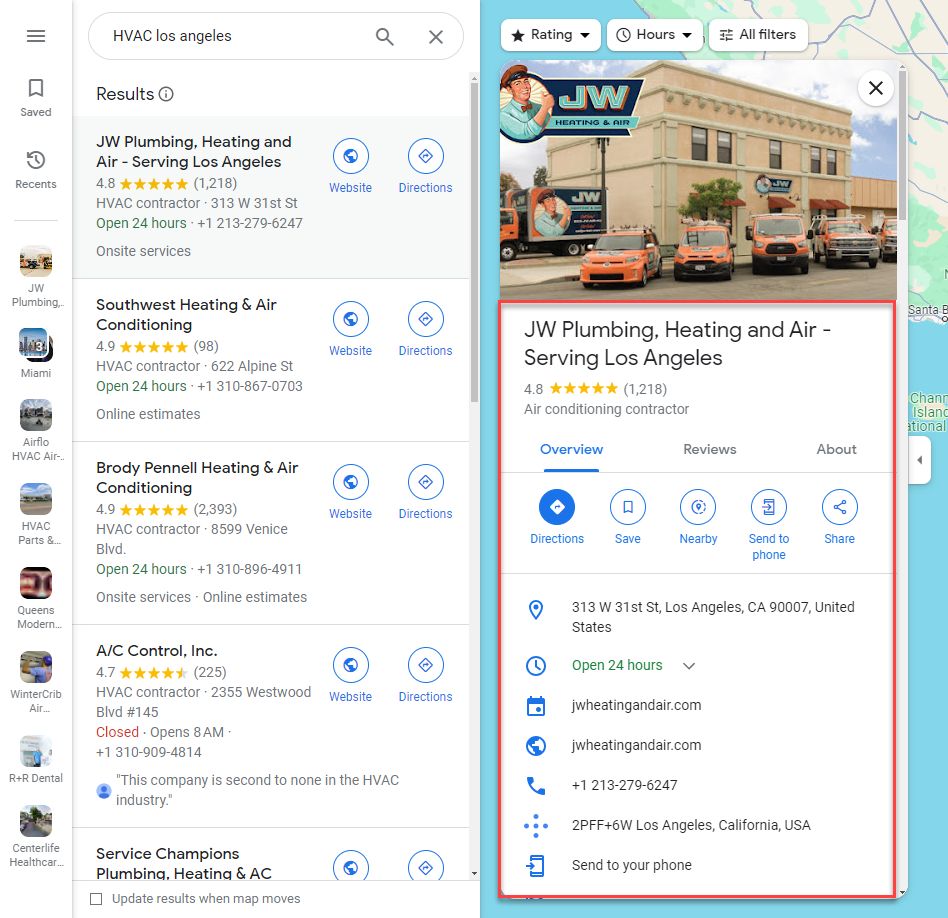
The most credible public read on this is Whitespark’s Official 2026 Local Search Ranking Factors report, published by Darren Shaw in November 2025. It surveys local SEOs who do this work every day and ranks the signals that track with Local Pack visibility. The headline finding is unglamorous: the boring fundamentals are the important bits, again.
Whitespark’s 2026 data puts the rough Local Pack weighting at around a third for Google Business Profile signals, about a fifth for reviews, and roughly fifteen per cent for on-page factors on your website. Most of the result is decided by your profile and your reviews, not your blog.
Here is what carries the most weight, in order.
1. Your primary Google Business Profile category
This is the strongest single Local Pack lever in the 2026 data, and most businesses get it wrong by being too broad or too timid. The category should describe what the business fundamentally is, not everything it occasionally does. A clinic that selects “Medical clinic” when it should be “Skin care clinic” can suppress its own visibility while doing everything else right.
Get the primary category exactly right first. Use secondary categories for genuine additional services. Correcting a wrong primary category often moves rankings faster than months of link building, which is not what most owners expect to hear.
2. Proximity to the searcher
Proximity is the second biggest factor and the one you have the least control over. The closer a searcher is to your verified location, the more likely you are to show. That has real consequences for how you should read your own rankings, which is the next section.
Service area businesses: how to beat the proximity problem with multiple bases
If you are a service area business (a trade, mobile service, or anything without a storefront customers visit), you do not get the proximity boost a physical premises gets near each searcher. That is a structural disadvantage, and no amount of profile polish removes it on its own.
The way to genuinely dominate a sprawling metro is to establish multiple legitimate bases of operation in strategic locations across the area, each able to support its own verified Google Business Profile. A real, staffed or operated location in the north, the south-east and the coast, for example, gives you three proximity centres instead of one, so you appear strongly across far more of the map rather than only near a single point.
This only works if each location is genuine: a real address you actually operate from, with verifiable signage, documentation and presence. Fake or virtual locations get suspended, and fast. Done properly and within Google’s rules, multiple real bases is the single most effective way for a service area business to offset the proximity penalty and cover a whole city instead of one corner of it.
3. Keywords in the business name
There is a hard truth here. A keyword in the Google Business Profile name does correlate with higher rankings. Used carelessly, it is also one of the most common reasons profiles get pulled, because the name must be your real-world business name and nothing more.
But this is a valid strategy if you do it properly. If you genuinely want a keyword-rich name, change your actual trading name to include it and register that name with ASIC on the Business Names Register, then use it consistently on your signage, website, invoices and everywhere else. At that point it is no longer keyword stuffing. It is your real, registered, legally used business name, which is exactly what Google asks for. A plumber who registers and trades as “Rapid Hot Water Plumbing” is compliant. A plumber who is registered as “Smith Pty Ltd” and just types “Best Emergency Plumber Perth” into the name field is not, and that is the version that gets suspended.
So the rule is simple: earn the name in the real world first, register it, use it everywhere, then put it on Google. Done in that order it is a legitimate, durable advantage. Done as a shortcut it is a fast way to learn that a business name change can trigger suspension.
4. A real address in the city of search
A verified address in the area you want to rank in matters, and so does showing it rather than hiding it as a service-area business when you do not need to. If you have a genuine premises customers can visit, displaying the address generally helps.
5. Being open at the time of the search
New in the 2026 data: profiles that are open when someone searches tend to rank better than ones that are closed. This is bigger than it sounds. Google increasingly suppresses closed businesses in Maps results, so a competitor that opens at 7am is visible to the 7:30am searcher while you, opening at 9, are not even in the running for those searches.
In Australia this is a genuine competitive lever, especially for home service businesses. Extending your stated hours, opening earlier than the competition, and being accurately marked as open when customers are actually searching can win you visibility your rivals simply are not contesting. Keep your hours accurate, including public holidays, and treat earlier and longer opening as a ranking decision, not just an operations one.
6. Ratings and a steady flow of native Google reviews
Both your average rating and the number of reviews left directly on Google carry real weight. What works is steady and recent, not twenty reviews in a week followed by a year of silence. Reviews that mention the service and the area help relevance too.
7. Whether your address shows on the profile at all
New in the 2026 data: profiles that display a physical address rank better than otherwise-similar profiles that hide it behind service-area-only settings. If you have a genuine premises, showing the address is a real, individually-weighted factor, not just a formality. While you are in the profile, also check your map pin: a pin dropped in the wrong spot is a separate factor that can still quietly cost you visibility, and it takes five minutes to fix.
Proximity: the factor you cannot fully control
Proximity is why a single ranking number is close to useless for a real business. You can sit first outside your own office and not appear at all four suburbs over, where a good share of your enquiries actually come from. Across a sprawling Australian metro, one location does not cover a whole city, and no amount of optimisation rewrites that.
So we track coverage, not a single position. A geo-grid scan shows where you actually appear in the Map Pack across every suburb you care about, which turns “we rank well” into a map you can act on. If you serve a wide area, expect strong visibility near your premises, patchier results further out, and a genuine decision about whether more legitimate bases are justified.
This is the conversation we have most often with new clients: expectations about how far a profile can rank from its base are usually unrealistic, and one scan settles it. Here is a real one, a Canberra handyman we work with, green near his base of operations in the south and fading through orange to red and then out of the top twenty as the grid moves north across the city:
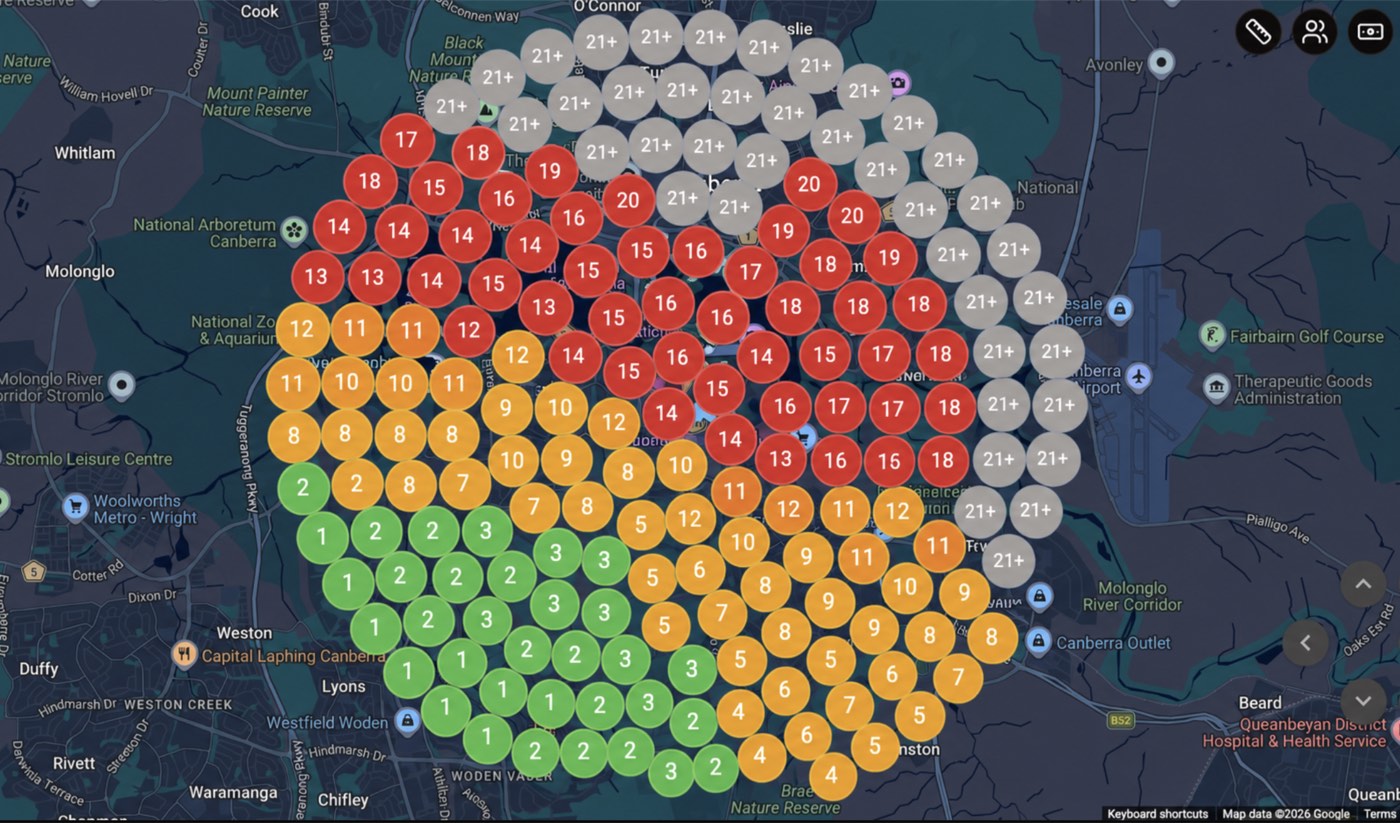
That fade is proximity doing its job. The green zone is winnable territory; the grey corners four suburbs over mostly are not, no matter how optimised the profile is.
When a competitor next door is filtering you out
Here is a scenario that drives owners up the wall and gets almost no coverage in the usual ranking-factor lists. You have done everything right, dozens of strong reviews, the correct category, a complete profile, and you still do not show for your main keyword, while a similar business almost next to you sits in the pack. That is often not a ranking weakness. It is the local filter.
The filter became obvious after Google’s 2016 Possum update. When two businesses share the same primary category and sit close together, most classically in the same building or right next door, Google tends to show only one of them for a given search and filters the other out, the way it filters near-duplicate organic results (Sterling Sky). It picks whichever listing has the most ranking authority for that exact keyword, so you can be filtered for “emergency electrician” yet rank fine for “switchboard upgrade”, because the filter is decided query by query.
You can usually spot it. Two tells:
- The zoom test. Pull up the Local Finder for the keyword, then scroll to zoom in on the map just once. Filtered listings that were hidden often pop into the list. If yours appears only after you zoom, you are being filtered, not simply outranked.
- The scattered grid. On a geo-grid scan, filtering shows up as a patchy, “Swiss cheese” pattern: top three in one spot, gone in the next, with no smooth proximity gradient. A clean ranking weakness fades gradually with distance. Filtering jumps around.
If it is the filter, polishing the profile harder rarely helps, because the issue is similarity to a stronger neighbour, not quality. What actually moves it: get your primary category exactly right (if you can legitimately pick a more specific category than the business filtering you, you may sidestep it), genuinely out-build that competitor’s relevance and prominence for the keyword so you become the listing Google chooses, and make sure you are not filtering yourself with a duplicate or a secondary profile. In stubborn cases where two businesses share a building, relocating even a short distance can break the tie, but that is a last resort, not a first move.
Why your ranking swings during the day
If you watch your Map Pack position closely you will notice it is not a fixed number. It moves through the day, sometimes by several positions, and it can look different hour to hour without anything being wrong.
Some of that is ordinary volatility and personalisation. Some of it is now structural: as covered above, Google increasingly favours businesses that are open at the moment of the search, so a profile can lift while its doors are open and slip once it is marked closed, while a longer-hours competitor stays visible. Add proximity, which changes with wherever each searcher happens to be standing, and a single “what position am I” check tells you very little.
The practical takeaways are simple. Do not panic over a one-off snapshot, and do not let an agency wave a single mid-morning screenshot at you as proof of anything. If you are tracking properly, scans need to run at a consistent time of day so you are comparing like with like, and the signal you actually trust is the trend in your coverage over weeks, not the reading at 11am on a Tuesday. Keeping all seven of these factors moving in the right direction is ongoing work, which is exactly what our Google Business Profile management in Perth service is built to do.
Google Business Profile local ranking relevance: category, services and your website
Past the primary category, relevance is built from a few specific things working together:
- Secondary categories that reflect genuine additional services.
- The services and products listed on the profile, filled out properly.
- The content on your website, described in the words customers actually use, not industry shorthand.
- Real pages for your core services and locations, with sensible local content and basic LocalBusiness schema.
This is standard practice as part of SEO services for Perth businesses. It supports the profile rather than replacing it.
Prominence: reviews, links and reputation
Prominence is reputation Google can see. Reviews are the largest visible part of it, but local links and brand signals matter too. A link from a recognised local organisation, a sponsorship, an industry body or a genuine local publication does more for local relevance than a generic directory mention. You are trying to look like a real, established business in your area, because that is what Google is trying to reward.
AI Overviews: why your rank can hold while your calls fall
A pattern we are now seeing: a business’s Map Pack position is steady, the geo-grid looks the same as last quarter, and yet the phone is quieter. The instinct is to assume a ranking drop. Often it is not. It is what happens above the Map Pack.
First, the reassuring part. AI Overviews are least likely to appear on exactly the searches local businesses live on. In a study of 2.3 million queries, adding a location or “near me” modifier collapsed the AI Overview rate from around 35 per cent to single digits, because Google still answers local intent with a map, reviews and call buttons rather than a paragraph of text (WebFX). For “plumber Fremantle” or “emergency electrician near me”, the Map Pack is not going anywhere soon.
The leak is one step earlier in the journey. The research questions people ask before they pick a local business (“how much does it cost to replace a hot water system”, “do I need a level 2 electrician for this”) increasingly trigger an AI Overview that answers them in place, and far fewer of those searchers click through to anyone. Ahrefs measured the click-through rate for the top-ranking page dropping by more than half when an AI Overview is present (Ahrefs). So you can hold your Map Pack position while quietly losing the top-of-funnel traffic that used to warm people up before they searched for you locally. On mobile, when an AI Overview does appear on a borderline-local query, it can also push the whole pack down the screen, costing visibility you never see in a rank number.
There is no trick that forces you into an AI answer. What helps is the same work that builds prominence, plus being the source these systems quote: clear, genuinely useful answers to the real questions in your trade, accurate structured data, consistent business information across the web, and reviews that describe the actual service. We track this as its own layer rather than guessing, alongside the Map Pack, which is the thinking behind how we measure the ROI of a campaign. The headline: judging local performance on Map Pack position alone now misses a slice of the picture that is only getting bigger.
What does not move the needle as much as people think
Three things get more attention than they earn.
NAP citations are hygiene. Consistent name, address and phone details across the major directories help Google trust your data, and you should get that right once. It is not a growth lever, and chasing hundreds of low-quality citations does very little. We set out the realistic role of NAP consistency separately.
Keyword stuffing the business name, as opposed to a properly registered trading name, is the riskiest “tactic” still being sold. It can work briefly. It can also remove your profile from the map.
Chasing one average rank is the quiet mistake. Proximity varies so much that a single position barely describes your real coverage.
How we approach Maps rankings for clients
Our order of operations is deliberate:
- The primary category first, because it is the highest-leverage fix and the most commonly wrong.
- A geo-grid scan, to see true Map Pack coverage across the service area rather than a vanity rank.
- Review volume, recency and rating.
- Profile completeness.
- The website’s local relevance and links.
Progress is measured on coverage and qualified enquiries, not a single position. A first-place cell on a grid that never turns into a phone call or a booking is a nice-looking number and nothing more, and the businesses that win over the long run treat Maps as a customer acquisition channel rather than a scoreboard. Blake Smith puts it well:
“Ranking #1 in the Map Pack feels great on a geo-grid report, but if those impressions aren’t turning into qualified enquiries, the ranking is just a vanity metric. The local businesses that win long term treat Google Maps as a customer acquisition engine: they align their profile details, reviews, and website evidence around the exact buyer questions that drive revenue.”
Blake Smith, Founder at Performance Agency
I have been in SEO since 2013. The businesses that win local are almost always the ones that fixed the dull fundamentals before chasing tactics.
FAQ
How does Google Maps ranking work?
Google ranks local results on relevance, distance and prominence: how well you match the search, how close you are to the searcher, and how trusted your business looks. Specific signals like your primary category, reviews and accurate profile data feed those three pillars.
What is the number one Google Maps ranking factor?
In Whitespark’s 2026 data, the strongest single Local Pack factor is your primary Google Business Profile category. Getting it exactly right is usually the highest-impact change a business can make.
How important is proximity?
It is the second biggest factor and you cannot fully control it. The closer the searcher is to your verified location, the better you tend to rank, which is why coverage across an area, and for service area businesses multiple genuine bases, matters more than one position.
Do reviews affect Google Maps ranking?
Yes. Both your rating and the number of native Google reviews carry real weight, and a steady, recent flow beats occasional bursts. Reviews also help relevance when they mention your service and area.
How long does it take to rank on Google Maps?
It depends on your category accuracy, proximity, competition, review profile, and how much is currently broken. Some fixes, like correcting a wrong primary category, can move things within weeks. Competitive areas take longer, and nobody credible can guarantee a position.
Why don’t I show up when a similar business right next to me does?
You may be caught by Google’s local filter. When two businesses share the same primary category and sit very close together, Google often shows only one of them for a given search. Check by zooming in once on the map for that keyword: if your listing then appears, you are being filtered, not outranked. The fix is a more precise primary category and genuinely stronger relevance for that keyword, not more profile polish.
Do AI Overviews affect my Google Maps ranking?
Not your ranking directly, and they rarely appear on “near me” or local searches, where Google still shows the Map Pack. The effect is on the informational searches people make before choosing a local business: those increasingly get answered by an AI Overview, so fewer people click through. Your Map Pack position can stay flat while that earlier traffic falls, which is why we track AI visibility separately from rankings.
Where this leaves you
Most of Google Maps ranking is decided by a short list of unglamorous things:
- The right primary category.
- A real and visible address.
- Accurate and generous opening hours.
- A steady flow of genuine reviews.
- A profile that matches what you actually do.
Proximity sets the ceiling, and for service area businesses multiple legitimate bases is how you raise it. Coverage tells you the truth about where you stand.
If you want someone to work out which of those is holding you back, and turn Map Pack visibility into more qualified enquiries, . No lock-in contracts, no agency theatre, just a clear read on what to fix first.