
AI Search for Franchise Brands: How to Get Locations Recommended by ChatGPT, Google AI and Perplexity
AI search recommends franchise locations, not brands. What ChatGPT, Google AI and Perplexity need from each location, plus a 30-day plan for head office.

- AI search recommends individual franchise locations, not franchise brands. In SOCi’s 2026 Local Visibility Index, ChatGPT recommended 1.2% of brand locations, while the same brands appeared in Google’s local 3-pack 35.9% of the time.
- ChatGPT, Google AI Overviews, Google AI Mode and Perplexity lean on different evidence. In our Perth AI Search Study 2026, ChatGPT cited Google 0 times across 1,794 citations, while 85.8% of Google AI Mode’s citations went to Google, almost entirely Google-hosted business panels.
- Each franchise location needs 5 things in its own market: pages AI systems can reach, facts that match everywhere, content that covers what customers ask, reviews and local proof, and independent sources that confirm it.
- Our Perth data found that review volume tracked AI recommendation, while star rating did not. Presence on the directories and review sites AI systems cite was associated with a business being recommended at all, not with being recommended by more AI systems.
- One screenshot is not measurement. In our Perth study, only 8% to 31% of recommended businesses held their place across 3 rounds, so measure a fixed prompt set per location, repeatedly.
Ask ChatGPT for a physio in Joondalup or a plumber in Tampa and it will not work through every branch of every franchise. ChatGPT picks which businesses to name, and for most franchise networks, most branches are not on that list. The brand can be a household name while the local answer goes to an independent operator down the road.
SOCi’s 1.2% figure for ChatGPT comes from an index of more than 350,000 locations across 2,751 multi-location brands, where Gemini recommended 11.0% of brand locations and Perplexity 7.4%.
Customers are using these AI tools, and they have not stopped checking. In BrightLocal’s 2026 survey of 1,002 US adults, 45% had used an AI tool for a local business recommendation in the past year, up from 6% the year before. Of those AI users, 97% sometimes double-check an AI recommendation against real reviews, and 42% always check reviews on the review platforms themselves.
For a franchisor, then, brand fame settles very little. The better question is whether each location carries enough consistent, checkable evidence for an AI system to recommend it, and for the customer to confirm the choice afterwards. A strong franchise brand and a network of recommendable franchise locations are 2 different things.
How we know this. The Perth AI Search Study 2026 is published by AI SEO Perth, a research publication Search Scope operates. For it, we asked Google AI Overviews, Google AI Mode, ChatGPT and Gemini 200 commercial questions about 20 Perth industries, 3 times over 3 days in September 2026, and recorded 2,400 answers. The Perth AI Search Study is not a franchise sample, so we use it to show how these systems behave and never quote it as a franchise rate.
Search Scope has 69 locations under management across 5 clients as at September 2026. Current and recent multi-location work includes Google Business Profile consulting for The Local Guys, a national franchise network, and search across a 17-campus early learning group.
Why franchise brands have a different AI search problem
Franchise brands have a different AI search problem because the customer is asking about a place, and AI answers name far fewer places than the local pack. In SOCi’s index, ChatGPT recommended 1.2% of brand locations. Someone who types “dentist open Saturday near Carindale” wants a branch they can get to, so the AI system has to decide which specific locations it is confident enough to name.
A strong national brand does not make that decision for it. If a franchisee has asked why an AI assistant keeps sending customers to the independent down the road, this is usually why.
Google already treats each franchise location as its own record. Google’s Business Profile guidelines allow 1 profile per location and ask chains to use the same name, and the same category at locations that provide the same service. They also ask for a phone number or website that connects to the individual location, with a local number preferred over a central call centre. Each of those records can be right, wrong or out of date on its own.
AI answers are more selective than the local pack. SOCi counted a location as likely to be recommended when it appeared in the first 5 of 10 businesses an AI named for the brand’s primary category in a market where it operates. That is how SOCi arrived at ChatGPT recommending 1.2% of brand locations.
Google’s own local results are heading the same way. Sterling Sky’s tracking found Google’s AI local packs surfaced 5,943 unique businesses against 18,330 in traditional 3-packs, and showed fewer businesses in 88% of the 322 markets it checked. At the time, Sterling Sky saw those AI packs on only about 7% of its tracked keywords, on mobile, in the US.
Why brand size does not carry franchise locations
Bigger franchise brands do not automatically win AI recommendations for their locations. Uberall’s analysis of 120,000+ AI mentions across 3,793 US locations, a sponsored and correlational piece, found brand size was a poor predictor of how often AI models recommended a brand. In restaurants and dentists, independent businesses could outperform chains on mention rates. SOCi saw a similar split in retail: only 45% of the top 20 brands in traditional local search were also in the top 20 for AI recommendations.
So every new franchise location adds work before it adds AI visibility: another set of facts to keep consistent, another profile to verify, another page worth reading and another review stream to build.
A note on these sources: SOCi, Yext, Uberall and BrightLocal all sell software to multi-location brands. They also publish the biggest datasets we could find on this topic, so we use them, and we read them as observations of what happened rather than proof of what caused it.
The 4 questions behind a location recommendation
Think of a recommendation as 4 questions an AI system needs answered about a franchise location, plus 1 precondition: it has to reach the location’s information before it can answer any of them. The questions map onto Search Scope’s AI Entity Authority System, which is why we run the system location by location rather than once for the brand.
| The question | What the AI needs to find for that location | Part of the system | Usually owned by |
|---|---|---|---|
| Can I reach this location’s information? | A crawlable, indexable location page that the main AI crawlers are allowed to fetch | Access, the precondition | Head office |
| Does this location exist? | The same name, address, phone, hours and category on the page, the Business Profile and the main listings | Resolve | Head office sets it, franchisee keeps it current |
| Does it offer what the person asked for? | Services, attributes, areas served and opening hours, stated clearly | Cover | Head office template, franchisee facts |
| Is it credible enough to recommend? | Review volume and recency, photos, local proof | Evidence | Franchisee |
| Can the claim be confirmed elsewhere? | The directories, review sites and publishers AI systems cite in that market | Corroborate | Both |
Measure, the last of the system’s 5 parts, is how head office finds out which of those answers is failing, and at which location.
How ChatGPT, Google AI and Perplexity find local businesses
ChatGPT, Google AI Overviews, Google AI Mode, Gemini and Perplexity do not share a method or a set of sources, so AI search is not a single channel for a franchise network to optimise. Each vendor documents a different access rule, and the systems we measured in Perth leaned on different evidence. ChatGPT cited Google 0 times across 1,794 citations, while 85.8% of Google AI Mode’s citations went to Google. If you want the general mechanism first, we explain how AI search works separately.
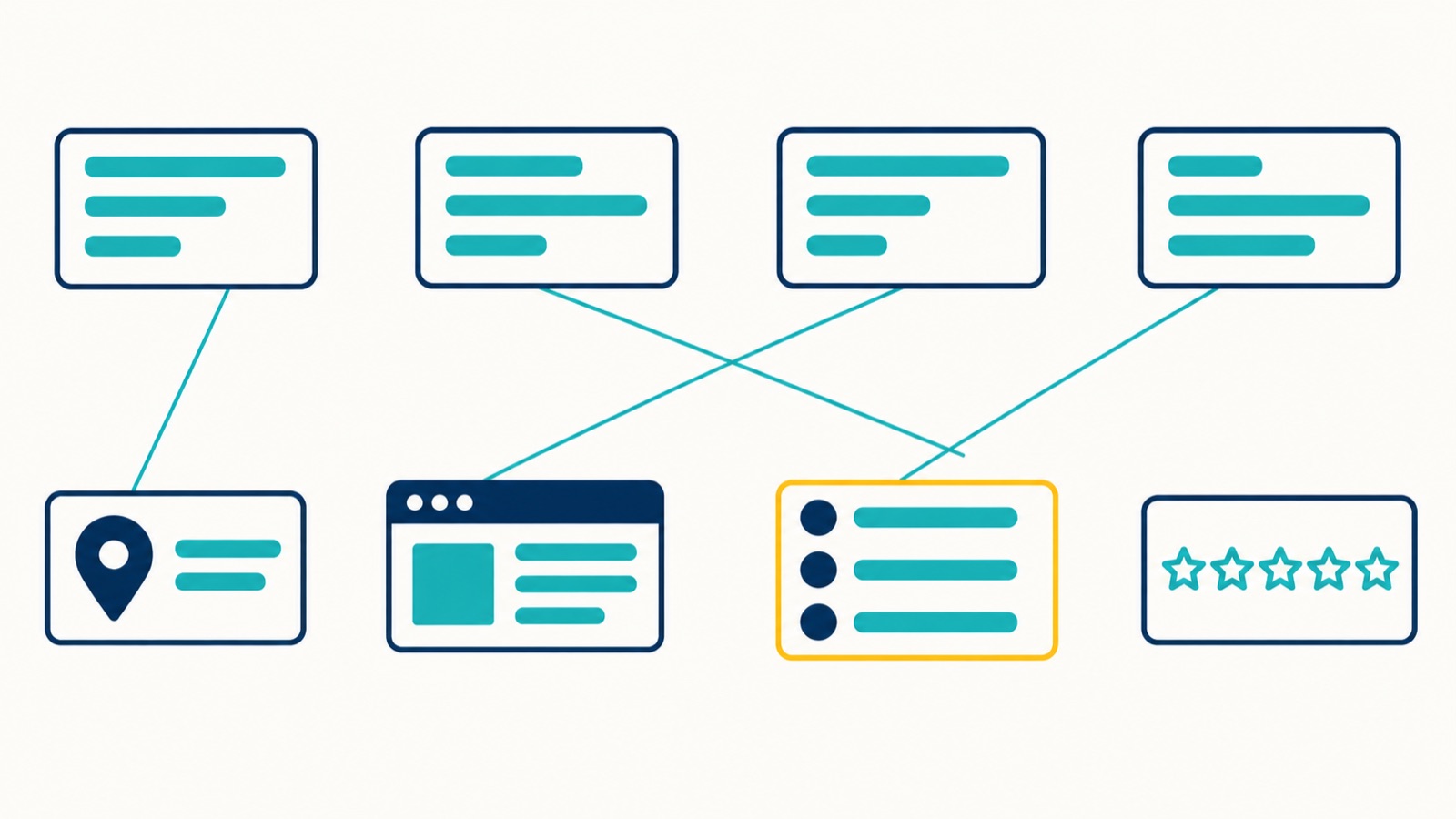
What each AI system documents and what was measured
Each row sets what the vendor documents beside any dataset that measured it.
| AI system | What the vendor documents | What was observed | What it means for a franchise location |
|---|---|---|---|
| ChatGPT search | Sites opted out of OAI-SearchBot are not shown in ChatGPT search answers. ChatGPT search sometimes partners with other search providers | 0 Google citations in 1,794 (our Perth study). Yelp was its most used local source in BrightLocal’s citation study | Allow OAI-SearchBot; build presence on the sources ChatGPT cites in each market |
| Google AI Overviews | A page must be indexed and eligible to show with a snippet; no additional technical requirements; may use query fan-out | In our Perth study, of recommended businesses matched to a website, 66.8% were in Google’s organic top 10 for the same question | Location pages that rank organically still matter |
| Google AI Mode | Same eligibility rules as AI Overviews; may use query fan-out | In our Perth study, of recommended businesses matched to a website, 78.6% were in the Google Maps top 20; 85.8% of citations went to Google, almost entirely Google-hosted business panels | Business Profile accuracy and strength, location by location |
| Perplexity | PerplexityBot surfaces sites in Perplexity’s search results; Perplexity-User fetches pages for user requests and generally ignores robots.txt | Not measured in our study | Allow PerplexityBot and its IP ranges at the firewall |
Where Gemini and Microsoft Copilot fit
SOCi found Gemini recommended 11.0% of brand locations, against ChatGPT’s 1.2%. Gemini’s location details also matched Google Maps in every profile SOCi checked, which is less surprising than it sounds: Gemini is grounded in Google Maps, and SOCi used Maps as its source of truth. Microsoft Copilot is grounded on Bing, so Bing Places and Bing’s index matter for that surface; we cover Bing and Copilot visibility in its own guide.
The studies behind that table used different questions and markets, so compare the direction they point in rather than the size of each figure. The direction is clear enough. A franchise location that is strong on Google can still be thin in ChatGPT (and the reverse), so head office needs to know which evidence each system uses before deciding what to fix.
Start with the questions customers actually ask AI
The prompt set for each franchise location should come from the questions a customer in that market would actually ask, phrased the way they would ask them. Wording matters more than it looks: in our Perth study, question-style phrasings produced a Google AI Overview for 97.5% of questions, against 46.7% for keyword-style phrasings of the same service and place.
| Prompt type | Example | What it tests |
|---|---|---|
| Category | ”best physio in Joondalup” | Whether the location makes the shortlist at all |
| Service | ”emergency plumber near Parramatta tonight” | Whether the service at that branch is clear |
| Attribute | ”dentist in Austin open Saturday” | Whether hours and attributes are stated |
| Trust | ”best-reviewed Invisalign provider in Brisbane” | Whether reviews and proof carry the location |
| Comparison | ”[Brand A] vs [Brand B] gym in Tampa” | How the location compares with a named rival |
| Problem | ”where can I get a cracked tooth fixed tonight” | Whether the location answers an urgent need |
| Commercial | ”affordable Invisalign consultation near me” | Whether pricing or process information exists |
| Validation | ”is [Brand] [Suburb] any good” | What an AI system says when someone checks you |
Spread the set across services, intent types and markets instead of tracking a single vanity keyword for the whole network. You do not need every combination for every location, just a fixed set that reflects what customers ask, run the same way every time.
Audit AI visibility location by location
A franchise AI visibility audit records what each AI system said about each location, rather than whether the brand turns up somewhere. Brand-level checks hide the pattern we see most in franchise networks: a strong flagship or two, and a long tail of branches that rarely get named.
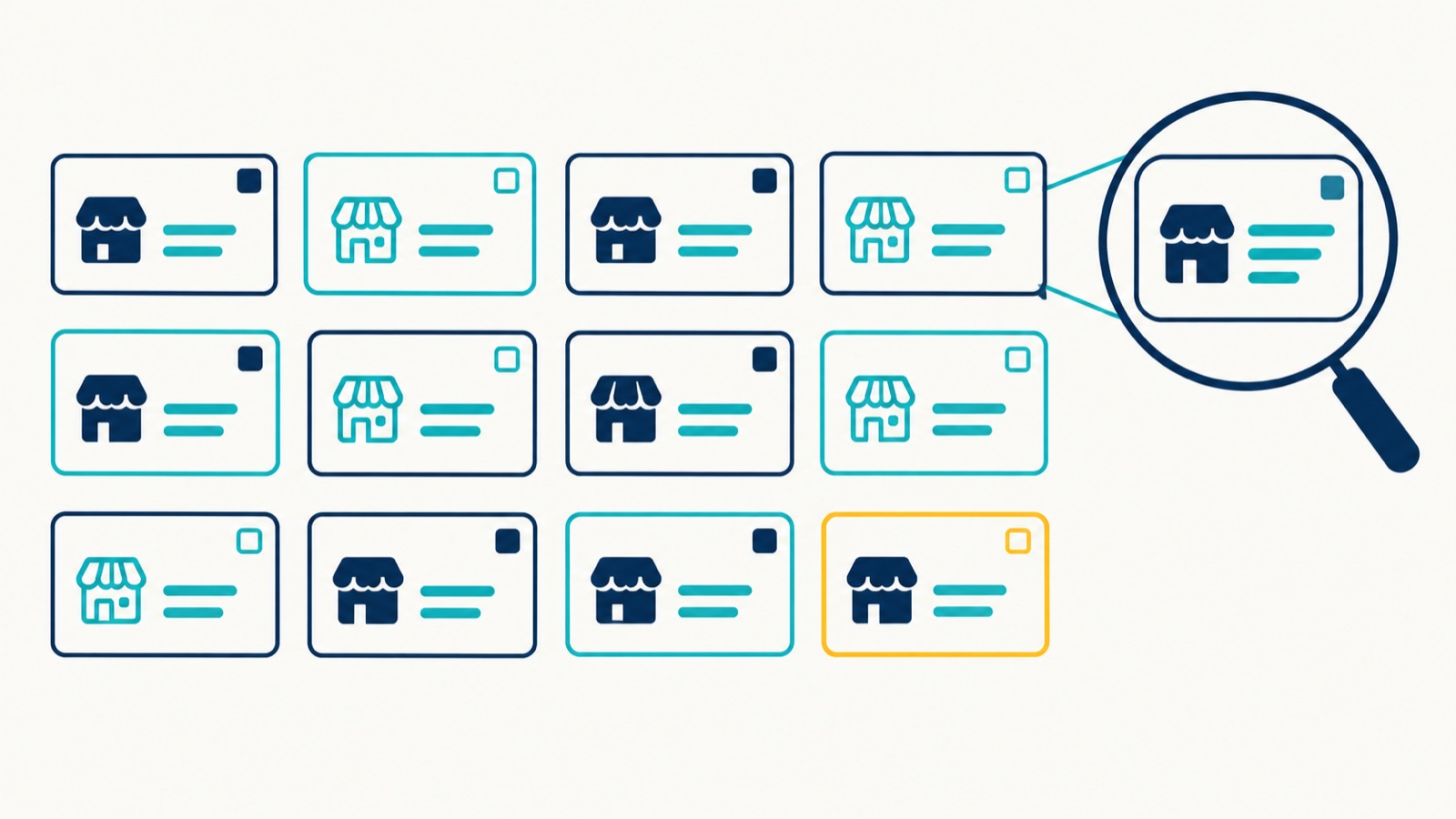
What to record for every AI answer
For each prompt, location and AI system, record 7 things:
- the engine, the exact prompt, the location setting and the date
- whether the branch was named, and whether it was recommended or merely mentioned
- where it appeared in the list
- which competitors were recommended
- the URLs and domains the answer cited
- whether the branch details in the answer were correct: address, phone, hours and services
- the reason the answer gave for choosing or skipping the location
A quick first look is a fine place to start, and our free AI Visibility Scanner does that for .au domains. Treat any single check as 1 reading of a moving target.
Why one screenshot proves very little
AI recommendations change from run to run, so a single screenshot cannot tell head office whether a franchise location is visible. Our Perth study found only 31% of the businesses Google AI Mode recommended were recommended in all 3 rounds, and the figure was 17% for ChatGPT, 11% for Google AI Overviews and 8% for Gemini.
Even the AI answer came and went: an AI Overview appeared in all 3 rounds for 91 of the 200 questions, in some rounds for 71, and never for 38.
The honest unit is a share of runs: how often a location was recommended across a fixed set of prompts, repeated on different days.
3 more mistakes that skew a franchise audit
Even with repeated runs, a franchise AI audit can still go wrong in 3 ways:
- Testing brand prompts only. “[Brand] Joondalup reviews” shows ChatGPT can find the branch, but it says nothing about whether ChatGPT picks that branch when someone asks for “best physio in Joondalup”.
- Counting mentions as recommendations. An answer that names a location in a list of places to avoid, or only as the brand’s head office, has not recommended it, so record them separately.
- Running prompts from the wrong place. OpenAI says ChatGPT may use an approximate location based on your IP address, so a “near me” prompt run from head office can come back with results for head office’s city rather than the branch’s. Name the location in the prompt, or set it in your tracking tool.
Step 1: Let AI systems reach every location page
Crawler access is the precondition for every other step. An AI system cannot use a franchise location page it is not allowed to fetch, and Google’s AI features will not show a page as a supporting link unless it is eligible for a snippet. Head office checks it once, and the fix covers every location at the same time.
Let the AI crawlers in
Head office needs 4 checks to confirm that Google, ChatGPT and Perplexity can fetch and show a franchise location page:
- Google indexability. Google says a page must be indexed and eligible to be shown with a snippet to appear as a supporting link in AI Overviews or AI Mode. A nosnippet rule left on a location template removes that eligibility.
- OAI-SearchBot. OpenAI states that sites opted out of OAI-SearchBot will not be shown in ChatGPT search answers, and recommends allowing its published IP ranges. Robots.txt changes can take about 24 hours to register.
- PerplexityBot. Perplexity asks sites to allow PerplexityBot and its published IP ranges, with firewall examples for Cloudflare and AWS.
- CDN and firewall rules. Bot protection that blocks unfamiliar crawlers can quietly block the ones you want, so check the firewall logs as well as robots.txt.
Keep every location page indexable
Settings and templates can also quietly take franchise location pages out of AI features. Check these 4:
- Search Console’s generative AI control. Google added a Search Console setting that keeps a site out of AI Overviews, AI Mode and AI Overviews in Discover. Google says it had rolled out to all websites worldwide by 31 August 2026. Sites that opt out receive no traffic or impressions from those features, so confirm nobody has switched it on for the franchise website.
- Canonicals and noindex. A location page that canonicalises to a city hub is unlikely to be indexed in its own right. A page still carrying a noindex from launch will not be indexed at all.
- Crawlable location links. A store locator that only shows results after someone types a postcode can leave location pages with no links pointing at them. Link every location from a plain, crawlable page.
- Content in the HTML. If hours, services and addresses only appear after JavaScript runs, compare the rendered page with the raw HTML before assuming a crawler sees them.
Step 2: Make every location an unambiguous entity
A franchise location becomes an unambiguous entity when its name, address, phone, hours, category and services match on its page, its Business Profile and the listings AI systems read. AI answers already get these details wrong often enough to matter: SOCi found business details on ChatGPT and Perplexity were only about 68% accurate when checked against Google Maps data, against 100% on Gemini.
The canonical facts each location needs
Each franchise location needs the same 9 facts to match on its page, its Business Profile and every listing.
| Fact | What good looks like |
|---|---|
| Name | The same brand name at every location in the country, as Google’s chain guidelines require, unless a branch consistently trades under a different real-world name |
| Address or service area | The real address, or a service area for branches that travel to customers |
| Phone | A local number that reaches that branch, not only the central call centre |
| Hours | Regular and holiday hours, updated before they change |
| Primary category | The same category at every branch that provides the same service |
| Services | The services this branch actually offers, not the whole network’s list |
| Location URL | 1 page per location, linked from its Business Profile |
| Parent brand | A clear relationship to the franchise brand on the page and in the structured data |
| Profiles | Google Business Profile, Bing Places, Apple Business Connect where relevant, and the directories that recur in that market |
The fix is mostly operational. Keep a single source of truth for these facts and feed the location page, the structured data and the listings from it. When a franchisee changes Saturday hours on Google only, the page and 3 directories now disagree with the profile. Our entity SEO work starts from exactly this kind of conflict.
Treat schema as entity hygiene, not a ranking hack
LocalBusiness structured data describes each franchise location to machines, but the controlled evidence that it changes AI recommendations is thin. Evergrow Marketing’s test added LocalBusiness schema to the home pages of 16 of 29 US landscaping websites (36 locations across both groups) and found no measurable effect on organic rankings or Google Maps.
ChatGPT position improved by 3.33 places at 92.91% confidence, and share of AI voice by 10 points at 91.51%, on 1 of 2 query types. That is 1 industry, 1 website template and a confidence level below the conventional 95%.
Mark up each location page with LocalBusiness data that matches what a person can see on that page (Google’s AI features guidance lists that among its best practices). Include the relationship to the parent brand, and generate the markup from the same location data as the page itself. The wider schema evidence sits in our answer engine optimisation reference. Schema is cheap enough to do properly on every location page, and nowhere near strong enough to build an AI search strategy around.
Step 3: Write location pages AI can answer from
A franchise location page gives AI systems something to work with when it states the specifics a customer asks about for that branch, in passages that still make sense on their own. AI systems often retrieve and use individual passages from a page, so each important section should name the location and carry the relevant facts instead of relying on the page around it. SOCi’s report lists differentiated local content, particularly on brand-owned local pages, among the traits of the locations ChatGPT recommended.
A useful franchise location page carries 10 kinds of branch detail:
- branch identity: name, address, phone, hours and the brand it belongs to
- the exact services available at that branch, and any that are not
- the areas served, named specifically
- the local team and their relevant experience
- real photos of the location and its work
- facilities, access, parking and booking details
- the themes that come up in that branch’s reviews
- pricing or process information, where the brand allows it
- FAQs built from the questions customers actually ask that branch
- nearby areas or landmarks, only where they genuinely help someone find or choose it
A template paragraph against a retrievable one
The same illustrative franchise location, written 2 ways:
Template version: “[Brand] Joondalup provides quality physiotherapy services to the Joondalup community. Contact us today.”
Retrievable version: “[Brand] Joondalup treats sports injuries, back pain and post-surgery rehabilitation, and takes Saturday morning appointments. Parking is free under the building. Hydrotherapy is not offered at this branch; the nearest branch with a pool is [Brand] [Suburb].”
The second version answers “who treats sports injuries near Joondalup on a Saturday” and “is there parking” without the reader needing anything else on the page.
The template trap runs the other way. A single page copied across 50 suburbs with the name swapped gives neither Google nor an AI system a reason to choose any of them. Our guide to location pages covers page structure and the doorway page line in detail.
Step 4: Build reviews at every location
Google reviews attach to each franchise location’s own Business Profile, so every location needs its own steady stream of genuine reviews. Head office cannot manufacture a reputation for 200 branches. What customers experience at each branch ends up as the reviews that AI systems, and the customers double-checking them, actually read.
Review volume tracked recommendation, a perfect rating did not
Our Perth study found review count climbed steadily with recommendation, while star rating did not move at all. Perth businesses never recommended had a median of 21 Google reviews, against 234 for businesses recommended by 3 or 4 AI systems, and the median rating stayed at 4.90 at every level. Holding the question, Maps position and star rating constant, the half of Perth businesses with more reviews was recommended 68.5% of the time, against 37.3% for the half with fewer.
A perfect score did not help on its own. Businesses rated 4.9 to 5.0 were recommended 49.6% of the time, against 59.5% for those rated 4.7 to 4.9, most likely because the 5-star group had a median of 38 reviews against 89. Uberall’s sponsored analysis reported the same direction across 5 US verticals: review volume predicted AI mentions, and ratings were a weaker factor in 4 of the 5. Ratings still matter to people, and SOCi found the locations ChatGPT recommended averaged 4.3 stars.
None of this proves that adding reviews causes recommendations. Busier, better-known businesses collect more reviews and more of everything else. Still, a franchise location with 20 reviews is up against far less evidence than a neighbour with 200.
Keep review requests inside Google’s rules
Franchise review programs go wrong when a network turns reviews into a target. Google’s Maps content policy rules out 6 review practices. The first 3 are about who you ask and how: offering incentives, asking only happy customers, and pressuring people to review while on the premises. The other 3 are about the review itself: requesting specific content, setting staff a number of reviews to collect, and asking for reviews that name a staff member. The policy also treats current or former employment as a conflict of interest.
A compliant franchise review program follows 5 rules:
- ask every customer, at the same point in the service, with the same neutral wording
- never suggest what to write, including the suburb or a staff member’s name
- no discounts, prizes, league tables or quotas tied to review counts
- staff and franchisees never review their own location
- reply to reviews as the location, where naming the branch and the service is fine
Reviews matter well beyond AI answers, and our guide to reviews for local SEO covers the wider case.
Step 5: Get each location corroborated off-site
Corroboration means the facts and reputation of a franchise location can be confirmed on sources the location does not control, and the useful sources are the ones AI systems actually cite in that market. That list changes from market to market, so build it from real answers, in the 5 steps below, rather than from a generic directory list.
Map the sources AI actually cites in each market
Run these 5 steps once for each market the franchise network trades in.
- Run the location prompt set on each AI system you care about.
- Record every domain each answer cites. Our LLM URL source extractor, a free Chrome extension, copies the cited links out of an AI answer.
- Group the domains: general directories, maps platforms, review sites, industry directories, “best of” publishers, local media, associations, community forums, social platforms and competitor-owned sites.
- Count how often each domain recurs across locations and markets.
- Treat the recurring domains as targets, then check each location’s presence and accuracy on them.
The source list changes by country
A directory list built mostly from US data is a poor starting point for an Australian franchise network. BrightLocal’s citation study, which covered 1,355 locations in the US, UK and Australia, was led by Google Business Profile, Yelp, Facebook, TripAdvisor, OpenTable and MapQuest, and found Yelp in 80% of ChatGPT’s local answers.
Yext’s Q1 2026 analysis of 155.5 million location-grounded citations put MapQuest at the top of the third-party list. Yext also found 80% of citations pointed to sources a brand can influence: the brand’s own website or its listings.
Our Perth study points somewhere else again: after google.com and reddit.com, the most cited domains were Australian, with starworks.com.au in 199 observations, wordofmouth.com.au in 94, productreview.com.au in 79 and hipages.com.au in 74.
Those 3 studies asked different questions in different markets, so their rankings do not line up against each other. The narrower point holds: a US list would have sent an Australian network to the wrong places first.
| Source type | Examples seen in the studies above | Typically maintained by |
|---|---|---|
| Maps and business profiles | Google Business Profile, Apple Maps (apple.com) | Head office, with franchisee updates |
| General directories | Yelp and MapQuest in US-weighted data; starworks.com.au and wordofmouth.com.au in Perth | Head office |
| Review platforms | productreview.com.au, TripAdvisor, Facebook | Franchisee activity, head office monitoring |
| ”Best of” publishers | bestaccountantsaustralia.com.au and bestconveyancersaustralia.com.au in Perth | Head office outreach |
| Industry directories | hipages.com.au for trades; Justia and Avvo for lawyers; Zocdoc and Healthgrades for dentists | Head office accounts, franchisee detail |
| Community forums | reddit.com | Nobody controls it; monitor and respond |
Directory listings are a floor, not a lever
In our Perth study, presence on the third-party pages AI systems cited was associated with a business being recommended at all (an odds ratio of 1.88). It was not associated with moving from 2 AI systems to 3 or 4 (0.76, not significant), while presence in Google’s organic top 10 stayed associated through to that final stage (3.00).
For a franchise location, that makes listings a floor: get each location listed accurately on the sources that recur, then stop counting listings. Buying 50 generic local citations per branch adds maintenance, not evidence.
Step 6: Split ownership between head office and franchisees
A franchise network keeps its AI evidence accurate when every fact has a named owner, because the same facts live on the franchise website, the Business Profile and dozens of listings. When nobody owns a fact, it drifts: a branch stops offering after-hours callouts, the location page still lists them, and an AI answer repeats whichever version it found. The split below covers 9 areas, each with a head office half and a franchisee half.
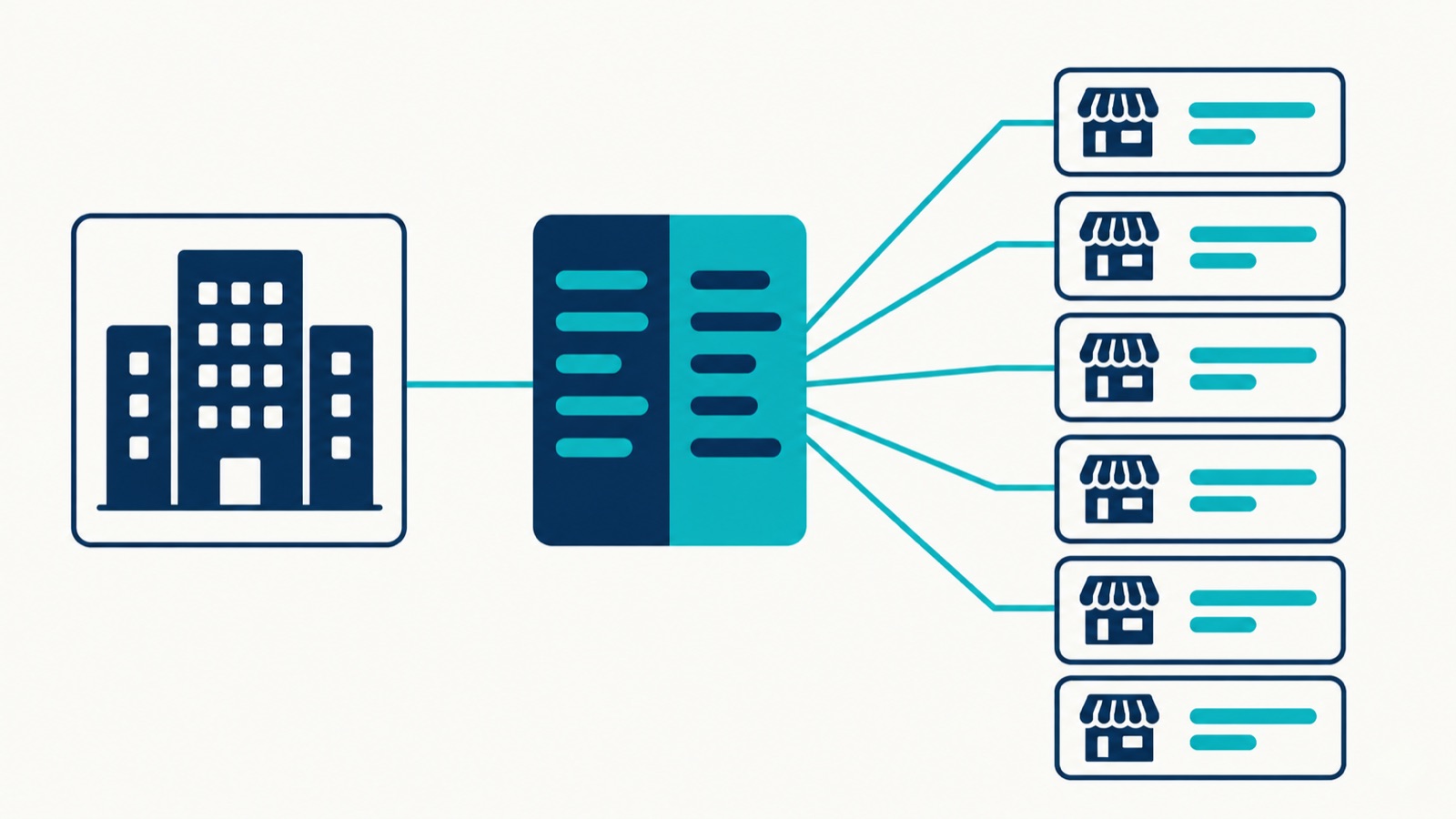
| Head office owns | Franchisee owns |
|---|---|
| Site architecture and the location page template | Correct local details, reported before they change |
| The location data model, a single source of truth for every fact | The services genuinely available at the branch |
| Structured data generated from that model | Real photos of the location, the team and the work |
| Business Profile ownership and the listings infrastructure | Day-to-day profile updates, as a manager |
| Crawler access, robots.txt, firewall rules and Search Console settings | Local community activity and local media opportunities |
| The prompt set and the source map | The customer experience that produces reviews |
| Review request policy and wording | Asking every customer, within that policy |
| Measurement and reporting | Acting on their own location’s report |
| Brand consistency across the franchise system | Changes to staff, hours and services |
Of everything in that table, settle profile ownership first. When the brand owns each Business Profile and adds the franchisee as a manager, the listing, its reviews and its history stay with the brand if a franchisee leaves. A handover then does not wipe out a location’s evidence. We cover the governance side of multi-location SEO in more depth.
How to measure AI visibility across 10 to 1,000 locations
Measuring AI visibility across a franchise network means tracking a fixed set of prompts per location, on each AI system, over at least 3 separate runs, and reporting shares rather than single answers. Search Scope defines Recommendation Share as the percentage of relevant prompt runs in a fixed measurement set where an AI system actively recommends the brand. For a franchise network, run it per location, alongside the 8 metrics below.
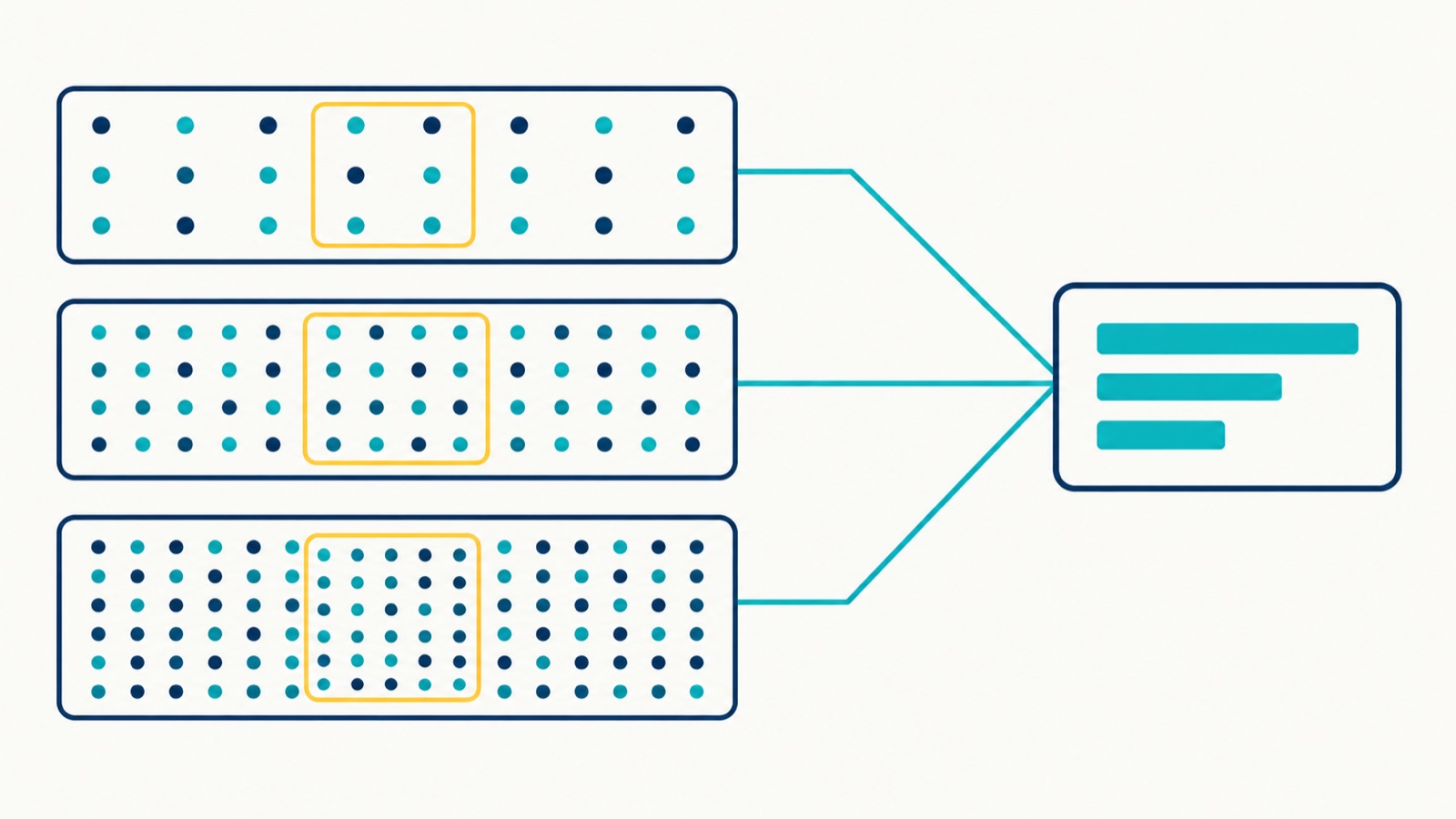
| Metric | What it tells head office | How to calculate it |
|---|---|---|
| Recommendation Share per location | How often each branch is actually recommended | Runs recommending the location, divided by relevant runs |
| Location coverage | How much of the network AI systems name at all | Locations recommended at least once in the period, divided by locations sampled |
| Share of AI voice | How each location compares with competitors in its market | Your recommendations against named competitors’ recommendations in the same runs |
| Citation share | How often your own location pages are the source | Citations to your domain, divided by all citations |
| Source share | Which third-party domains shape the answers | Citations per domain across runs |
| Accuracy | Whether AI answers get branch details right | Answers with correct address, phone, hours and services, divided by answers naming the branch |
| Reason given | Why a location is or is not chosen | Quoted reasons, grouped by theme |
| Commercial outcome | Whether any of it turns into demand | Branded searches, calls, bookings and AI referral sessions per location |
What Search Console’s AI report adds
For Google’s AI features, and only those, Search Console now gives a franchise network a location-page view. Google launched generative AI performance reports in June 2026 and says they reached all websites worldwide by 31 August 2026. They show impressions from AI Overviews and AI Mode by page, country, device and date, with no click metric listed. A site without enough impressions in AI features may not see the report at all.
Filter the report by location page URL to see which location pages Google’s AI features show. It says nothing about ChatGPT, Perplexity or whether a location was recommended.
Sample 5 to 10 locations before you scale
Start with 5 to 10 representative franchise locations: a strong branch, an average branch, a weak branch, a new branch and a branch whose details changed since the last reading. Keep the prompt set and the location settings fixed. Tools that check AI answers through provider APIs measure a narrow surface, so treat what AI visibility tools report as directional. Re-run the same set monthly, and again after a location changes its name, address, hours or services.
A 30-day AI search plan for a franchise network
A franchise network can run its first AI search cycle in 30 days on a sample of locations.
| Week | What head office does | Output |
|---|---|---|
| Week 1 | Pick 5 to 10 representative locations and build the prompt set for each. Check crawler access, indexability, firewall rules and the Search Console AI setting | Prompt set and access checklist |
| Week 2 | Run every prompt on each AI system on at least 3 separate days. Record recommendations, competitors, citations and accuracy | A baseline per location and a source map |
| Week 3 | Fix entity mismatches, location page gaps and profile gaps. Start a compliant review request process at each sampled location | A fix log per location |
| Week 4 | Pursue presence on the recurring sources where locations are missing or wrong. Re-run the same prompt set and compare shares, not single answers | A second reading and next month’s priorities |
After the first cycle, build the fixes that worked into the location template and the data model so every branch inherits them, then widen the sample. The second and third readings will tell you more than the first, which only shows where each location starts.
AI search for franchises: frequently asked questions
Does traditional local SEO help a franchise location get recommended in ChatGPT?
Traditional SEO is still associated with AI recommendation, so treat AI search as work that sits on top of it rather than a replacement. In our Perth study, 1.5% of businesses that no AI system recommended were in Google’s organic top 10, against 52.1% of businesses recommended by 3 or 4 systems. That is an association, not proof that rankings cause recommendations.
If a location ranks first in Google Maps, will AI recommend it?
A top Maps position does not mean an AI system will recommend the location. In our Perth study, between 60% and 78% of the businesses AI systems recommended, depending on the system, were not in the Google Maps top 20 for the same question. Google AI Mode sat at the low end of that range, 60.1%. Separately, 78.6% of the AI Mode picks we could match to a website were in the Maps top 20. The 2 figures count different groups of businesses, so they do not contradict each other.
Businesses ranked 1 to 3 in Maps were still recommended more often than those ranked 11 to 20.
Does every franchise location need its own page?
Every physical franchise location, and every service-area branch with its own staff and territory, needs its own page, with facts only that branch can state. Google allows 1 Business Profile per location and asks for a website that represents the individual location. Do not create pages for suburbs where the network has no presence, because those read as doorway pages.
Do reviews at one location help the rest of the network?
Reviews attach to the profile of the location they are written about, so a strong flagship cannot lend its reviews to a thin branch, and each branch has to build its own. In our Perth study, AI recommendation tracked each business’s own review count: a median of 21 Google reviews for businesses never recommended, against 234 for businesses recommended by 3 or 4 AI systems.
Does LocalBusiness schema help franchise locations appear in AI answers?
LocalBusiness schema is worth adding to every location page as accurate entity data, but the evidence that it moves AI recommendations comes from 1 small test. There, ChatGPT positions improved on 1 query type at below the conventional 95% confidence level, and Google rankings and Maps showed no measurable change. Treat it as hygiene.
How do you track ChatGPT visibility for 100 locations?
Start with a representative sample rather than all 100, with a fixed prompt set per location run on at least 3 separate days. Record recommendations, competitors, citations and accuracy, report each location’s share of runs, then widen the sample once the method is stable.
Which directories matter for a franchise’s AI visibility?
The directories that matter are the ones AI systems actually cite for your category in each market, and those differ between countries. Map them from real answers and get every location listed accurately on the recurring ones.
BrightLocal found Yelp in 80% of ChatGPT’s local answers across its US, UK and Australian sample, while the most cited directory in our Perth study, after Google and Reddit, was starworks.com.au. Our Perth data associated that kind of presence with a business being recommended at all (odds ratio 1.88), not with being recommended by more AI systems.
Can head office control what ChatGPT says about a location?
Nobody outside OpenAI decides what ChatGPT says. Head office can make the correct answer the easiest to assemble: fix the facts at the source, keep them consistent, build real evidence at every location, and measure whether the answers change. Measure over repeated runs, because in our Perth study only 17% of the businesses ChatGPT recommended were recommended in all 3 rounds.
Getting every location recommended, not just the flagship
Search Scope runs franchise SEO for networks that want every location visible in Google Maps, organic search and AI answers, with per-location reporting that head office and franchisees can both read.
A brand with no location network wants AI SEO instead: the same evidence work, without the per-location layer. Search Scope has 69 locations under management across 5 clients as at September 2026. If your flagship shows up in AI answers and the rest of the network does not, that gap is where the work starts.