Entity SEO: make Google and AI certain who you are.
Google does not rank text, it ranks businesses it understands. AI systems do not recommend websites, they recommend businesses they can identify. If the machines are not sure which business you are, you are not competing badly, you are not eligible.
Written by Dorian Menard. Executing SEO since 2013. Based in Perth, working Australia-wide.
→Google does not rank text, it ranks businesses it understands. If a machine cannot resolve which business you are, you are not competing badly, you are not eligible.
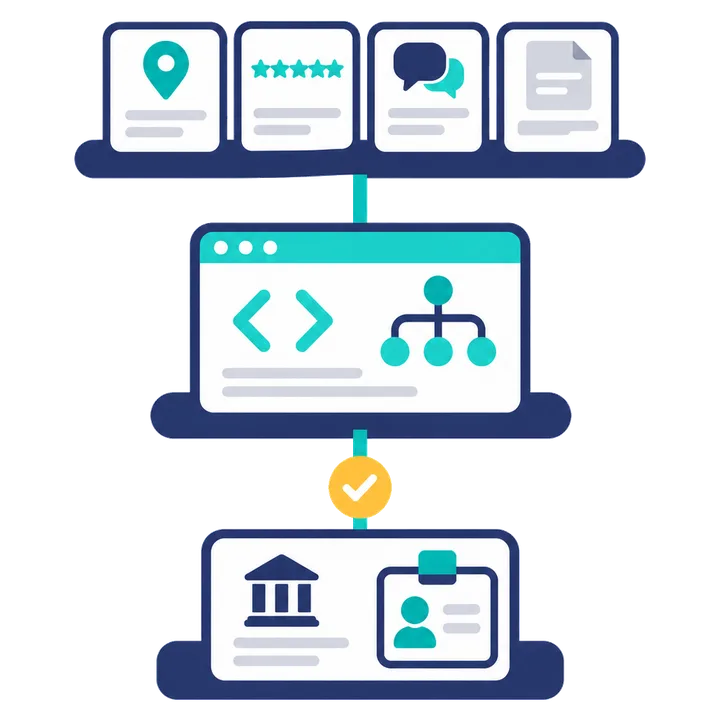
→Entity SEO works across 3 layers: the registry layer (your ABN and ASIC record), the site layer (schema), and the corroboration layer (everything said about you elsewhere).
→Australia has an advantage. auDA requires an Australian commercial identifier to hold a .com.au, so your ABN can anchor the whole entity.
→Fixed-price projects from $1,950 ex GST. No entity retainer, because the work does not need one.
Published . Last reviewed .
What entity SEO is
Entity SEO, also called entity-based SEO, is the work of making one business identifiable to machines: settling the facts, publishing them in the places search engines and AI systems read, and making sure every one of those places agrees. An entity is a specific, uniquely identifiable thing that a search engine can recognise and attach facts to. A business is an entity, and so is each of its locations, its services and its named people.
Entity SEO is not a ranking tactic and it does not replace anything. It is the layer
underneath both classic search and AI search. Content, links, local SEO and Google
Business Profile work all assume the search engine already knows which business is being
talked about. When that assumption is wrong, every other investment underperforms and
nobody can work out why.
How entities differ from keywords in SEO
Google described the shift in 2012 as things, not strings. A string is the literal text
you typed. A thing is the entity behind it, and the machine has to work out which one you
mean. Understanding entities is what turned Google Search from a text matcher into
something closer to a database of the real world.
Keywords still matter. Entities are how a search engine decides what your keywords are
about. Someone searching "emergency plumber Subiaco" is not just matching words: the
system is connecting a service entity, an urgency, and a suburb entity, then looking for
businesses it can resolve confidently at the intersection of all three. Entity SEO and
keyword work are not alternatives. Related entities give a page context; keywords give it
a query to answer. There is a longer plain-English walkthrough in our guide to
entities in local SEO.
The practical difference: you can rank a page for a phrase. You cannot rank a business the
machine cannot identify.
How search engines and AI systems actually use entities
4 mechanisms, and each one is a place the work can fail.
Entity recognition
Named entity recognition is how a system picks businesses, people and places out of ordinary text. Consistent naming and consistent presentation get picked up. A business written 6 different ways across the web gets dropped or split.
Entity resolution
Having found a name, the system decides which entity it points to. This is where a namesake business, an old trading name or a former address quietly costs you, because references that should reinforce one entity get attributed to another.
Entity linking
Once resolved, the reference connects to a record in a knowledge graph. Google’s Knowledge Graph is the best known, Wikidata is the open one, and both are read by search engines and large language models. Unlinked mentions add nothing until the connection is made.
Semantic relationships
The record then carries relationships: this organisation employs this person, operates in this place, provides these services. Those entity relationships are what let an AI system answer a question about your category and know you belong in the answer.
An AI system deciding who to name in your category is running exactly this sequence over
whatever it can retrieve about you. Google uses entities the same way to decide which
businesses belong in a set of search results. Entity SEO is the work of making every step
of it succeed.
The 3 layers of entity SEO
Being recognised is not one job. Entity-based SEO works across 3 layers of entity signals,
and a business missing any one of them is a business the system has to make a judgment
call on. Judgment calls get resolved in favour of the better-corroborated business.
Layer 1: the registry layer
The verified public record. In Australia that starts with something almost every
legitimate business already has: an ABN, an ASIC record, an entry in the Australian
Business Register. On top of it sit the open knowledge databases, principally Wikidata,
which accepts the ABN as a property, and Google's Knowledge Graph.
Layer 2: the site layer
Structured data on the site you control. Schema markup is how you state, in a form a
machine reads without interpreting, what your business is: Organization for the business,
Person for your named experts, Place for your locations, Service or Product for what you
sell, and sameAs relationships connecting every profile back to one primary entity.
Done properly, schema turns a website from a set of pages into a structured description of
one business and its relationships. Done as a template drop, it produces valid markup
describing nothing in particular. The validation matters less than whether the structured
data agrees with the registry layer above it and the web below it.
Layer 3: the corroboration layer
Everything said about you that you do not control: directory listings, industry bodies,
review platforms, media, community discussion. Layers 1 and 2 are you describing yourself.
Layer 3 is whether anyone else confirms it.
In our experience this is the layer that decides most contests. It is also the part our Perth AI
Search Study 2026 did not measure, so we hold it as a working hypothesis rather than a
finding: a competitor whose details agree across 40 independent sources beats a better
business whose facts disagree across 12, because consistency across independent sources is
what turns a claim into a fact a machine will repeat.
Why entity SEO is different in Australia
Nearly all entity SEO advice is written for the United States, where no government-verified
business identifier is built into the domain system. Australia has one.
The ABN is your anchor identifier
auDA will not issue a .com.au without an Australian commercial identifier:
usually an ABN or an ACN, and for foreign companies trading here, an ARBN or an Australian
trade mark. Eligibility is not a one-off check at registration, it is a condition of
holding the licence. auDA's own guidance is blunt about it: close the business, and once
the ABN or ACN tied to it is cancelled, you are no longer eligible to hold the domain.
Set the ABR and ASIC record as the master, then have every profile inherit from it, and
each layer is corroborating something independently verifiable rather than repeating
whatever your website happened to say that year. It is a cleaner starting point than most
brands anywhere else can get.
The three ways weak entity signals show up
Nobody books a call asking for entity SEO. They book asking about one of these.
AI describes your business wrongly, or describes a different business with your name
Old address, a service you dropped 2 years ago, a competitor's price, or a company on the
other side of the country that happens to share your trading name. This is an entity
resolution failure, the most common one entity SEO fixes, and the fix is in the sources,
not the model.
AI recommends your competitor and you cannot see why
They are usually easier to verify, and often they rank better too. In our
Perth AI Search Study 2026,
52% of the businesses recommended by three or four of the AI systems sat in Google's organic
top 10, against 1.5% of the businesses none of them recommended, and that was the strongest
signal the study could measure. The study did not measure verification. Verification stays a
separate part of our method, a hypothesis we test on your own footprint rather than a finding
of the study: a competitor whose name, address and services agree everywhere a machine can
check gives the model a reason to name them that your site cannot supply on its own.
Google will not commit to you locally
Rankings that move for no reason, a Google Business Profile that behaves as though it is on
probation, a suspension that came from nowhere. Google is often not punishing you. It is
unsure about you.
How to tell which one you have
Those 3 symptoms look different and often share a cause. The order you check in matters,
because each layer decides whether the next one tells you anything useful.
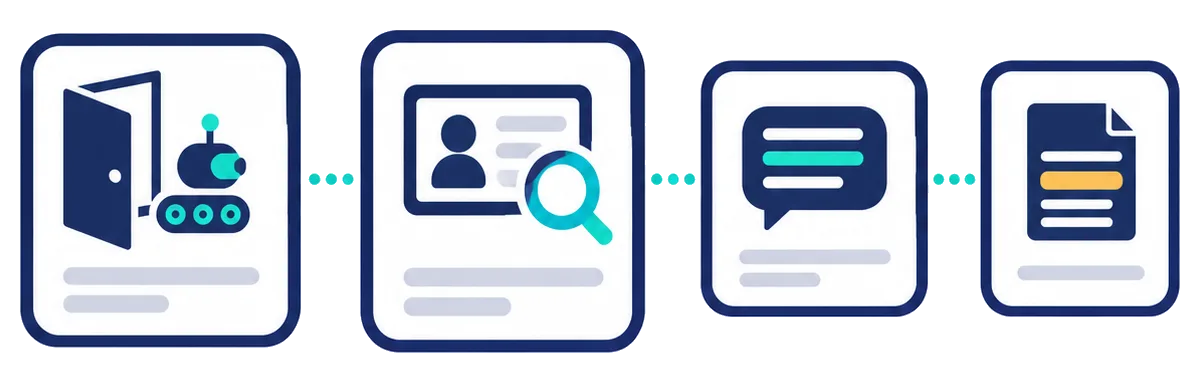
Access, identity, outcome, passage. Check them in that order.
1. Access: can the machines reach and read the site at all
The cheapest check, and the one that invalidates every other finding. If the AI crawlers
are blocked or served an error, everything below is explained by that single fact. It is
read-only, takes about 15 minutes, and needs no paid tools. A page that returns 200 to
your browser can still be refused to a crawler, so this gets tested properly rather than
assumed.
2. Identity: does the entity resolve off the site
Whether the registry, site and corroboration layers agree well enough for a machine to
trust them. This one gates spend. Score below 60 out of 100 and entity-dependent work
like digital PR or a citation campaign is not worth funding yet, because there is nothing
stable for it to attach to. Fix the resolution first and the same budget goes further.
3. Outcome: what the models actually say today
A fixed set of prompts, run repeatedly, recording mentions, citations and recommendations
as 3 separate things. Run this first and you get a list of symptoms with no causes
attached. Run it after access and identity, and every blind spot already has an
explanation waiting for it. 1 screenshot from 1 prompt is not a measurement.
4. Passage: whether a given page can be lifted into an answer
Page by page, and only after the first 3. A page can be perfectly quotable and still never
get used, because the business behind it does not resolve. This is the last question worth
asking, not the first.
All 4 checks are read-only, so nothing changes between them and the first reading stays a
valid before-picture. Most businesses discover their problem is 1 or 2, not 3, which is
why starting at the outcome and working backwards wastes so much money.
What actually breaks while the entity stays unclear
The cost of weak entity SEO is not one ranking. It is that the rest of your marketing
quietly stops compounding.
Coverage lands and gets attributed to a different business. Directory listings reinforce an
old address instead of the current one. Schema on your site argues with the public record
instead of confirming it, so neither is trusted. Content ranks for a business the machine
cannot resolve, and converts worse than it should. Links point at an ambiguous entity and
build less than they cost. Each of those is individually survivable. Together they are why
a business can spend properly for 2 years and feel like it is standing still.
There is a harder version in AI answers. A buyer asking an assistant who to use in your
category gets 3 or 4 names. That is the whole shortlist. There is no page two to scroll to,
and the buyer never learns you were an option. Getting onto that shortlist is what
AI visibility work is for, and it only works once the entity underneath
it resolves.
How an entity SEO project runs
5 stages, in this order, because the order is what makes it hold.
1
1. Resolve
Pull the verified record from the ABR and ASIC, settle the canonical name, address, phone, services and locations, and write them once into a single brand fact document. Every later stage publishes from that document, so nothing drifts.
2
2. Clean
Find the wrong versions already published and correct or close them: old addresses, dead numbers, duplicate listings, a previous trading name, profiles created by a former agency nobody can log into. Most entity gaps are things that used to be true.
3
3. Label
Site-wide structured data so the whole site reads as one organisation, one set of people, one set of places, one set of services, with every profile tied back through sameAs. The technical names matter less than whether they agree with the registry layer.
4
4. Publish and corroborate
Put the same facts on the profiles, registries, directories and public knowledge databases that search engines and AI systems read, including a Wikidata entry where the business is eligible.
5
5. Measure
Re-run the audit and read the score back, plus prompt testing across the AI platforms to see whether the answers changed. That is the only honest read on entity SEO performance: not a tool score, but whether the machines changed their minds.
The full method behind this, including how it feeds ongoing AI visibility work, is on the
AI Entity Authority System page.
How I know this works
I ran the audit on Search Scope before selling it to anyone.
It scored 63 out of 100. A pass, on a threshold of 60, on a site run by someone who does
this for a living. The structured data was fine. The problems were elsewhere: 2 unrelated
software products share the name Search Scope, so the brand results were contaminated and
entity resolution was doing real damage, and a LinkedIn description written years earlier
was being served as Bing's featured answer for our own brand name and picked up as
grounding by AI tools.
That is what this work usually turns out to be. Not a missing schema tag. An old profile
nobody remembered, a namesake nobody planned for, and a set of facts that quietly stopped
agreeing with each other.
Pricing
Entity SEO services and what they cost.
Search Scope prices entity SEO as fixed projects, in Australian dollars, ex GST. Same
numbers as the AI SEO rate card, because it is the same work whichever door you come in
through.
Start with the entity SEO audit, $1,500 ex GST.
It tells you where machines currently get you wrong, what is causing it, and what it takes
to fix, with the entity gaps ordered by impact. Credited in full against a foundation
booked within 30 days. $3,000 for ecommerce and multi-location.
Entity Foundation, Local
$1,950project, ex GST
Search Scope’s entry tier of entity SEO, for a single-location Australian business.
✓1 brand fact document, everything the business is and does, written once as the single source of truth
✓ABN and ASIC records aligned to it
✓25 branded profiles created or corrected, all carrying the same details
✓10 Australian business directory listings
✓10 factual write-ups published on the platforms AI systems read
✓Behind-the-scenes labels across every page of the site (schema)
✓1 Wikidata entry submitted, where the business is eligible
✓1 AI instructions file (llms.txt) and 1 AI information page
✓3 pages rewritten so a machine can lift the answer whole: homepage, About, main service page
At the end of Local you have one set of facts published in 45 places that agree with each other, and a site that reads as one business.
Entity Foundation, Standard
$3,450project, ex GST
The entity SEO tier most Australian businesses take. Everything in Local, and in total:
✓50 branded profiles (the 25 from Local plus 25 more)
✓20 Australian business directory listings (10 plus 10 more)
✓20 factual write-ups (10 plus 10 more)
✓6 pages rewritten for machine retrieval (3 plus 3 more)
✓Duplicate and conflicting listings tracked down and closed, including ones created by previous agencies
✓Namesake disambiguation where another business or product shares your name
At the end of Standard you have one set of facts published in 90 places that agree with each other, and the wrong versions closed rather than left running.
Entity Foundation, Network
From $5,000project, ex GST
A one-off entity SEO project, not a monthly fee, for multi-location businesses, franchise networks and catalogue brands. Everything in Standard, and in total:
✓100 branded profiles (the 50 from Standard plus 50 more)
✓30 Australian business directory listings (20 plus 10 more)
✓30 factual write-ups (20 plus 10 more)
✓1 entity record per location, each tied back to the parent organisation
✓Service area labels checked against what each location actually covers
✓Location pages checked so each reads as one place rather than a copy with the suburb swapped
At the end of Network you have one parent business and every location underneath it, all saying the same thing, across 160 places.
After the project
There is no entity retainer, because the work does not need one. Facts change when the
business changes: a new location, a rebrand, a new service line, an address move.
Everything after that is either an AI SEO program, from $1,499 a month, or an SEO
campaign, and entity maintenance is already inside both. If nothing changes, nothing
needs paying for. Month to month, 30 days notice, no lock-in.
Who entity SEO is not for
Anyone expecting entity work to fix a weak offer
Entity SEO organises proof. It cannot invent it. A thin website with nothing to say stays thin once the machines can identify it.
Anyone who will not correct profiles they own
Half this work is correction, and correction needs access. If the old listings cannot be touched, the contradictions stay published.
Anyone wanting a guarantee about what an AI will say
Nobody outside the vendor controls a closed model’s output. The work is making the correct answer the easiest one for it to assemble.
Businesses trading under conflicting names on purpose
That is a branding decision, not a technical one, and no amount of structured data resolves it.
Founder
Dorian Menard
Search Scope · Australia
SEO since
The founder
Meet your senior SEO consultant, Dorian Menard
Founder. SEO only, since 2013.
Specialising in SEO since 2013. Founder of Search Scope. I work directly with every client on strategy
and execution. No account managers, no offshore teams, no templated retainers.
My work covers multi-location and franchise SEO, organic and national SEO, local SEO, Google Maps,
GBP and GMC reinstatement, technical audits, and AI search visibility. I work with established
businesses and multi-location networks that want a senior specialist, not a service package.
The 30-minute call answers the rest. No pitch deck. No proposal at the end unless you ask.
A specific, uniquely identifiable thing a search engine can recognise and attach facts to: a business, a person, a place, a product, an event. Entities are what Google connects information to, as opposed to the words on a page. Your business is an entity, and so is each of your locations, services and named people.
Traditional SEO gets pages ranking for queries. Entity SEO gets the business behind those pages recognised as one identifiable thing, so search engines and AI systems know which business the pages belong to. They work together. Ranking a page is achievable without entity work; being recommended by name in an AI answer generally is not.
No. Entity SEO makes your business identifiable. AI SEO makes it recommended. Entity work is the prerequisite: a program aimed at getting you cited cannot work while the system is unsure which business is being cited. Most businesses do the foundation once, then run an ongoing AI SEO program on top.
Find the source. AI systems repeat what they can verify, so a wrong answer nearly always traces to a real published page: an old directory listing, a stale profile, a former agency’s write-up, or a namesake business. Correcting the source and publishing the right version in enough independent places is what changes the answer. There is no button, and anyone offering to edit the model directly is selling you something that does not exist.
Usually because they are easier to verify, and often because they rank better too. In our Perth AI Search Study 2026, the businesses recommended by three or four of the AI systems were far more likely to sit in the Google organic top 10 than businesses none of them recommended. Verification is the part the study did not measure. Our working hypothesis, which we test on your footprint rather than assume, is that a competitor with a consistent footprint across 40 places beats a stronger business whose facts disagree across 12, because AI systems favour details that agree across sources they already trust.
Not necessarily. If rankings, enquiries and Maps visibility are healthy, the entity is probably fine. It becomes worth checking when results plateau for no visible reason, when a Google Business Profile keeps having problems, or when AI answers in your category name everyone except you.
No. Wikipedia’s notability standards exclude most small and mid-sized businesses, and paid entries get reverted. Wikidata is the accessible target and gives search engines and AI systems the same entity resolution benefit. Your ABN helps, because it is a government-verified identifier Wikidata accepts.
We submit a Wikidata entry where the business is eligible, and eligibility is a real bar: notability, independent sources, verifiable identifiers. Nobody can promise acceptance, and anybody who does is guessing.
Everything you published becomes the wrong answer, and machines keep repeating it until enough independent sources say otherwise. Plan a rebrand or a move as an entity project, not a website update. Doing it deliberately takes weeks. Doing it by accident takes 12 months and costs enquiries the whole time.
The project runs over a few weeks. Schema and site-side work ship inside the first stage. The registry and knowledge database layer lands over the following weeks. Corroboration compounds over months, as independent sources are re-crawled and re-read. Anyone offering a 30-day turnaround on how machines describe your business is describing something they cannot control.
A project. Priced once, delivered once. Maintenance is included in an ongoing AI SEO or SEO campaign if you run one, and if you do not, there is nothing to maintain until the business itself changes.
● 30 minutes · One specialist · No obligation
Find out what machines currently think you are.
We run live prompt tests on your business across the AI platforms, check what your profiles and registries actually say, and tell you whether the entity is your problem or something else is. No proposal at the end unless you ask for one.
✓ No lock-in contracts ✓ Specialising in SEO since 2013 ✓ Founder-led from first call
● Pick a time · 30 minutes
Pick a time for the entity review.
Thirty minutes on the calendar. Bring your ABN and your website and we will go through what the machines currently believe about your business, and what it would take to fix.