
AI SEO for Small Business in Australia: A Practical Guide for 2026
AI SEO for Australian small businesses: what Google actually requires, which sources AI systems cited in our 2,400-answer study, and a 30-day plan you can run yourself.

- Google says there is nothing extra to build. Its documentation rules out llms.txt, an AI-specific schema and any special AI file. A page is eligible for AI Overviews and AI Mode when it is indexed and could show a normal snippet.
- Ranking well still matters. In our Perth AI Search Study 2026, presence in Google’s organic top 10 showed the strongest measured association with being recommended repeatedly across AI systems.
- Being in the Google Maps top 20 is not the same as being recommended. Between 60% and 78% of the businesses AI systems named in our study did not appear in the Maps top 20 for the same question.
- 1 check proves nothing. Only 8% to 31% of recommended businesses held their place across 3 rounds asked over 3 days.
- The sources AI systems leaned on for Australian businesses were Google’s own pages, Reddit, and Australian review platforms like Word of Mouth, ProductReview and hipages, not a generic citation-building list.
Ask ChatGPT for a good conveyancer in your suburb and it will name 3 or 4 businesses. Ask Google AI Mode the same question and you often get a different 3 or 4. Neither is working from a ranking list, and for most Australian small businesses, neither is naming them at all.
AI Mode has been available in Australia since 8 October 2025, in English, so this is no longer something to prepare for. It is running on the queries your customers already use.
That has produced a lot of confident advice, most of it untested and some of it invented. This guide separates what Google actually documents from what the industry repeats, adds what we measured ourselves in Australia, and ends with a plan you can run in a month without buying anything.
How we know this. Search Scope is a Perth SEO consultancy. For the Perth AI Search Study 2026, we asked Google AI Overviews, Google AI Mode, ChatGPT and Gemini 200 commercial questions about 20 Perth industries, 3 times over 3 days in September 2026, and recorded 2,400 answers. The industries were ordinary small-business categories: plumbers, electricians, dentists, mechanics, conveyancers, physios, accountants, removalists and 12 more. It is Perth data, so we use it to show how these systems behave and never quote it as a national rate.
Why AI SEO matters more to small businesses
Small businesses are not a niche in Australia, they are the market. At 30 June 2026 the Australian Bureau of Statistics counted 2,814,778 actively trading businesses. Of those, 1,818,575 employed nobody and 922,512 employed between 1 and 19 people. Add those together and 2,741,087 businesses, 97.4% of the total, sit under the ABS definition of small.
Almost all of them compete locally, on questions where an AI answer names 3 businesses instead of 10 blue links.
The same population is not rushing to adopt AI inside the business, which is a different question from whether their customers use it. On the Australian Government’s AI adoption tracker, read on 16 September 2026, 4.3% of surveyed SMEs reported broad use of AI and 16.5% limited use. The largest single group, 37.0%, said they do not intend to implement it at all. The tracker is run monthly by Fifth Quadrant for the National AI Centre, with 400 completed SME surveys a month since May 2024, weighted by industry, location and employee count.
Read those 2 facts together and the opportunity is obvious. Your customers are using AI to shortlist businesses. Most of your competitors are not doing anything about it.
What AI SEO actually means
AI SEO is the work of getting a business retrieved, understood and named by AI answer systems, rather than only ranked in a list of links. Traditional SEO asks whether a page can rank. AI SEO adds 4 more questions. Can the system find the page, and can it work out what the business is and does? Does it trust the claim enough to repeat it? And does it name the business when a customer asks for a recommendation?
You will see the same work sold under other labels. Generative engine optimisation usually means optimising for systems that generate an answer. Answer engine optimisation usually means optimising to be the answer rather than a result. The underlying job is the same, and we explain the wider environment in our guide to AI search.
What matters more than the label is that these platforms do not work alike. Google AI Overviews, Google AI Mode, ChatGPT, Gemini and Perplexity each choose their own sources. In our Perth study, ChatGPT cited Google 0 times across 1,794 citations, while Google’s AI Mode sent 85.8% of its citations to Google-hosted pages, mostly business panels. AI Overviews leaned on businesses’ own websites, at 38.2% of citations on a strict count. Anyone telling you that one tactic covers all of them has not measured them separately.
What Google actually requires
Google is unusually direct about the technical side. Its documentation on AI features states there are no additional requirements to appear in AI Overviews or AI Mode, and no special optimisations. To be eligible as a supporting link, a page has to be indexed and able to show a normal search snippet. Google also says you do not need to create new machine-readable files, AI text files or markup, and that there is no special schema.org type to add.
That single paragraph invalidates a large share of what was being sold as AI SEO in Australia when we checked in September 2026.
Get the ordinary foundations right before the AI layer
Google’s list of SEO practices for AI features runs to 7 items, and not 1 of them is new. Optimising for AI on a site Google cannot crawl properly is like hanging a good sign on a building with no door. AI features run on pages that are indexed and snippet-eligible, so the unglamorous work is the entry ticket rather than an alternative to the clever work.
For a small business, the foundations that carry the most weight are:
- Crawlability and indexing. Robots.txt allows crawling, pages are actually indexed, and your hosting or CDN is not blocking bots.
- 1 strong page per service you actually sell. Not 40 thin variations. A single page that answers everything about gutter replacement beats 6 pages that each answer a third of it.
- Internal links that make pages findable. If a page is 4 clicks from the homepage with no contextual links pointing at it, it is not going to be retrieved for anything.
- Important information in text. A price list inside an image, or service details injected by JavaScript that never renders for a crawler, is information that does not exist as far as retrieval is concerned.
- Structured data that matches what visitors see. Google asks specifically that markup agrees with the visible content, and our entity SEO work starts at exactly that mismatch.
- A Google Business Profile that is current. Google lists Business Profile accuracy in the same set of practices as everything above.
What our own Australian data says about foundations
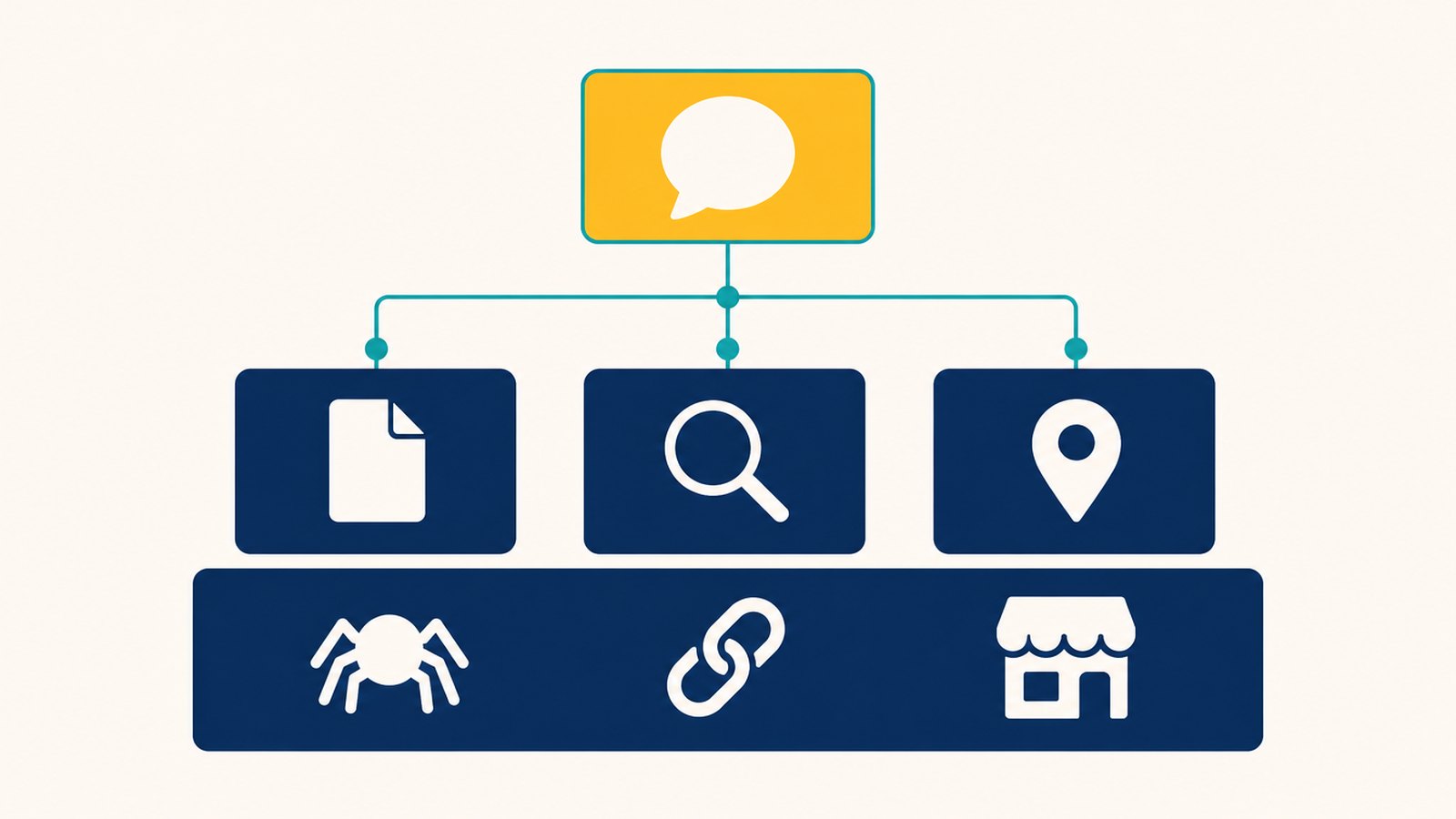
Our Perth data supports the same order of operations from a different angle. Across all 4 platforms, presence in Google’s conventional organic top 10 showed the strongest measured association with a business being recommended repeatedly. That is an association in one Perth sample, not proof that ranking causes recommendation, but it points the same way as Google’s documentation: the foundations are the qualifier.
Our older guide to small business SEO covers that groundwork in priority order, and nothing in the AI shift has changed it.
Build your AI SEO question list
AI SEO starts with a query universe: a fixed list of 20 to 50 real questions your customers put to AI assistants, written the way they say them rather than the way a keyword tool spells them. Keyword research gives you “commercial electrician perth”. It does not give you “I need a commercial sparky in Perth who can do a switchboard upgrade on a strata building, who should I call”.
Map your questions across the shapes buyers actually use:
- Informational: “do I need a licensed electrician to replace a powerpoint in WA”
- Commercial: “best commercial electrician in Perth”
- Comparison: “MYOB vs Xero for Australian small business”
- Alternatives: “alternatives to hiring a bookkeeper”
- Recommendation: “who should I use for a switchboard upgrade in Fremantle”
- Local with a qualifier: “best solar installer Adelaide reviews”
- Situational: “Xero accountant for a small construction business in Brisbane”
- Trust: “is [your business name] any good”
Google confirms why the phrasing matters. Both AI Overviews and AI Mode may use what Google calls query fan-out, issuing multiple related searches across subtopics before writing an answer. Your customer’s one long question becomes several searches you never see. The useful question is whether those smaller searches want genuinely different information or just reword the same one, which is what a query fan-out audit separates. Write for the question, not for the keyword it decomposes into.

Prioritise ruthlessly. For most small businesses, 20 to 50 questions covers everything commercially meaningful, and the ones nearest the purchase decision are worth more than the ones nearest the top of the funnel.
Make your business easy for a machine to identify
AI SEO fails at the first step if an AI system cannot pin your business down. If your trading name appears 3 ways, your address 2 ways, and your service area is a mystery, the safest thing for the model to do is name a competitor it is more confident about.
Make these consistent and explicit everywhere they appear:
- The business name, exactly as you trade, including or excluding “Pty Ltd” the same way every time
- The address and phone number, in the same format on the site, the Google Business Profile and every major directory
- The suburbs, council areas or states you actually serve, named in text
- The people, with real names, real roles and real credentials on a real About page
- Licence and registration numbers where your trade requires them, which in Australia is most of them
- Prices or price ranges in AUD, with GST treatment stated
Australian context is a disambiguation tool, not decoration. “Servicing Perth’s southern suburbs from Canning Vale, WA electrical contractor licence shown in full, prices in AUD including GST” separates you from a similarly named business in Ontario far more effectively than any schema property does.
Speaking of which: add structured data because it describes your business accurately, not because you think it is a ranking hack. Google’s position is that markup must match the visible page. It does not say markup earns trust.
Write so one section can stand on its own
Retrieval-ready writing is the part of AI SEO most guides skip, and it means content that survives being lifted out of the page and shown on its own. 4 habits do most of that work, and they are the practical difference between content that ranks and content that gets quoted:
- Answer first, elaborate after. Put the direct answer in the first 40 to 80 words under the heading, then the detail.
- Use headings that match the question. If people ask “how much does a switchboard upgrade cost in Perth”, that is the heading, and the price range sits directly beneath it.
- Re-state the subject inside the passage. Do not write “it usually takes about a week” when the last mention of what “it” is sat 900 words earlier.
- Keep the evidence next to the claim. A figure in one paragraph and its source 3 paragraphs later can be retrieved separately, which turns a sourced fact into an unsourced assertion.
Include the specifics generic competitors leave out: real price ranges, suburbs, turnaround times, exclusions, what you will not do, and the qualifications behind the advice. Tables help for anything comparative, because a table row is already a fact a machine can lift.
Do not write to a word count. A 900-word page that answers the question completely beats a 2,500-word page padded to hit a target.
Local signals and reviews, inside Australian law
Local AI SEO runs into 2 sets of rules at once, and reviews are where Australian small businesses most often break the law by accident. The ACCC’s rules make fake and misleading reviews unlawful. Google’s rules govern how you are allowed to ask for them. The Google Business Profile sits underneath both, and it is still the highest-return asset most local owners hold. Keep the categories right, the hours current including public holidays, the services listed, and the photos real.
Reviews deserve more care than they usually get, for 2 reasons.
The first is legal. The ACCC’s guidance for businesses is blunt: it is against the law for a business to create fake or misleading reviews, or to arrange for others to do so. Incentives for reviews must be offered to everyone regardless of what they write and disclosed so consumers know the review was incentivised. The ACCC also warns businesses to have an adequate basis before removing or editing a review, because taking down a genuine negative review can itself mislead consumers. Any AI-assisted shortcut that ends in a review a customer did not write is a compliance problem, not a tactic.
There is also a Google policy layer that trips people up. Under Google’s Maps user-contributed content rules, you can ask every customer for a review. What you cannot do is select who you ask based on how happy they are. You also cannot suggest what the review should say, and you cannot offer incentives. Ask everyone, say nothing about content.
Do reviews affect AI recommendations?
Most AI SEO advice treats reviews as a ranking factor, and the evidence for that is much weaker than the industry claims. In our Perth study, review volume tracked AI recommendation within every Maps ranking band, while star rating did not. That is an observed association in one sample. It is a good reason to build genuine review volume steadily, and not a reason to believe that a review count causes an AI system to recommend you.
The sources that showed up in our Australian data
The third-party half of AI SEO is measurable, and we measured it. Across 2,400 AI answers about Perth businesses, the domains AI systems cited most were Google’s own pages, Reddit, and a small set of Australian review and directory platforms. That is the practical answer to “which citations should I build”, and it is category-specific rather than universal.
The most-cited domains in the study, counted by the number of observations citing them:
| Domain | Observations citing it |
|---|---|
| google.com | 451 |
| reddit.com | 234 |
| wordofmouth.com.au | 94 |
| productreview.com.au | 79 |
| hipages.com.au | 74 |
| facebook.com | 56 |
| solarquotes.com.au | 54 |
| autoguru.com.au | 36 |
| canstar.com.au | 34 |

2 things follow for a small business.
Category platforms only matter in their category. SolarQuotes appeared because we asked about solar installers. AutoGuru appeared because we asked about mechanics. Canstar appeared around financial services. There is no general Australian citation list that applies to every trade, which is why buying a 200-directory package is the wrong move.
Reddit and community discussion are doing real work. That does not mean astroturfing Reddit, which is both against its rules and, if you are posing as a customer, an ACCC problem. It means that genuine presence in the places your market actually discusses your category is worth more than another listing nobody reads.
The method is to reverse-engineer it for yourself. Ask your 20 to 50 questions, write down every domain the answers cite, and work out which of those sources you could legitimately appear on: an industry association, a licensing register, a genuine comparison site, a local paper, a supplier’s installer directory, a category platform your customers actually use.
Use AI to write better content, not more of it
AI SEO does not mean publishing more. Using a model to mass-produce pages is the fastest route to a Google problem. Google’s spam policies, updated on 28 August 2026, define scaled content abuse as generating many pages primarily to manipulate rankings rather than help users, and name using generative AI tools to produce many pages without adding value as an example. The one-page-per-postcode trick sits squarely inside that definition.
Where AI genuinely helps a small business:
- Pulling the real questions out of your inbox, quotes and phone notes
- Turning a 30-minute recorded interview with the owner into a structured draft
- Clustering topics and spotting what your existing pages never answer
- Finding sources to read, which you then actually read
- Refreshing a page you already own, with new facts you supply
The pattern is the same in every case: the model handles structure and speed, you supply the information nobody else has. Rewriting the top 10 Google results adds nothing, because everything in that draft already exists on 10 indexed pages.
We have been on the wrong side of this ourselves, and wrote up what publishing AI slop cost us and how the site recovered.
Measure AI visibility separately, and more than once
AI SEO needs its own measurement, repeated, because a single check is close to a coin toss. In our Perth study, only 8% to 31% of recommended businesses held their place across 3 rounds of identical questions asked over 3 days. A screenshot taken on a good day and a screenshot taken on a bad day will tell you 2 different stories about the same business.
Measure it properly:
- Freeze a prompt set of 20 to 50 commercially meaningful questions. Do not change the wording between runs.
- Run it on each platform separately. In our study, Google AI Overviews and Google AI Mode named largely different businesses for identical questions, and they are 2 features of the same search engine.
- Record, per question: were you mentioned, were you cited, which URL was cited, what was the context, which competitors appeared, and which source domains recurred.
- Repeat monthly, same questions, same platforms.
- Tie it to outcomes. Branded search volume, direct traffic, referral traffic from AI platforms and actual enquiries.
On the Google side, be realistic about the reporting. Google’s documentation says traffic from AI features is included in the overall Search Console Performance report under the Web search type, and points you there for AI Overviews and AI Mode. It does not describe a separate AI report that splits those clicks out for you, so do not plan your measurement around one.
We built our own tooling for this because the commercial options disagreed with each other, and wrote up how accurate AI visibility tools actually are when we compared them.
A 30-day AI SEO plan for an Australian small business
4 weeks, with 1 focus each week. You do not need to buy any software to run it. The 30 days buys you the work and a measured baseline, not a guaranteed citation: AI visibility moves quarter over quarter.
Week 1: fix what is broken underneath. Confirm your important pages are indexed. Check robots.txt is not blocking crawlers. Fix the pages that hide key information in images or scripts. Audit your Google Business Profile against reality: categories, hours, services, service area, phone, website. Write down every version of your business name, address and phone that exists online, and make a list of what needs correcting.
Week 2: build and baseline the question set. Write your 20 to 50 real buyer questions. Ask all of them on Google AI Overviews, Google AI Mode, ChatGPT and Gemini. Record mentions, citations, competitors and cited domains in a spreadsheet. This is your before picture, and it is the only thing that will tell you later whether any of this worked.
Week 3: rewrite your 3 to 5 most commercial pages. Add the direct answer under each heading. Add the specifics you have been leaving out: prices, suburbs, licences, timeframes, exclusions. Make sure each section survives being read on its own. Fix any structured data that disagrees with the page.
Week 4: build evidence and one asset worth citing. Chase the third-party sources your week 2 data showed up. Claim or correct the profiles that matter in your category. Ask your recent customers for reviews, all of them, with no steering. Then publish one thing only you could publish: your real pricing, a project with before and after numbers, a local comparison, a checklist from your actual process.
Then re-run week 2’s questions, unchanged. The comparison is the point.
Mistakes that cost Australian small businesses the most
8 mistakes come up again and again, and most of them start with treating AI search as a separate discipline rather than an extension of the work you already do.
- Abandoning normal SEO to chase ChatGPT. Google’s AI features run on indexed, snippet-eligible pages. Neglecting that removes you from both.
- Publishing generic AI articles. If a model could write it without your input, it adds nothing a model needs.
- Spinning up 40 near-identical suburb pages. Named as an example of scaled content abuse in Google’s own policy.
- Buying reviews, or “arranging” them. Unlawful under Australian Consumer Law, and the ACCC has been active on it.
- Treating schema as a trust hack. It describes your content. It does not vouch for you.
- Judging visibility from one answer. Our own data says a single check is close to a coin toss.
- Counting mentions and stopping there. A mention that produces no enquiry is a vanity metric.
- Adding llms.txt because someone said Google needs it. Google says explicitly that no new AI file or markup is required for its AI features. Publish one if you want to, but do not believe it buys you anything on Google.
Where to start
The honest summary is that AI SEO for a small business is not a new discipline bolted onto the old one. It is the old work, done with more specificity, plus a measurement habit most businesses have never had.
Small businesses have a real advantage here, and it is worth naming. You can publish your actual prices, your actual service area, your actual licence number, photos of your actual work and answers from the person who actually does the job. A national publisher writing about your category cannot. Information gain is the whole game, and you are sitting on the kind nobody can synthesise.
If you would rather have someone run this properly, our AI SEO service does exactly the sequence above, with the measurement built in. Perth businesses can start with AI SEO Perth, where the local data behind this guide came from.