
We Published AI Slop on Our Own Site. Here Is What It Cost, and Exactly How We Recovered
Our own traffic fell 77% in a month after publishing AI-assisted content at volume. The full data, the content cut that followed, and an honest look at what actually caused the recovery.

Most agency case studies are about someone else’s problem. This one is about mine.
In February 2026, searchscope.com.au lost 77% of its impressions in a single month. Not a client site. Ours. The cause was content I had published myself, at volume, with AI assistance and no real editorial standard behind it.
We fixed it. July 2026 clicks came in higher than the pre-collapse peak. But there is a part of this story where the data does not support the tidy version, and I have included that too, because the tidy version is what you would get from an agency trying to sell you something.
Every figure here comes from our own Google Search Console property. Nothing is estimated.
The numbers
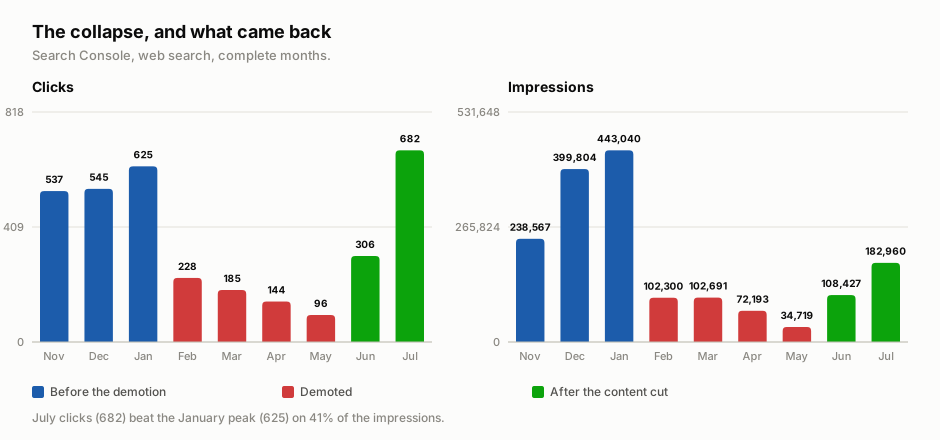
| Month | Clicks | Impressions | CTR |
|---|---|---|---|
| Nov 2025 | 537 | 238,567 | 0.23% |
| Dec 2025 | 545 | 399,804 | 0.14% |
| Jan 2026 (peak) | 625 | 443,040 | 0.14% |
| Feb 2026 | 228 | 102,300 | 0.22% |
| Mar 2026 | 185 | 102,691 | 0.18% |
| Apr 2026 | 144 | 72,193 | 0.20% |
| May 2026 (trough) | 96 | 34,719 | 0.28% |
| Jun 2026 | 306 | 108,427 | 0.28% |
| Jul 2026 | 682 | 182,960 | 0.37% |
Impressions fell from 443,040 to 102,300 between January and February. Clicks kept sliding for three more months, bottoming at 96 in May. That is 96 clicks in a month, for an SEO agency.
Look at the CTR column before you look at anything else, because it is the whole story in one number.
What I actually did wrong
I was running client projects and my own site got whatever was left, which was not much. I used several AI writing tools, at volume, without a brand voice guide, without an editorial line, and without injecting any first-hand experience into any of it.
I never ran bulk generation. There was no script pumping out 500 pages overnight. But there was no plan either, and no standard that a piece had to meet before it went live. Publishing was the goal rather than being useful, and over a year that adds up to a lot of pages that exist for no reason.
This was the golden age of AI content, right before Google worked out how to deal with it. If you look at our traffic curve, it is the textbook shape: strong growth through late 2025, a peak in January, then a cliff. Thousands of sites have that exact chart.
I am not going to name the tools. They were not the problem. The problem was that I did not give my own site the standard I sell to clients, and I did it because I was busy, which is the least impressive reason there is.
What “58% of pages” actually looked like
When we audited, 73 of 126 indexed pages had picked up fewer than 150 impressions in 90 days. Around 29 pages were driving 90% of the clicks. Everything else was ballast.
That is what a quality demotion looks like from the inside. Not a manual action, not a warning in Search Console, just a site where the good pages are outnumbered four to one by pages nobody needed.
What it was not: the migration
This matters, because if your traffic drops after a site rebuild, the rebuild is the first thing you will blame. It is almost always wrong, and here I can prove it.
The traffic collapsed in February 2026. Our Astro repository’s first commit is dated 12 May 2026, and the Cloudflare Pages project was created on 17 May 2026. The new site did not exist for three months after the drop.
The rebuild was a separate decision entirely. I had worked on Astro projects for clients and for people I know, liked the stack, and had run out of patience with WordPress and what I call its mountain of debt. I also could not have done the surgery this recovery needed on a WordPress page builder. So the rebuild helped me execute the fix, but it had nothing to do with causing the problem.
If you take one thing from this post: check your dates before you blame your developer.
What hit us, and when
Here is where I have to be careful, because the honest answer is less satisfying than the one I would like to give.
There was no announced Google core update in February 2026. Per Google’s own Search Status Dashboard, the 2026 ranking updates were a Discover update on 5 February, a spam update on 24 March, a core update on 27 March, a core update on 21 May, and a spam update on 24 June.
The February Discover update is not our answer, because we have no Discover traffic. Our collapse was entirely in web search.
The nearest core update before the drop was the December 2025 core update, which finished on 29 December. We then had our best month ever in January. So either the demotion was a lagging effect of that update reaching our queries and our market late, which is my own read, or it was one of the unannounced adjustments Google makes constantly and never publishes.
I cannot prove either. What I can say is that a sitewide quality demotion does not need an announced update to arrive, and if you are waiting for a named update to explain your drop, you may be waiting for something that does not exist.
What we did
The work followed the same content SOP we use on local SEO client campaigns. Cross-reference the indexing data, Search Console and analytics, then decide per URL whether it gets cut, merged or kept, weighted against a topical authority map.
The 58% figure told us how big the problem was. It did not tell us what to do with any individual page, so we went through them one at a time.
What came out of that:
- 26 redirects. Five outright cuts, ten consolidations, five full merges, six posts folded in as sections of a larger piece.
- Four pillars absorbed most of it: local citations, reviews, location pages and local keyword research.
- Around 346 internal links re-pointed. Every link aiming at a URL that was about to disappear had to be found and re-aimed at the new target, with anchor text that matched the destination.
- Five or six unfinished categories cut entirely. We had started topical coverage in a lot of directions and finished almost none of them. We kept the three where coverage was nearly complete, which are local SEO, Google Business Profile, and GBP suspensions, and consolidated the missing pieces into those.
- Cannibalising pages de-conflicted, including our own Perth and national local SEO pages that had been competing with each other.
The rule we did not break: every cut or merge got a 301, and no page was allowed to disappear while internal links still pointed at it. Orphaning a redirect is how you turn a content cleanup into a second problem.
What it cost
About a week of real work, at two to three hours a day on average. That is roughly 15 to 20 hours, and it does not count the audit that preceded it.
I mention it because “prune your thin content” is advice people give in a single sentence, as if it were an afternoon. It is not. The redirects are quick. Re-pointing 346 internal links correctly is not.
What came back
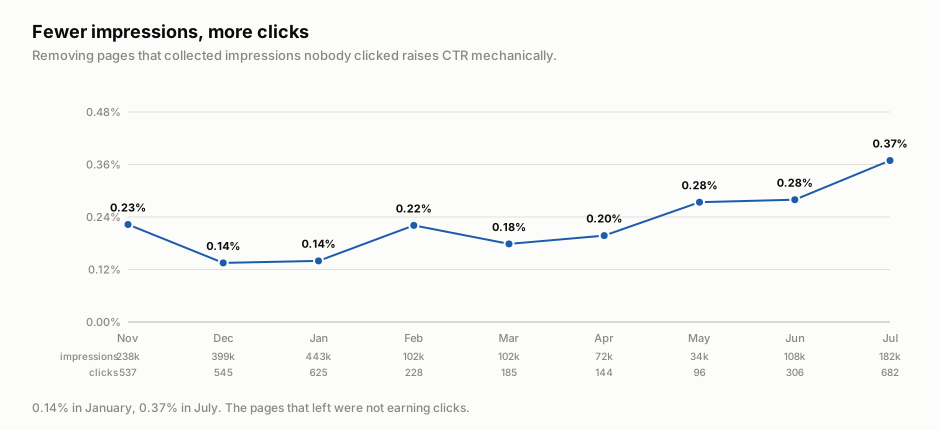
July 2026: 682 clicks. The January peak was 625.
We are earning more clicks than we ever did during the AI content era, on 41% of the impressions. CTR went from 0.14% to 0.37%, nearly triple.
That is the number I would point at if you only let me keep one. Impressions are a vanity metric when they come from pages ranking at position 40 for queries that were never yours. We deleted the pages that were collecting impressions nobody clicked, and what is left converts.
Which brings me to something worth saying plainly: part of what we “lost” was never worth having. That January peak of 443,000 impressions was itself built during the slop period. Framing this as “we recovered our traffic” would quietly imply the old traffic was good. It was not. Most of it was noise with a 0.14% click-through rate attached.
We published an anonymous client case study recently where the same principle applied in reverse: a site with almost no pages needed building, not pruning.
On tracked keyword positions, “local seo perth” went from 23 in April to 72 at its worst on 1 June, back to 17 by the end of June, and 8 on 2 August.
The part where I cannot take the credit
Here is the awkward bit.
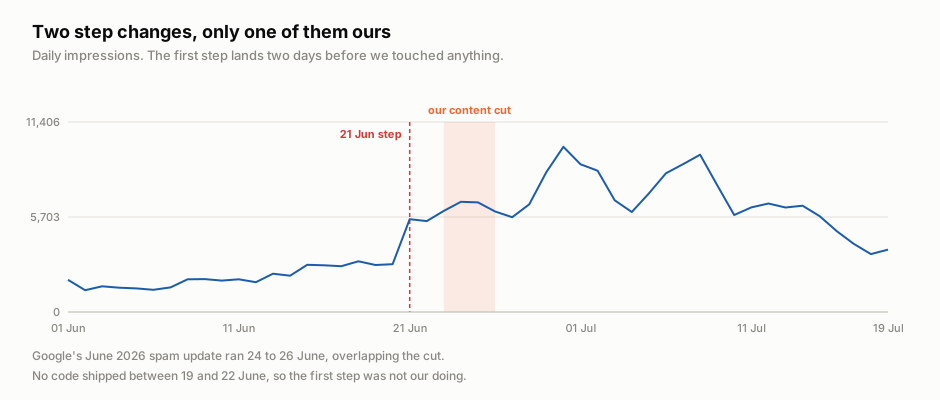
Our content cut ran from 23 to 26 June. But daily impressions had already stepped up sharply on 21 June, two days before we touched anything. There are no commits in our repository between 19 June and 22 June, so whatever moved on the 21st, it was not us.
Then a second, larger step landed on 29 and 30 June, which is after the cut finished, and after Google’s June 2026 spam update completed on 26 June. That level held through July.
So the honest reading is two step changes, and only the second one is plausibly ours. Google was actively re-evaluating the web during the exact days we were cutting, and I cannot separate our work from that re-evaluation. Anyone who tells you they can separate those two things on a single site is guessing.
What I will claim, because it does not depend on any of this: the CTR shift is structural. You cannot get a near-tripling of click-through rate from an algorithm update alone. That came from removing pages that were pulling impressions and no clicks, and it would have shown up whether or not Google refreshed anything.
What I would do differently
Apply my own standards to my own site. Every rule in our client content process, brand voice, evidence, first-hand experience, a reason for the page to exist, was already written down. I just did not enforce any of it on searchscope.com.au. The process was never the problem.
Prune continuously instead of in one panic. A quarterly cull of pages under an impressions floor would have caught this at 15 pages instead of 73.
Track the work as it happens. Our project dashboard did not exist during most of this, so I am reconstructing parts of the timeline from git history and Search Console. That is why I cannot tell you what happened on 21 June. Keep a log.
Stop publishing into unfinished categories. We had coverage spread across a dozen topics and depth in none. Cutting five or six of those was the single decision that made the site coherent.
What is still not finished
This is not a closed case. We cut several categories that are genuinely relevant to what we sell, ecommerce SEO being the obvious one, and those need rebuilding properly rather than being restored. Impressions are still well below the old peak, and I am fine with that, but it does mean the topical footprint is deliberately narrower than it was.
The rule I have given myself is that a category gets built only when I can finish it.
What this means for your site
If your traffic has fallen and you are looking for the update that caused it, check the dates first. If nothing announced lines up, you are probably looking at a sitewide quality assessment, and the fix is not a technical one.
If you published AI-assisted content at volume without an editorial standard, the fix is not to rewrite it all. It is to work out which pages have a job, merge what overlaps, cut what does not, and redirect everything you remove. That process is the same one behind any proper local SEO audit and strategy. Expect it to take longer than you think, mostly because of the internal links.
And do not measure the recovery in impressions. Measure it in clicks per impression. Ours nearly tripled, and that number told us the cleanup had worked well before the traffic came back.
Method and caveats
- All figures are from the searchscope.com.au Google Search Console property, web search type only, complete calendar months.
- Keyword positions are from our organic rank tracker, not Search Console average position.
- Update dates are taken directly from Google’s Search Status Dashboard.
- The rebuild dates are from our repository’s first commit and the Cloudflare Pages project creation date.
- The 21 June step change is unexplained. We have not attributed it to our work.
- We cannot isolate the effect of the content cut from Google’s June 2026 spam update, which overlapped it. The CTR change is the only outcome here that does not depend on that distinction.
- One site, one recovery. This is what happened to us, not a rule about what will happen to you.
If this sounds like your site
If your traffic dropped and you are not sure whether it was your content, your migration or an update, we will look at the dates and the page-level data in an SEO audit and tell you which one it was. If the answer is that your content is the problem, we will tell you that too.