
The State of SEO and Marketing in Australia (2026)
Australian SEO and marketing in 2026: search ad spend $8B (+11.5% YoY per IAB), Google at 88-91% (Statcounter), AI Overviews on 48% of tracked queries.

Australian digital marketing in 2026 is shaped by three measurable shifts: search advertising hit a new annual high at $8.0 billion (+11.5% YoY) per IAB Australia’s CY2025 report, Google’s monthly search share has slipped from ~94% to 88-91% per Statcounter Australia as Bing rises on Copilot/Edge defaults, and AI Overviews now appear on 48% of tracked queries per BrightEdge Feb 2026 data.
This report is rebuilt against IAB Australia’s March 2026 release, Datareportal Digital 2026 Australia, Statcounter’s monthly Australia tracking, Stanford AI Index 2026 (April 13), and the BrightLocal Local Consumer Review Survey 2026. Older figures are flagged with date qualifiers.
The structural pattern for Australian businesses in 2026: traditional SEO still matters, but optimising for AI citation, structured data depth and brand strength is now where marginal effort returns the most.
Search engine market dominance and usage patterns
Core search statistics (May 2026)
Australia remains a highly concentrated search market, but the picture has shifted meaningfully over 2025-2026. Google is still dominant, but Bing has roughly doubled its share on the back of Microsoft Copilot integration and Edge defaults.
- Statcounter Australia, June 2026: Google 88.04%, Bing 9%, Yahoo 1.55%, DuckDuckGo 0.94% (Statcounter)
- Statcounter Australia, August 2024: Google 93.67%, Bing 4.7%. This is the reading the ACCC rounded to “nearly 94 per cent”, so the comparison below is like for like: same dataset, same monthly methodology, 22 months apart
- ACCC August 2024 reported Google at nearly 94% of the general search market, drawn from Statcounter and rounded up from 93.67%, materially higher than the current monthly trend
There is no methodology gap to argue about here, which makes the fall cleaner than it usually gets reported: the 94% and the 88% are the same monthly Statcounter series, 22 months apart. Worth noting where that leaves us. At 88.04% Australia now sits below the worldwide Google share of 91.27%, reversing the long-standing pattern of Australia being more Google-dominated than the global average. The directional read for planning purposes is that Google’s monthly Australian share has slipped from around 94% in mid-2024 to 88-91% across early 2026. Our Search Engine Usage in Australia 2026 report has the full breakdown, including the Statcounter series behind those figures.
The structural implication for Australian SEOs: Bing has crossed the threshold where Microsoft Ads campaigns can deliver meaningful incremental reach, particularly in B2B and technology categories where Edge and Microsoft 365 usage skew high. Paid is not the only lever there, and the organic side of Bing is the cheaper half.
- 75% of users still rarely scroll past first-page results (long-running industry consensus, the absolute number has remained stable for years)
Device usage
Australia is not the mobile-first market most global benchmarks assume. Statcounter’s June 2026 device split puts desktop at 53.27% of Australian web traffic, mobile at 44.25% and tablet at 2.48%. Mobile connections exceed population because that counts SIMs, not sessions. Datareportal Digital 2026 Australia:
- 34.1 million mobile connections (126% of population)
- 26.2 million internet users (97.1% of population)
- Per Statcounter, Google takes 97.48% of Australian mobile search but only 79.79% on desktop, where Bing sits at 16.37% on Edge and Microsoft 365 defaults. Because desktop is the larger half of Australian traffic, a desktop-skewed B2B audience is a materially different search market from the blended 88% headline
The implication for Australian marketers is unchanged from 2024 in directionality, but the new layer is AI Overview impact on mobile SERPs (covered below). Mobile-first content design is now table stakes; mobile-first content that survives AI Overview citation pressure is the new bar.
Click-through rate and AI Overview impact
Position-one organic CTR is no longer a single number worth planning around. Advanced Web Ranking’s 2025 desktop benchmarks range from roughly 16% to 45% depending on industry, and non-branded queries cluster lower than the often-quoted 27.6%. Where an AI Overview is present it drops further again. Any model that assumes one flat position-one CTR will be wrong in both directions.
The biggest structural change in search behaviour is the rise of zero-click searches and the rapid expansion of AI Overviews.
- Zero-click: SparkToro and Datos 2024 clickstream data found around 58.5% of US and 59.7% of EU Google searches now end without a click to the open web
- AI Overview prevalence: BrightEdge tracking put AIOs on 48% of tracked queries by February 2026, up from 31% a year earlier, a rise of 17 percentage points
- CTR impact: Ahrefs December 2025 update put position-1 CTR loss at 58% when an AI Overview is present (up from 34.5% in April 2025); Pew Research put it at 47% relative drop (8% click rate with AIO vs 15% without)
- Recovery signal: Seer Interactive’s 2026 update shows organic CTR on AI Overview queries rebounded from 1.3% in December 2025 to 2.4% in February 2026, but pages cited inside the AIO still pull ~2.1% vs ~0.9% for pages on the same SERP not cited
- Our own Australian tracking: across 53 Australian queries we monitor for AI-visibility work spanning three client verticals (childcare, allied health and SEO services), an AI Overview was present on 49, 92%, at the latest capture (July-August 2026). These queries are selected for AI-visibility tracking rather than randomly sampled, so read it as a ceiling for commercial queries rather than a market-wide average, but it is a first-party Australian data point in a debate otherwise argued entirely from US datasets
For Australian businesses, this means ranking well still matters, but query type and SERP layout materially affect how much traffic those rankings actually deliver. Informational and comparison queries are most exposed; transactional and local queries (currently AIO trigger rate ~5%) much less so.
Key takeaway: AI Overviews have reshaped the click economics of informational SEO; transactional and local SEO continue to drive traffic and revenue largely unaffected.
Australian digital ad spend (IAB Australia CY2025)
Australia’s internet advertising market grew 11.5% to $18.4 billion in calendar year 2025 per the IAB Australia Internet Advertising Revenue Report (released March 2026, prepared by PwC Australia). Search advertising hit a new annual high.
Australian internet ad spend by category (CY2025, AUD billions)
Search remains the dominant channel at 44% of total online ad spend, with video the fastest-growing category. Source: IAB Australia CY2025 Internet Advertising Revenue Report (PwC, March 2026).
YoY growth: Search +11.5%, Video +19.8%, Classifieds +5.0%, Display +1.9%, Audio +8.2%.
The SEO services market within this picture: andava.com’s 2026 compilation and industry trackers estimate Australian SEO services spending at around $1.5 billion in 2025 (+12% YoY), with average SMB SEO investment of $1,200-$1,500/month. The relationship: search ad spend ($8.0B) is the paid-channel measure; SEO services spend ($1.5B) is the organic-channel investment, both growing strongly.
Voice search
Current usage
Voice search has stabilised as a meaningful but not dominant behaviour in Australia. Red Search local SEO analysis finds roughly one-third of Australians use voice search daily, most often to find local businesses nearby. Typical voice queries run 6-10 words vs 2-3 for typed searches.
Google’s long-running local-search research has found that around 76% of people who perform a local “near me” search on their smartphone visit a related business within 24 hours, and about 28% of those searches lead to a purchase. The numbers are well-aged but the underlying behavioural pattern has held: local intent converts fast, and voice queries skew strongly local.
The practical SEO implication: voice and “answer engine” optimisation are now the same workstream. The same content that wins featured snippets typically wins Siri “near me” responses and AI Overview citations.
Social media landscape (2026 update)
The Australian social media ecosystem continues to fragment. Single-channel social strategies no longer work; Australians use an average of 6.6 social platforms per month (Meltwater 2026).
Australian social media: users (millions) and YoY growth rate (2025-2026)
YouTube leads on absolute reach; TikTok leads on growth rate at +13.9% YoY; X is the only major platform to lose Australian reach (-5.4% YoY). Source: Datareportal Digital 2026 Australia, October 2025 snapshot.
Australian social media users (Datareportal Digital 2026, October 2025 snapshot)
- 21.0 million total social media user identities (77.7% of population)
- YouTube: 21.0M reach, Facebook: 17.7M (+4.4%), Instagram: 15.2M (+8.6%)
- TikTok: 10.9M adult reach (+13.9% YoY, fastest growth of any major platform)
- LinkedIn: 17M registered AU users per NapoleonCat April 2026
- X: 4.74M (-5.4% YoY, the only major platform to lose AU reach)
- Reddit: ~23.3M ad-platform reach estimate (+179% YoY, the biggest mover overall though ad-API estimates run high)
Daily time spent: TikTok 1h 14m, YouTube 1h 12m, Instagram 1h 3m, Facebook 46m (Meltwater 2026).
Our Social Media Statistics for Australia 2026 report has the full breakdown of how Australians use each platform.
Marketer platform usage
Short-form video and social commerce remain the top spend-growth categories among B2B and B2C marketers. Reels, Shorts and TikTok native video converge on the same vertical, captioned format, which has consolidated content production around a single creative pipeline rather than per-platform variations.
The structural shift through 2025-2026: AI-driven content optimisation tools (Semrush, Ahrefs, SurferSEO, and AI Overview tracking specialists like BotRank, BrightEdge, Profound) have moved from experimental to standard. Adoption among Australian agencies and in-house teams is now widely above 50%.
Key takeaway: Australian social media is now genuinely multi-platform. Successful Australian brands run primary spend on 2-3 platforms with secondary brand presence on 2-3 more.
Content marketing performance metrics
Content marketing in Australia has matured from “produce more content” to “produce content systems that deliver measurable business outcomes”. The shift through 2025-2026 has been toward fewer, deeper assets and active distribution rather than high-volume publishing.
Performance benchmarks
- Email ROI: multiple studies based on DMA data put average email ROI at $36-$38 per $1 spent (3,500-3,800%), with best-in-class programs in retail and ecommerce reaching $40-$45 per $1
- Video adoption: around 91% of businesses globally use video as a marketing tool, and 82% of video marketers say it delivers positive ROI, down from 93% the year before (Wyzowl)
- AI tool adoption: HubSpot reports 80% of marketers now use AI for content creation, most commonly for research, drafting and copy
- Interactive content: calculators, quizzes and assessment tools typically generate around twice the conversions of static content, with higher engagement and lead quality per Upland Kapost research
- Long-form content: a BuzzSumo/Backlinko study of 912 million blog posts found articles longer than 3,000 words attract 77.2% more referring domains than posts under 1,000 words
For Australian brands competing in saturated niches, the highest-leverage moves through 2026 are: build interactive assets around high-intent queries, publish fewer but deeper articles, and prioritise content that can be cited by AI Overviews (clear definitions, structured FAQ blocks, definitive statements, primary-source citations).
Strategy implementation
- ~74% of marketers have documented content strategies (stable from 2024)
- ~48% employ dedicated content strategists
- ~67% rate video as most effective content
- Companies with documented strategies report 3.2x higher content ROI than ad-hoc publishers
The shift toward documented, data-driven content strategies marks the maturation phase in Australian digital marketing. Random content creation is being displaced by structured approaches aligned to specific funnel stages.
Local SEO
Local SEO continues to be one of the highest-leverage marketing channels for Australian businesses with a physical presence. The reason is structural: the gap between local intent and purchase action is small, which makes Map Pack visibility one of the few digital channels with a genuinely short causal chain to revenue.
Google’s own guidance and multiple industry analyses show that complete, well-maintained Google Business Profiles earn substantially more visibility and interactions than incomplete listings, often several times more clicks and calls, because they’re more likely to appear in local packs and on Google Maps.
The BrightLocal Local Consumer Review Survey 2026 (released February 2026) shifted the review-stat baseline meaningfully:
- 97% of consumers read reviews for local businesses (up from previous years)
- 41% always read reviews (up from 29% in 2025)
- 31% only consider businesses with 4.5+ stars (nearly double the 17% from 2025)
- 80% are more likely to use a business that responds to every review
- 89% expect business owners to respond to reviews
- 45% have asked AI for a local business recommendation in the past 12 months (up from 6% in 2025)
Search behaviour and intent
- A large share of all Google searches carry local intent (the often-cited 40-46% figure originates from various Google research releases over the past decade)
- Google’s local-search research found around 76% of people who perform a “near me” search on their smartphone visit a related business within 24 hours, with about 28% leading to a purchase
Investment and spending patterns
- Australian SMB SEO investment averages $1,200-$1,500 per month per andava.com’s 2026 compilation
- Medium and large businesses typically invest from $3,000 to $10,000+/month on ongoing SEO, especially in competitive national verticals (Safari Digital)
- The IAB Australia CY2025 Internet Advertising Revenue Report put search advertising at $8.0 billion (+11.5% YoY) for calendar year 2025, around 44% of total online advertising spend
Key takeaway: Local SEO services deliver some of the highest measurable ROI for Australian businesses with a physical or service-area presence. The BrightLocal 2026 data confirms the review-economy bar has risen sharply.
Industry challenges and growth opportunities
What’s holding Australian marketers back
Measurement is now the dominant challenge for Australian marketers rather than channel adoption. Per Nielsen’s Annual Marketing Report, the majority of marketers feel reasonably confident measuring ROI within individual channels, but only just over half are confident measuring full-funnel ROI across the customer journey.
Measurement is where most teams are stuck: integrating data across platforms, extracting insight from it, and tying performance to business goals (76%) (Nielsen 2023).
Salesforce’s State of Marketing shows 75% of marketers globally are experimenting with or have fully implemented AI, but also rank AI adoption as both their number-one priority and their number-one challenge due to data, trust and skills gaps. For Australian teams, these global patterns play out against frequent Google core/local algorithm updates and rising zero-click behaviour.
Where the highest-leverage opportunities sit (2026)
- AI Overview citation work: structuring content to be cited by AI Overviews (now on 48% of tracked queries) is the highest-payoff content-strategy shift available right now
- Local SEO and GBP review economy: review count, recency, response rate and 4.5+ star averages now materially decide local visibility, per BrightLocal LCRS 2026
- AI search visibility (ChatGPT, Perplexity, Claude, Gemini): AI tools now cite businesses; entity-strong brands win citations
- Hyperlocal landing pages built on genuinely location-specific substance: Google’s March 2024 scaled content abuse policy sets no uniqueness percentage, and the August 2025 spam update widened enforcement to programmatic near-duplicate sets. The test is whether a page carries information that could only have been written about that location
- Video content with VideoObject schema: one of the few SERP features still reliably driving CTR
- Interactive content (calculators, configurators, assessment tools): AI Overviews can’t fully summarise these, so CTR holds
AI and technology integration (2026 update)
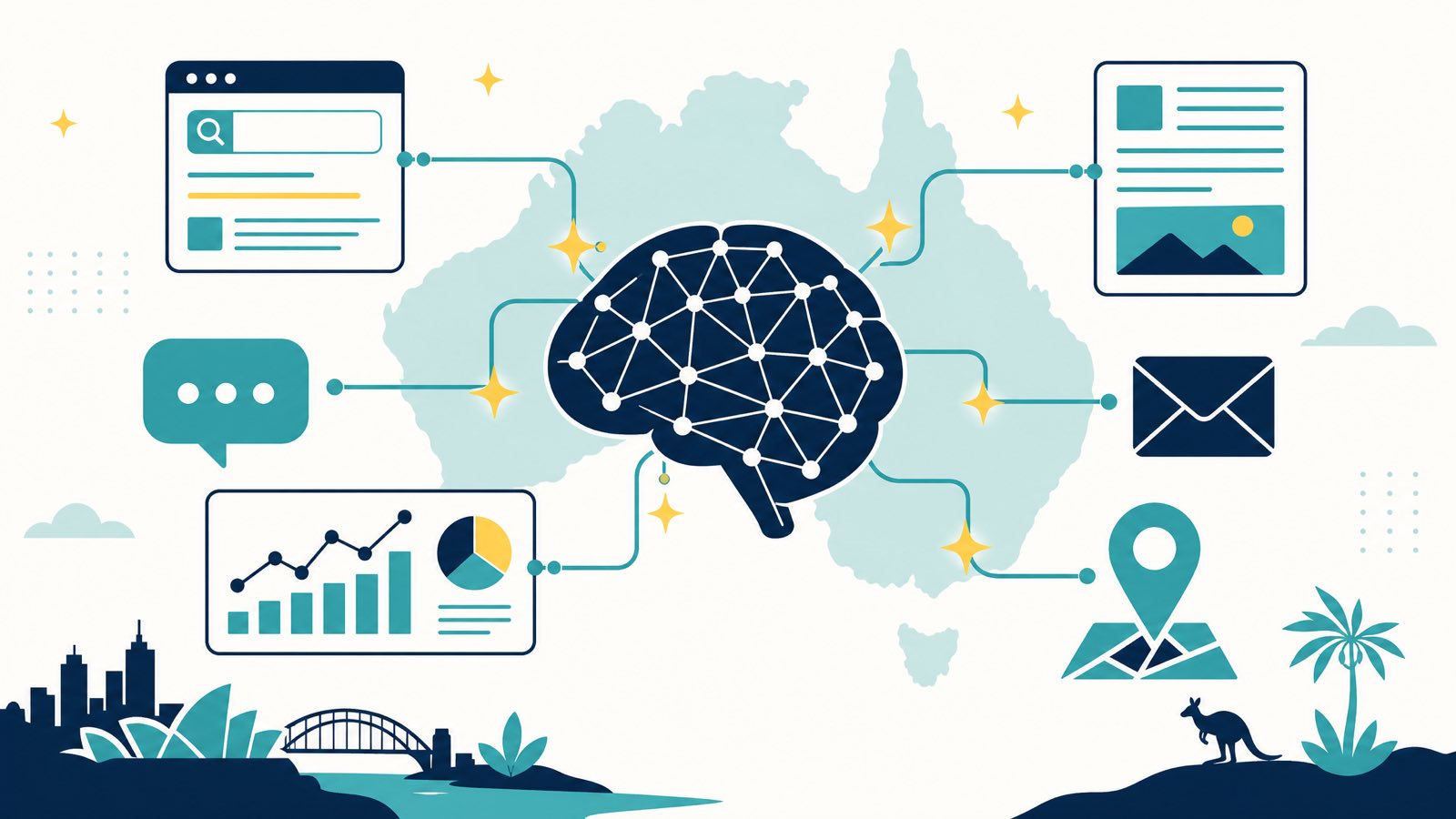
Artificial intelligence has moved from experimental to infrastructure in Australian digital marketing. The Stanford AI Index 2026 (released April 13) found 53% global GenAI population adoption within three years of ChatGPT’s launch, faster than the personal computer or the internet reached comparable adoption.
Australian adoption rates
- Google/Ipsos AI Adoption in Australia survey (January 2025): 49% of Australians had used a generative AI tool in the past year, up from 38% in 2023, with 74% of users applying AI at work
- National AI Centre SME pulse (December 2025-February 2026): Australian SME AI adoption at 43% for the quarter, rebounding to 44% in February 2026
- AWS’s Unlocking Australia’s AI Potential report estimates 1.3 million Australian businesses (around 50%) are now regularly using AI, with adoption growing ~16% YoY. (Note: AWS framings here are marketing-led; figures are directionally useful but treated as upper-bound estimates.)
- HubSpot’s marketing AI report: 74% of marketers globally already use at least one AI tool for research, writing or content creation
- Salesforce State of Marketing: 75% of marketers experimenting with or fully implementing AI
Our AI statistics report covers the broader Australian picture on adoption, trust and regulation.
Performance impact
Businesses using AI-powered SEO tools through 2025-2026 report:
- Faster keyword research and content production cycles
- Material time savings on draft content (typically 30-50%, though final-quality editing still requires human time)
- Improved AI Overview citation rates when content is restructured for AI consumption
- Better local search visibility when AI tools are used for entity research and competitor gap analysis
The pattern that matters: AI augments human SEO work; it doesn’t replace it. The teams getting the most leverage use AI for ideation, drafting and competitive research, then apply human editing for local nuance, accuracy and brand voice.
Strategic recommendations for the rest of 2026
The Australian digital marketing landscape calls for active recalibration through the rest of 2026. The combination of Google share decline, AI Overview expansion, the new eSafety Internet Search Engine Services Code (effective 27 December 2025) and the under-16 social media ban means most 2024-vintage SEO playbooks need updating. For Western Australian operators working out what that means for their own channel mix, that recalibration is the work our Perth SEO service does.
Five priorities for AU SEO and content teams in 2026
- AI Overview citation work: structure key informational content for AI extraction (clear definitions, FAQ blocks, primary-source citations, definitive statements)
- Local SEO and GBP: review velocity, response rate and 4.5+ star averages are now decisive (BrightLocal 2026)
- AI search visibility tracking: monitor citations across ChatGPT, Perplexity, Claude, Gemini and Google’s AI Mode (1B+ MAU)
- Mobile and CWV: still table stakes, with Australia at 97.1% internet penetration and 95%+ mobile-first search behaviour
- eSafety code compliance: from 27 December 2025, search engines must blur explicit images and redirect self-harm queries; from 27 June 2026, age assurance for logged-in users becomes mandatory
Immediate actions (0-3 months)
- Audit and optimise Google Business Profile completeness (categories, attributes, photos, services)
- Restructure highest-traffic informational pages for AI Overview citation
- Audit structured data on key conversion pages, and note that FAQ rich results were retired from Google Search on 7 May 2026. Existing FAQPage markup is harmless but earns nothing now. Keep the question-and-answer content itself, which still feeds AI Overview and AI Mode extraction
- Set up AI Overview tracking (BotRank, Profound, or BrightEdge)
- Prioritise mobile Core Web Vitals on top revenue pages
Medium-term investments (3-12 months)
- Build out local SEO programs for service-area businesses (geo-grid tracking, hyperlocal landing pages)
- Develop systematic video content production with VideoObject schema
- Implement advanced analytics and attribution (CRM-aligned, not vanity metrics)
- Test Microsoft Ads/Bing visibility given Bing’s share growth in AU
Long-term planning (12+ months)
- Prepare for continued AI search evolution (Ask Maps AU rollout, Gemini integration depth, agentic AI), and fold ChatGPT SEO into the core search plan
- Build domain authority through E-E-A-T (genuine expertise, author bios, primary sources)
- Develop omnichannel content distribution (social, email, AI surfaces)
- Invest in technical SEO infrastructure (Schema.org coverage, internal linking, sitemaps, hreflang for multi-region)
Conclusion
The Australian SEO and digital marketing industry in 2026 is shaped by three real forces: AI Overview expansion has changed click economics on informational queries, Bing has crossed the threshold where it matters for media planning, and the new eSafety code plus the under-16 social media ban have changed the regulatory landscape that all of this operates within.
Market outlook (verified): IAB Australia’s CY2025 report puts total internet ad spend at $18.4B (+11.5% YoY), with search at $8.0B (+11.5%) and video the fastest-growing segment at $5.4B (+19.8%). The Australian SEO services market is estimated at around $1.5B in 2025 (+12% YoY) per industry trackers, with average SMB SEO investment of $1,200-$1,500/month.
Taken together, investment in search visibility (both paid and organic) continues to grow steadily, with AI-assisted optimisation, local search, video content and AI-citation-ready content likely to capture a disproportionate share of that growth through 2026 and into 2027.
For Australian businesses thinking through how to apply this to their own SEO and content programs, or drop us a line and we’ll come back with a scoped recommendation.
Sources (verified May 2026):
- IAB Australia Internet Advertising Revenue Report (CY2025): March 2026 release, prepared by PwC
- Datareportal Digital 2026 Australia: October 2025 snapshot, published November 2025
- Statcounter Global Stats Australia: May 2026 monthly data
- SerpSculpt Search Engine Statistics by Country (2026): May 2026 verified country dataset
- Stanford AI Index 2026: released April 13, 2026
- BrightLocal Local Consumer Review Survey 2026: February 2026 release
- BrightEdge AI Overview tracking: February 2026 data
- Seer Interactive AI Overview CTR rebound: 2026 update
- Ahrefs AI Overviews Reduce Clicks (December 2025 update)
- Pew Research AI summary click-through study
- Google/Ipsos AI Adoption in Australia: January 2025
- NAIC SME AI Pulse (Dec 2025-Feb 2026)