
Zero-Click Searches: The Silent Killer of Your Website Traffic?
Zero-click searches now account for ~60% of Google queries in the US and EU. AI Overviews appear on 48% of tracked queries (BrightEdge Feb 2026) and cut position-1 CTR by up to 58% (Ahrefs). Here's how Australian businesses are adapting.

As an SEO consultant who founded Search Scope here in Perth, I speak with Australian business owners every week who are seeing their traffic fall despite holding stable rankings. The dominant cause is the continued rise of zero-click searches and the rapid expansion of Google’s AI Overviews.
The numbers have moved fast. SparkToro’s early-2026 update, based on Similarweb clickstream data from the first four months of 2026, found US zero-click searches have climbed to 68.01%, up from 60.45% in 2024, only 276 of every 1,000 US Google searches now reach the open web. BrightEdge tracking puts AI Overview presence at 48% of tracked queries as of February 2026, up from 31% a year earlier (+58% YoY). And Ahrefs’ December 2025 update puts position-1 CTR loss at 58% when an AI Overview is present, nearly double their April 2025 figure of 34.5%.
This isn’t a death sentence for your digital strategy. It’s a forced shift from “rank for the click” to “be the answer”. This article covers what the latest 2026 data shows, where the lost clicks are actually going, and what Australian businesses can do about it.
- Focus on “On-SERP SEO”: Optimise for visibility in answer boxes, local packs, and knowledge panels.
- Dominate Local Search: Turn your Google Business Profile into a powerful conversion tool.
- Create “Un-snippable” Content: Develop in-depth resources that demand a click-through.
- Leverage Video: Use video snippets to capture attention and drive traffic.
What are zero-click searches and why are they increasing?
A zero-click search happens when a user’s query is answered directly on the search engine results page (SERP), so they don’t need to click any website link. Google has become very efficient at providing instant answers through a range of SERP features.
The trend has accelerated through 2025-2026. Sundar Pichai’s Q4 2025 Alphabet earnings call (February 2026) said AI launches are “proving to be more helpful and driving a greater usage.” Alphabet’s total FY2025 revenue crossed $400 billion for the first time; Google Search & other revenue specifically grew to $224.5 billion, up from $198.1 billion in 2024.
The SERP features driving the shift:
- AI Overviews: AI-generated summaries appearing at the top of the page. BrightEdge measured AIOs on about 48% of tracked queries by February 2026 (up from 31% a year earlier); Conductor put the figure at 25.11% of 21.9M analysed searches. The variation reflects different keyword samples; the direction across every study is up.
- Featured Snippets: “Position Zero” answer boxes for many informational queries. Highly visible, satisfy user intent without a click.
- People Also Ask (PAA) Boxes: a major driver of on-SERP behaviour, appearing in a large share of search results. Each PAA click expands more questions, keeping the user on the page.
- Knowledge Panels: factual cards about businesses, people and places, often pulling from Google Business Profile.
- Local Pack Results: for any “near me” or location-based search, the map pack shows hours, phone, reviews. A Backlinko study found 42% of local searchers click on map pack results, often resolving the query without ever leaving Google.
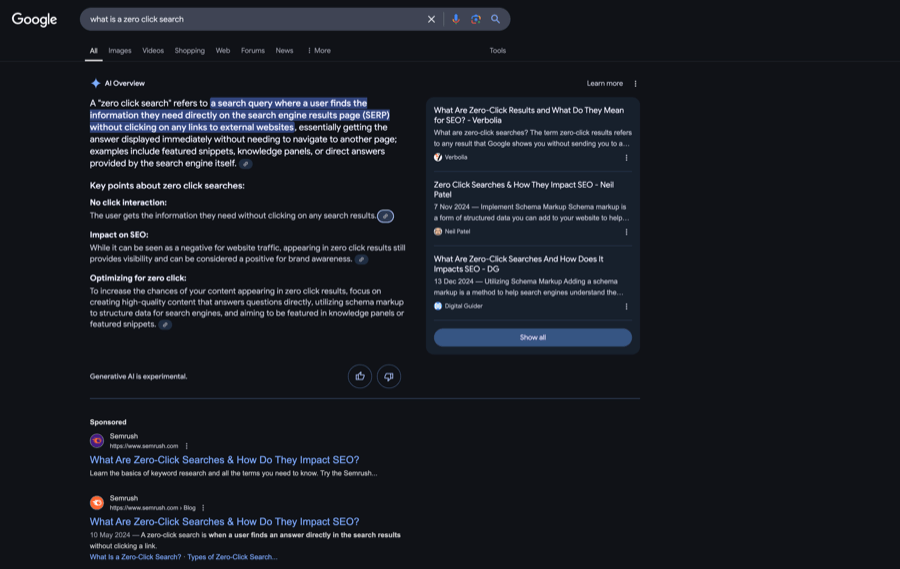
Google now takes considerably more SERP real estate with AI Overviews, featured snippets, the local pack and traditional ad spots, pushing organic blue links progressively further down the page.
AI Overview prevalence by query type (Seer Interactive, 2026)
Comparison and question-style queries trigger AI Overviews almost every time. Transactional queries are still largely AIO-free, which is why local and shopping searches are far less exposed than informational publishers. Source: Seer Interactive 2026 update covering 53 brands and 5.47M queries.
Is this the end of website traffic?
Seeing those numbers, it’s easy to feel disheartened. But what the 2026 data actually shows is more nuanced: clicks are down on affected queries, but visibility and brand presence on the SERP are more valuable than ever, and being cited inside an AI Overview now matters more than ranking first under it.
Per Seer Interactive’s 2026 update, pages cited inside an AI Overview pull about 2.1% CTR vs about 0.9% for pages on the same SERP that aren’t cited. Branded queries with AI Overviews actually see a +18.68% CTR increase per Amsive’s 700,000-keyword analysis. The new strategy is “On-SERP SEO”: winning in the search results themselves, not just winning the click. For Perth businesses, that’s the specific problem our AI SEO and GEO service solves: getting cited inside AI Overviews and tools like ChatGPT, not just ranking under them.
The goal has shifted from driving clicks to being the answer Google quotes. Your brand can reach more eyes than ever, even if fewer people visit your site directly.
How Australian businesses can adapt to zero-click SEO
On-SERP SEO doesn’t mean abandoning traditional tactics; it means enhancing them so you compete on the new SERP layout. The four shifts below are what we see working with Australian clients across retail, hospitality, professional services and trades.
1. Optimise for featured snippets and People Also Ask
The pattern we see with clients in retail and food categories: when an established blog or product page starts losing direct clicks to AI Overviews, the most effective response is to restructure the page around clearly-answered questions, not to add more length. Dedicated FAQ sections that directly answer common customer questions, with FAQ schema, consistently lift SERP visibility even when direct clicks soften.
The trade-off is real but usually net-positive: direct clicks dip while citation frequency rises, and citation frequency tends to flow through to brand recall and assisted conversions.
Actionable tips:
- Answer concisely: structure answers in clear, 40-60 word paragraphs right below a question-based heading (H2 or H3). A Semrush study found the average PAA answer is 41 words.
- Structure for extraction, not schema: Google retired FAQ rich results in May 2026, so FAQPage schema no longer earns extra SERP real estate. The value now is purely in the page structure itself: clear question-format headings with direct, extractable answers are what gets pulled into AI Overviews and People Also Ask boxes.
- Find questions with tools: use Ahrefs or Semrush to find the PAA questions your competitors are ranking for. AlsoAsked is a free alternative for discovering related questions for any search term.
2. Make your Google Business Profile the conversion layer
For local businesses, your Google Business Profile (GBP) is the most powerful single lever against zero-click search traffic loss. The pattern we see in hospitality and retail: a fully managed GBP, with consistent posts, fast review responses, and active Q&A management, often outperforms a website at converting local search demand.
The BrightLocal Local Consumer Review Survey 2026 found 97% of consumers read reviews for local businesses, 89% expect business owners to respond, and 80% are more likely to use a business that responds to every review. The trust signal is the conversion lever; the website is increasingly a confirmation step rather than the discovery point.
What actually works on GBP for hospitality and retail clients:
- High-quality photos with Australian-specific descriptions (e.g. “house-made Vegemite hollandaise”, “Cottesloe coffee roastery”)
- GBP Posts for local events, daily specials, opening hour changes
- Reviews answered within 24 hours, particularly negatives
- Service and product descriptions used proactively to answer common questions about parking, dietary options, accessibility, before customers have to ask
Here is a full tutorial on how to optimise your GBP!
3. Create content that Google can’t summarise
The pattern we see with professional services and B2B publishers: how-to guides that compete on summary-able information get cannibalised by featured snippets and AI Overviews. Content that includes original local data, downloadable templates, interactive tools, or detailed comparison tables consistently holds CTR better because the value can’t be fully extracted.
What survives the AI Overview era:
- Local case studies and unique data that isn’t widely available
- Downloadable resources: checklists, application templates, contract checkers, ROI calculators
- Interactive elements: eligibility calculators, comparison configurators, location maps
- Genuine depth: not pad-content, but real walkthrough material that demonstrates expertise
This is the practical interpretation of the “Skyscraper Technique” (a concept popularised by Brian Dean of Backlinko): if you can’t be better than the existing top result on a topic, don’t write the article.
4. Use video to capture attention on the SERP
For ecommerce and product-led businesses, video-rich snippets are one of the few SERP features still reliably driving clicks. Embedding short product preview videos (60-90 seconds) with the correct VideoObject schema makes them eligible for video carousels that visually stand out.
The pattern we see: users watch the brief preview directly in search, then click through if it confirms interest. The schema is the unlock; without it, search engines treat the video as a generic embed rather than an indexed asset.
YouTube remains one of the most effective platforms for generating qualified search traffic. As a Google property, YouTube videos are frequently prioritised in mixed-media SERPs, which builds both trust and visibility.
Why zero-click searches are an opportunity
The rules of SEO have changed, but the game is far from over. Success in this new landscape means looking beyond website traffic as your only measure of success. Your brand can still connect with customers, and it often happens before they ever land on your homepage.
The rise of zero-click searches forces better SEO. It rewards higher-quality content, structured data done well, active engagement on Google Business Profile, and a brand recognisable enough that people search for it by name. Brand searches with AI Overviews actually see CTR increases (Amsive +18.68%), so the brand-build payoff is real.
For Australian businesses thinking through how to adapt their SEO program for the new SERP, or drop us a line and we’ll come back with a scoped recommendation.
Frequently asked questions about zero-click searches
What percentage of searches are zero-click in 2026?
SparkToro and Datos clickstream data put US zero-click at around 60% and EU around 60% as of mid-2024, with Similarweb showing it rising toward 69% after the May 2024 AI Overview rollout. Australia-specific clickstream at the same methodology isn’t published, but local behaviour is likely to track close given Australia’s heavy Google reliance and rapid AI rollout.
How do AI Overviews affect website traffic?
The impact is significant and worsening. Ahrefs’ December 2025 update found AI Overviews reduce position-1 CTR by 58% (up from their April 2025 figure of 34.5%). Pew Research’s actual-browsing-behaviour study put it at 8% click rate with AIO vs 15% without (a 47% relative drop), with only 1% clicking a link inside the AIO. Seer Interactive’s 2026 update shows organic CTR starting to recover slightly (from 1.3% in December 2025 to 2.4% in February 2026), but pages cited inside the AIO still pull more clicks than pages on the same SERP that aren’t.
Are all keywords affected by zero-click searches equally?
No. Per Seer’s 2026 data: comparison queries trigger AIOs 95% of the time, question queries 86%, informational queries 36%, transactional queries only 5%. Local and shopping queries are the least exposed because users still need to visit a site to purchase or get contact details. Informational publishers are taking the hit.
What is On-SERP SEO?
On-SERP SEO focuses on maximising brand visibility directly on the search results page rather than only chasing the click. The goal is to appear in as many SERP features as possible: featured snippets, People Also Ask, knowledge panels, the local pack, and crucially, citations inside AI Overviews.
What tools can I use to track zero-click opportunities?
Semrush and Ahrefs both track which SERP features appear for your target keywords and where competitors are being featured. Both have added AI Visibility / AI Overview tracking modules through 2025-2026. Specialised tools (BotRank, Profound, BrightEdge) are emerging specifically for AI Mode and AI Overview citation tracking.
Does zero-click mean SEO is dead?
No. It means SEO is evolving. The focus is shifting from purely driving clicks to building brand authority, structured data depth, and citation worthiness for AI surfaces. The same entity work that wins traditional rankings now wins AI Overview citations and Ask Maps recommendations. See how our AI SEO consultant structures this for clients.