
Google Maps Proximity Ranking: How Distance Actually Works in 2026
Proximity shifts with every search and you can't fake it. How the Google Maps proximity ranking factor works in 2026, and how to win at distance.
You rank well outside your front door and disappear two suburbs over. That isn’t a bug. It’s proximity doing its job, and most guides that come up when you search for an answer either repeat a contested percentage or sell you a SaaS tool dressed up as advice.
This is a different take. Proximity is real, but it isn’t 15% or 70% of the algorithm. It’s a fluid filter that changes with every search, and the smartest local SEO work happens when you stop fighting it and start winning the parts of the algorithm you can actually move.
TL;DR
- Google Maps proximity ranking is the distance between the searcher’s inferred location and your verified business address. It’s one of three local ranking factors, alongside Relevance and Prominence.
- Proximity is fluid. It shifts with every search and you can’t fake it without putting the profile at risk.
- The Vicinity update (30 November to 8 December 2021) increased proximity weighting and reduced the impact of keyword-stuffed business names.
- Practitioner surveys (Whitespark 2026) put proximity at roughly half of total weighting, with a lot of variation by industry. Treat that figure as a useful range, not Google fact.
- The work is in the 85% you control: prominence (reviews, links, citations), relevance (categories, on-page), and not getting suspended chasing shortcuts.
What Google Maps Proximity Ranking Actually Means
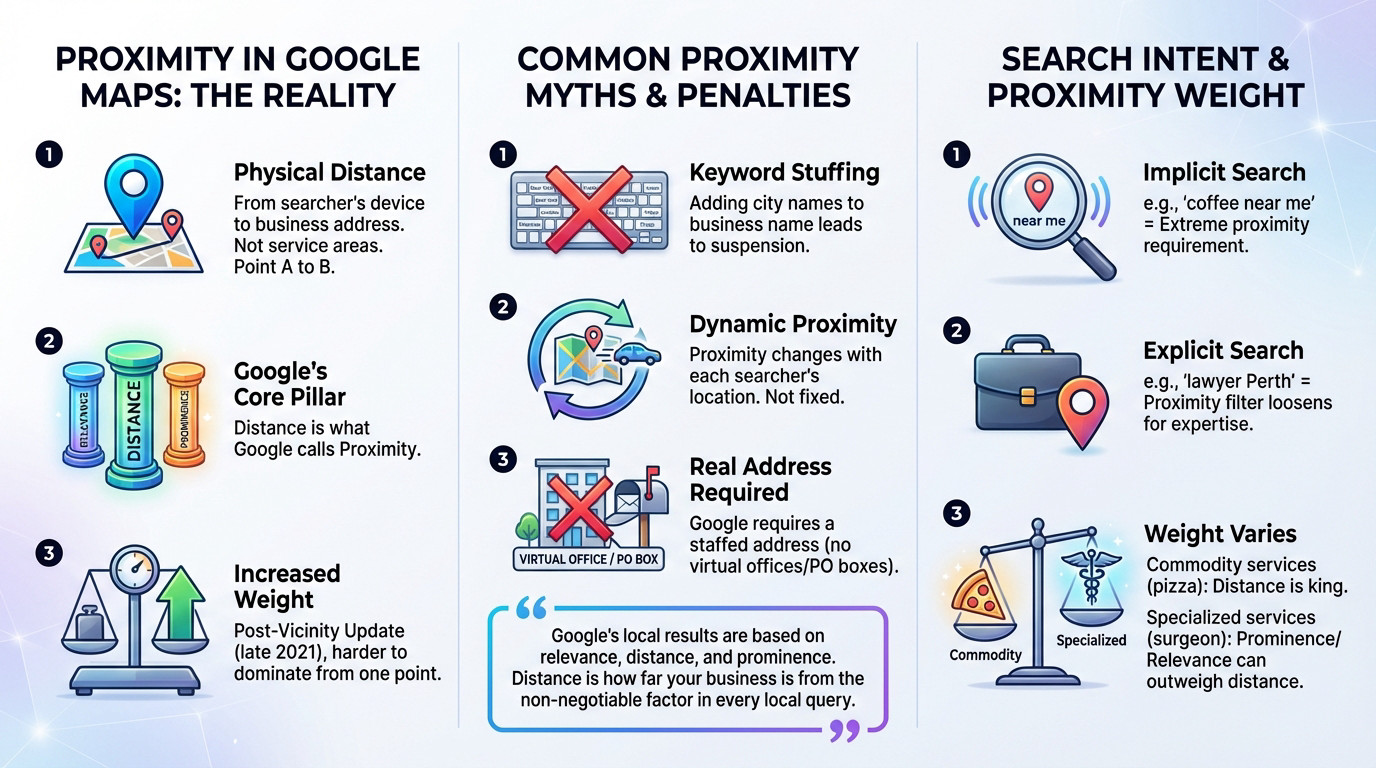
Proximity is the physical distance between the searcher (or Google’s best guess at where they are) and your verified business address. Point A to point B. Not your service area radius. Not the suburbs you list in your bio. The actual GPS coordinates Google has on file for your profile.
Google is direct about how it ranks local results. In its own help documentation, Google says local rankings come down to three things:
“Relevance is how well a Business Profile matches what someone is searching for.”
“Distance refers to how far each business is from the customer who’s searching.”
“Prominence means how well-known a business is. Prominent places are more likely to show up in search results.”
Distance is what we mean by proximity. It’s the only one of the three you can’t directly influence, because the searcher decides where they’re standing when they type their query.
So proximity is fluid. A Subiaco dentist might rank first when a patient searches from Hay Street, slip to fifth from Leederville, and vanish by the time the search happens in Mount Hawthorn. Same business. Same profile. Same reviews. Different searcher location.
Most of what gets written about Google Maps proximity ranking gets stuck on the wrong question. The popular debate is whether proximity is 15% of the algorithm, 55%, or 70%. The honest answer is that nobody outside Google knows. The useful answer is that the percentage doesn’t change what you should do.
Writing “Perth” into your business name three times won’t move your GPS coordinates either. What it does is flag the profile under Google’s naming policy, which is a fast track to suspension.
How Google Determines Distance and the Searcher’s Location
Most guides skip past this and say “Google uses your location.” That’s half the story. The interesting half is how Google decides where the searcher is when no one shares an explicit address.
On mobile, Google leans on the device GPS signal. The famous blue dot. It’s the most precise data Google can get, and it powers the bulk of “near me” search behaviour.
When GPS is unavailable or the user hasn’t granted location permission, Google falls back on what it already knows: the IP address, recent search history, saved Home and Work locations in the Google account, and patterns of past activity. Reasonable inference, not precise positioning, but enough to drive a proximity calculation.
Then there’s the query itself. Explicit-location queries like “plumber in Joondalup” override the searcher’s actual GPS. Google treats the named suburb as the target centroid and ranks businesses by their distance from that point. Queries like “coffee near me” do the opposite. They lock proximity to the searcher’s current device location and weight distance heavily.
Two real searcher behaviours create the visibility gaps owners notice:
- The same query from different parts of a city returns different local pack results. Proximity is doing its job.
- A staff member testing rankings from the office gets a flattering result. A customer two suburbs over gets a different one. The screenshot from your own desk is not the truth.
A single ranking check from your office means nothing. You need to see the picture across the area you actually serve. We’ll come back to that in the geo-grid section.
The Vicinity Update: Why Proximity Got Heavier in Late 2021
If you’ve run a Google Business Profile since 2021, your rankings probably look different from how they did in early that year. There’s a reason.
In late 2021, Google rolled out an unannounced local search update that the industry quickly named the Vicinity update. Sterling Sky, Joy Hawkins’ agency in Canada, documented it most thoroughly. The update ran from 30 November to 8 December 2021, with the biggest visible ranking swing on 6 December.
Two things changed:
- Proximity got heavier. Businesses with strong rankings well outside their immediate area shrank back toward their physical address.
- Keyword-stuffed business names lost their dominance. Firms with names like “Best Dog Bite Lawyer Sydney” suddenly stopped ranking across the whole metro for “dog bite lawyer” queries.
Joy Hawkins called it “the biggest change I have seen to the local SERPs since the Hawk update in 2017.” The naming was coined by Sterling Sky’s Colan Nielsen and Dave DiGregorio. Google never officially confirmed or named the update, but the ranking signature was unmistakable across thousands of tracked profiles.
A small correction in March 2022 softened some of the effects, but the broader direction held. If you noticed your map pack getting more zoomed-in, with smaller and more local businesses surfacing, that’s the Vicinity logic still in play.
The practical takeaway: a business with a brilliant brand and weak proximity will still lose visibility in suburbs far from its physical address. That isn’t a punishment. It’s Google trying to make local results feel more local.
The Proximity Curve: How Visibility Decays With Distance
The proximity curve is the pattern your visibility follows the moment a searcher steps away from your address. In dense urban areas the curve drops fast. In rural areas, it’s flatter.
A dentist on Hay Street in the Perth CBD might rank top three within 500 metres and be gone by 2 kilometres, because there are 30 other dentists in that radius. A dentist in a rural shire town can rank across 40 kilometres, because there are only two other dentists in the postcode.
The curve is shaped by competitive density, not by some fixed Google rule. The more businesses Google has to choose from in a given area, the tighter the curve becomes around each one’s address.
Think in ranking zones, not single positions
A useful mental model from Phil Rozek of Local Visibility System: instead of asking “where do I rank for this keyword”, think in concentric rings or zones around your business. Different terms rank in different zones, and the goal isn’t to dominate the entire map.
- Inner ring (typically the first few kilometres): where you have a realistic shot at top-three for your most competitive terms. For dense urban Perth, this might be 1-3 km. For a rural Western Australian town, it might be 30 km or further.
- Middle ring: where you can still rank, but on softer, more specific terms (“emergency plumber Subiaco” rather than “plumber Perth”), or in the localised organic results below the map pack rather than in the 3-pack itself.
- Outer ring: where map-pack visibility evaporates and you have to win on organic, city-specific landing pages and content.
The practical implication is the one most owners resist: you cannot rank #1 across your whole service area for your biggest term. Setting that as the goal burns budget and time. Setting zone-specific goals is what actually moves the leads needle. Same idea is behind the “11×11 grid with 0.5-mile spacing” that most rank-tracking software defaults to, it’s about visualising how visibility decays across about a 5-6 km diameter circle, not whether you crack a single arbitrary keyword.
You can’t see this from a single rank check. You have to scan the area, and the standard way to do that is with a geo-grid tool.
Geo-grid tools like Local Falcon, BrightLocal, and the Whitespark Map Tracker simulate Google searches from a grid of GPS points around your business and produce a heatmap. Common grid sizes are 5x5 (25 data points), 7x7 (49 points), and 9x9 (81 points). Dark green points show top-three rankings. Yellow and orange show middle of the pack. Red means you’re nowhere.
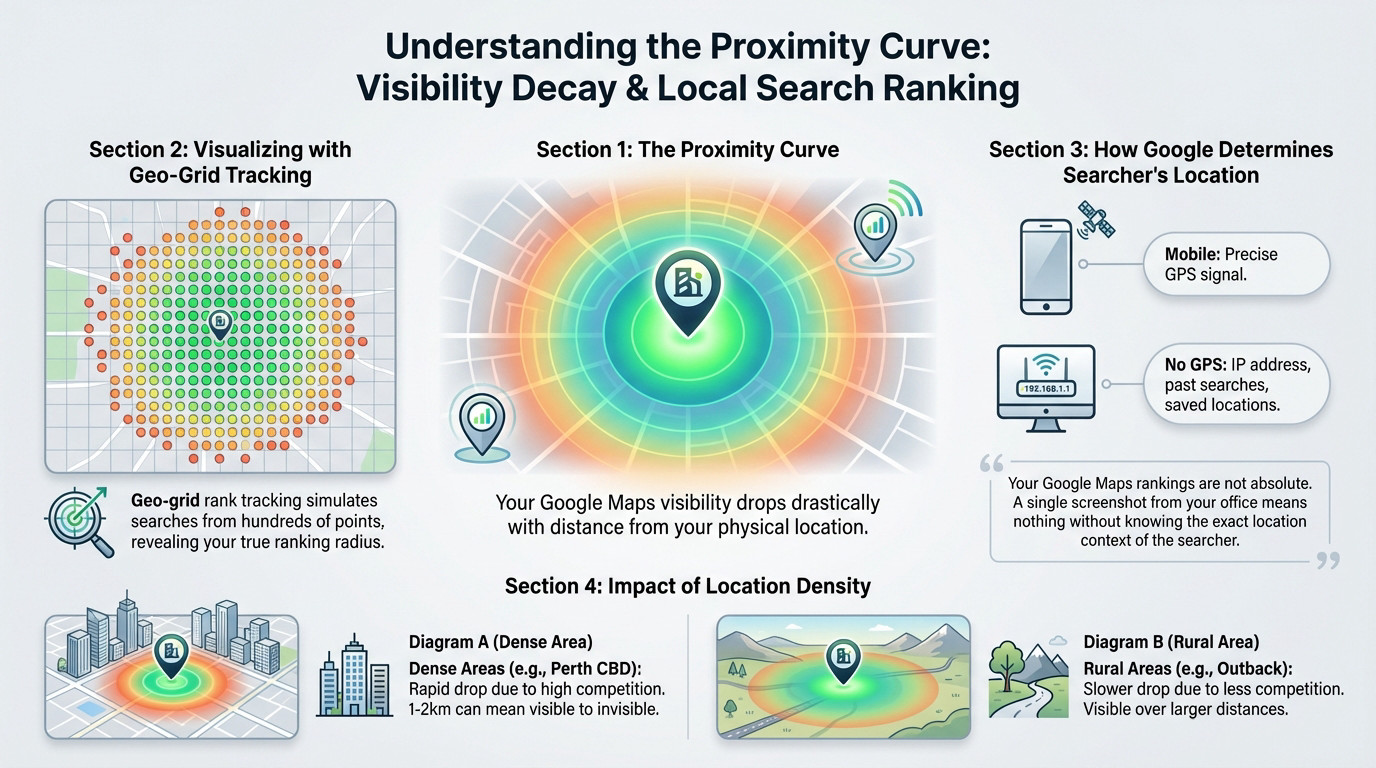
A geo-grid scan from a real client account is usually a humbling moment. The first time most business owners see one, they understand why their conversion numbers don’t match their “I rank #1 from my desk” assumption.
If you want to go deeper on the tools and the methodology, we’ve got a longer breakdown of geo-grid rank tracking and a comparison of geo-grid local ranking tools.
Myths That Get Businesses Suspended
A surprising amount of the bad advice in this space isn’t just useless. It’s the kind of thing that ends with a suspended Google Business Profile and three months of lost leads.
I run a lot of Google Business Profile reinstatements, and the same patterns show up over and over. Mostly they come from business owners who tried to outsmart proximity.
Most of the owners I help didn’t set out to cheat. Someone in a Facebook group told them adding their suburb to the business name would help. An agency offered to set up a “second location” at a co-working desk. The advice sounded plausible at the time. The suspension doesn’t care about intent.
Stuffing the business name with location or service keywords. “Joe’s Plumbing Perth”, “Sydney CBD Dental Clinic”, “Best Migration Lawyer Brisbane”. The most common naming policy violation we see, and the easiest one for Google to detect.
Virtual offices and unstaffed co-working memberships. A Regus desk you visit once a quarter isn’t a business location under Google’s guidelines. The address has to be a real place where you serve customers during your stated hours, with permanent signage. A piece of paper taped to a door doesn’t qualify.
PO Boxes and mail forwarding addresses. Never eligible. Not for storefront. Not for SAB.
Lead-gen addresses borrowed from a friend’s business. Fast track to suspension, and a hard reinstatement to win, because the address verification chain breaks the moment Google checks.
The underlying problem is the same in every case. Google calculates your rank from the verified GPS coordinates you provided. Lying about those coordinates doesn’t move your business in real life. It just creates a paper trail Google’s verification systems can audit and act on.
When a profile gets suspended, the right response is a clean appeal with proper Australian evidence: ASIC business name registration, a recent utility bill at the address, an industry licence where applicable, a commercial lease if you have a storefront, and photos of permanent signage. Not a tax invoice. Not a BAS. Those documents don’t address the issue Google flagged.
Save yourself the trouble. Build prominence at your real address.
The 85% You Actually Control: Prominence and Relevance
If proximity is the part you can’t move, prominence and relevance are where the actual work happens. Whitespark publishes the most-cited practitioner survey in this space. Their 2026 Local Search Ranking Factors report puts proximity at roughly half of total ranking weight, with prominence and relevance signals making up the rest.
That number is a practitioner survey, not a Google-confirmed weighting. The actual weight varies by industry. Restaurants depend heavily on review and proximity signals. Home services lean more on proximity. Professional services often see prominence carry more weight than either.
Whatever the exact split, the work is concentrated in a small number of signals you can actually influence:
Reviews. Volume, recency, response rate, and the keywords customers naturally use in their reviews. Reviews are the single most consistent prominence signal across every survey and every industry, and the easiest signal for a business to influence directly without breaking any rules. Sustained review velocity beats a one-off campaign every time.
Citations and the 5 Kings. Consistency of Name, Address, Phone, URL, and Categories (NAPUC) across the AU directory ecosystem. The directories themselves matter less than the consistency. Google uses citations to verify your business identity, not to count link equity.
Local backlinks and digital PR. Mentions and links from local AU publications, industry associations, suppliers, partners, and community organisations. A backlink from a local council site or a state industry body is worth more than ten generic guest posts.
Categories. Your primary category is the single biggest relevance signal. Secondary categories matter, but they should be real. Stuffing 10 unrelated categories doesn’t help, and it creates audit risk.
GBP completeness. Hours, attributes, services, products, photos, posts. Whitespark’s 2026 survey flagged that businesses open at the moment of search rank measurably better than businesses that just closed. Keep your hours accurate.
On-page SEO that matches the profile. Your service pages should describe the same services your GBP lists. Your location pages should reflect the same addresses. When the two systems drift apart, Google trusts the profile less.
For deeper coverage on this, we’ve got a full piece on mastering local SEO prominence that gets into the day-to-day tactics. If you operate as a service area business, how to beat storefronts as a SAB is the matching playbook.
Diagnose Before You Fix: A Decision Framework
Most local SEO budget gets wasted because the owner is fixing the wrong thing. Your ranking pattern tells you what’s actually broken. Read it before you spend.
| Symptom | Likely Cause | Primary Action |
|---|---|---|
| You lose rankings even when the searcher is physically close to your address. | Relevance problem. Wrong primary category, weak on-page content, profile and website out of sync. | Audit your GBP categories and your on-page service content. Make sure both match the query language your buyers actually use. |
| You rank well within 500m and disappear by 2km. | Proximity problem. Your physical location is too far from a meaningful share of demand. | Build serious prominence to compete at distance, or open a legitimate second location closer to the demand. |
| You appear across a wide area but always sit below weaker competitors. | Prominence problem. Reviews thin, links weak, citations inconsistent. | Run a sustained review campaign, fix NAPUC across the AU directory ecosystem, and earn relevant local links. |
This is the diagnosis any local campaign should start with. It’s also what we use on strategy calls to work out where the actual money should go. No point chasing reviews when the problem is the wrong primary category. No point fixing citations when the real issue is that the address is 12 kilometres from the demand.
If you want a deeper view on how these three pillars interact, we cover it in the three pillars of local search.
Edge Cases: SABs, Home-Based, Co-Working, Multi-Location
The basics get you most of the way. The edge cases are where most businesses either lose visibility unnecessarily or get themselves suspended.
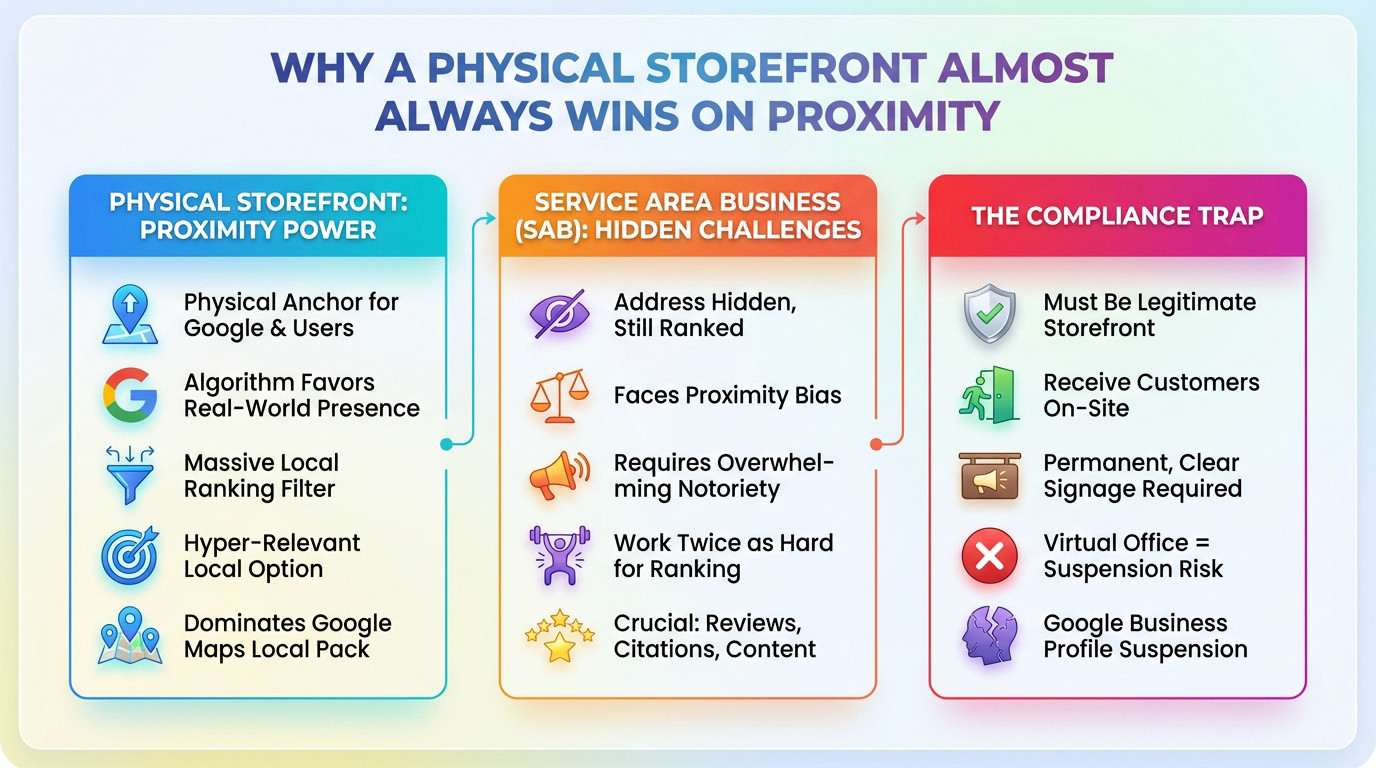
Home-based businesses. If you don’t invite customers to your home, you must operate as a Service Area Business (SAB) and hide your address. Google’s policy is clear and well-enforced. An SAB still has a verified anchor point, and rankings are calculated from that point even though the public profile shows no pin. Hiding the address doesn’t automatically demote you, despite the rumours.
Hybrid businesses. A restaurant that delivers, a retailer that ships, a tradie with a shopfront and a service area. Show the address publicly and define the service area. Google warns against stretching service areas beyond about a two-hour drive from your base.
Co-working and virtual offices. Default position: not eligible. The only exception is a dedicated private office that you rent permanently, where your own staff are present during your stated hours, with your own permanent signage on the door (not the building’s reception). A floating desk in a shared lounge isn’t enough, no matter how clever the workaround sounds.
Multi-location brands. One GBP per real, staffed location. Each one needs proper category alignment, real signage, real hours, and ideally a unique local page on the website that matches. Trying to run six profiles from one office is a documented suspension pattern, and a hard reinstatement to win.
Practitioners in a shared practice. Doctors, lawyers, real estate agents, accountants, and similar public-facing professionals can each have their own profile alongside the main practice profile. A 12-doctor clinic can run 13 profiles legitimately (one for the clinic, one per doctor) if the practitioners are public-facing and named.
For complex multi-location and risk situations, we run GBP risk, compliance and account architecture consulting for businesses that need to scale safely without inviting a mass suspension.
Tracking Your Rankings Across a Whole Service Area
A single rank check is worse than no rank check, because it gives you false confidence. If you want to actually know how you sit across your market, you need a geo-grid view.
The mainstream options are Local Falcon, BrightLocal, and Whitespark Map Tracker. They all work the same way. You drop your business at the centre of a grid, choose a grid size (7x7 is the standard starting point), and the tool runs simulated searches from each grid point.
The output is a colour-coded heatmap. Dark green where you rank top three. Yellow and orange where you rank in the middle. Red where you don’t show up at all.
Read it as a strategic tool, not a vanity tool. The interesting question isn’t “where am I number one in the local pack.” It’s “where do I go from green to red across the area, and what does that tell me about where to invest.” A business that’s dark green near its address and red two suburbs over is in a different position from one that’s yellow everywhere but never green.
The pattern to look for in your first scan isn’t where you rank highest. It’s where the colour shifts. The point where you go from green to yellow is your effective service radius. Everything beyond that is where prominence has to do the work.
Run a scan, save the screenshot, and compare it to where your enquiries actually come from. That comparison is usually more useful than any conversation about ranking tactics.
FAQ
Is proximity the single most important factor for Google Maps rankings? Depends on the query and the industry. For “near me” or convenience searches like petrol stations or coffee, proximity dominates. For specialist or high-stakes searches like a medical malpractice lawyer or a commercial property valuer, prominence and relevance can outweigh distance, which means a strong business several suburbs away can still rank above a closer competitor.
Can I rank in a suburb where my business isn’t physically located? Yes, but it takes serious prominence to overcome the proximity gap. The further you are from the searcher, the more your reviews, links, citations, and content have to do the lifting. It’s possible. It’s not a quick fix.
Will a virtual office help me expand my proximity reach? No, and it carries real suspension risk. Unless you have your own staff present at the address during stated hours, with permanent signage, the address isn’t eligible under Google’s guidelines. Virtual offices and unstaffed co-working desks are one of the most common reasons we see profiles suspended.
Why do my rankings drop off so sharply just a few kilometres away? Competitive density. In a dense metro suburb, Google has dozens of relevant businesses within a few hundred metres of the searcher, so it doesn’t need to look further. In a less dense area, the curve is flatter because there are fewer alternatives. The same business can have a steep curve in Perth CBD and a much flatter one in a regional shire.
Does adding city names to my business name help with proximity? No. Proximity is calculated from your verified GPS coordinates and the searcher’s location. Text in your name doesn’t change either. Worse, adding suburbs or services to the name violates Google’s naming policy and is one of the most common triggers for suspension.
How long does it take to see improvements in Google Maps rankings? For prominence and relevance work, expect noticeable shifts within 60 to 120 days for most local markets, longer in highly competitive metros. The first visible movement is usually on the long-tail queries (specific service plus suburb), with broader category queries following later. Be sceptical of anyone promising faster timelines.
How can I track my Google Maps ranking accurately? Use a geo-grid tool. Local Falcon, BrightLocal, and Whitespark Map Tracker all produce heatmaps of your visibility across a grid of search points. A 7x7 grid is a good starting point. Run a scan monthly and compare across time, not just at a single moment.
What is a good Google rating for a business? A 4.5-plus average with recent reviews is competitive in most AU markets. The exact threshold varies by industry. What matters more than the absolute number is the volume, recency, and response rate. A 4.7 with 200 recent reviews beats a 5.0 with 8 reviews from three years ago.
When To Get Help
If you’ve read this far and the diagnosis maps cleanly onto your business, you probably already know how to improve your local ranking on Google. Run the audit. Fix the prominence gaps. Get the categories right. Sort out the citations. In single-location situations with a basic competitive set, the work is straightforward.
Get help when the problem is bigger than the playbook. Multiple locations. A suspension history. A competitive metro where the basics aren’t enough. A business that’s been told it has a proximity problem but actually has a relevance problem hiding underneath. Or a Google Business Profile that’s been suspended and needs to be reinstated properly the first time.
We run senior-led Google Maps SEO for established Australian businesses, plus advanced GBP risk and compliance consulting for multi-location operators. If you want a practical view on where your visibility actually sits and what to do about it, the easiest next step is a 30-minute strategy call.
No prep required. Bring your GBP and your search market, and we’ll work through it.