
Citation Audit: A Complete Guide to Web Directory Listings for Perth Businesses
How to run a local citation audit: find every listing, fix NAP and duplicate errors in priority, and keep them clean. Practical guide for AU businesses.
As the founder of a Perth SEO agency, I see the same blind spot constantly: business owners chase the big, obvious SEO tasks while a quiet mess of inconsistent listings drags on their local visibility. A citation audit fixes that mess.
A citation audit is the process of finding every online mention of your business and making sure your name, address and phone number (NAP) are consistent everywhere. If you want the background on what citations are and whether they still matter, our companion guide on what local citations are covers it. This guide is the practical part: how to actually run the audit and clean it up.
TL;DR — running a citation audit:
- A citation audit finds every listing of your business and fixes inconsistent name, address and phone details.
- Discover listings via branded search, phone-number search, and a scanner tool; check each against one canonical NAP.
- Fix in priority order: Google Business Profile, then Apple Business Connect and Bing Places, then the core Australian directories.
- Use your real trading name (the one on your signage), not your “Pty Ltd” entity name.
- Citations are foundational, not a strong direct ranking lever in 2026. A clean audit removes confusion and supports trust and AI visibility; it is not a magic ranking switch.
Why citations matter (and how much)
Your listings act as digital anchor points. Google cross-references your NAP across directories, and when the details agree, its confidence that you are a single, legitimate business goes up. When they conflict, that confidence drops, and so does its willingness to show you in the Maps “Local Pack”.
Be honest about the size of the effect, though. Citations used to be a top-tier local ranking factor. They are not anymore. Whitespark’s Local Search Ranking Factors research now places citation building well behind your Google Business Profile, reviews and proximity, and Whitespark itself is clear that consistency still matters even as raw citation-building loses weight. So the goal of an audit is not a ranking jump; it is removing the data conflicts that hold you back and confuse both Google and the AI systems now summarising local results.
There is a trust cost to inconsistency too. BrightLocal research (2018) found around 80% of consumers lose trust in a business when they see incorrect contact details. That figure is dated, but the behaviour has not changed: a wrong number sends a Perth customer straight to your competitor.
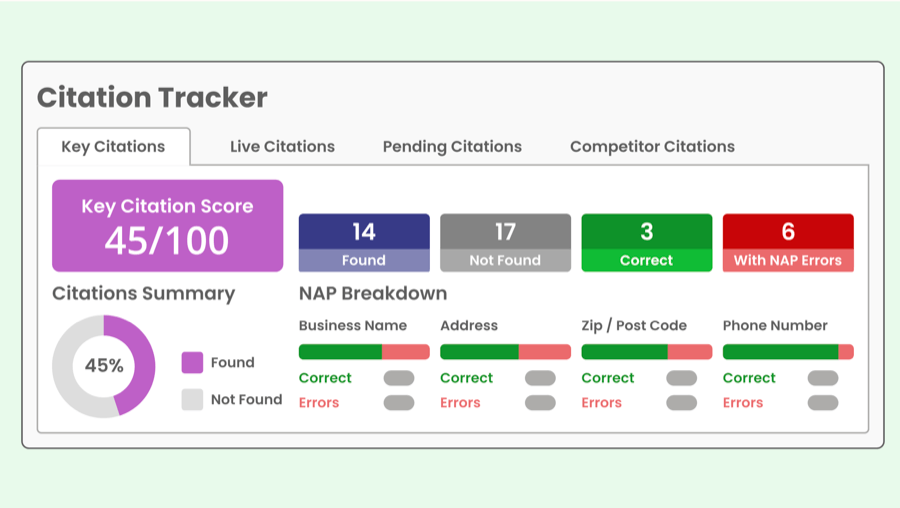
The parts of a citation
NAP is the core, but a complete listing has more. Get these consistent:
| Element | Best practice |
|---|---|
| Business name | Your real-world trading name, the one on your signage. Not your “Pty Ltd” entity name. Use it identically everywhere. |
| Address | One consistent format based on the official Australia Post format. Be consistent with the suburb (“Northbridge”, not sometimes “Perth”). |
| Phone | One number, one format, everywhere. A local landline is fine as your primary. |
| Website URL | The same version every time (for example, https://www.yourdomain.com.au), pointing to your homepage or a sensible landing page. |
| Hours | Kept current, including public holidays, especially on your Google Business Profile. |
How citation problems happen
Most Perth businesses have inconsistencies without realising it. They creep in after a relocation, a phone-number change, or a rebrand, and old details linger on dozens of directories. Worse, low-quality SEO providers sometimes build new listings without cleaning up the old ones, leaving you with several conflicting profiles. Each conflict chips away at Google’s confidence in which version of you is correct.

How to run the audit
A proper audit is a systematic project, not a quick glance at a couple of directories.
Step 1: Set your canonical NAP
Write your correct, current details in one master sheet: the exact trading name, address, phone, website and hours. Also note historical data, previous addresses and old numbers, because those are exactly what you will be hunting down.
Step 2: Discover every listing
- Branded search: search
"Your Business Name" Perthand your business name plus suburb. - Phone-number search: search your number (and any old numbers) in quotes. Numbers are often easier to trace than names and surface listings with mismatched business names.
- Old details: search previous addresses and former business names.
- Scanner tools: run a tool like the free Moz Local listing check or BrightLocal’s Citation Tracker for a fast snapshot, and Whitespark’s Local Citation Finder to see where competitors are listed that you are not.
Record every listing in a spreadsheet: platform, URL, the NAP shown, and whether you have access.
Step 3: Map the inconsistencies
Compare each listing to your canonical NAP and flag every difference, plus any duplicate listings (these split your reviews and confuse Google). Prioritise by authority and visibility:
| Tier 1 (fix first) | Tier 2 (claim once, then leave alone) |
|---|---|
| Google Business Profile | Hotfrog Australia |
| Apple Business Connect | TrueLocal (Thryv-owned, dormant) |
| Bing Places | StartLocal |
| Yellow Pages Australia | White Pages Australia |
| Localsearch | Industry-specific directories |
Step 4: Fix in priority order
Correct the highest-authority listings first: Google Business Profile, then Apple Business Connect and Bing Places, then the core directories. You may need to claim listings and verify ownership, and some platforms take weeks to update publicly. One Australian-specific note: there is no AU equivalent of the US data-aggregator model (Data Axle, Neustar/Localeze) that syndicates a single update across hundreds of directories. What does happen in 2026 is that global location-data sources (Foursquare, Apple Maps, OpenStreetMap, TomTom, Waze) act as de facto aggregators for AU business data into many apps and AI products, so it is worth checking those too. The active AU directories still need to be claimed and corrected one by one. For many locations, a listings management tool can push corrections at scale, but for a single location, careful manual cleanup is usually enough.
Step 5: Validate the foundations
While you are in there, make sure your website backs up your listings. Adding LocalBusiness schema states your NAP in a structured way, and you should validate it so it is error-free. This is the same NAP discipline as our 5-step NAP audit.

Keeping citations clean
An audit is not a one-off. New listings get scraped, staff create profiles, and details change. Keep it clean with a routine:
- Quarterly spot-check of your main platforms.
- A free Google Alert for your business name with old addresses or numbers, so you are notified if an incorrect listing appears.
- A change protocol: when something changes, update your website and Google Business Profile first, then Apple and Bing, then the directories, in that order.
And get the unstructured side too. Mentions of your business in Perth news, local blogs, or community event pages you sponsor are valuable citations that confirm you are genuinely part of the local community. Avoid the opposite trap: blasting hundreds of low-quality directories does nothing useful and can do harm. Quality and consistency beat volume, every time. We cover the pitfalls in 10 local citation mistakes to avoid, and our list of the best Australian citation sites is a sensible target list.
How to know it worked
Do not expect citations to move rankings on their own, so do not measure them that way. Instead, watch your Google Business Profile Performance report after the cleanup: are calls, direction requests and website clicks trending up over the following months? A clean foundation lets your stronger signals (reviews, proximity, an active profile) do their work without Google second-guessing who you are.
Where Search Scope fits
Citation cleanup is tedious, easy to leave half-done, and exactly the kind of foundational work most businesses never finish. We audit and clean it as part of our local SEO work, because there is no point chasing Google Maps rankings on a foundation Google is not sure it can trust. If you suspect your listings are a mess, book a call and we will audit them and tell you exactly what needs fixing first.
FAQ
How often should a Perth business audit its citations?
Do a full audit at least once a year, with quarterly spot-checks on your most important platforms (Google Business Profile, Apple Business Connect, Bing, Yellow Pages). Always update immediately when something changes.
Should I include “Pty Ltd” in my business name on listings?
No. Use your real-world trading name, the one customers see on your signage, consistently everywhere. Keep the registered “Pty Ltd” entity name for invoices and legal documents, not your public listings.
How long until I see results from a cleanup?
Usually a few weeks to a few months, gradually, as platforms update and Google re-crawls. A cleanup is foundational rather than instant; it removes friction so your other local SEO can work, rather than producing an overnight ranking jump.
What’s the difference between structured and unstructured citations?
A structured citation is a listing in a formal directory with defined NAP fields (Yellow Pages, Localsearch, Apple Business Connect). An unstructured citation is a mention of your NAP in an article, blog or social post. Both help; structured listings are the foundation, unstructured mentions build local credibility.
Do I need a citation management service?
It depends on scale. A single-location business can usually do it manually. Multiple locations, or a business that has moved several times, often benefit from a managed service or tool to keep things consistent at scale.