
Australia's National AI Plan: Six Months In, What's Actually Happened
Australia's National AI Plan, six months in: AISI status, AI.gov.au launched May 2026, $70M Accelerator in the Federal Budget, SME adoption at 44%.
On 2 December 2025, the Australian Government released its National AI Plan. Six months on, this update covers what has actually happened, the things that have shifted, and the operational implications for Australian businesses making AI decisions now.
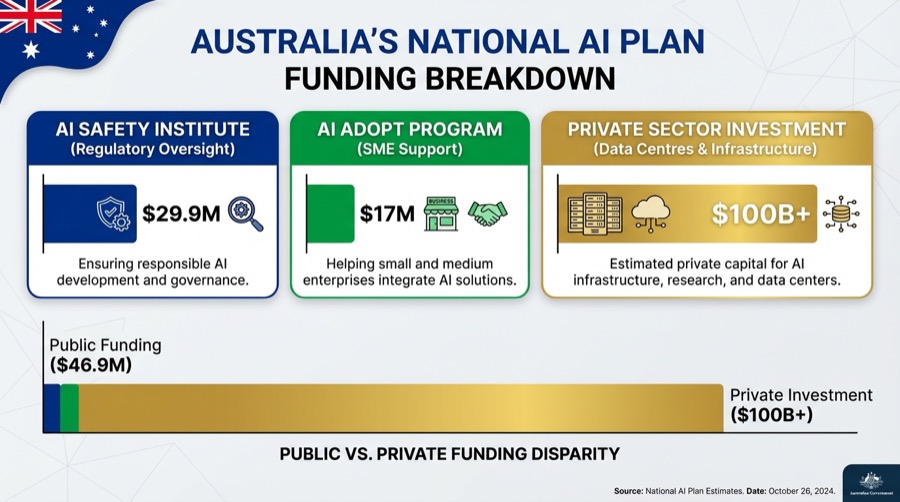
The headline numbers still hold: $29.9M for the AI Safety Institute, $17M for the AI Adopt Program, and a lighter-touch regulatory direction over EU-style comprehensive legislation.
What’s changed is the operational pace:
- The AI Safety Institute is still being established. Recruiting concluded in Q1–Q2 2026, per Privacy108’s February 2026 update.
- AI.gov.au launched on 11 May 2026 as the central guidance hub.
- The May 2026 Federal Budget added a fresh $70M AI Accelerator program delivered through the Cooperative Research Centre programme.
The framing question for Australian businesses six months in is no longer “will AI regulation come?”. It’s “where in the implementation curve are you compared to the Productivity-Commission-influenced light-touch model the government has settled on?”.
Understanding the financial architecture
The numbers tell you where money and attention are flowing, so let’s start there.
The government’s commitment
$29.9 million flows to the new AI Safety Institute (AISI), which is still being established as of May 2026. Recruiting for the founding team concluded in early 2026; the institute is being stood up as a unit within the Department of Industry, Science and Resources.
$17 million supports the AI Adopt Program for SMEs. The first quarterly AI adoption insights from the National AI Centre (covering December 2025 to February 2026) show SME AI adoption sitting at 43% across the quarter, with February 2026 at 44%. The “don’t know how to use AI” cohort remains the largest barrier to adoption, which is exactly what the AI Adopt Program is designed to address.
More than $460 million in existing funding is already committed across research grants, ecosystem development, and capability building. Most has been allocated, so new applicants face genuine competition.
$70 million AI Accelerator program was added in the May 2026 Federal Budget, delivered through the Cooperative Research Centre program. Grants will be awarded across 2026 and 2027.
$1 billion from the National Reconstruction Fund is committed to data centre infrastructure expansion, per Privacy108’s analysis.
The private sector reality
Over $100 billion in private commitments for data centre infrastructure between 2023 and 2025. This dwarfs public investment by orders of magnitude and is where the actual compute capacity gets built. The Productivity Commission has flagged AI as a potential $100B+ economic boost to the Australian economy, which has shaped the government’s lighter-touch regulatory approach.
The plan organises around three strategic pillars: capturing opportunities through infrastructure and investment, spreading benefits via SME adoption and workforce development, and keeping Australians safe through the Safety Institute and regulatory frameworks. Each pillar creates specific opportunities and obligations for different business segments. For the global adoption and investment numbers behind this, see our 2026 AI statistics report.
Government AI investment commitments (AUD, as of May 2026)
The headline-grabbing AISI funding is a fraction of total committed AI spend. The $1B National Reconstruction Fund allocation and existing $460M ecosystem grants are the larger flows. Sources: Department of Industry, Science and Resources, Privacy108 analysis, SmartCompany (Federal Budget 2026).
Excludes the $100B+ in private data centre commitments, which dwarf government investment by orders of magnitude.
Why this matters more than a standard policy announcement
For marketing agencies and professional services firms, this plan introduces vocabulary clients will expect their providers to understand. Government and enterprise procurement processes are already beginning to reference these safety and governance frameworks.
Legal advisors across the country are telling clients that alignment with these standards will increasingly differentiate winning proposals from unsuccessful ones.
The AI Safety Institute carries a mandate to test frontier models, assess risks, and coordinate with international counterparts through the International Network of AI Safety Institutes (Australia signed up in May 2024). When the AISI designates something as high-risk, that assessment will flow through corporate risk registers, insurance requirements, and procurement criteria across both public and private sectors.
For SMEs and operational businesses, the $17 million AI Adopt Program is a tangible pathway through implementation challenges. The May 2026 launch of AI.gov.au consolidated guidance, tools and case studies into a single resource hub, lowering the friction for SMEs that don’t know where to start. The National AI Centre’s first quarterly tracking report (Dec 2025-Feb 2026) found “don’t know how” as the single biggest non-adoption reason among Australian SMEs, ahead of even trust and cost concerns.
The Infrastructure Constraint
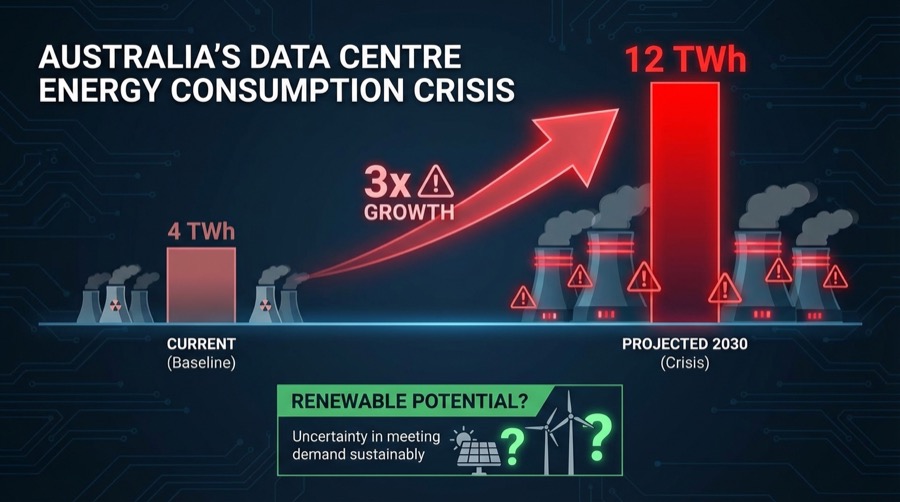
Here’s something that deserves more attention than it’s receiving. The plan explicitly acknowledges that Australia’s data centres currently consume approximately 4 terawatt hours annually, and this figure is expected to triple by 2030. That’s not speculation, that’s based on current investment commitments and growth trajectories.
If you’re running compute-intensive operations, this creates both cost implications and potential regulatory exposure around energy consumption. Companies with strong ESG commitments will face increasing scrutiny about the sustainability of their AI infrastructure choices.
The AI Safety Institute: Australia’s new compliance benchmark
The AISI represents a significant shift in how AI deployment gets evaluated in Australia. As of May 2026, it’s still being established (founding-team recruiting completed in Q1-Q2 2026, full operational launch ongoing).
The original Husic-era proposal was a permanent AI advisory body funded under the 2024 Budget at $21.6M, with mandatory guardrails likely requiring legislation. After 15 months of expert recruiting and a $188,000 process to narrow 270 nominees down to 12, that approach was scrapped in December 2025 in favour of the Ayres-era $29.9M AI Safety Institute model. The new framing: empower every existing agency to take responsibility for AI, rather than create a single new authority.
Core functions
The AISI will:
- Monitor emerging AI technologies and publish expert assessments, creating a reference standard for “responsible AI” in practice
- Support policy development by collaborating across government agencies
- Recommend legislative amendments and coordinate government action on AI-related harms
- Provide guidance to businesses and the public on responsible AI adoption
- Participate in the International Network of AI Safety Institutes, aligning with UK and US frameworks while maintaining local considerations
Early indications suggest the institute will include a Technical Evaluation Division, a Policy and Regulatory Advisory Unit, a Research and Standards Team, and a Partnerships and Engagement Office (Privacy108).
Strategic positioning
Companies that align with AISI standards before they become mandatory will carry a meaningful advantage in procurement and partnership discussions. Safety is shifting from a compliance checkbox to a competitive differentiator.
As legal experts note, consumer trust in AI technologies remains relatively low in Australia.
The NAIC’s first quarterly survey confirmed this. Around 65% of non-adopting Australian SMEs cited distrust in AI decision-making, or a strong preference for human control, as the reason.
The AISI aims to address this trust gap through clear standards and oversight. Businesses that demonstrate alignment with emerging standards will be better positioned when clients and partners conduct vendor due diligence.
Three practical angles worth thinking through now
Model risk management beyond content generation
Marketing and operations teams need to think beyond generative AI tools and consider how automated decision-making systems get governed. If you’re using AI for personalization, customer segmentation, pricing decisions, or workforce management, you need frameworks for managing how those systems operate.
Regulators and sophisticated clients will increasingly ask not just whether you use AI, but how you govern it. The plan’s emphasis on preventing harm creates accountability expectations that extend beyond traditional software oversight.
Contract Review: Data Residency and Audit Rights
Your vendor agreements need scrutiny in two specific areas:
Data Residency: The plan emphasizes sovereign capability goals, which means data leaving Australia creates both compliance risk and procurement disadvantage. If your AI vendors are processing Australian data offshore, you need to understand the implications and potentially seek alternatives or amendments.
Evaluation Rights: Do your contracts include rights to audit or evaluate the AI systems you’re deploying? When clients or regulators ask about your AI governance, “we trust our vendor” won’t satisfy the inquiry. You need contractual mechanisms for verification.
Energy and ESG Alignment
The “4 TWh growing to 12 TWh” statistic represents a genuine constraint on Australia’s AI infrastructure development. The government is pushing for renewable-powered data centres, and companies with ESG commitments need to verify that their AI vendors align with sustainable infrastructure.
This matters for investor relations, government procurement eligibility, and increasingly for corporate reputation. The question “where does your AI compute happen, and how is it powered?” will become standard in sustainability reporting.
Following the Money: Public Framework, Private Infrastructure
The dynamic between public and private investment tells you how this ecosystem will actually develop.
Government Investment: $29.9M (Safety) + $17M (Adoption) + $39.9M (Ecosystem) = regulatory scaffolding and support mechanisms.
Private Investment: $100B+ in infrastructure = where actual capability gets built.
This structure means the government shapes rules and provides adoption support while private capital builds compute capacity and services. If you’re a vendor, you need strategies for both the government support programs and the private infrastructure market.
For businesses adopting AI, this means government resources can help you navigate implementation, but the tools and platforms you’ll use come primarily from commercially-driven infrastructure.
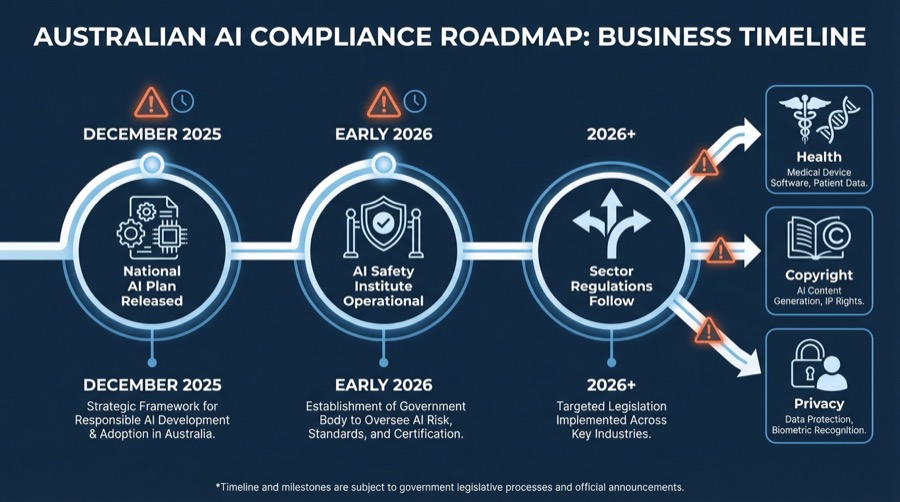
The compliance timeline (updated to May 2026)
December 2025: National AI Plan released. Establishes strategic direction and signals regulatory priorities.
Q1 2026: AISI recruiting concluded; ABC’s February 2026 reporting revealed the Husic-era $21.6M advisory body had been scrapped in favour of the new institute model.
February 2026: First NAIC quarterly SME AI Pulse report published, showing 44% Feb 2026 adoption (43% quarter average), with “don’t know how” as the largest non-adoption reason.
May 2026: AI.gov.au platform launched (11 May) as the central guidance, training and use-case hub. The Federal Budget added the $70M AI Accelerator program delivered through CRC.
Mid-2026 onwards: AISI testing standards, risk assessment frameworks and guidance documentation expected to start flowing. Sector-specific regulations in health, copyright, finance and other domains will likely build on AISI frameworks. The Attorney-General’s Department continues consulting with the Copyright and Artificial Intelligence Reference Group on licensing models for copyrighted material in AI training.
The most strategic approach is still to build compliance frameworks now, before specific regulations crystallise. Companies that wait for finalised rules will spend the back half of 2026 retrofitting systems while early movers operate under established, pre-approved frameworks.
The Western Australia Opportunity
If you’re operating in Western Australia, pay particular attention to infrastructure dynamics.
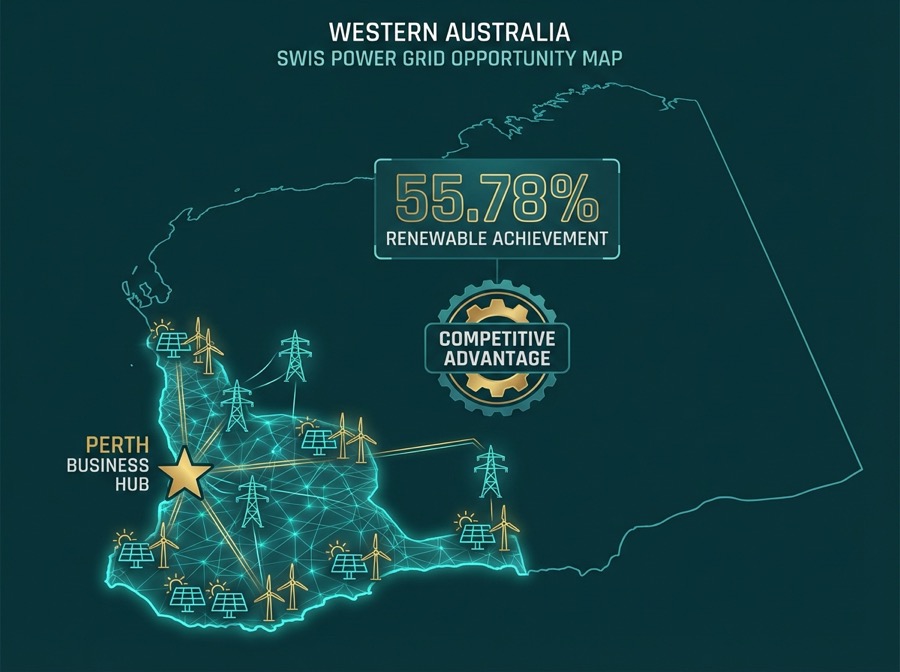
The South West Interconnected System (SWIS) faces different power grid characteristics than eastern Australian networks. WA recently achieved 55.78% renewable energy contribution on the SWIS in November 2025, and significant transmission upgrades are underway.
The plan’s emphasis on renewable-powered data centres creates genuine competitive advantage for Western Australia. While eastern states manage grid congestion and competing demands, WA offers available land, growing renewable capacity, and improving infrastructure.
For Perth-based businesses, particularly in mining, resources, and industrial technology, the AI Adopt Centres targeting these sectors provide resources specifically designed for your operational context. These aren’t generic programs, they’re sector-aligned support.
The renewable energy angle also positions WA favorably for attracting data centre investment, which creates downstream opportunities for businesses serving that infrastructure.
The Regulatory Approach: Evolution, Not Revolution
One of the most significant aspects of this plan is what it doesn’t include. The government explicitly rejected the European Union’s comprehensive AI legislation model.
As legal observers note, Australia will instead strengthen existing technology-neutral laws and issue guidance for responsible practices. This means no economy-wide AI law is arriving soon. Instead, expect incremental amendments to the Privacy Act, Australian Consumer Law, and potentially the Online Safety Act.
Advantages of This Approach:
This evolutionary method supports wider AI adoption by avoiding rigid rules that become obsolete as technology advances. It provides flexibility for innovation while maintaining legal accountability through established frameworks.
Challenges to Consider:
The approach does create uncertainty, particularly around data use, intellectual property for training models, and AI output rights. Companies operating under clear EU regulations at least know their compliance requirements. Australian businesses are managing shifting guidance and sector-specific developments.
For SMEs especially, this uncertainty can encourage delay. Without clear rules, many firms will hesitate to invest in governance frameworks and auditing capabilities. That creates technical debt in safety and ethics that becomes expensive to address later when regulations do arrive.
Foreign Investment: Opportunity With Oversight
The plan describes foreign direct investment as critical for Australia’s AI ambitions. It also outlines the oversight mechanisms that investment will face: Foreign Investment Review Board reviews, the Department of Home Affairs’ Hosting Certification Framework, and potentially ACCC’s mandatory merger clearance regime.
Significant AI infrastructure, compute, cloud, or data-processing investments will trigger scrutiny based on national security considerations, critical infrastructure status, or supply chain sensitivity.
Australia welcomes foreign investment in AI, but substantial capital commitments for AI infrastructure should anticipate thorough vetting processes. The plan doesn’t fully reconcile its enthusiasm for foreign partnership with the practical obstacles those partners encounter during approval processes.
The Copyright Question Affecting Model Development
One area of genuine regulatory uncertainty involves copyright law’s application to training data and AI outputs.
The government ruled out a broad text-and-data-mining exception. This means developers need to work within existing copyright frameworks or wait for new licensing models to emerge from ongoing consultations.
Creative industries, education, media, and technology sectors are watching this closely. The outcomes will determine legal parameters for using datasets in training, how licensing fees get structured, and what rights attach to AI-generated content. This affects anyone building AI products or using AI for content creation at scale.
Liability Frameworks: The Unresolved Question
Here’s what creates genuine uncertainty for corporate risk management: liability frameworks for AI remain undefined.
When electrical infrastructure expanded a century ago, courts determined responsibility for accidents and failures. The balance they reached between strict liability and negligence created predictable operating conditions for industry.
AI is entering that phase now, but policymakers haven’t yet established how responsibility gets allocated among developers, deployers, and users.
Infrastructure policy analysts point out that this uncertainty makes risk difficult to price. Without clear compliance targets, organizations face inconsistent expectations between domestic guidance and binding international rules.
Practical Implications:
You need to think through liability chains for any AI systems you deploy. If an automated system makes a harmful decision, who bears liability: you as the deployer, your vendor, the model provider, or the training data source?
Getting clear contractual allocations of risk established before incidents occur provides much better protection than trying to establish responsibility after something goes wrong.
Practical Steps to Consider Now
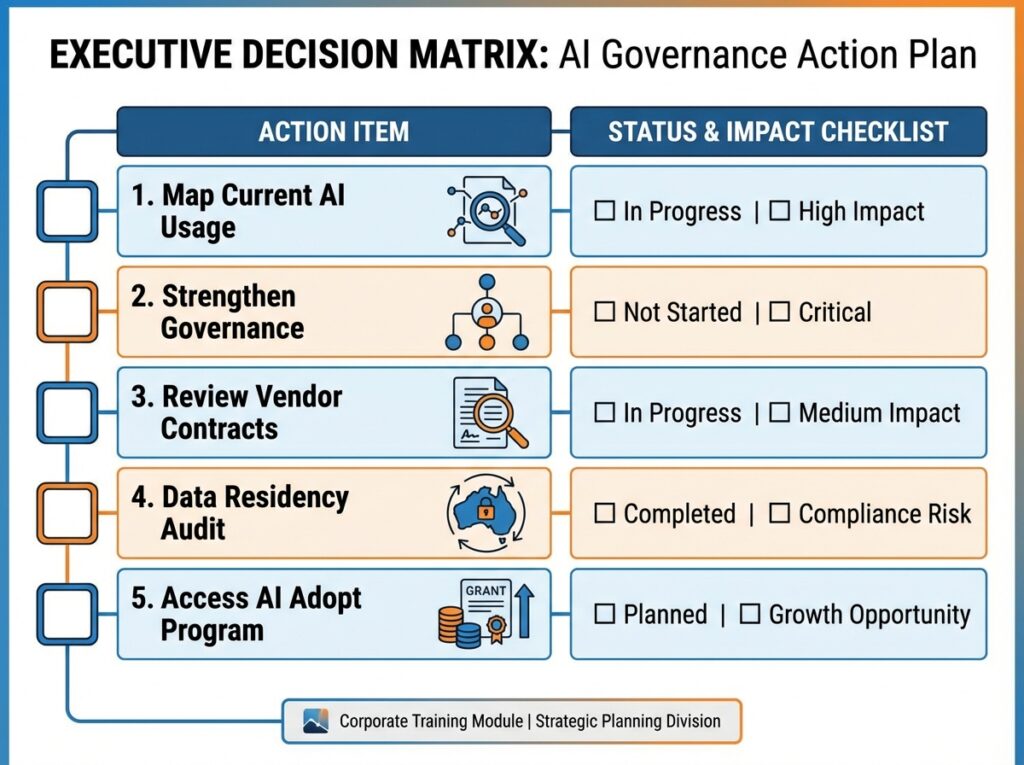
Rather than waiting for regulatory clarity that may take years to fully materialize, consider these strategic actions:
Map Your Current AI Usage
Identify everywhere AI operates in your business: marketing automation, customer service tools, data analysis platforms, operational systems. You can’t govern what you haven’t documented.
Strengthen Governance Structures
Establish clear executive accountability for AI deployment and oversight. When regulators or clients ask who’s responsible for your AI strategy, you need defined roles and documented frameworks.
Review Vendor Contracts
Examine every agreement touching AI for data residency clauses, audit rights, and liability terms. The sovereignty emphasis in this plan means data leaving Australia creates risk exposure.
Engage With Support Programs
If you’re an SME, investigate the AI Adopt Program before it becomes oversubscribed. That $17 million supports businesses working through implementation challenges.
Build Safety Into Your Positioning
For agencies and consultancies, developing capabilities around “responsible AI implementation aligned with emerging AISI standards” creates differentiation in enterprise and government proposals.
These aren’t reactive compliance measures, they’re strategic positioning for an environment where AI governance becomes a competitive factor.
Where this leaves Australian businesses in mid-2026
The National AI Plan doesn’t answer every question about Australia’s AI future, and it wasn’t designed to. The government deliberately chose an incremental, evolutionary approach because technology develops faster than comprehensive legislation can keep pace with.
What’s clearer now than it was in December 2025 is the operational rhythm:
- The AISI is still being established, not yet “operational” in the strict sense. Expect formal guidance documents through the second half of 2026.
- The AI Adopt Program is running, with AI.gov.au as the new front door for SMEs.
- Government procurement is already shifting toward vendors who demonstrate responsible AI practices, particularly at the Commonwealth level.
- The Productivity Commission’s $100B+ economic boost framing is shaping the regulatory direction, not the safety-first framing some had expected.
The businesses that engage this quarter will have structural advantages locked in before others finish “evaluating their options”. The five practical steps below have not changed since December 2025; the urgency has.
For Australian businesses thinking through how to apply this to their own AI implementation work, book a 30-minute call or drop us a line and we’ll come back with a scoped recommendation.