
How Much Does SEO Cost in Australia in 2026? An Honest Pricing Guide
SEO in Australia costs $1,000 to $10,000+ per month in 2026. Perth, Sydney and Melbourne price bands, what drives the cost, and how to budget.

If you have asked three agencies what SEO costs and received three wildly different answers, you are not being scammed. You are seeing an honest reflection of a market where the same two letters can mean a junior on a content mill or a senior operator rebuilding your search presence properly.
This guide gives you the real numbers for Australia in 2026, explains what actually moves the price, and shows you how to work out a budget that returns more than it costs. No dodging the question, and no pretending there is a single right number.
- SEO in Australia typically costs $1,000 to $10,000+ per month for retainers. Local campaigns often start around $595+GST per month. Consultants charge $80 to $250 per hour. One-off projects run $1,000 to $5,000+.
- City matters: single-location local campaigns typically run $800 to $1,500 per month in Perth, $1,000 to $2,000 in Melbourne, $1,200 to $2,500 in Sydney, and $500 to $1,500 in regional towns.
- The price gap is mostly explained by five things: competition, site complexity, campaign scope, content and link velocity, and the seniority of the people doing the work.
- Cheap SEO is the most expensive option once you count cleanup. Penalty recovery and content rewrites usually cost more than doing it properly the first time.
- The right question is not “what is the cheapest quote” but “what return does this need to generate to be worth it.” SEO is a 6 to 12 month investment, not a monthly expense.
- Match the spend to the opportunity. A suburb plumber and a national ecommerce brand should not be paying the same, and neither should be paying for activity that does not move enquiries.
How Much Does SEO Cost in Australia? The Direct Answer
In 2026, most Australian businesses pay between $1,000 and $10,000+ per month for ongoing SEO. Smaller local campaigns frequently start around $595+GST per month. Enterprise and highly competitive national campaigns run $10,000+ per month.
The range is that wide because “SEO” is not one service. It covers technical fixes, content, local keyword research, link acquisition, Google Maps visibility, and reporting, delivered by anyone from an offshore content factory to a senior strategist who has been doing this since before the algorithm cared about your reviews. You are not paying for “SEO.” You are paying for a specific scope of work, delivered at a specific level of skill, against a specific level of competition.
Everything below explains what changes where you land in that range.

The Four Ways SEO Is Priced
Monthly Retainers
This is how most established Australian businesses buy SEO, because search is ongoing work, not a one-time fix. A retainer covers a rolling scope: technical maintenance, content, link building, Google Business Profile work, and reporting.
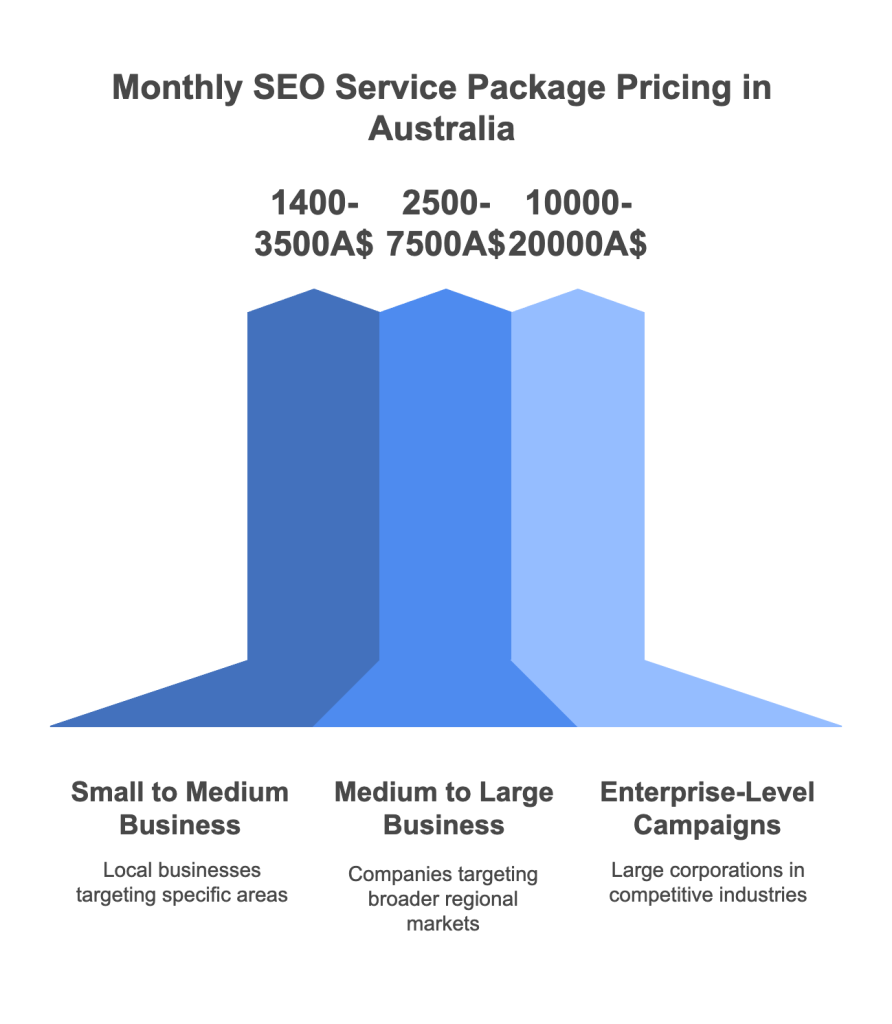
- Local and small business campaigns: roughly $595+GST to $3,500 per month
- Mid-size and competitive regional or national campaigns: roughly $3,000 to $7,500 per month
- Enterprise and aggressive national or ecommerce campaigns: $10,000+ per month
Retainers work because compounding does. The gains in month nine come from foundations laid in month two. The trade-off is that you are committing to a provider before you have proof, which is exactly why provider selection matters more than the headline number.
For a sense of what the lower end of that range buys in practice, we published a local SEO case study on a smaller retainer covering the first three months, including the channel that did not perform as well as the one that did.
Hourly Consulting
Senior consultants in Australia charge roughly $80 to $250 per hour, with specialists at the top of that band and occasional experts billing higher for narrow, high-stakes work. Hourly suits a specific question: a migration risk review, a ranking-drop diagnosis, a second opinion on an existing agency. It does not suit ongoing growth, because good SEO is not billed in tidy hours. For the full picture of what an ongoing Perth engagement covers, see our SEO consultant in Perth page.
Project-Based Work
Defined-scope projects run roughly $1,000 to $5,000+, and larger technical jobs go well beyond that. Common examples:
- A standalone technical audit and fix list
- Site speed and Core Web Vitals work
- A site migration with SEO protection (this is where costs climb fastest, because the downside of getting it wrong is severe)
- A local schema markup implementation
Projects are useful when you have a clear, contained problem. They are not a substitute for ongoing work when the goal is sustained growth.
Hiring In-House
An in-house SEO specialist in Australia typically costs $65,000 to $120,000+ per year in salary, before tools, training, and the cost of them being one person with one skill set. In-house works once you have enough sustained search-driven revenue to keep a specialist fully productive. Below that point, you are paying a full salary for part of a role, and a single person rarely covers technical, content, and links to the same standard.
What Actually Drives the Price
Two businesses can receive quotes that differ by a factor of five for legitimate reasons. Here is what actually moves the number.
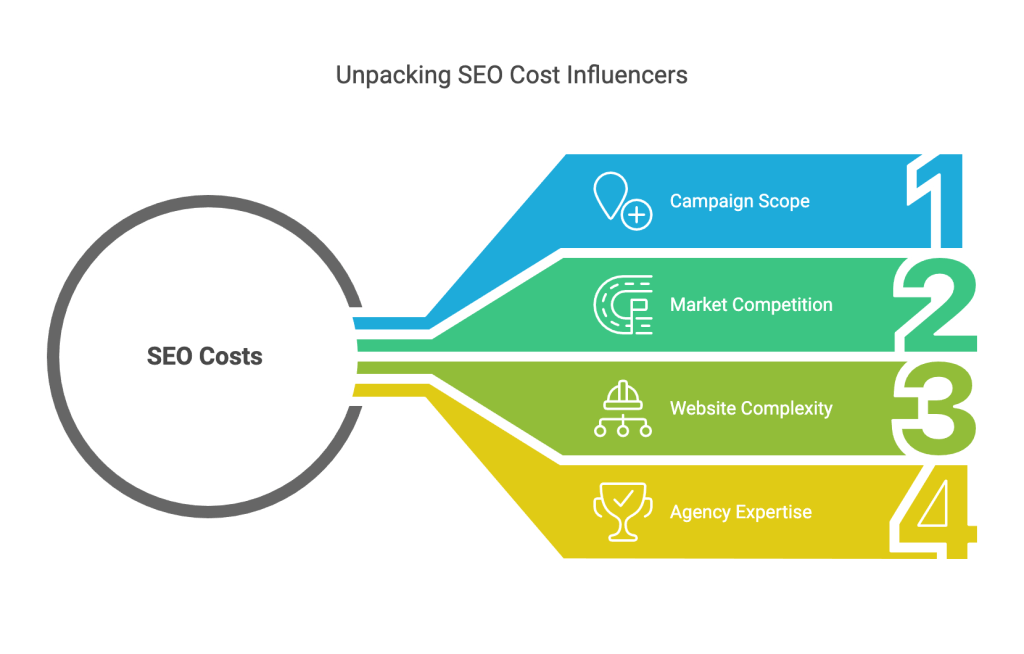
Competition. This is the biggest single factor. Ranking a regional trades business is a different job to ranking a finance, legal, or insurance site where every competitor has a serious budget and a backlink profile built over years. More competition means more content, stronger links, and more time, which costs more.
Site complexity. A clean ten-page service site is cheap to work on. A large ecommerce catalogue with faceted navigation, thousands of URLs, and a tangled history is not. Complexity raises both the initial work and the ongoing maintenance. This is also why ecommerce work usually sits at the higher end.
Campaign scope. Targeting five commercial keywords in one city is a smaller job than targeting dozens of terms across multiple regions with ongoing content. Scope should be set by your commercial goals, not by what looks impressive in a proposal.
Content and link velocity. Quality content and genuine links are the two most resource-heavy parts of SEO. The faster you need to move against entrenched competitors, the more both cost. Slower and steadier is cheaper, and often safer.
Who is actually doing the work. A senior operator costs more per hour and usually costs less per result, because they spend the budget on what moves enquiries instead of on activity that fills a report. Cheap rates almost always mean junior execution or offshore volume, and you pay the difference later.
SEO Cost by Business Size and Market
| Business type | Typical monthly range | What it usually covers |
|---|---|---|
| Local or single-location business | $595+GST – $3,500 | Google Business Profile, local content, citations, a focused keyword set |
| Mid-size or multi-location | $3,000 – $7,500 | Broader content program, technical work, link building, reporting |
| Enterprise or competitive national | $10,000+ | Deep technical work, large content operation, aggressive link acquisition |
Location matters too, enough that it deserves its own section.
How Much Does SEO Cost in Perth, Sydney and Melbourne?
For a single-location local service business, typical retainers run lowest in regional towns, then Perth, then Melbourne, with Sydney the most expensive market in the country. The gap is competition density, not different deliverables: the same scope of work has to beat more entrenched competitors in Sydney than it does in Bunbury.
| Location | Typical local SMB retainer (AUD/month, ex-GST) |
|---|---|
| Perth (local service area) | $800 – $1,500 |
| Melbourne (local service) | $1,000 – $2,000 |
| Sydney (local service) | $1,200 – $2,500 |
| Regional town or low-competition area | $500 – $1,500 |
These bands are modelled from Australian pricing guides and agency rate cards published for 2025 and 2026, for legitimate campaigns covering on-page work, content, local visibility and links, not $299 spam packages.
How much does SEO cost in Perth?
Most Perth businesses pay between $499 and $2,999 per month for SEO, according to published Perth pricing pages, with a single-location local service business typically landing at $800 to $1,500 per month. Competitive verticals and city-wide targeting push it higher.
That matches what we see from the inside. Our own Perth SEO retainer, covering Google Business Profile, suburb-level organic and AI search, starts at $1,999 per month plus GST, month to month, with no lock-in. Smaller single-suburb campaigns start lower; the business-size table above covers those bands.
Sydney and Melbourne pricing
Sydney is consistently the most expensive major market. One Sydney agency reports a client average of $3,710+GST per month across its campaigns, and local-tier retainers for small service businesses commonly quote $1,200 to $2,500 per month. Melbourne usually lands slightly under Sydney: around $1,000 to $2,000 per month for local service businesses, with serious suburb-coverage campaigns closer to $1,500 to $2,500. StudioHawk’s 2026 pricing guide puts entry-level Australian retainers at $500 to $1,000 per month and growth campaigns at $1,500 to $3,000, which lines up with those city bands.
Regional and low-competition areas
Regional campaigns run cheaper because the competition is thinner, not because the work is worse. Budget guides for regional Australia suggest $500 to $2,000 per month for a business focused on a local service area or regional town, and national cost guides put the floor for meaningful work at around $400 per month, with $1,200+ the realistic level once content and links are included.
None of this means cheaper markets get worse results. It means the work should match the opportunity in your market, not a national average.
What a Legitimate SEO Package Should Include
If a quote does not make the scope clear, that is the first red flag. At a minimum, ongoing SEO worth paying for should cover:
- A real technical foundation: crawlability, indexation, site speed, mobile, structured data
- Search intent and keyword research tied to commercial outcomes, not vanity volume
- Content that has a job, written or edited by someone who understands the business
- Google Business Profile optimisation where local visibility matters, because for many businesses Maps is the main issue, not a side issue
- Link acquisition that protects the site long term, not directory spam
- Reporting that ties activity to enquiries and revenue, not just rankings
If a package is mostly “we will publish four blog posts a month,” that is not an SEO strategy. It is content production with an SEO label.
Why Cheap SEO Is the Most Expensive Option
Unusually cheap SEO is not a bargain. It is deferred cost, and the bill is larger when it arrives.
What bargain providers actually do
To deliver SEO at a price that should not be possible, something has to give. Usually it is one or more of these:
- Automated link schemes using low-quality directories or private blog networks
- Spun or unedited AI content published at volume with no editorial judgement
- Keyword stuffing and thin pages built for crawlers, not customers
- Cloaking or other tactics that breach search guidelines
These methods can produce a short-lived bump. They also expose you to manual actions and algorithmic filters that can erase your visibility, and recovery typically costs far more than doing the work properly would have.
The new AI SEO crowd loves talking about scale. Fair enough. Scale without judgement is just a faster way to fill a site with pages Google does not need, and then pay someone to clean it up.
And the new $49 “AI SEO on autopilot” tools
A wave of cheap tools now promises to “do your SEO automatically” for $29 to $49 a month. Be clear on what they actually are.
They are an execution layer, not a strategist. A language model can draft, cluster keywords and take the grunt work off your plate, and we use them every day for exactly that. What it cannot do is the judgement: positioning, knowing which fights are worth picking, or noticing that the page it just produced is one Google does not need.
Left unattended, these tools multiply weak assumptions at speed. Pointed by someone who knows the terrain, they save real time. The experience and the strategy are the part you are paying a professional for, and the part the $49 plan quietly leaves out.
Red flags worth walking away from
- Guaranteed rankings or guaranteed page-one results in a fixed timeframe. Nobody controls Google. Anyone promising otherwise is either inexperienced or not honest.
- No transparency. If they cannot clearly explain what they will do and why, they are hiding either incompetence or risky tactics.
- Long lock-in contracts with vague deliverables. Good operators do not need to trap clients to keep them.
- One agency that does your website, your branding, your ads, and your SEO equally well.
A fifteen-minute background check before you sign
The cheapest insurance against an SEO-cost mistake is fifteen minutes of search before the discovery call. AU operators who got burned consistently say the same thing in hindsight: the warning signs were findable, they just weren’t looked for. The pattern that surfaces on Whirlpool’s business and tech forum is consistent enough that an Australian agency owner wrote the methodology up:
- Search the agency name plus “reviews”, “scam”, “ripoff”, “complaints”, and “whirlpool”. Whirlpool threads in particular often surface specific client horror stories that don’t make it to Google reviews.
- Search the owner’s name plus past company names. Some agencies rebrand when the negative reputation gets unmanageable; checking the principal’s history reveals the through-line.
- Cross-check ProductReview.com.au for complaint patterns. Genuinely terrible operators usually have ProductReview entries; a clean profile there is a positive signal.
- Be wary of generic-sounding positive reviews with no reference to specific work, no named contact at the agency, and no link to a real reviewer profile. Industrial-strength fake review networks are common in this niche.
- Look up the business name on ASIC Connect for free. Confirm the trading name matches the entity you’re contracting with and that the business has been operating long enough to be accountable.
This is not paranoia, it’s the same diligence you would run on a tradesperson quoting tens of thousands of dollars of work on your house. SEO retainers over 12 months easily clear that threshold.
That last one in the red-flag list is worth dwelling on.
Be cautious of “do-it-all” agencies that claim to be masters of code, design, and SEO at once. Web and design studios build good websites. SEO is a different discipline with different fundamentals. It is like asking your accountant to also be your personal trainer and your therapist. You will probably end up with mediocre tax returns, half-baked fitness, and questionable life advice. For search performance, work with people who do this specifically.
Lock-in contracts and pay-on-results: read the model, not just the price
Two pricing models trip up Australian owners more than any headline rate.
Lock-in contracts. SEO does compound over time, so give the work a fair run, but you should never need a long lock-in to get it. A month-to-month arrangement keeps the agency accountable; a 12 or 24-month contract with a punitive exit fee and vague deliverables is a red flag.
The test is simple: can you see what you are getting each month, and can you leave if it stops working? Disputes over digital-marketing contracts are common enough that the Australian Small Business and Family Enterprise Ombudsman runs a low-cost service for exactly them. Read the exit clause before you sign, not after.
Pay-on-results SEO. It sounds like the safe option, and it can be, but read how “results” are defined.
If you only pay when you rank, the incentive is to rank you for whatever is easy: obscure, near-zero-search phrases that hit the target and trigger the invoice, while the keywords that actually make you money go nowhere. If you do consider it, insist on a defined set of terms customers genuinely search, verified in your own Search Console, with no penalty clause. A fair version exists. The common version games the metric.
Is SEO Worth It? How to Think About the Return
“Is SEO worth it” is the wrong question in isolation. The right one is: what does this need to return to be worth it for my business.
Work it backwards. If a new client is worth $3,000 to you and SEO costs $3,000 a month, you need roughly one extra client a month to break even, and everything beyond that is profit. For most established service businesses, that is a low bar once the campaign matures. For a low-margin, low-ticket business in a thin-demand niche, the maths can be harder, and an honest provider will tell you that before you sign.
Two things to hold in mind:
- SEO is a 6 to 12 month investment. Meaningful returns build progressively. Judging it at month two is judging a crop before it has grown.
- Rankings are not the goal. Qualified enquiries and revenue are. Traffic is not the same as demand. A provider who reports ranking screenshots while your phone stays quiet is reporting on the wrong thing.
If your current SEO spend cannot be tied to enquiries, you do not have a pricing problem. You have a strategy problem, and spending more will not fix it.
Already paying for SEO? Run this quick check
Before you argue about price, work out whether the spend is doing anything. Tick what is genuinely true of your current provider.
Is your current SEO actually working?
Tick each one that is genuinely true. The more you leave unticked, the more likely you are paying for activity, not results.
0 of 6 ticked
Red flags
On this little, you may be paying for activity, not results. A second opinion is cheap insurance.
If you ticked two or fewer, a $49 fifteen-minute Loom audit is the fastest way to get an independent read before you renew anything.
DIY vs Consultant vs Agency: An Honest Take
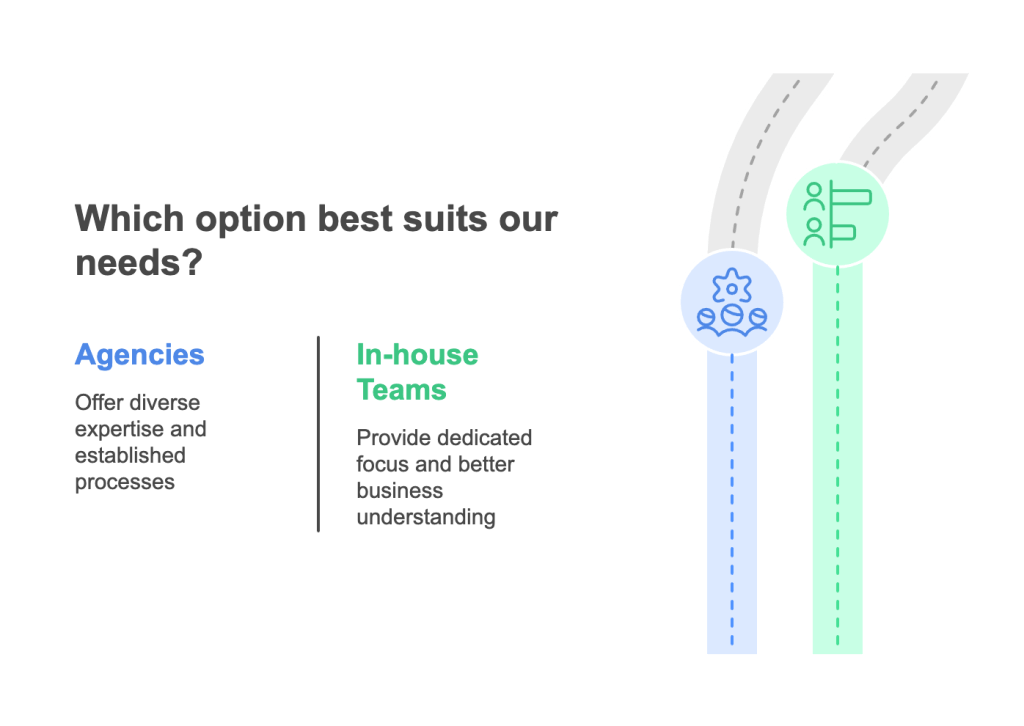
DIY is realistic for the basics: claiming and optimising your Google Business Profile, fixing obvious technical issues, publishing genuinely useful content, and keeping your business information consistent. Many small businesses get real early wins this way. The ceiling is competitive markets and anything technical, where guessing gets expensive.
A consultant suits a specific problem or a business with internal capacity that needs senior direction rather than execution.
An agency or senior operator suits businesses that want the work done properly without building an internal team, particularly where competition is real and the cost of getting it wrong is high.
There is no universally correct answer. There is only the right answer for your competition, your margins, and your capacity.
How to Set Your SEO Budget
Stop starting from “what is the cheapest quote.” Start from these:

- What is a customer worth, and how many more could you handle. This sets the ceiling on a sensible spend and the floor on what the campaign needs to deliver.
- How competitive is your space, honestly. Thin competition needs less. Finance, law, and competitive metro service markets need more. A good provider will tell you which one you are in.
- What is the gap between where you are and where the opportunity is. This is what an audit is for, and it is the cheapest way to find out before committing to a retainer.
- Can the provider tie the budget to outcomes. If they can only tie it to activity, the number is irrelevant because you cannot tell whether it is working.
A useful low-risk first step is a proper diagnosis rather than a retainer. Our SEO audit runs from a $49 fifteen-minute Loom video audit for a senior set of eyes, through a $599 comprehensive 25-point technical audit (the most common starting point for businesses already spending real money on SEO), to a $999 audit plus on-page implementation for businesses without a dev team. All one-off, ex-GST. That tells you what the work actually needs to be before anyone quotes you a monthly figure.
Frequently Asked Questions
How much does SEO cost in Australia per month?
Most businesses pay between $1,000 and $10,000+ per month. Local and small business campaigns commonly start around $595+GST per month. Where you land depends mostly on competition, site complexity, and scope.
How much does SEO cost in Perth per month?
Most Perth businesses pay between $499 and $2,999 per month for SEO, with a single-location local service business typically landing at $800 to $1,500 per month. Our own Perth retainer starts at $1,999 per month plus GST, month to month with no lock-in. Competitive verticals and city-wide targeting sit higher.
Are SEO prices different in Sydney and Melbourne?
Yes, mostly because of competition density rather than different deliverables. Sydney is the most expensive major market, with local campaigns commonly at $1,200 to $2,500 per month and a reported client average of $3,710+GST. Melbourne usually lands slightly under Sydney at $1,000 to $2,000 per month for local service businesses. Perth runs lower again, and regional towns lower still.
How much should you pay for SEO?
Enough to fund the work your competition and goals actually require, and no more than the opportunity justifies. For many established service businesses that is somewhere in the $2,500 to $5,000 per month range, but the honest answer is that it should be set by a diagnosis of your situation, not a generic figure.
Is it worth paying someone for SEO?
Usually yes, when you lack the in-house expertise and want measurable growth without managing the complexity. It is not worth it if the provider cannot connect their work to enquiries, or if your margins and demand cannot support the spend. Both are worth checking before you commit.
Can SEO be combined with Google Ads?
Yes, and they solve different problems. Ads buy immediate visibility while SEO compounds over months. The strongest setups run both, then let organic progressively reduce dependence on paid clicks. If budget forces a choice, decide on how quickly you need leads and how competitive your organic landscape is.
Can I do SEO myself?
You can do the foundations yourself: Google Business Profile, basic technical hygiene, useful content, consistent business information. Many businesses rank well in low-competition areas this way. Technical SEO, link building, and competitive markets are where most DIY efforts stall and professional help pays for itself.
What should you look for in a Perth SEO agency?
Scope transparency, no punitive lock-in, senior people doing the actual work, and reporting that ties activity to enquiries rather than ranking screenshots. Run the ten-minute background check covered earlier before signing: search the agency and owner’s names with terms like reviews and complaints, and confirm the entity on ASIC Connect.
Is SEO dead in 2026?
No. It has changed. AI Overviews and tools like ChatGPT and Perplexity now sit alongside traditional results, and visibility increasingly means being the source those systems trust. The fundamentals that earn that trust, sound technical foundations, content that deserves to rank, and genuine authority, are the same ones that have always mattered. The businesses declaring SEO dead are usually the ones who were never doing it properly.
The Honest Bottom Line
SEO in Australia costs what it costs because the work, the competition, and the skill behind it vary enormously. The cheapest quote is almost never the cheapest option once you account for what it does or does not deliver. The right spend is the one that matches your opportunity and can be tied to enquiries, not activity.
If you want to know where your site actually stands and what it would realistically take to move it, we offer a no-pitch Perth SEO audit that gives you an honest read on what is working, what is not, and what to fix first. If you would rather talk it through, or email seo@searchscope.com.au. No lock-in, no theatre, just a straight answer on whether the maths works for your business.