The Old School SEO Comeback: Why Citations and Press Releases Now Matter for LLM Rankings
Last Updated on 21 January 2026 by Dorian Menard
Essential takeaway: LLMs prioritize verifiable reality over keywords, making consistent citations and press releases critical for validation. This return to foundational SEO transforms accurate business data into the primary trust signal driving AI answers. With minimal overlap between Google rankings and LLM sources, an indisputable entity profile is the only durable competitive moat.
Are you fighting a losing battle for traffic while AI chatbots answer your customers’ questions without ever mentioning your brand name? The most effective counterattack currently involves revisiting old school SEO for LLM rankings, specifically using consistent citations and press releases to feed these models the verifiable data they require to trust you.
We are going to dismantle the hype and give you a raw, actionable playbook for building the specific digital footprint that turns your business into a cited authority in the age of artificial intelligence.
- What Changed: From Ranking Pages to Ranking Entities
- The Renaissance: Why Citations Are Back
- The Renaissance: Why Press Releases Are Back (If Done Right)
- What Actually Helps LLM Visibility: The Signal Stack
- What to Do: A Practical Playbook
- Common Traps and Why Most People Fail
- Measurement: How You Know It’s Working
- The Future: Boring Wins
What Changed: From Ranking Pages to Ranking Entities

The Old Game vs. The New Reality
The old SEO model focused entirely on ranking individual URLs for specific keywords. That era is fading because the new AI-driven search model uses Large Language Models (LLMs) to synthesize information into a single answer. The goal is no longer just to rank, but to be the source of truth for the AI’s answer, which is why old school SEO for LLM rankings is making a comeback.
This shift means a huge loss of traffic from zero-click searches. The game is now about being cited within the AI’s response. This is a fundamental change in how we must approach visibility.
Traditional rankings on Google don’t guarantee a citation by an LLM.
Why LLMs Crave Corroboration
LLMs rely on entity resolution to understand the world. They are trying to understand “things” (entities), not just strings of text. An entity is your business, your brand, your products, or your founders.
They build confidence by finding consistent information about your entity across multiple, disconnected, and authoritative sources. This mechanism is corroboration. If your data is inconsistent across the web, it creates doubt and reduces your chances of being cited.
The AI’s job is to deliver a reliable answer. It will always favor sources that appear verifiable and consistent across the open web.
From Keywords to Verifiable Facts
Keyword stuffing and thin content are dead. LLMs are looking for verifiable facts: your business name, address, phone number (NAP), founding date, key services, and official statements.
LLMs don’t just rank webpages; they build a profile of your entire business entity by cross-referencing every piece of data they can find about you online.
This is why “boring” business data suddenly matters again. Every online mention contributes to this entity profile. This is the core of what some now call Generative Engine Optimization (GEO), shifting the focus from keywords to facts.
The Data Gap Between Google and LLMs
Look at the data from recent analysis. It points out the low overlap between top Google results and sources cited by ChatGPT or Gemini, which is often below 15%.
A different set of signals is clearly at play. Your Google ranking is not a ticket to AI visibility.
The Renaissance: Why Citations Are Back
So, if the game has changed and LLMs are building a profile of your business, how do you feed them the right information? It starts with something SEOs have neglected for years.
Citations Are More Than Just Local SEO
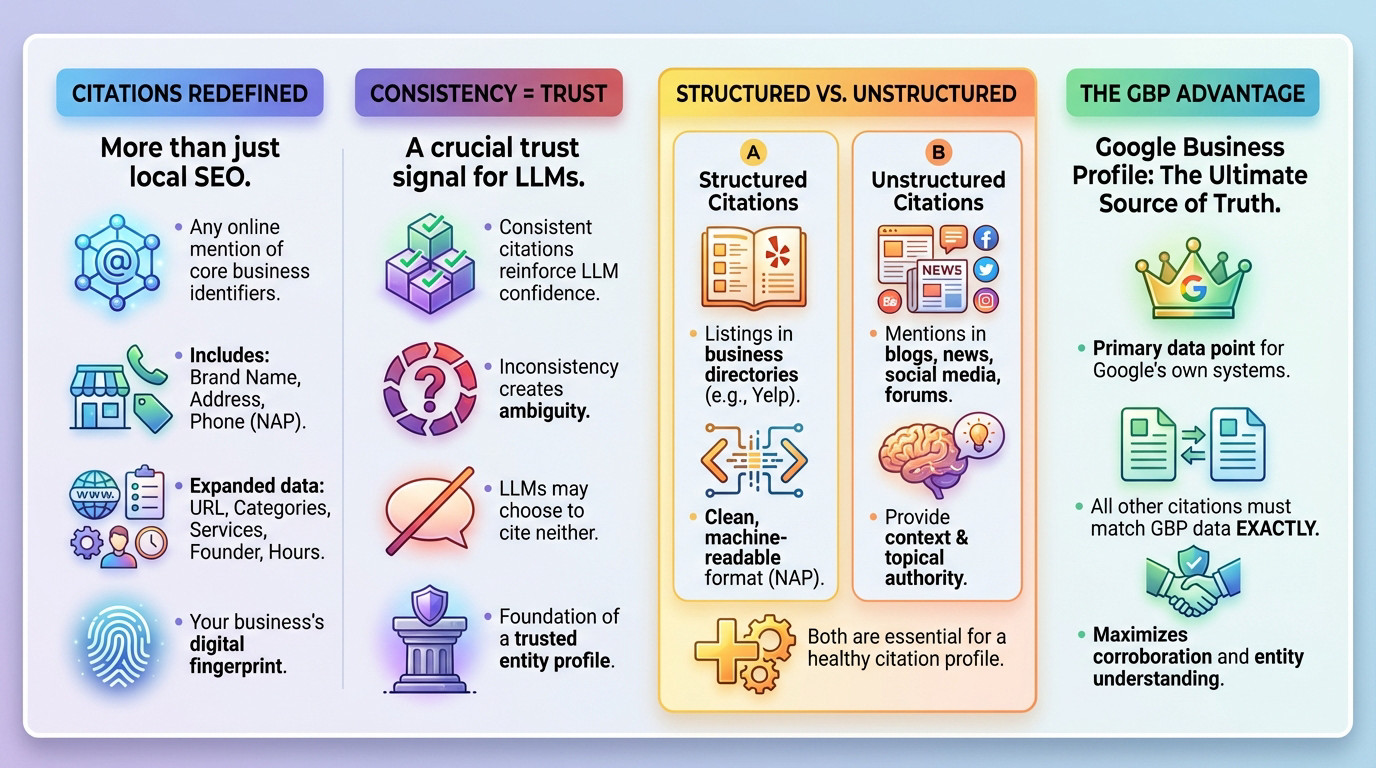
Let’s strip back the jargon. This is old school SEO for LLM rankings in practice. A citation is any digital instance where your core business identifiers appear. Specifically, we are talking about your brand name, address, and phone number (NAP).
But don’t stop there. Your digital fingerprint extends to your website URL, business categories, specific service lists, founder names, and operating hours. These data points define you.
While the principles are rooted in local SEO, their application is now much broader. See exactly What are local citations in SEO? to understand the baseline.
Consistency as a Trust Signal
Here is the logic. Every time an LLM encounters consistent data, its confidence score in your entity rises. It’s essentially like having five independent witnesses confirm the same alibi.
Inconsistency is poison. If Yelp lists your old office while your footer lists the new one, you create ambiguity. The AI cannot determine which reality is true, so it often chooses to cite neither.
Precision is non-negotiable here. It is the absolute bedrock of building a trusted entity profile.
Structured vs. Unstructured Citations
First, you have structured citations. These live in rigid databases like Yelp or Yellow Pages, where your NAP sits in a clean, machine-readable format.
Then, there are unstructured citations. These appear in blog posts, news articles, or forum discussions. They are vital because they provide semantic context and demonstrate co-occurrence with relevant industry topics.
You need both to win. Structured data builds the factual base; unstructured mentions build topical authority.
The Role of Your Google Business Profile
Think of your Google Business Profile (GBP) as the ultimate source of truth for local entities. It is the primary data anchor that Google’s own systems prioritize.
Consequently, every other citation across the web must match your GBP data exactly to maximize corroboration.
The Renaissance: Why Press Releases Are Back (If Done Right)
Citations build your foundational identity, but they are slow and static. To inject fresh, authoritative information into the ecosystem, you need a different tool—one that most of the SEO world wrote off as spam. This is where old school SEO for LLM rankings creates a massive advantage for those paying attention.
Separating Real PR From Syndication Junk
Immediately address the elephant in the room: 99% of press release services are absolute garbage. They just “spray and pray” your release onto worthless sites, creating digital noise, not signal. This is exactly what gives PR a bad name.

A real press release strategy is different: it means distributing genuine news to legitimate distribution channels with the goal of getting picked up by actual journalists or high-authority industry outlets. You aren’t paying for a link.
The goal is earned media coverage, not just syndicated links on domains nobody visits.
Creating a Permanent, Quotable Record
Here is the unique value of a press release for LLMs. When published through a credible newswire, it creates a permanent, time-stamped record of a fact. This fact is now part of the public web archive.
You need “real news” that works: new product launches, strategic partnerships, company milestones, publishing original research, or winning a significant award. These aren’t opinions; they are verifiable data points.
This record acts as a primary source an LLM can cite to verify information about your company’s history and activities.
How Structure and Recency Signal Importance
A well-structured press release is incredibly easy for bots to parse. A clear headline, a summary that answers “so what?”, and distinct sections help an LLM extract the key facts immediately.
Content needs to be “sliceable” for LLMs to digest it effectively. A press release format is naturally “sliceable.” It signals recency and relevance to the AI, telling the system this information is current.
This helps your brand’s content get cited in relevant queries by showing it has fresh, newsworthy information.
The Third-Party Citation Effect
The real power comes when a journalist or a tier-one publication (like TechCrunch or a major industry journal) references your press release. Getting mentioned by a human editor validates your existence.
This creates a high-authority, third-party citation, which is one of the strongest trust signals you can send to an LLM.
What Actually Helps LLM Visibility: The Signal Stack
Okay, so we’ve established that consistent citations and real PR are back on the menu. But they’re just two ingredients. Let’s look at the full recipe—the complete signal stack for LLM visibility.
The Foundational Layer: Consistency and Clarity
You can’t build a reputation if machines can’t verify who you are. Consistent NAP and brand identifiers across every platform act as your digital fingerprint. This is your non-negotiable foundation.
Next, audit your First-Party “About” Clarity. Your site’s ‘About Us’ page must be crystal clear, factual, and detailed. It is your primary declaration of identity to the engines.
Don’t guess; tell them. Implement Structured Data (Schema)—specifically Organization, LocalBusiness, and Person markup—to explicitly label your entity’s facts for scraping bots.
The Authority Layer: External Validation
Self-declaration isn’t enough; you need corroboration. Secure high-authority mentions from reputable news sites, industry publications, and academic sources. A single mention from a trusted source is worth more than a thousand spammy directory listings ever could.
For established players, Wikipedia/Wikidata entries are the gold standard. Having a presence here is a massive signal of notability that feeds the Knowledge Graph. But don’t force it if you aren’t ready.
Finally, Review sentiment at scale matters. LLMs process sentiment, not just stars. Consistently positive feedback on trusted platforms directly builds your perceived authority and trustworthiness.
Comparing Old SEO Signals with New LLM Signals
While the tactics look similar, the engine under the hood has changed. It is about verifiable proof now, not just raw ranking power.
| Signal | Old SEO Interpretation (Ranking Factor) | New LLM Interpretation (Trust & Corroboration Factor) |
|---|---|---|
| Backlinks | High DA/PA links pass “link juice” | A mention from an authoritative source that validates a fact. Context matters more than DA. |
| Keywords | Match the query exactly | Part of a broader topical footprint that proves expertise on a subject. |
| Citations (NAP) | A local ranking factor | A core data point for entity corroboration for ALL businesses (local and national). |
| Content Freshness | A signal that the page is updated | A time-stamped fact (like from a PR) that proves a recent event occurred. |
The Human Layer: Founder and Brand Credibility
Here is the kicker: LLMs build profiles of people, not just companies. The credibility of your founder or key team members matters immensely. Old school SEO for LLM rankings relies on this human element.
Mentions in interviews, author bios, and speaker profiles all contribute to the overall entity trust of the brand. It connects the dots.
What to Do: A Practical Playbook
Theory is great, but you need a plan that generates leads. Here’s a no-fluff, actionable playbook to start building your LLM visibility today, focusing on ROI, not vanity metrics.
Step 1: The Citation Cleanup and Build-out
Start with a baseline audit right now. Use a tool to find all existing citations for your business across the web. Identify all inconsistencies in NAP and other business data. This is the single most important first step you will take.
Next, execute a ruthless duplicate suppression campaign. You must find and remove all duplicate or incorrect listings immediately. This is about cleaning the noise before you build the signal.
Improving your local SEO starts with this foundational cleanup. You simply cannot build real authority or trust on a fractured, messy identity.
Step 2: Strategic Citation Building
Once your foundation is clean, start building new, high-quality citations. This is where old school SEO for LLM rankings begins.
- Tiered Citation Build: Start with the most authoritative national and local directories first.
- Niche Citations: Find directories and websites specific to your industry. citation from a relevant industry association is worth 10 generic ones.
- Location/Service Consistency: Ensure your listed services are consistent everywhere. Don’t offer “plumbing” on one site and “pipe repair” on another. Keep it uniform.
Here are the top citations to secure for your Australian website!
Step 3: The “Real News” PR Cadence
Adopt a quarterly “real news” cadence. Aim for one strong press release per quarter, not a weekly blast of nonsense. You want legitimate pickup, so prioritize quality over quantity.
Before you publish, create a media kit on your website. Include your logo, founder bios, and high-res images. Also, publish supporting assets—like the full data report you’re announcing—on your own site to capture the value.
Target industry-specific outlets and journalists who actually cover your space. You must personalize your pitch to get results.
Step 4: An GSC-based Experimental Framework
Use the Google Search Console API to find very long, conversational queries with impressions but zero clicks. These are often queries from LLMs. Analyze these to understand the exact language AI is using to research your topics, then weave that language into your content.
This is how you start to truly rank in AI chatbots, by using their own language.
Common Traps and Why Most People Fail
This all sounds straightforward, but it’s incredibly easy to get wrong. The internet is filled with vendors selling shortcuts. Here are the traps that will torch your money and your trust signals.
The “Spray and Pray” Fallacy
This is the biggest failure point. Buying a package that promises “500 citations” or “PR distribution to 400 sites” is a waste of money. Most of these sites are worthless and create a spammy, low-quality footprint.
LLMs are not stupid. They can differentiate between a mention on a respected industry blog and a post on a junk PR syndication site. The difference matters.
You are paying for noise. It is not an authoritative signal.
Data Inconsistency and Fake Information
Another common trap is using fake addresses. Virtual office numbers to target multiple locations often backfire. This is a direct path to creating entity confusion. You risk getting penalized.
In the LLM world, this is even more dangerous. It directly contradicts the principle of verifiable reality. It can also lead to a Google Business Profile suspension.
You can Avoid GBP suspension by keeping your data 100% accurate. Consistency is the only safe play.
Confusing Syndication with Coverage
When you buy a cheap PR package, you’re buying syndication. This means your release is auto-published on a network of partner sites. There is no human review.
Coverage happens when a real human sees your news. A journalist or editor decides to write about it. This is earned media. It carries immense weight because it is a third-party endorsement.
Syndication is a weak, self-published signal. Coverage is a strong, authoritative, third-party signal.
Other Mistakes That Destroy Trust
Here are other specific ways to ruin your old school SEO for LLM rankings:
- Spinning Releases: Publishing the same “news” with slightly different wording.
- Irrelevant Citations: Submitting a Perth plumbing business to a directory for New York lawyers.
- Over-optimised Anchor Text: Focusing on exact-match anchor text in PRs instead of natural brand mentions.
Measurement: How You Know It’s Working
In our business, results are the only thing that matters. So how do you measure the ROI of this “boring” work? You can’t just look at rankings anymore. Here are the new KPIs for the LLM era.
Shifting From Rankings to Mentions
The primary metric is no longer your position on a SERP. It’s the frequency and quality of your brand’s appearance in AI-generated answers. This is the reality of old school SEO for LLM rankings today.
Track this by regularly asking AI tools like ChatGPT, Gemini, and Perplexity questions related to your services and location. Document exactly when and how you are mentioned.
This is your new “share of voice” metric.
Leading Indicators of Success
Before you see direct citations, you’ll notice these leading indicators.
- More Consistent Brand Summaries: When you search your brand, does the AI provide a consistent, accurate summary? This means it’s successfully resolving your entity.
- Improved Knowledge Panel: Your Google Knowledge Panel becomes more detailed and accurate as Google corroborates facts.
- Increase in Branded Search: As your brand footprint grows, you’ll see more direct searches for your company name.
- Improved Local Pack Stability: For local businesses, clean citations lead to more stable and prominent rankings in the Google Maps 3-pack.
Lagging Indicators: The Business Outcomes
These are the metrics that actually matter to your bottom line. They show up after the leading indicators are in place.
The key lagging indicator is an increase in qualified leads. This means more contact form submissions and more phone calls from customers who are ready to buy, not just browsing.
Another is an increase in referral mentions. Customers will start saying “I saw you mentioned on…” or “ChatGPT recommended you.”
Tracking Co-citation Patterns
Pay attention to who the LLM mentions alongside you. This is co-citation. Being mentioned with industry leaders reinforces your authority.
Your goal is to be consistently named as one of the top 3 solutions for a given problem in your space.
The Future: Boring Wins
Verifiable Reality is the Ultimate Ranking Factor
My prediction is this: the more AI is used to generate answers, the more “verifiable reality” will matter. The systems have to ground their answers in a set of provable facts to maintain user trust.
The brands that will win are those with the cleanest, most consistent, and most authoritative public footprint. It’s not about who creates the most content.
It’s about who has built the most indisputable entity in the eyes of the machines.
The Mispricing of Foundational Work
For years, the SEO industry chased shiny objects: algorithm hacks, link-building schemes, and content fads. Foundational work like citation cleanup was seen as low-value.
That was a miscalculation. AI has drastically increased the value of these “boring” but essential tasks. The market is just now catching up to this new pricing.
Old school SEO for LLM rankings never died; it was just undervalued.
Your Competitive Moat is Your Public Record
Your content can be copied. Your website design can be cloned. Your ad strategy can be reverse-engineered.
But your history of consistent citations, your earned media coverage from real PR, and your years of positive reviews cannot be easily replicated. This is your competitive moat.
It’s a durable asset that gets stronger over time, unlike a temporary ranking boost from a short-lived tactic.
What This Means for Your Business
The winners will be the brands that invest in building a clean, consistent, and verifiable public footprint, not the ones with the loudest content machine.
It means focusing on your business’s real-world reputation and ensuring it’s accurately reflected online.
Stop chasing the next algorithm hack. The future of visibility belongs to brands that build a verifiable, consistent reality across the web. By mastering these “boring” fundamentals—clean citations and authoritative news—you create an unshakeable entity profile. In the age of AI, truth is your strongest ranking signal.
FAQ
Do citations actually influence how LLMs see my business?
Absolutely. Think of LLMs as rigorous fact-checkers rather than just keyword counters. When an AI sees your business name, address, and core data consistently listed across authoritative sources, it builds a high “confidence score” for your entity. If your data is messy or missing, the AI treats you as a potential hallucination risk and simply ignores you.
I thought press releases were dead for SEO. Why use them now?
The old “spam and pray” method of blasting low-quality releases for backlinks is definitely dead. However, strategic press releases are now a goldmine for LLMs because they create a time-stamped, verifiable record of a specific event. When you publish real news through a reputable wire, you are feeding the AI a primary source it can reference to validate your company’s history and activity.
If I rank #1 on Google, will ChatGPT cite me automatically?
Surprisingly, no. Recent data shows a massive gap between Google’s top results and the sources LLMs prefer to cite—often with less than 15% overlap. Google ranks webpages based on links and keywords, whereas LLMs construct answers based on trust and corroboration. You can dominate the SERPs and still be invisible to the AI if your entity profile lacks that external validation.
What is the first step to fixing my brand’s visibility in AI?
Start with the boring work: a total citation audit. You need to ensure your Name, Address, and Phone number (NAP) are identical across every major directory and platform. Once your foundation is clean, move to “active” signals like publishing a quarterly press release about a genuine company milestone to create fresh data points for the models to ingest.
How do I measure ROI if there are no traditional rankings to track?
You have to shift from tracking positions to tracking “share of voice.” Regularly query the major AI models (ChatGPT, Gemini, Perplexity) about your services in your location to see if you are recommended. On the backend, look for leading indicators like a more detailed Google Knowledge Panel and an increase in direct branded searches, which often signal that your entity authority is growing.

Dorian Menard
https://searchscope.com.auI’m Dorian, founder of Search Scope and an SEO obsessed with ROI and lead generation. After a decade in the trenches, I’ve built and ranked digital assets for businesses across the world. I cut through the noise with data, automation, and strategies that actually convert. When I’m not scaling rankings, you’ll find me on a motorbike or setting chess traps — always planning three moves ahead.