AI Statistics for 2026: Adoption, Jobs, Consumer Use, Trust and Regulation

Last Updated on 21 January 2026 by Dorian Menard
The bottom line: With the global AI market projecting $1 trillion by 2031, superficial adoption is no longer enough. While generative AI grows at a massive 37% annually, true competitive advantage now requires shifting from basic tools to autonomous agents. Businesses must implement responsible scaling strategies immediately to convert this explosive potential into tangible, long-term results.
Are you still relying on vague predictions to guide your tech strategy, or do you have the concrete data needed to make high-stakes decisions?
We have compiled the most definitive AI statistics 2026 to reveal exactly where the industry is heading regarding market adoption, workforce displacement, and the emerging world of regulation.
You are about to uncover the specific data points and generative AI trends that will separate the winners from the unprepared in the coming year.
- AI by the Numbers: Market Size and Headline Stats
- How Businesses Are Deploying AI: From Tools to Agents
- The Impact on Jobs and People: Displacement, Skills, and the AI Divide
- Trust, Regulation, and the Road to Responsible AI
AI by the Numbers: Market Size and Headline Stats
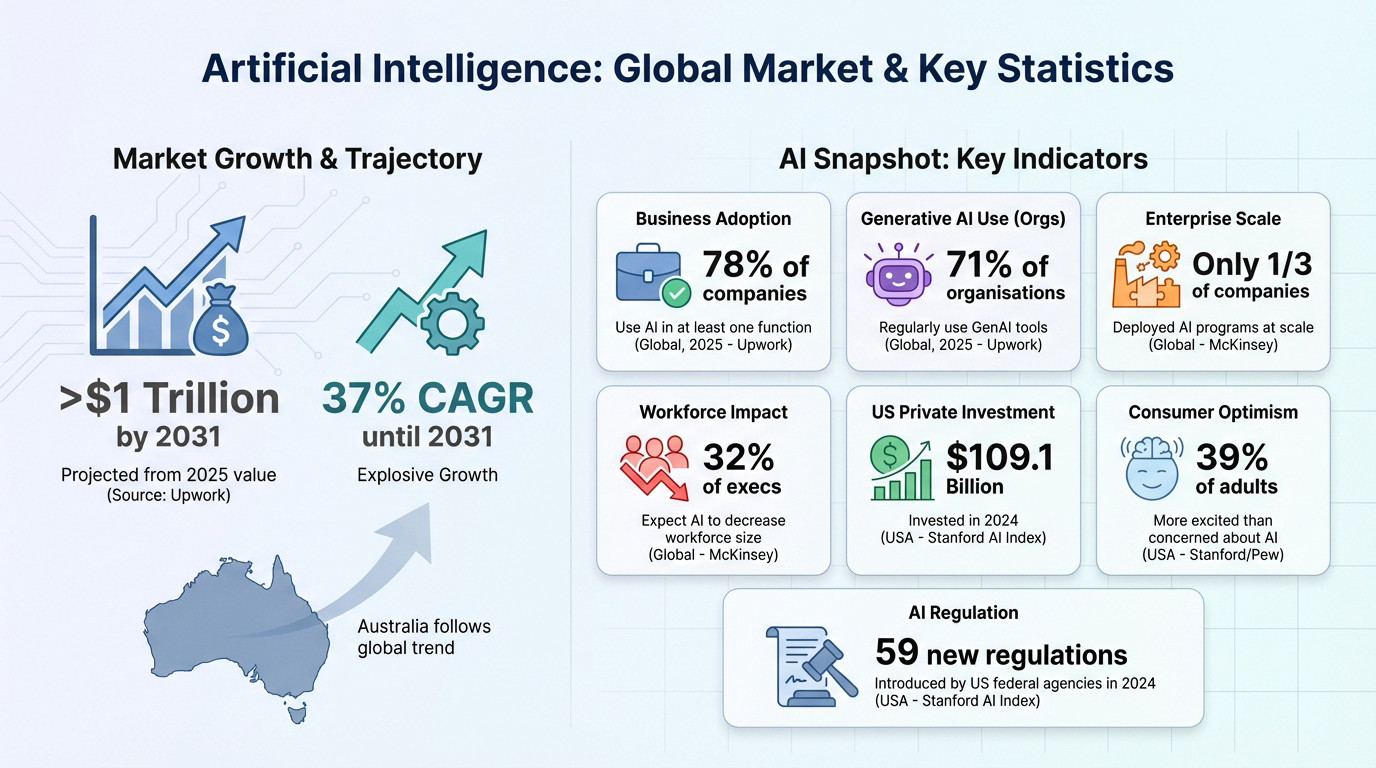
The Global and Australian AI Market Explosion
The global AI market is barreling toward a valuation exceeding $1 trillion by 2031. Starting from its 2025 baseline, this trajectory signals a fundamental economic shift, according to recent market projections highlighted by Upwork.
Generative AI isn’t just hype; it’s driving this surge with a projected CAGR of 37% through 2031. This sustained growth proves we are looking at a long-term industrial evolution.
Australia’s local ecosystem is mirroring this aggressive expansion, setting the stage for significant regional adoption.
AI Snapshot: Key Indicators for 2026
Stop guessing. This table delivers the critical metrics you need right now—covering actual business adoption rates, workforce shifts, and the fluctuating levels of consumer trust.
| Statistic Category | Data Point | Geography | Source |
|---|---|---|---|
| Business Adoption | 78% of companies use AI in at least one business function. | Global (2025) | Upwork |
| Generative AI Use | 71% of organisations regularly use generative AI tools. | Global (2025) | Upwork |
| Enterprise Scale | Only 1/3 of companies have deployed AI programs at scale. | Global | McKinsey |
| Workforce Impact | 32% of execs expect AI to cause a decrease in workforce size. | Global | McKinsey |
| US Private Investment | $109.1 billion invested in 2024. | USA | Stanford AI Index |
| Consumer Optimism | 39% of adults are more excited than concerned about AI. | USA | Stanford/Pew |
| Australian Consumer Use | 36.9% of the population uses AI (H2 2025). | Australia | Microsoft / ADII |
| AI Regulation | 59 new AI-related regulations introduced by US federal agencies in 2024. | USA | Stanford AI Index |
We see a sharp contrast: massive capital investment in the US versus lingering consumer caution detailed in the Stanford AI Index report.
How Businesses Are Deploying AI: From Tools to Agents
The big headline numbers paint a pretty picture, but the devil is in the details. Let’s look at how businesses—in Australia and globally—are moving from playing around to integration that actually generates revenue.
Widespread Adoption, Shallow Deployment
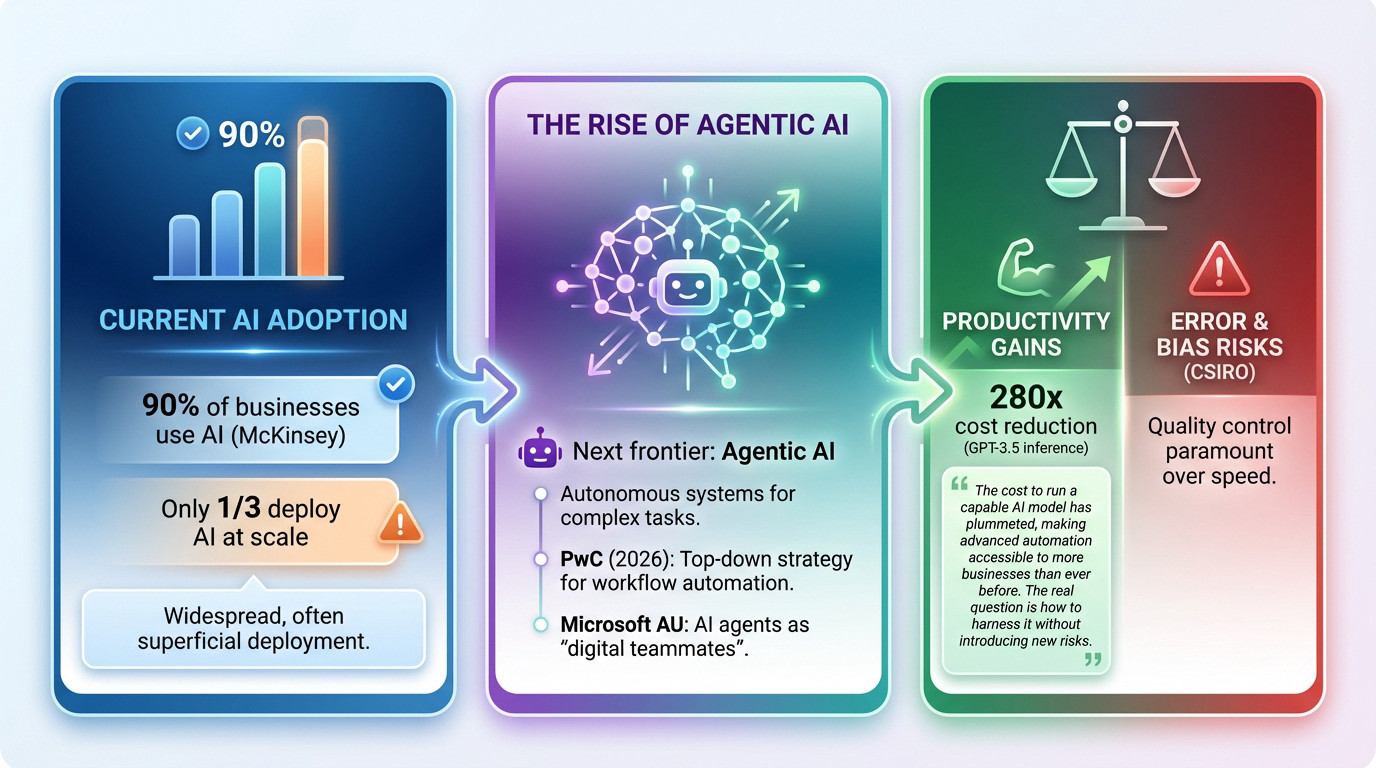
According to The state of AI report, nearly 90% of organizations now use AI. It sounds impressive on paper, but don’t be fooled—usage is broad, yet often incredibly shallow.
Here is the paradox: while adoption is sky-high, only one-third of companies are actually scaling AI. Most are stuck in “pilot purgatory,” lacking the infrastructure to move beyond basic experiments.
Real competitive advantage doesn’t come from signing up for tools; it comes from strategic, deep integration.
The Rise of Agentic AI
Agentic AI is the logical next step. We aren’t just talking about chatbots anymore; these are autonomous systems capable of executing tasks without constant hand-holding.
According to PwC’s AI predictions for 2026, smart companies will shift to a top-down strategy, using agentic AI to automate complex, high-value workflows.
Microsoft Australia reports leaders are already planning for agents as “digital team members.” For business owners, this means you need to start thinking about how to position for AI recommendation right now.
Productivity Gains vs. Error Risks
Everyone wants the productivity boost. Inference costs have dropped massively—about 280x for GPT-3.5 class systems—making it cheap to deploy.
The cost to run a capable AI model has plummeted, making advanced automation accessible to more businesses than ever before. The real question is how to harness it without introducing new risks.
But there is a catch. The CSIRO foundation models report warns that without oversight, these systems introduce significant risks regarding errors and bias.
The race isn’t just about speed; it is about quality control. A sloppy implementation will cost you far more in errors than it saves you in efficiency.
The Impact on Jobs and People: Displacement, Skills, and the AI Divide
This transformation of business processes hits people directly. Beyond the productivity graphs, let’s look at the hard AI statistics 2026 delivers regarding workforce shifts and public adoption.
Job Market Shifts: Creation, Displacement, and New Roles
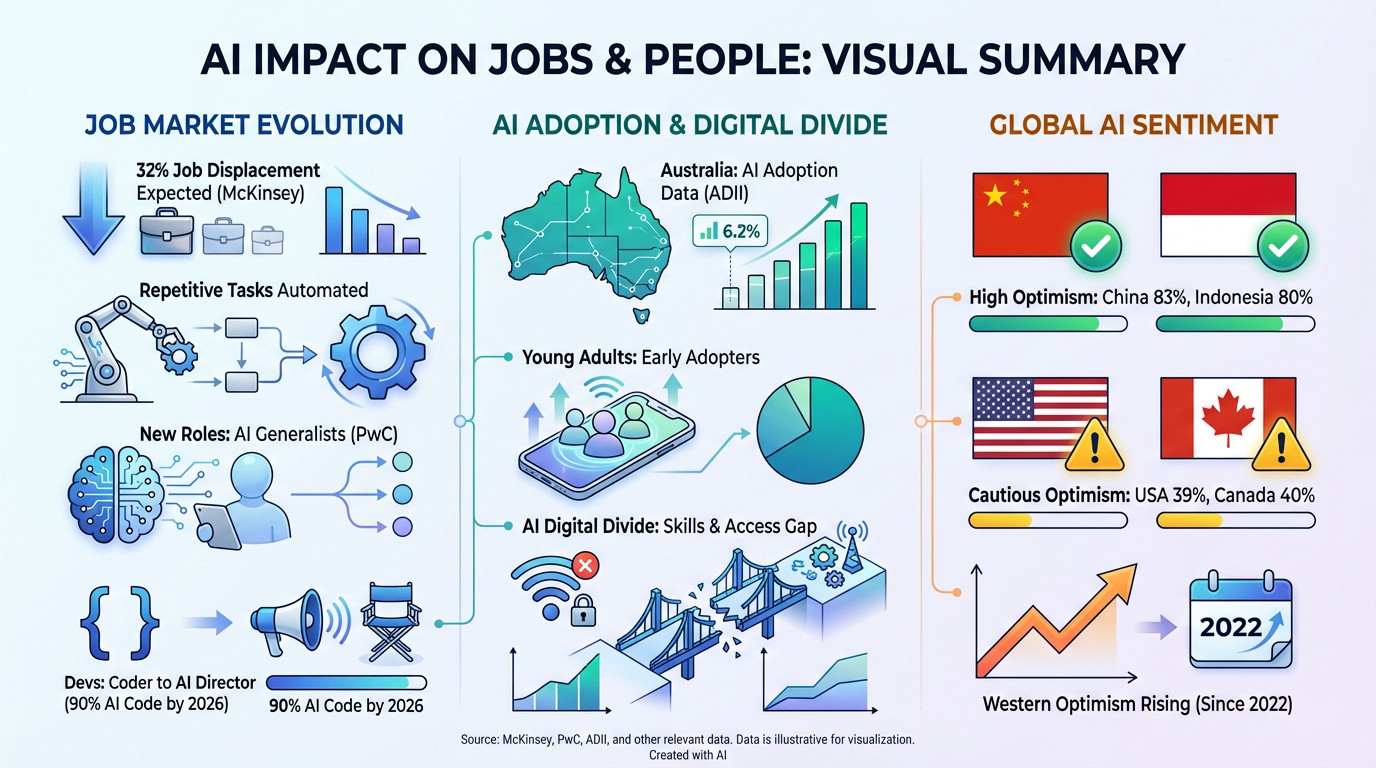
Let’s address the displacement anxiety head-on. McKinsey data indicates that 32% of executives expect headcount reductions, primarily targeting repetitive clerical and support tasks. It is not just a tweak; it is a fundamental restructuring of the payroll.
But the story isn’t just about loss; it is about evolution. PwC points to the rise of “AI Generalists”—professionals who don’t just do the work but orchestrate agents to do it. You stop being a player and start being a coach.
Developers face the most radical change. With nearly half of all code now AI-generated, the role shifts from syntax writer to “AI Director.” See these predictions on the developer role to understand why logic now trumps typing speed.
Australia’s Consumer Adoption and the Digital Divide
Zooming in on the local market, the Australian Digital Inclusion Index (ADII) shows a rapid uptake: nearly half of Australians have recently used a generative AI tool. The appetite for these tools is undeniable.
Compare this to the UK, and the trajectory is similar. Much like search engine usage statistics, young adults are the early adopters, outpacing older demographics by a wide margin. They are native to this shift.
This creates a risky “AI digital divide.” Segments of the population without access or skills aren’t just lagging; they are being locked out of the modern economy.
Global Consumer Attitudes: A Mixed Bag
Trust is not uniform across the map. The Stanford AI Index reveals a sharp contrast in how different cultures perceive these tools.
- High Optimism: China (83%), Indonesia (80%)
- Cautious Optimism: United States (39%), Canada (40%)
- Context: Despite low numbers in the West, optimism has been rising since 2022.
This perception gap dictates speed. You can scale an AI product in Jakarta much faster than in Toronto simply because the market is ready to believe in it.
Trust, Regulation, and the Road to Responsible AI
The Growing Web of AI Regulation
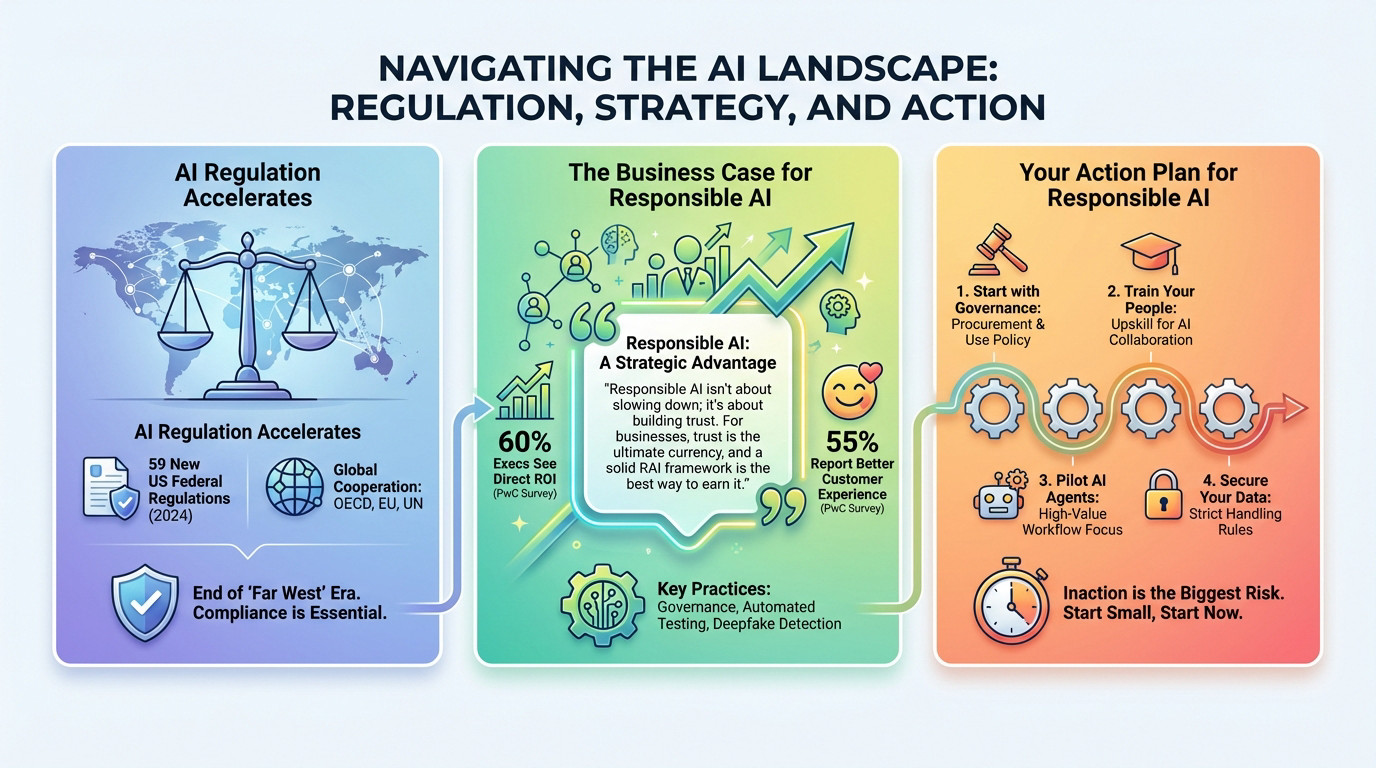
The “wild west” era of unregulated deployment is officially over. According to the Stanford AI Index, federal regulations in the US spiked by over 56% in a single year, with agencies scrambling to set hard boundaries.
This isn’t just an American phenomenon; global cooperation through the OECD and EU is rapidly tightening the net. This shift means businesses now face a complex, international compliance minefield where ignorance is no longer a valid legal defense.
Compliance has shifted from a background check to a survival metric. You either adapt to these rules or you risk being shut down.
The Business Case for Responsible AI (RAI)
Stop viewing Responsible AI (RAI) as a compliance headache; it is actually a massive competitive advantage. Sustainable growth now depends entirely on how safe, ethical, and reliable your systems are.
Responsible AI isn’t about slowing down; it’s about building trust. For businesses, trust is the ultimate currency, and a solid RAI framework is the best way to earn it.
The numbers back this up: PwC reports that 60% of executives see direct ROI from RAI, and 55% cite improved customer experience. The connection to commercial results and lead generation is undeniable—safety drives revenue.
Real RAI requires dirty hands: rigorous governance, automated testing, and proactive deepfake detection. You must manage these risks before they destroy your reputation.
Practical Takeaways for Australian Businesses
We need to move from theory to the trenches. Here is your immediate battle plan to turn these statistics into a defensible business strategy.
- Start with Governance: Establish clear procurement rules and an acceptable use policy for AI tools.
- Train Your People: Don’t just deploy tools; invest in upskilling your team to work alongside AI.
- Pilot AI Agents: Identify one high-value, complex workflow and pilot an agentic AI solution. Measure the outcome.
- Secure Your Data: Define strict data handling rules. Garbage in, garbage out—and data leaks are a business killer.
Sitting on the fence is now your biggest liability. Start small today, because the regulatory gap is closing fast.
The stats paint a clear picture: AI is rewriting the rules of business in Australia. Generative Engine Optimization (GEO) is a must for any Australian business. Ignoring this shift is no longer a safe option. You don’t need to overhaul everything overnight, though. Start with one high-value pilot, secure your data, and move forward. The only wrong move right now is standing still.
FAQ
What is the projected size of the AI market by 2026?
The numbers are staggering. The global AI market is on a trajectory to surpass $1 trillion by 2031, with Generative AI specifically growing at a compound annual growth rate (CAGR) of 37%. This isn’t just a temporary bubble; it represents a fundamental shift in the global economy. By 2026, we expect to see this investment translate from experimental budgets into core operational spending across Australian and global markets.
Will AI actually reduce the number of jobs available?
The data suggests a shift rather than a simple deletion. While 32% of executives do expect AI to cause a decrease in workforce size, this primarily impacts routine and clerical tasks. Conversely, we are seeing the rise of “AI Generalists” and new roles focused on orchestrating these tools. The real threat in 2026 isn’t necessarily AI taking your job—it’s a professional who knows how to leverage AI taking your job.
How many companies have fully adopted AI?
There is a massive gap between “using” AI and “deploying” it. While 78% of companies report using AI in at least one function, only about one-third have deployed these programs at scale. Most businesses are still in the experimentation phase. Real competitive advantage in 2026 will come to the organisations that move past simple chatbots and integrate AI into their deep infrastructure.
What is “Agentic AI” and why is it important?
Agentic AI represents the evolution from “chatting” to “doing.” Unlike standard Large Language Models (LLMs) that generate text, AI agents can autonomously execute complex workflows and tasks. By 2026, we expect businesses to treat these agents as digital team members capable of handling end-to-end processes, rather than just tools for drafting emails.
Is AI regulation increasing in Australia and globally?
Absolutely. The “Wild West” era of unregulated development is over. In 2024 alone, US federal agencies introduced 59 new AI-related regulations, setting a precedent that Australia and other Western markets are following. For businesses, this means that trust and compliance are no longer optional—they are now critical components of a sustainable AI strategy.

Dorian Menard
https://searchscope.com.auI’m Dorian, founder of Search Scope and an SEO obsessed with ROI and lead generation. After a decade in the trenches, I’ve built and ranked digital assets for businesses across the world. I cut through the noise with data, automation, and strategies that actually convert. When I’m not scaling rankings, you’ll find me on a motorbike or setting chess traps — always planning three moves ahead.