Ecommerce link building tactics that drive revenue in 2026

Last Updated on 12 January 2026 by Dorian Menard
The bottom line: Direct outreach for product pages is a losing battle. Real ecommerce growth comes from building “linkable assets”—such as original research or interactive tools—that earn high-authority backlinks naturally. This equity must then be funneled to transactional category pages via internal linking, shifting the focus from vanity metrics to tangible revenue generation.
Are you frustrated by expensive ecommerce link building campaigns that inflate your domain metrics but fail to generate a single dollar in additional revenue for your store? We are rejecting the outdated obsession with quantity to focus entirely on securing high-impact backlinks that directly influence your transactional rankings and drive qualified organic traffic where it matters most.
You will discover exactly how to leverage entity-based SEO, execute precision digital PR, and master internal linking to turn your category pages into high-converting assets that dominate the search results in 2026.
- Why Ecommerce Link Building Is A Different Beast
- The Pre-Work: Building Your Link Strategy On Solid Ground
- What to Link to: The Anatomy of a Link-Worthy Ecommerce Site
- Tactics That Actually Drive Revenue In 2026
- The Art of Outreach That Doesnt Get You Ignored
- Measuring What Matters: From Backlinks To Bank Deposits
- The Minefield: What to Avoid to Keep Your Site Safe
Why Ecommerce Link Building Is A Different Beast
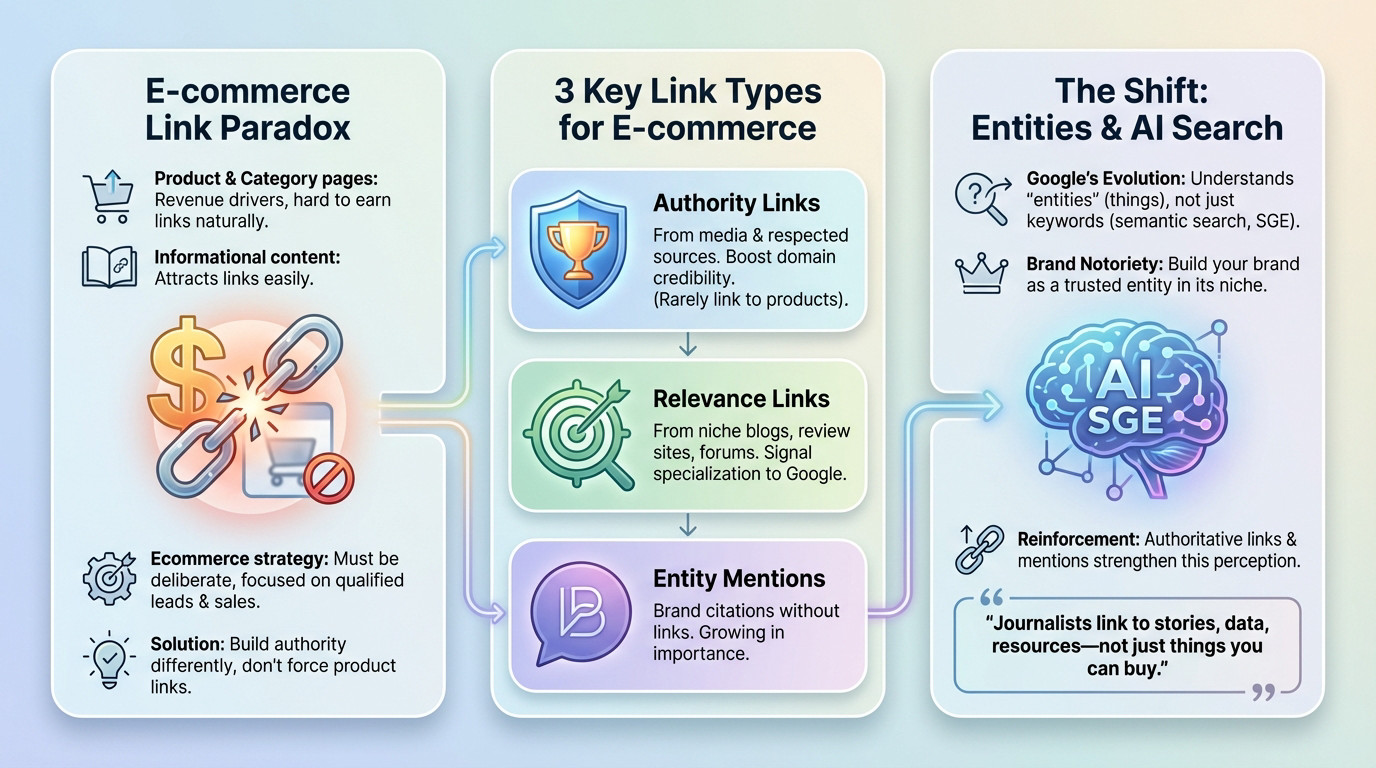
The ‘Money Page’ Paradox
Let’s face it: the pages that generate your revenue—products and categories—are notoriously repulsive to backlinks. Nobody wakes up eager to link to a generic “Men’s Leather Jacket” page naturally.
Compare that to informational content, which attracts citations organically. For ecommerce link building, you can’t rely on luck; you need a deliberate system. The end game is qualified leads and revenue, not a vanity metric of accumulated links.
Stop trying to force unnatural links to product URLs. You build authority differently.
Three Types of Links That Actually Matter for Stores
Forget volume. In 2026, only three specific link categories actually move the needle for online retailers.
First, you need authority links. These come from major media outlets or industry heavyweights. They boost your entire domain’s credibility, though they rarely point directly to a product page.
Next are relevance links from niche blogs and review sites that confirm your specific expertise to Google. Finally, don’t ignore entity mentions… critical trust signals.
The Shift Towards Entities and AI-Driven Search
Google has evolved beyond simple keyword matching to semantic search and SGE. The algorithm now interprets “entities”—real-world concepts, products, and brands—rather than just counting strings of text.
For you, this means link building is actually about brand awareness. You must establish your store as a trusted entity. When authority sources mention you, they validate your legitimacy to the AI, regardless of the anchor text used.
Trying to get journalists to link to your product pages is a losing game. They link to stories, data, and resources—not just things you can buy.
The Pre-Work: Building Your Link Strategy on Solid Ground
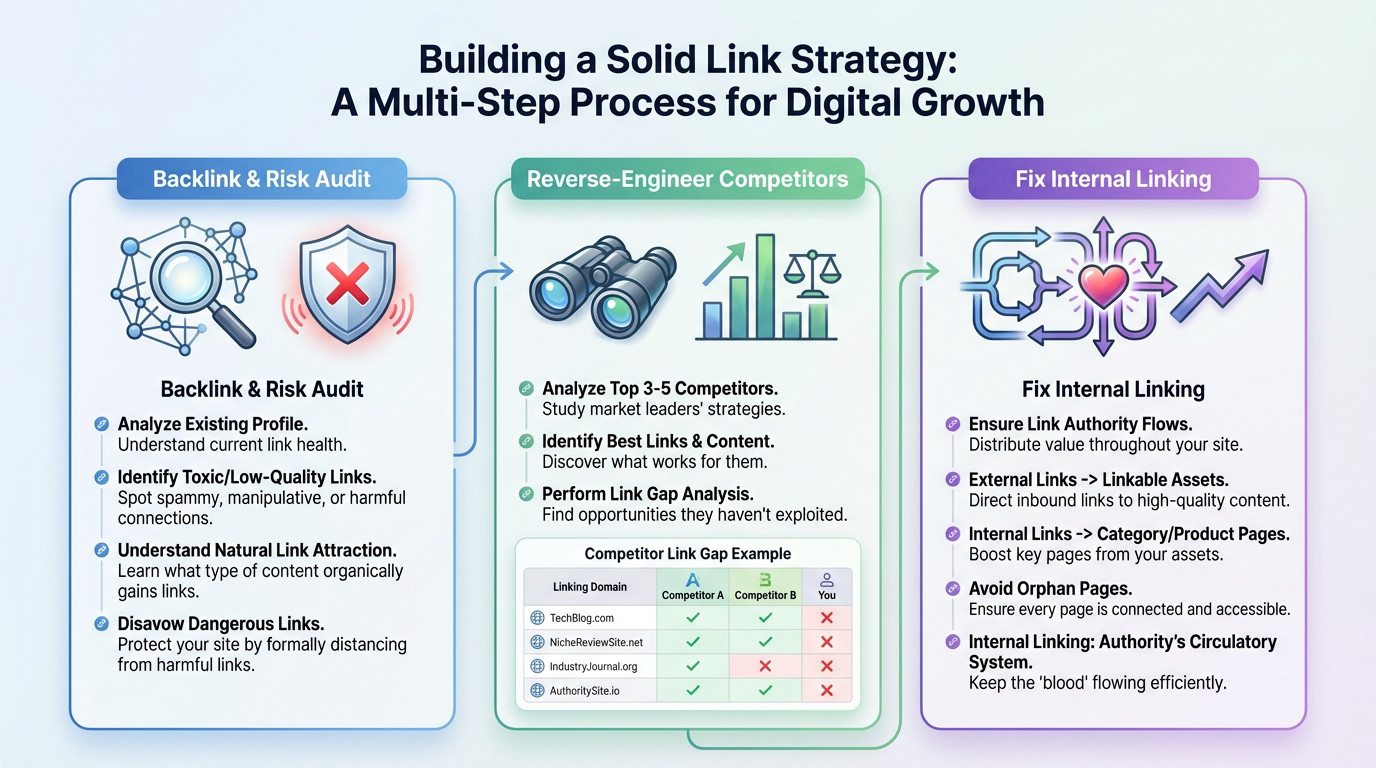
Before you even think about sending a single outreach email, a significant amount of foundational work is required to ensure your efforts aren’t wasted.
Start With a Backlink and Risk Audit
You cannot build authority blindly. First, analyze your current standing using tools like Google Search Console—essential for performing a Google Search Console SEO audit—alongside Ahrefs or Semrush to map your baseline.
The goal is twofold: identify toxic links or low-quality spam that could sabotage your SEO, and pinpoint which page types already attract links naturally. Consider this a mandatory health diagnostic before scaling up.
You must disavow dangerous links immediately to clean the profile before building upon it.
Reverse-Engineer Your Competitors’ Success
Your top competitors have already done the heavy lifting for you. You just need to decode their strategy.
Pick three to five direct rivals. Scrutinize where their best links originate, which specific pages get linked, and what content formats earn those placements. We call this a link gap analysis to find easy wins.
| Linking Domain | Links to Competitor A | Links to Competitor B | Links to You |
|---|---|---|---|
| TechBlog.com | ✔️ | ✔️ | ❌ |
| NicheReviewSite.net | ✔️ | ✔️ | ❌ |
| IndustryNewsDaily | ✔️ | ❌ | ❌ |
| BestProductsGuide | ❌ | ✔️ | ❌ |
Fix Your Internal Linking First
Earning a high-power link to a blog post is pointless if that authority doesn’t transfer to the pages that matter. This is the specific job of internal linking.
“Link juice” must circulate. External links hit “linkable assets,” which must pass value via effective internal linking strategies directly to category pages and products, a core part of a proven ecommerce SEO strategy.
Orphaned category pages represent a massive missed opportunity. Internal linking is the circulatory system of your site’s authority.
What to Link to: The Anatomy of a Link-Worthy Ecommerce Site
Now that the foundations are sound, the question becomes: where exactly do we point this precious link authority?
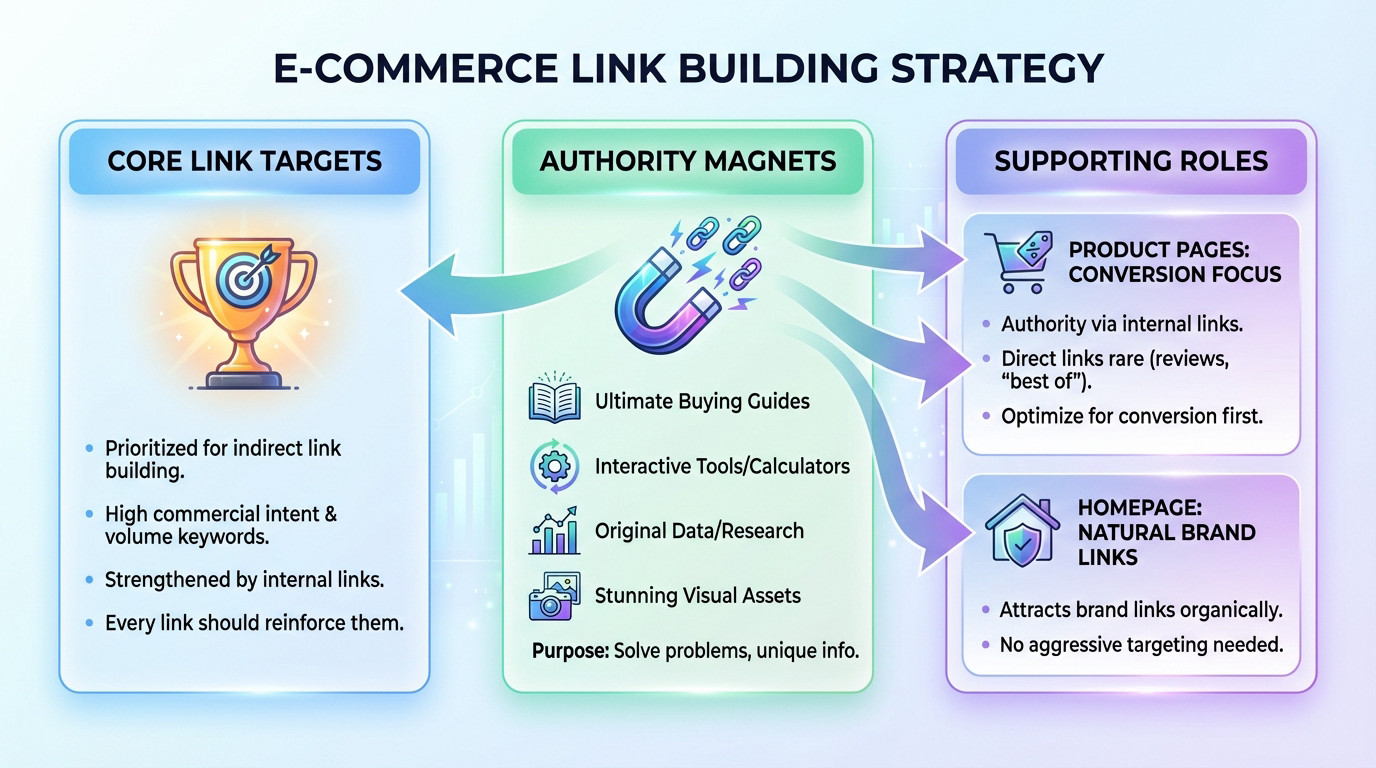
Your Category Pages Are Your Power Players
Your category pages are the absolute priority for indirect link building. They hold massive commercial intent and target high-volume keywords. This is where the real revenue happens.
Even though they rarely attract links directly, they benefit massively from authority passed through internal linking. The goal is reinforcing these pages to rank for terms like “mens running shoes”. You need that juice flowing here.
Every earned link must have a clear path to strengthen one or more category pages.
Creating ‘Linkable Assets’ That Pull in Authority
A “linkable asset” is content created specifically to attract backlinks. Think of this as your trading currency in the market.
You cannot just beg for links; you must offer something tangible to the publisher. These assets are the specific formats that consistently earn high-authority placements in 2026. Here is the inventory that actually works for stores:
- Ultimate Buying Guides: Comprehensive guides helping customers choose the right product.
- Calculators or Interactive Tools: Useful utilities users want to share (e.g., “How much paint for my room?”).
- Original Data/Research: Studies based on your own sales data or customer surveys.
- Stunning Visual Assets: Infographics, high-quality original photos, or videos.
These assets solve a problem or provide unique information, which compels journalists and bloggers to cite them. It is a proactive approach rather than a passive hope. You create the hook, and they bite.
The Supporting Role of Product and Brand Pages
Let’s clarify the role of your product pages (PDPs) immediately. They receive authority primarily via internal linking from your category pages and blog posts. They are the destination, not the bait.
While they can sometimes get links directly, it remains rare and unpredictable. This usually happens via “best of” articles, gift lists, or detailed product reviews. You must optimise your product pages for conversion above all else.
Your homepage will naturally attract brand links over time. There is no need to target it aggressively.
Tactics That Actually Drive Revenue in 2026
Once you know what to prep and where to point links, it is time to move to action. Here are the ecommerce link building tactics that work today and will continue to dominate in 2026.

Win Big With Digital PR
Digital PR is the undisputed king for earning massive authority at scale. This is not about sending boring press releases; it is about crafting stories that journalists actually want to cover.
- The Hook: The unique or surprising angle of your story.
- The Data: The asset (study, visual, unusual product) backing it up.
- The Target List: Precise list of relevant journalists and publications.
- The Pitch: Personalized email delivering the story.
Take a coffee brand publishing a study on caffeine consumption by profession. That study is your “linkable asset.” You pitch it to business and lifestyle publications, earning legitimate media coverage and high-authority links because you provided value.
Tap Into Your Existing Business Relationships
You are likely sitting on a goldmine of link opportunities within your current business ecosystem. These are the easiest wins you will ever find.
Look at your suppliers and manufacturers. Many have “where to buy” or “partners” pages waiting for your logo. Don’t forget local charities you support or industry events you sponsor; these links are incredibly relevant signals to Google.
You don’t need a complex strategy here. Just send a simple email explaining the mutual benefit. This is about leveraging real-world relationships, not SEO manipulation.
Strategic Acquisitions: Niche Edits and Broken Links
Let’s look at two surgical tactics. Broken link building involves spotting dead links on niche sites and offering your working content as the perfect replacement.
Then you have “niche edits” (or link insertions). You find an existing, high-ranking article that lacks depth and offer a specific resource to improve it. You are doing the editor a favor by updating their content.
Both tactics require finesse and genuine value. If you approach this with a spammy template, you will get ignored.
The Art of Outreach That Doesnt Get You Ignored
Having the sharpest tactics and assets is useless if your message ends up in the trash. The quality of your outreach makes all the difference.
Stop Blasting, Start Targeting
Mass emailing is a quick way to burn your brand’s reputation. It’s lazy and ineffective. The only thing that cuts through the noise today is extreme relevance and genuine personalization.
Stop scraping generic “admin@” addresses. You need to hunt down the specific journalist or blogger covering your niche. Read their last three articles to understand their beat. If you don’t know what they care about, don’t email them.
I’d rather pitch 20 people with a legitimate reason to care than spam 2,000 strangers hoping for a miracle.
Crafting a Pitch That Gets a ‘Yes’
A winning email respects the reader’s time. Keep it under 200 words. Prove you’ve done your homework in the first sentence. Focus entirely on the benefit for them—how your asset makes their job easier or their story better.
Your subject line determines if you get opened or deleted. Avoid “Guest Post Request.” Try something specific like “Data for your next piece on [Topic]”—intriguing, but never misleading.
Make the “ask” effortless. “Here is the study your readers might like.” Don’t make them guess; serve the value on a silver platter.
The Follow-Up and Tracking System
Silence doesn’t mean “no”—it usually means “buried.” Most positive responses actually come from the follow-up. Journalists are drowning in emails; you are just doing them a favor by resurfacing.
Send one polite, concise nudge 3 to 5 days after the initial pitch. That’s it. Don’t be a pest. Use a simple spreadsheet or a tool like Pitchbox to track who you’ve contacted so you don’t double-dip.
If they don’t reply after that, move on. Knowing when to quit saves your sanity.

Measuring What Matters: From Backlinks to Bank Deposits
Beyond Vanity Metrics: Tracking ROI
Stop obsessing over Domain Authority or raw backlink counts. These numbers look pretty on reports but don’t pay the bills. Focusing here means missing the real picture entirely.
The only success indicator is ROI. We need to know exactly how much extra revenue came from the organic traffic boost on your target pages. If ecommerce link building doesn’t generate profit, it’s just an expense.
The number of referring domains is a vanity metric. The only numbers that count are qualified leads in your inbox and revenue growth in your bank account.
Connecting Links to Rankings and Revenue
Here is how we trace the connection. First, track the ranking movement of target keywords for your priority category pages. A clear climb in position following a link campaign is your initial positive signal.
Next, analyze the increase in organic traffic to those specific pages using Google Analytics. You must isolate non-branded growth to see what the links actually delivered.
Finally, measure the conversion rate and revenue generated by this extra traffic. That is the ultimate proof.
Key Performance Indicators for Your Campaigns
You need a concrete list of KPIs to track for any e-commerce campaign. These specific figures separate successful growth strategies from wasted marketing budgets.
Track these main KPIs: organic traffic growth to category pages, ranking improvements for transactional keywords, the number of quality referring domains (relevance beats quantity), and finally, the revenue growth attributed directly to the organic channel.
Also, monitor “link velocity” to keep your profile growth looking natural to Google’s algorithms.
The Minefield: What to Avoid to Keep Your Site Safe
The growth potential is huge, but the risks are just as real. Ignoring Google’s rules is the fastest way to see years of work wiped out.
Understanding Google’s Link Spam Policies in 2026
Google doesn’t mince words about link spam. According to the “Google Search Essentials,” any link intended to manipulate rankings is a violation of their spam policies. It is black and white.
Buying or selling links that pass PageRank is strictly prohibited. Likewise, excessive link exchanges, low-quality guest posting campaigns, and Private Blog Networks (PBNs) are direct paths to a penalty. You can’t cheat the system.
Google cares about intent. Is the link a genuine editorial recommendation or a paid manipulation?
Red Flags of a Toxic Link Building Service
The industry is full of snake oil salesmen promising the moon. Spotting them is a survival skill you need now.
Run away if you see these offers:
- Guarantees of “#1 rankings” overnight.
- Selling “DA/DR link bundles” in bulk.
- Heavy use of exact-match anchor text.
- Zero transparency on where links go.
- Prices that look too good to be true.
These offers signal short-term tactics that completely ignore relevance. In reality, cheap link-building services almost always end up costing you a fortune in penalties and lost traffic. You get what you pay for.
Common Mistakes That Kill Ecommerce SEO
Even well-intentioned businesses fall into specific traps. These are easy mistakes to avoid if you know what to look for.
Watch out for anchor text over-optimization by stuffing exact keywords. Don’t confuse press release syndication with real editorial coverage, and stop focusing 100% of your effort on the homepage. Distribute the value.
Remember that ecommerce link building is a marathon, not a sprint. Patience and quality always win.
Ecommerce link building isn’t about gaming the system; it’s about building a brand that deserves to rank. Stop chasing vanity metrics and focus on genuine relationships and revenue-driving assets. The strategies we’ve covered require patience, but they build a defensive moat around your business that competitors can’t easily cross.
FAQ
Can I build backlinks directly to my product pages?
Honestly, it is incredibly difficult to get high-quality sites to link directly to a transactional page. Nobody wakes up wanting to link to a pair of socks or a blender. Instead of forcing it, focus on earning links to “linkable assets” (like guides or tools) and your category pages. You then pass that authority down to your specific products through smart internal linking.
What is the most effective link building tactic for ecommerce in 2026?
Digital PR remains the heavyweight champion. By creating data-driven stories, original research, or unique visual assets, you give journalists and bloggers a genuine reason to cite your brand. It’s not about sending press releases; it’s about providing value that earns you high-authority placements on major publications, which drives massive trust signals to Google.
How do I measure the ROI of my link building campaigns?
Stop obsessing over vanity metrics like Domain Authority. The only numbers that pay the bills are organic traffic growth and revenue. You need to track the ranking improvements of your commercial keywords and the increase in qualified traffic to your category pages. If your link building isn’t eventually leading to more sales, you are just collecting digital trophies, not growing a business.
Is it safe to buy backlinks for my online store?
It is a minefield. Google’s spam policies are smarter than ever, and buying cheap link packages or using private blog networks (PBNs) is the fastest way to get your site penalised. While some grey-hat tactics exist, the risk to your revenue stream is rarely worth it. Focus on earning editorial links or leveraging existing relationships with suppliers and partners for safe, sustainable growth.
What exactly is a ‘linkable asset’ for an ecommerce site?
A linkable asset is a piece of content designed specifically to attract references. For an online store, this isn’t usually a standard blog post. It’s often a useful tool (like a wallpaper calculator), original industry data (like a survey on shopping habits), or an ultimate buying guide. It must solve a problem or provide insight so valuable that other websites feel compelled to link to it.

Dorian Menard
https://searchscope.com.auI’m Dorian, founder of Search Scope and an SEO obsessed with ROI and lead generation. After a decade in the trenches, I’ve built and ranked digital assets for businesses across the world. I cut through the noise with data, automation, and strategies that actually convert. When I’m not scaling rankings, you’ll find me on a motorbike or setting chess traps — always planning three moves ahead.